Stop Chasing Removalist Quote Follow-Ups in Melbourne
Melbourne removalists send quotes that go quiet. Here is how AI automation chases every quote, books the survey and turns silences into booked moving days.
A Melbourne removalist's week rarely dies at the quote. It dies after the quote. You drive out on Sunday to count the boxes, write up a fair price, send it the same night, and then hear nothing. Nobody told the customer you had moved on to the next job, so nobody followed up. The quote sits in the sent folder until you either cave and call them, or the moving date passes and you find out they went elsewhere.
Short answer: For Melbourne removalists, the biggest leak is not losing the quote, it is never following it up. An AI follow-up agent chases every quote by text and email until the customer answers or declines, books the in-home survey into your calendar, and hands anything unusual to you before it becomes a problem.
This post walks through where the follow-up work actually goes missing, what an automated version looks like, and what it takes to build.
Why do quotes go quiet after you send them?
Think about what happens after you hit send. The customer is comparing two or three movers. Your quote lands in the same inbox as the others, often the same day. Whoever reminds them they exist wins a large share of those decisions, because moving house is one of those jobs people get around to rather than commit to.
The manual workflow looks like this:
- Enquiry comes in by web form, text or phone, usually at night.
- You ask questions to price it: suburbs, stairs, lift access, parking, dates.
- You do a survey, or estimate from photos and a video call.
- You write the quote and send it.
- You mean to follow up in a few days.
- You are on a truck. It does not happen.
Steps 5 and 6 are where the money goes. On a realistic week with eight quotes outstanding, chasing them properly means a dozen texts and calls, most of them at times you are holding furniture. So they get chased late, or not at all, and the customer books the mover who texted on Tuesday. Slow follow-up is not unique to movers, either. It is the same leak we fixed for Adelaide caterers losing function bookings, only with trucks instead of canapés.
There is a second leak, earlier in the funnel: the survey itself. Most removalist enquiries need questions answered before a price is even possible. That back-and-forth can take two days by itself, and some customers never get there.
What does an AI follow-up agent actually do for a removalist?
The automation is not a chatbot bolted to your website. It is a worker that sits over your existing tools and does the chasing.
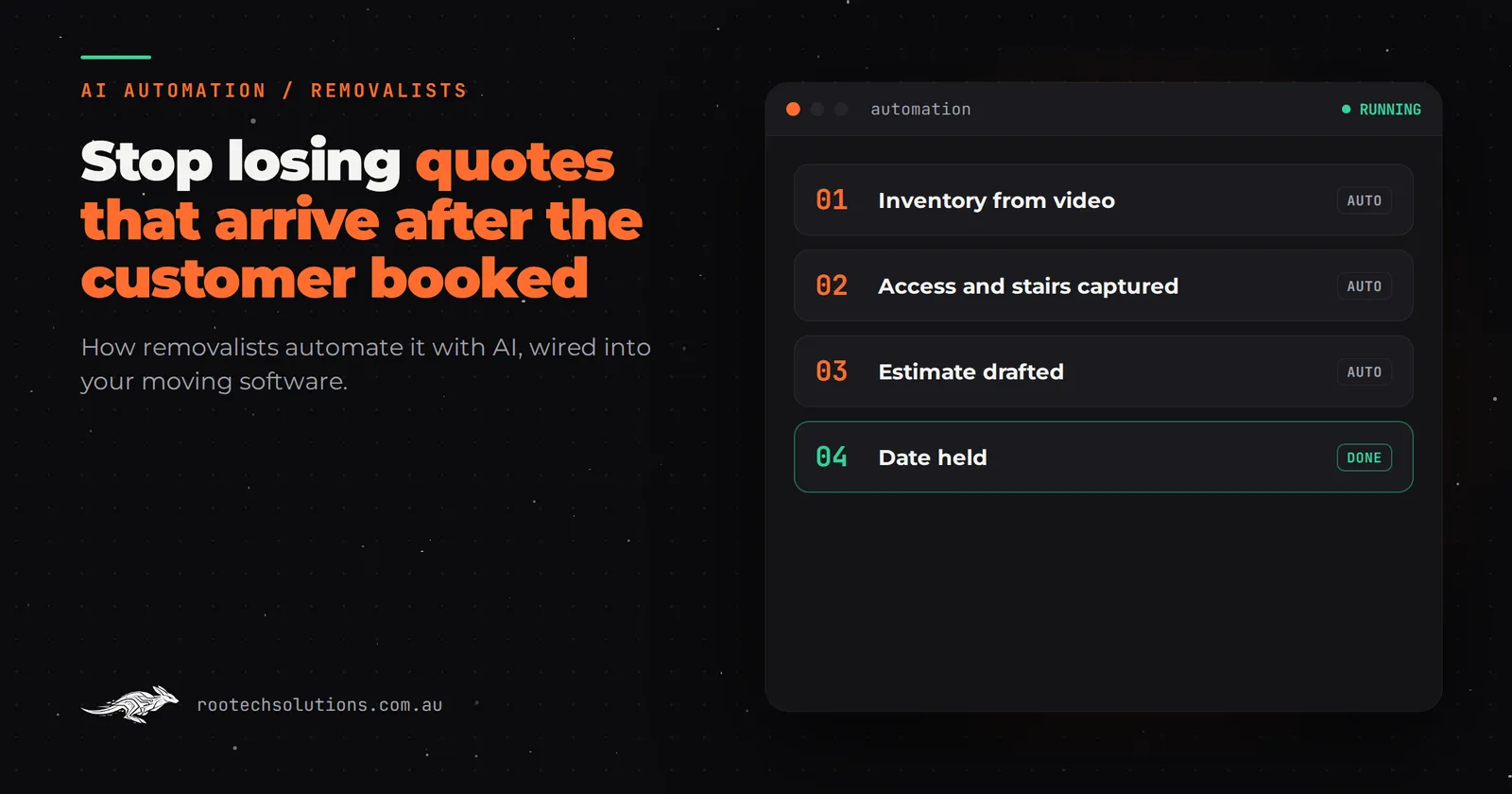
- It answers the first questions instantly. When an enquiry arrives at 9pm, it replies within a minute from your approved information: what you move, your service area, whether you do piano relocations, and the fastest way to get a price. It asks the pricing questions in order and saves the answers.
- It books the survey. It offers your real available survey slots, from your calendar, and puts the booking in. A video survey works fine for most Melbourne metro moves, which means nobody drives across town for a two-bedroom unit.
- It drafts the quote for you to approve. With the survey answers captured, it can assemble a draft quote using your own rate card. You check it, adjust it, send it. You keep the pricing judgement; the machine keeps the admin.
- It follows up until there is an answer. A polite text a few days after the quote, a check-in before the preferred moving date, a message asking if anything changed. It stops the moment the customer replies, and hands the reply to you.
- It writes everything back where you work. Enquiry details, survey answers and booked dates go into your job board or calendar, and the customer details into your contact list. No double entry.
Where a person stays in the loop: pricing anything unusual, promising dates, handling a distressed customer on a delayed settlement, and anything involving money or commitments. The AI qualifies and chases. You decide and commit.
Should you buy off-the-shelf or build custom?
Your existing tools already do parts of this. Most job-management apps removalists run can send a quote and a reminder. If you are sending fewer than a handful of quotes a month, use those features and spend nothing.
A custom layer earns its keep when the pieces need to talk to each other. Off-the-shelf tools send reminders, but they do not read the reply "settlement slipped a fortnight, can we push it?", update the right job, ask about your availability, and text back a new option. They do not answer stair and access questions at 10pm from your own service list. That is the same line we draw in our custom software work for Melbourne businesses: a custom agent earns its keep by joining the steps your platforms keep separate.
What is quote follow-up actually worth?
Here is a worked example with the assumptions labelled, so you can substitute your own numbers.
Assumptions: you send 10 quotes a month, you win 3 of them today, each won move is worth about $900, and better follow-up lifts your win rate by a conservative 2 quotes a month rather than the more dramatic claims you see online.
- Extra jobs booked: 2 per month
- Extra revenue: 2 x $900 = $1,800 per month
- Running costs: typically $20 to $200 a month in AI usage, plus hosting usually under $50
- Time saved on chasing: a few hours a week you currently spend calling people who have already booked someone else
Even on cautious numbers, the follow-up automation is several times its running cost. The honest caveat: if your problem is not follow-up but lead volume, automation will chase quotes that do not exist. Fix the pipeline first.
What does it take to build?
A follow-up agent like this is one of the faster builds. Most ship in two to four weeks at a fixed price: a discovery call to map how quotes actually run in your business, a build wired into the tools you already use, then a review period where you watch it handle live enquiries and tighten the wording.
The guardrails matter. Customer-facing replies come only from approved information, the agent never quotes a price you have not approved, and it hands over to a person the moment it is unsure. That is how we build every AI integration, whether it is a removalist follow-up agent or an after-hours booking assistant like the one we built for Hobart tour operators.
The 60-second summary
- Your quotes go quiet because chasing them is a job for a Tuesday afternoon, and your Tuesdays are on a truck.
- An AI agent answers first questions, books surveys, drafts quotes for your approval and follows up until someone replies.
- You keep pricing and promises. It keeps the admin and the persistence.
- If you send 10 quotes a month, an extra 2 wins covers the running costs many times over.
If you want to see what this would look like in your business, book a free AI workflow audit. We map where your enquiries, quotes and follow-ups actually leak, and the audit fee comes off your first project if you go ahead.
Frequently asked questions
Do customers dislike being chased by an automated message?
A reminder that is short, on-topic and arrives a few days after the quote reads the same whether a person or a machine sent it. Customers dislike silence, and they dislike pressure. The automation handles the first, and you set the tone for the second.
Will it send quotes without my approval?
No. The system drafts quotes from your rate card and the survey answers, but nothing goes out until you approve it. Anything involving money or a commitment keeps a human in the loop by design.
What happens when a customer asks something it cannot answer?
It escalates to you rather than guessing. The agent answers only from the information you have approved, and hands over anything unusual, angry or sensitive.
Does this work with the tools we already run?
Yes. It writes into the tools you already use, such as your job board, calendar and contact list. The point is to remove the double entry, not to add another system to check.
How quickly could it be running?
Most follow-up builds ship in two to four weeks at a fixed price, including time watching it handle real enquiries and tightening the wording.