Hobart Tour Operators: Stop Losing After-Hours Bookings
Hobart tour operators lose bookings to enquiries that arrive overnight or from overseas. Here's how AI automation answers them in minutes, not mornings.
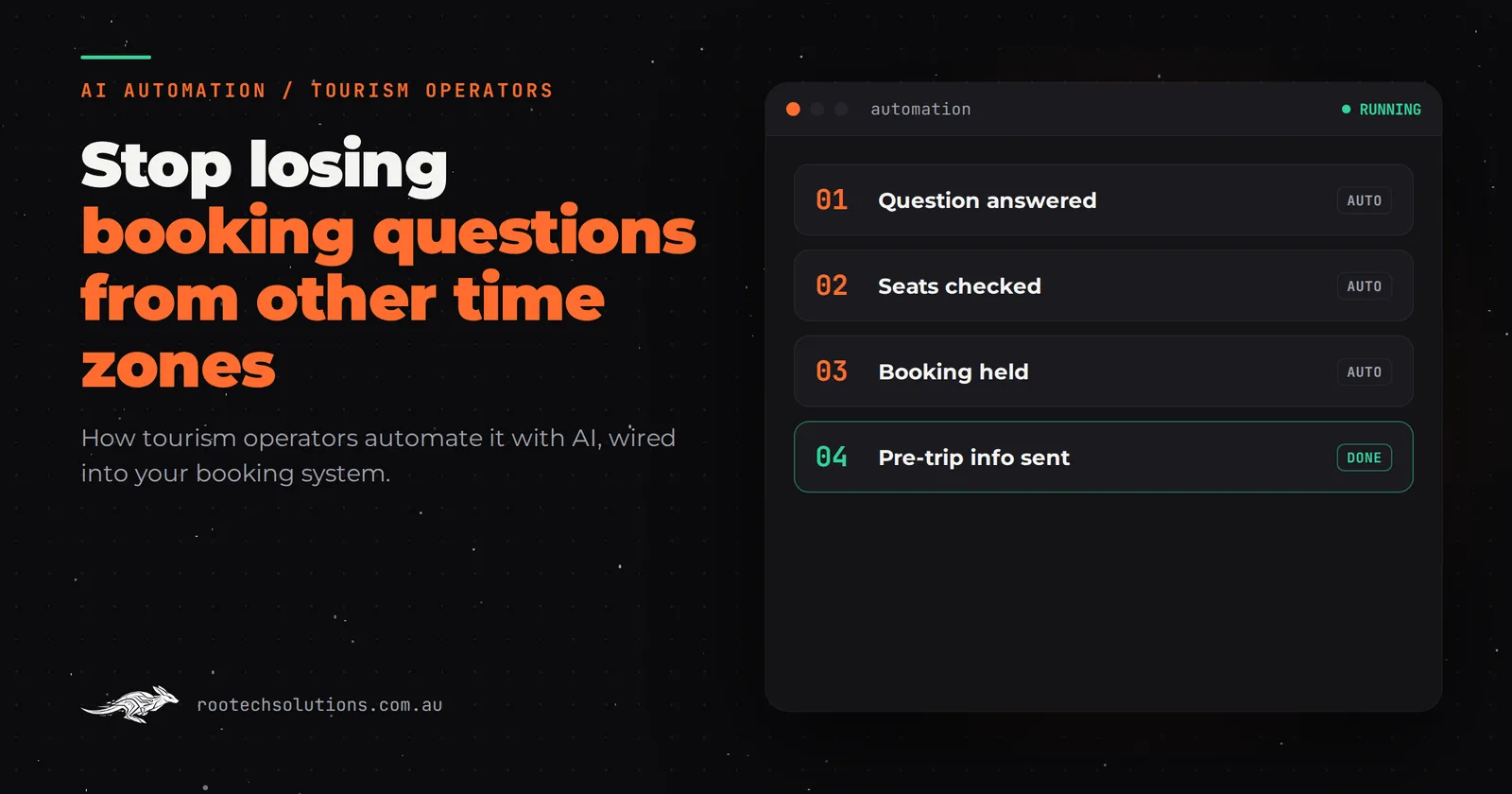
Your best booking window is the one you never see. A couple in Singapore plans their Tasmanian trip at 10pm their time, which is midnight in Hobart. They message three tour operators. By the time you open at 7am and reply at 9am, two of them have already confirmed, and the third one is not you.
That is the everyday reality for Hobart tourism operators. Guests plan evenings and weekends, from Melbourne, Sydney, Singapore, London and Los Angeles, and almost every one of those moments falls outside your working day. The fix is not working later. It is an AI automation that answers the enquiry within minutes, sorts it, and books it into the systems you already use.
Short answer: Tour and accommodation operators in Hobart lose bookings because enquiries arrive overnight or from overseas time zones, and the first operator to reply usually wins. An AI automation can answer within minutes, quote your real availability, and put a confirmed booking or a qualified enquiry in front of you by morning. You stay in control of anything involving money or exceptions.
Why the enquiry goes cold overnight
Walk through what actually happens to a typical enquiry now:
- A guest fills in your website form, sends a DM, or emails at 11:40pm Hobart time.
- Nothing happens until you or your ops person opens the inbox next morning.
- By then the guest has messaged two or three other operators, and whoever replies first with real availability gets the booking.
- You reply at 9am with availability and a price. The guest has already booked elsewhere, or has gone cold and never answers.
The leak is not your price or your product. It is the eight hours of silence. In travel, the first useful reply usually wins, and Hobart's time zone puts you last in the queue against operators in the guest's own time zone, every single night. The same first-to-reply logic decides function bookings for caterers, as we covered in our post on losing function bookings to slow replies.
Summer makes it worse. Peak season is exactly when enquiry volume peaks, and exactly when you and your guides are flat out running the tours. The admin is furthest behind when the leads are hottest.
What an automated after-hours reply looks like
A well-built AI automation is not a generic chatbot waffling at strangers. It is a small pipeline wired into your booking system:
- Capture. Every enquiry, whether it lands in the website form, email, or a social message, flows into one place with a timestamp.
- Understand. The AI reads what the guest actually wants: which tour, which date, how many people, any constraints like kids or mobility.
- Answer from approved information only. It replies within minutes using your real tour descriptions, prices, departure times and availability. It does not invent discounts, promise weather, or make up availability it cannot see. That guardrail matters: customer-facing AI answers come only from information you have approved, and it escalates to a person whenever it is unsure.
- Book or qualify. If the guest wants a date you have seats for, it can complete the booking in your booking platform. If the request is unusual, a private charter, a group of twelve, a wheelchair-accessible date, it takes the details and flags it for you.
- Follow up. Enquiries that stall get a polite nudge the next morning, so a half-finished conversation does not quietly die in an inbox.
If you also run an online store for merchandise or vouchers, the same pattern is what stops the after-hours leak in retail, which we broke down in our piece on after-hours sales for online stores.
Where a person stays in the loop
This is the part owners worry about, so be clear about the line. The AI handles availability, pricing from your published rates, and routine questions. A person handles refunds, custom quotes, complaints, safety questions and anything the AI is not certain about. Done properly, the automation makes your morning admin smaller, not your customer service colder.
Off-the-shelf booking software vs a custom layer
You may already run a booking platform (Rezdy, FareHarbor, Checkfront and similar; check their current pricing and features). These are good at taking payments and managing inventory, and many have some automated messaging. So when is a custom layer worth building?
| Situation | What usually works |
|---|---|
| All enquiries arrive through your booking widget, guests self-serve, few questions | Off-the-shelf booking software alone is probably enough |
| Enquiries arrive through website forms, email and social DMs, and guests ask questions before booking | A custom AI layer on top of your existing booking system |
| You run several products (tours plus cabins or rooms) with different availability rules | A custom layer that reads all of them and answers consistently |
| Frequent private charters, group quotes or exceptions | Off-the-shelf messaging plus a custom quote and escalation flow |
The usual shape is not replacing your booking system. It is wiring an AI layer into it so every enquiry, from any channel, gets the same fast, accurate first reply, while the booking system keeps doing what it is good at.
The payoff, in numbers
Worked example with labelled assumptions:
- Assumption: 10 enquiries a week arrive outside business hours (roughly one a night in season).
- Assumption: your current after-hours reply averages 14 hours; an automation replies in under 5 minutes.
- Assumption: reply speed lifts your win rate on those enquiries from 1 in 5 to 1 in 3 (a conservative estimate; travel buyers heavily favour fast responders).
- That is about 1.3 extra bookings a week. At an average tour value of $150 per guest and 2.5 guests, call it $475 a week, or roughly $1,900 a month in season.
Against running costs (hosting usually under $50 a month and AI usage typically $20 to $200 a month), the numbers are not close, provided the volume assumption holds. If you get two after-hours enquiries a month, the honest answer is that a spreadsheet and a good autoresponder are fine, and automation is not worth building yet.
What it takes to build
A build like this is a two-to-four-week job, fixed price. Discovery happens over video, the build runs in the cloud, and your booking system, calendar and inbox stay exactly where they are. Because Rootech is a Melbourne studio working Australia-wide, including Tasmania, delivery is remote either way: a video call to map your enquiry flow, a staged build you review on screen, and a handover session with your team before peak season. See our custom software for Hobart businesses page for how that works.
The takeaway
You cannot answer the phone at 2am, and you should not have to. An AI automation answers the enquiry in minutes from approved information, books what it can into your existing system, and leaves the judgement calls to you in the morning. Start by counting last month's enquiries that arrived outside 9 to 5. If that number is more than a handful a week, the leak is already bigger than the build.
Rootech offers a free AI workflow audit, and the audit fee comes off your first project. Book a free call and we will map where your bookings are going cold.
Frequently asked questions
Will guests know they are talking to an AI?
They will know it is an automated reply, and honest operators label it. What guests care about is getting an accurate answer in two minutes instead of silence for fourteen hours. The AI answers only from your approved information and hands over to a person for anything it is unsure about.
Can it actually take payment and confirm the booking?
Yes, when your booking platform supports it and availability is live, the automation can complete a standard booking. Anything involving refunds, discounts or non-standard requests is escalated to you, so money decisions always keep a human in the loop.
Does this work for accommodation as well as tours?
The same pattern applies. Availability, rates and house rules come from your approved information, the AI answers in minutes, and bookings land in the system you already run. Multi-property availability rules are one of the cases where a custom layer earns its keep.
What does it cost to run each month?
Estimates, in AUD: hosting usually under $50 a month, and AI usage typically $20 to $200 a month depending on enquiry volume. Compare that against the value of one or two saved bookings in season.
We are in regional Tasmania, not Hobart. Is this still relevant?
Yes. The time-zone problem is the same anywhere in Tasmania, and delivery is remote regardless, so being in Strahan or St Helens changes nothing about how the build or support works.