Where Newcastle Solar Installers Start With AI
Newcastle solar installers lose jobs to slow quotes and follow-up. Here's what to automate first with AI, what to skip, and one step you can take this.
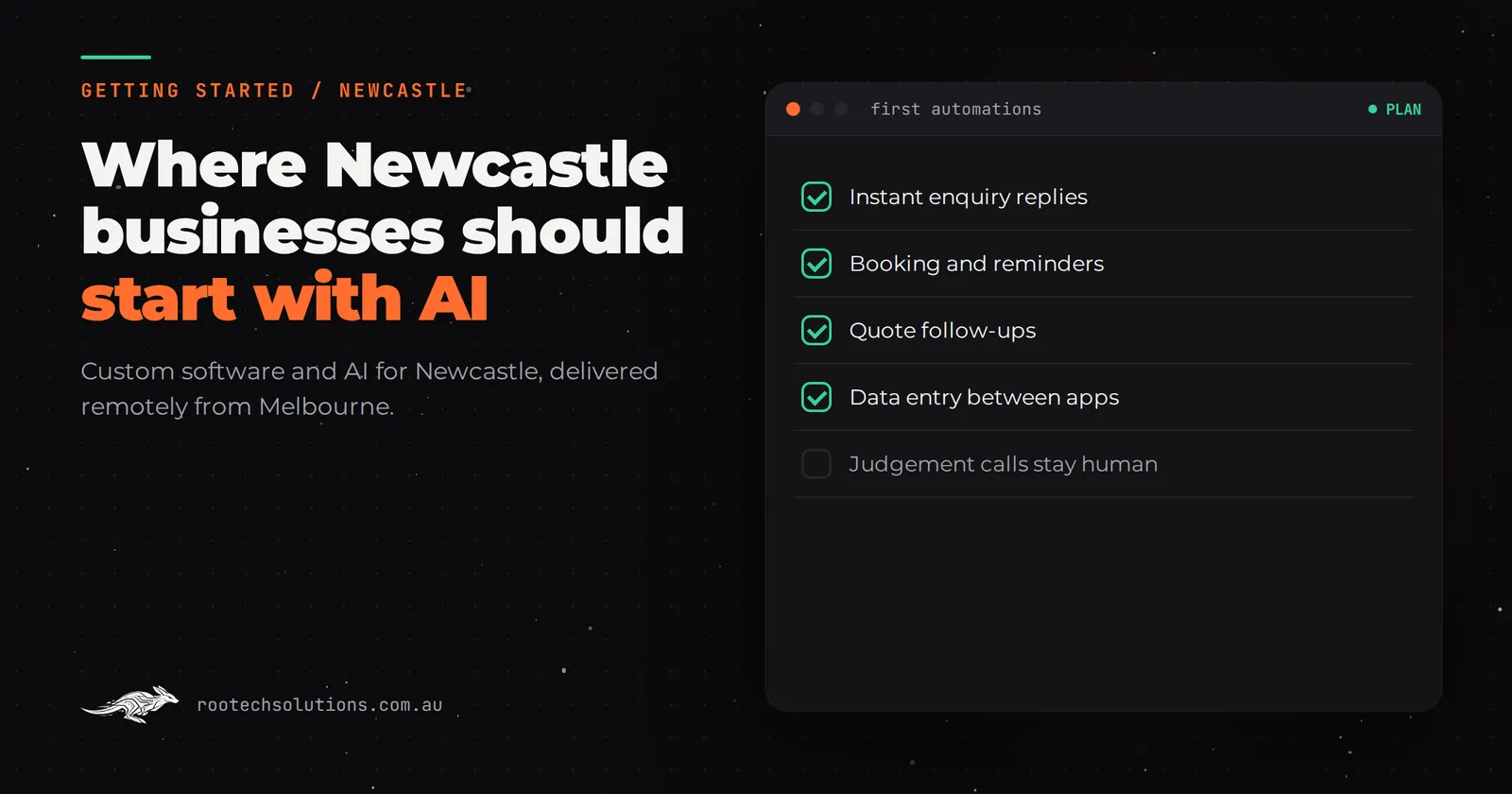
A Newcastle solar installer gets the same enquiry three competitors get. Whoever replies first with a sensible quote usually wins the job. Yet most installers are up a ladder all day, and the quoting, the follow-up and the paperwork happen at 9pm, if at all.
That is the problem AI automation fits first. Not a flash website, not a full custom platform. The first build should plug the biggest leak in the pipeline: the hours between an enquiry landing and a quote going out.
Short answer: Newcastle solar installers should automate lead follow-up first, then AI-assisted quote drafting, then stalled-quote chasing. Keep the site assessment and the final price with a human. Expect a first build to take two to four weeks at a fixed price, and start with a week of counting your own enquiry response times.
What an installer's week actually loses
Run the maths on a typical week. Say you get 40 enquiries. Each one needs a reply, a system recommendation, a rough price, and three or four follow-ups before it either books or dies. Written by hand, that is easily 30 to 45 minutes per lead across the cycle. That is a part-time job you are doing after dark.
And the losses compound. A lead bought from a lead platform is sold to several installers. The first one to send a clear, itemised quote gets the site visit. The others are chasing a customer who has already picked. Slow follow-up, not price, is where most of those jobs are lost, which is the same pattern this deep-dive on lead response automation covers.
What to automate first, second and third
| Priority | What to automate |
|---|---|
| 1 | Lead follow-up: an instant, useful first reply buys you time to quote properly. |
| 2 | Quote drafting: an AI draft you check and send, instead of 40 minutes at night. |
| 3 | Stalled-quote chasing: timed reminders recover jobs you already did the work for. |
First: reply to every enquiry in minutes
The moment an enquiry lands, the system sends a reply that names their suburb, asks the two or three questions that matter (roof type, current bill, battery interest) and offers appointment times. It reads like a person because it is built from your approved wording, and anything it cannot answer goes straight to you.
This is not a gimmick. In a market where three installers hold the same lead, minutes beat hours. The AI's job is to make sure you are always first with something useful in the customer's inbox.
Second: draft the quote before you pick up the phone
Once the enquiry details are in, an AI layer can draft the quote: panel count from the roof details, an inverter to match, battery options, and a price band based on your own rate card. You check it, adjust it, send it. What took 40 minutes at night takes ten minutes between jobs.
This is the same shape of problem as the AI takeoff estimator Rootech built for a builder, where every prospective job gets a measured takeoff and a draft estimate before anyone picks up a scale ruler. The AI drafts; the tradesperson signs off. Solar is no different, and the sign-off matters: rebate amounts, switchboard surprises and roof condition are judgement calls that stay with you.
A worked example: 40 enquiries through the pipeline
Take a quiet-but-real month: 40 enquiries, and one installer doing all the admin. Walk the same 40 enquiries through both versions of the business:
- First reply. By hand, the average gap is 3 to 8 hours, which means the two competitors who answered first are already in the inbox. Automated, every enquiry gets a useful reply in under 5 minutes.
- Quote drafted. By hand, 30 to 40 minutes each, done at night. Automated, the AI drafts the system and price band and you spend 10 minutes reviewing it between jobs.
- Follow-ups. By hand, most quotes get one touch, if that. Automated, three to five timed touches go out without you remembering any of them.
- Total admin load. Roughly 15 to 20 hours a week by hand, down to roughly 4 to 6, most of it review rather than typing.
The point is not that the AI closes sales. It is that the same enquiries get a fast reply, a quote and a proper follow-up sequence, on the weeks you are flat out on roofs.
Third: chase the quotes that quietly died
Every installer has a folder of quotes nobody answered. An automated chase does the polite persistence you never have time for: a check-in after a few days, a reminder with the quote attached, a final nudge before it closes. It runs on autopilot and hands you the leads that came back warm.
What to skip for now
Skip the custom CRM. Most installers already run a job management tool or a spreadsheet plus accounting software, and replacing it is expensive disruption with no customer-facing payoff. Build the AI layer on top of what you use, wired into the tools you already pay for.
Also be careful automating the grid application itself. Connection paperwork has hard rules and real consequences for getting it wrong. Let the system remind you it is due and hold the documents, but keep the lodgement human until you trust the workflow.
Off-the-shelf or custom: what your software already does
You may already have software that sends enquiry auto-replies or tracks jobs. Check what it actually does before paying for anything: many platforms do basic reminders well. Where off-the-shelf tools stop is the specific part of your business: quoting your own system combinations, your own pricing bands, your own follow-up sequence, across the tools you actually use. That is where a custom AI integration earns its keep, because it is built on your rate card and your rules rather than a generic template.
If you are weighing a monthly platform against a one-off build, the honest comparison in fixed-price versus hourly development explains how the money works either way.
The do-it-this-week step that costs nothing
Before you talk to anyone, count one week of enquiries. For each one, write down:
- How long it took you to first reply.
- How long to get a quote out.
- Whether anyone followed up more than once.
Most installers find fewer than half the enquiries got a same-day reply, and almost none got a second follow-up. That number is your business case, and it is worth more than any sales pitch.
What the first build looks like
A first AI automation for an installer is usually scoped in a workshop call, connects to your existing enquiry inbox or CRM and your quoting spreadsheet or tool, and goes live in two to four weeks. Guardrails are standard: the AI answers only from information you have approved, escalates to you when it is unsure, and never quotes a final price without a person checking it. Running costs are modest: hosting is usually under $50 a month and AI usage typically $20 to $200 a month depending on volume.
Rootech is a Melbourne studio that works Australia-wide, Newcastle included, with delivery done remotely: video calls for discovery and reviews, cloud builds, and setup with your team over a call. If you want a second opinion on where your pipeline leaks, Rootech offers a free AI workflow audit, and the audit fee comes off your first project. Book a free call.
Frequently asked questions
How much does AI automation cost a solar installer?
A focused first build (follow-up plus quote drafting) is typically a fixed-price project rather than an open-ended engagement, and Rootech quotes it upfront. Hosting is usually under $50 a month with AI usage typically $20 to $200 a month depending on volume. Exact figures depend on your quoting rates and volume, so treat any number you read online as an estimate.
Will customers know they are talking to AI?
The first reply can be written in your voice from your approved information, and it should be honest about being fast rather than pretending to be you on site. Most customers care that they got a useful answer in minutes. Anything sensitive, like a final price or a complex roof, goes to you.
Do I need to replace my job management software?
No. The better path is an AI layer on top of what you already run, connected by an integration. Replacing the system your whole team lives in is the most expensive way to start, and it is the thing most installers should skip for now.
Is this worth it for a small two-person installation team?
Usually yes, precisely because you have no admin staff. The automation does the work a bigger competitor hires someone to do: replying fast, quoting quickly, and chasing every quote. With a small team the hours saved come straight back into installs.