Should Removalists Start With an AI Quoting Tool?
An AI quoting tool for removalists is usually the right first build, if it asks about inventory and access. What to automate next, what to skip, and costs.
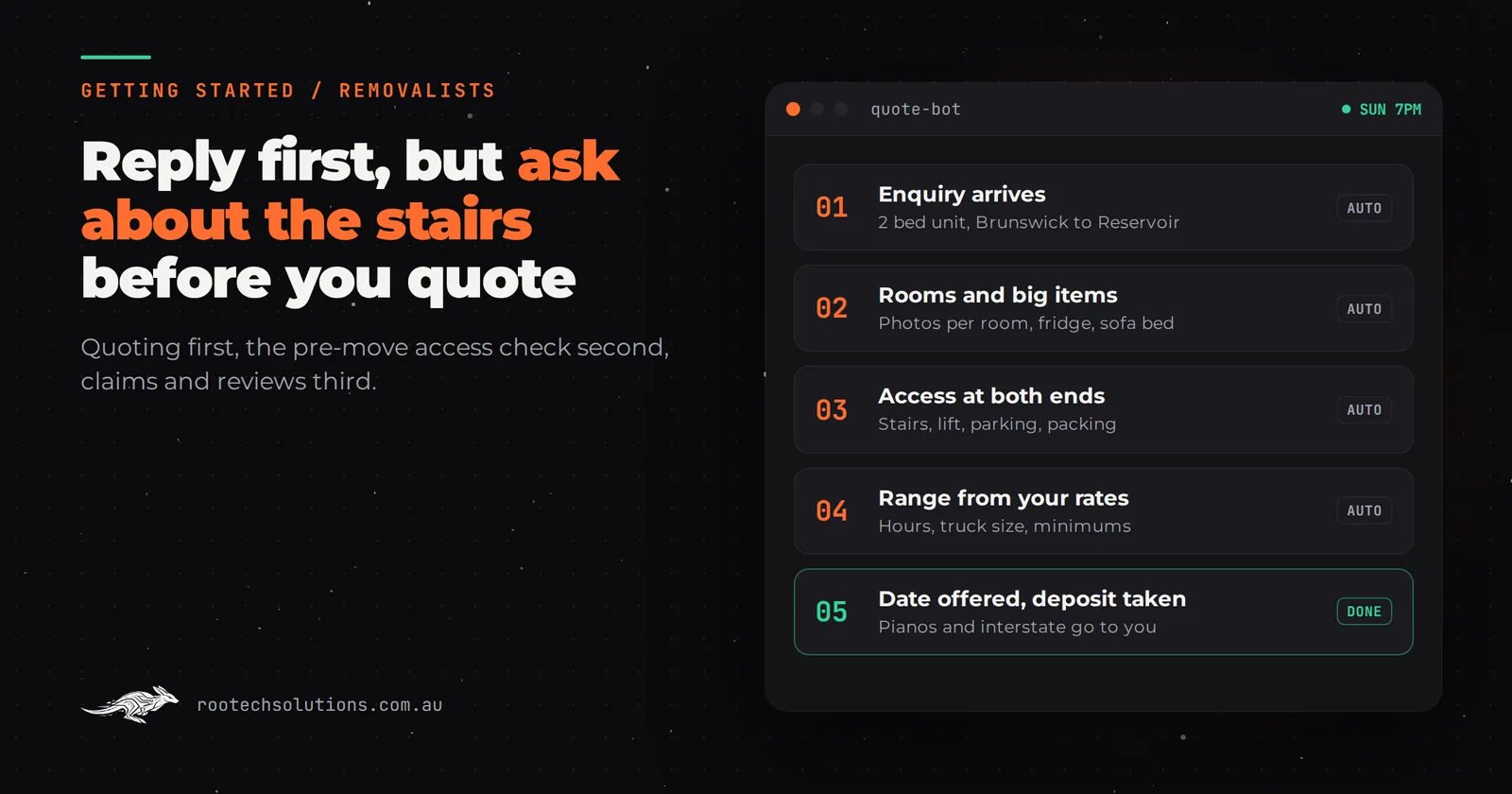
Someone fills in your quote form at 7pm on a Sunday: "2 bed unit, Brunswick to Reservoir, next Saturday." You ring them at 8am Monday, and they have already booked the mover who replied in ten minutes. Or you do win it, and on the day you find a third-floor walk-up, no parking, and a piano nobody mentioned.
Short answer: Yes, for most removalists an AI quoting tool is the right first automation, because the fastest reply usually wins the job. It only works if it asks the questions that drive your price: rooms and big items, stairs and lifts, parking, packing and date. Second, automate the pre-move access check. Keep pianos, interstate and storage quotes with a person.
Why is a removalist quote harder to automate than it looks?
Because the price is set by things the customer doesn't think to mention. "Two bedroom unit" tells you very little. Is it a ground-floor flat with parking out front, or a third-floor walk-up on a clearway? Is there a fridge, a sofa bed, a pool table? Is the customer packing, or are you?
Most small removalists price by the hour with a truck and crew, so every unknown becomes a longer day, and a longer day becomes either a margin you absorb or an argument at the end of the job. A quick reply with a confident wrong number is worse than a slow one. The AI's job is to ask the questions your best estimator asks, in order, before it gives any range at all.
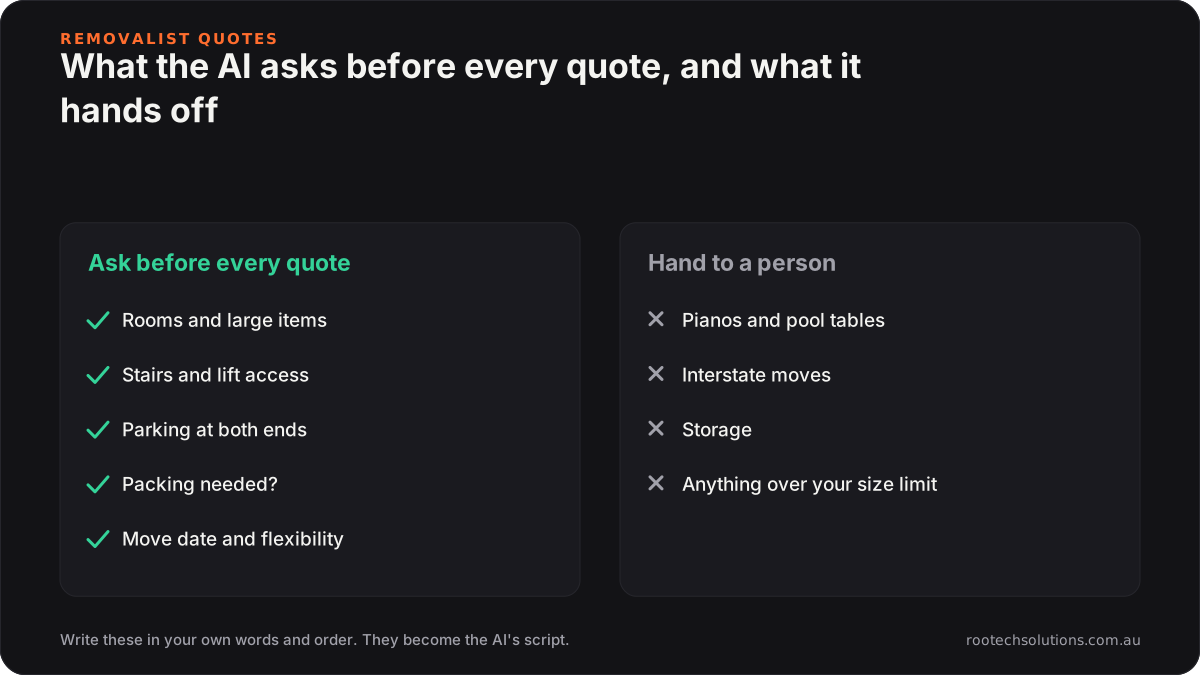
Caption: The quote is only as good as the access questions asked before it.
What should a removalist automate first, second and third?
Win the job, then protect the day, then close the loop. That order matches where the money goes.
- The quoting conversation. On your website, Facebook and SMS, the AI asks for rooms and large items (or photos of each room), access at both ends, parking, packing, the date and whether it is flexible. It applies your rates and minimums to give a range in hours and dollars, offers available dates, and takes a deposit or booking request. Anything outside your rules, or over the job size you set, goes to you with all the answers attached.
- The pre-move access check. Two days before the move, the AI messages the customer to confirm the address details, parking, any lift booking with the building manager, what is packed and anything that has changed since the quote. Changes that affect the price come to you before the truck leaves, not on the doorstep.
- After the move: claims and reviews. A customer reporting damage gets a calm, structured intake (what, where, photos) routed straight to a person. Everyone else gets a short thank-you with your review link the next day.
Skip for now:
- Auto-pricing specialist items. Pianos, pool tables and safes need your judgement and sometimes extra crew. The AI collects the details and books a call.
- Interstate and backloading quotes. Too many variables for a first build.
- Dynamic or surge pricing. Not until you have clean data on what jobs actually took.
- Replacing your daytime phone. Customers moving house are stressed. Keep a person on the phone during business hours and let the AI cover nights and weekends.
What does a fast quote actually win you?
The enquiries that arrive when you can't answer. Plenty of moves get organised in the evening or on the weekend, once the lease is signed, and customers often contact several businesses at once. The first credible reply with a price and a date is often the one that gets booked. We go into why in how removalists win jobs by quoting first.
As a rough guide, a two-bedroom local move in Melbourne might bill somewhere around $700 to $1,200 depending on access and hours. Losing two or three of those a week to slow replies adds up quickly. Your own figure depends on your rates, so use your last month of enquiries to work it out.
Removalist software or a custom AI quoting tool?
Your existing system should keep running the jobs. A custom AI quoting tool earns its place in front of it, handling the conversation your system wasn't built for.
| Option | Good at | Where it falls short |
|---|---|---|
| Removals-specific systems, such as Moveware | Job management, crews, storage, invoicing, larger multi-branch operations | Quoting conversations at 9pm still depend on someone replying |
| US-built moving CRMs, such as SmartMoving or Elromco | Sales and scheduling tools built for moving companies | Built for US moving conventions; check fit with Australian pricing and access norms |
| General job tools (ServiceM8, a shared calendar, Xero) | Small operators who need bookings and invoices | No inventory or access logic at all |
| Custom AI quoting tool | Your questions, your rates and minimums, your hand-off rules, on every channel | Needs a clear pricing method to start with |
Check each provider's current features and pricing. If an off-the-shelf online estimator already asks your access questions and books into your diary, use it. Custom earns its keep when your pricing has rules a form can't express ("add an hour for any walk-up above the second floor", "two-person crew minimum for anything with a fridge"). We compare these options in more depth in removalist software vs custom AI.
What can you do this week without building anything?
Write down your quoting brain. It is the hardest part of any build and costs nothing.
- List every question you ask before giving a price, in the order you ask it. Include the ones you only remember after a bad job.
- Write your pricing rules as plain sentences: base rate, minimum hours, truck sizes, stairs, long carries, travel time.
- Turn the questions into your web form today, with a field for photos of each room. Even without AI, a better form means better quotes.
- Time your replies. For your last 20 enquiries, note when each arrived and when you replied. If most evening and weekend enquiries waited until the next business day, the AI quoting tool is your first build.
What does a custom AI quoting tool for removalists look like?
A quoting assistant on your website, Facebook and SMS, connected to your diary and your pricing rules, usually live in two to four weeks.
- Week 1: your questions and pricing rules become the AI's script, plus the list of jobs it must hand off.
- Week 2: connections to your calendar or job system, SMS and payment link for deposits, tested against your real past enquiries.
- Week 3: live with a safety net: every quote is copied to you, and you adjust anything that's off.
- Week 4: the safety net comes off for standard local moves; specialist jobs keep coming to you.
Cost, as estimates: most builds land between $3,000 and $6,000 depending on how complex your pricing is and how many systems it connects to. Running costs are usually $100 to $300 a month for hosting, AI usage and SMS.
Human in the loop: specialist items, interstate, storage, damage claims and any customer who asks for a person. You also review a sample of quotes weekly for the first month. The AI quotes a range; you confirm the booking.
Frequently asked questions
Can an AI quote a move from photos?
It can use photos to identify rooms and large items and to spot obvious access issues, which makes the range more accurate. It should still confirm the details in words and never treat a photo as a guarantee. Unusual items always go to a person.
Will customers trust a quote from an AI?
They trust a quote that is fast, specific and clearly explained, with a real business behind it. Say it is an automated estimate, show what it includes, and make it easy to talk to someone. Most customers would rather have a range tonight than a call tomorrow.
What if a customer understates what they have?
The access check two days out catches most of it, and the AI's questions make it harder to forget the big items in the first place. Put your policy on extra time in the quote so a longer day is expected, not a surprise.
Is it worth it for a one-truck operator?
If you are on the road all day and quote at night, often yes, because it gives you the evenings back. If you get fewer than about ten quote requests a week, start with the better web form above and revisit later.
Want to know if quoting is your first build?
We will look at your enquiries, your reply times and your pricing rules, and tell you whether an AI quoting tool should come first or something else should. Book a free AI workflow audit. The audit fee comes off your first project if you go ahead.