Hire an Admin or Automate Orders? Darwin Wholesalers
Hire admin staff or use AI order automation for Darwin trade wholesalers? Compare cost, hours covered and fit, then run a simple test to choose this week.
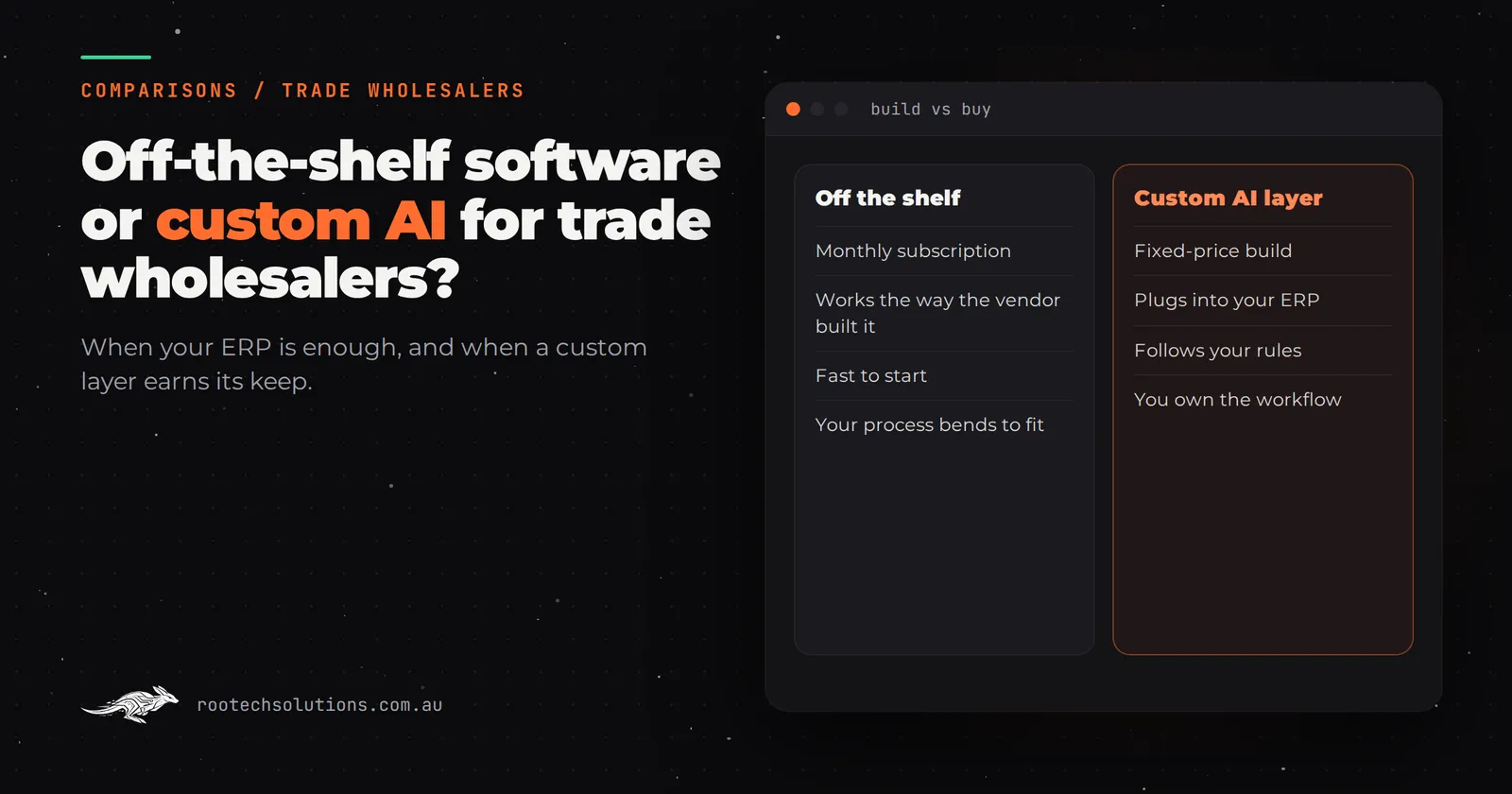
A Darwin wholesaler doing decent numbers hits the same wall: orders arrive by phone, text and email, someone re-types them into the inventory system, and the paperwork only clears after hours. The two obvious fixes are hiring another admin person or automating the order intake with AI. Both cost money. Both change how the place runs. Choosing badly wastes either a salary or a build.
This post compares the two options honestly for trades wholesalers and suppliers, because the right answer changes with your order volume, not with the sales pitch. (For the same choice in a different trade, see our take on hiring an admin versus AI automation for Melbourne landscapers.)
Short answer: If you need flexible human judgement across varied, messy jobs, a part-time admin is the safer first hire. If your orders are repetitive, predictable and coming in around the clock, AI order automation usually costs less over a year and never takes leave. Many Darwin wholesalers end up running a hybrid: automation for the bulk, a person for the exceptions.
What does a new admin actually cost a Darwin wholesaler?
A full-time admin or order desk person costs roughly $55,000 to $70,000 a year including super and loadings, based on award rates for clerical roles. You can check the current figures yourself with the Fair Work pay calculator. Part-time and casual arrangements scale that down proportionally, and many wholesalers start there.
What you buy for that money:
- Judgement. A person can spot that a customer ordering "the usual" last month is actually missing the fittings they will need.
- Flexibility. The same person can answer the phone, chase a delivery, and help with a stock count.
- Coverage of whatever hours you schedule, including weekends if you pay for them.
What you also take on: recruiting, training, superannuation, leave cover, and the risk that the person you trained leaves just as they got good. In a small Darwin labour market, finding someone with trade-counter experience is genuinely harder than it is in Melbourne or Brisbane, and vacancy months are expensive.
What does AI order automation actually do in a wholesaling business?
AI order automation is not a chatbot bolted onto your website. For a trade wholesaler, it is software that sits where the orders arrive and does the re-typing work:
- Reads incoming orders from email, text messages, web forms and voicemail transcripts.
- Extracts the structured facts: customer, account number, items, quantities, delivery address, required date.
- Checks them against your inventory or accounting system, so a discontinued SKU is flagged instead of silently accepted.
- Writes the clean order into the system you already run, for example Xero, Shopify or your inventory package.
- Sends the customer a confirmation, and routes anything it is unsure about to a human queue with a note about why.
The person's job changes from typing to reviewing. Instead of processing forty orders, they review the ten the system was not sure about. Running costs are typically modest: hosting is usually under $50 a month and AI usage typically runs $20 to $200 a month depending on volume, so the whole thing sits far under the cost of a salary.
Where it falls short, and this matters, is judgement. It does not know that a long-standing customer's odd order is actually a mistake. It will not smooth over an angry phone call about a short delivery. Anything involving money or commitments needs a human in the loop, which is a rule we build into every Rootech AI integration rather than a limitation we quietly ignore.
Side by side: hiring versus automating
Score the two options on the six things that actually decide this:
- Cost to start. A hire means recruiting, training and onboarding time. A focused automation build is a fixed-price project, usually shipped in weeks.
- Running cost. Salary, super and leave cover on one side; on the other, an estimated under $250 a month in hosting and AI usage.
- Hours covered. A person covers their scheduled hours only. Automation reads orders around the clock, including the 6am texts before tradies reach site.
- Judgement on odd orders. The human wins clearly. The AI escalates the unusual ones to a person, it does not resolve them.
- How it scales. Growth means another hire on one path. On the other, the same build absorbs higher volume with higher usage costs.
- Best fit. Messy, varied work suits a person. Repetitive, high-volume intake suits the build.
Read that last point as the decision rule. The two options are not really competitors for the same job; they are competitors for different jobs.
How to choose: a test you can run this week
Before committing to either, do one afternoon of counting on your own business:
- Count the orders. Pull last month's order intake and note how many arrived. Under about 150 a month of genuinely repetitive orders, a part-time admin or just doing it better is often enough. Above that, automation starts paying for itself in recovered hours.
- Time one order end to end. Time the re-typing, checking and confirmation for a single order. If it takes six minutes and you have 200 orders a month, that is twenty hours of someone's month spent on data entry. Multiply by what that person's hour is worth.
- Sort your orders into two piles. Pile one is standard reorders from account customers: same items, known prices. Pile two is everything else: quotes, custom jobs, credit issues. If pile one is the majority, automate it. Pile two is what your human is actually for.
- Check your after-hours volume. Wholesalers supplying tradies get orders at 6am and 9pm, before and after site. If a meaningful share lands outside admin hours, a hire working business hours does not touch it, and automation does.
If piles one and the after-hours share are both small, do not automate yet. Hire casually, or just keep the process lean. If they are both large, automation is the obvious first spend and the admin hire follows once the exceptions queue justifies a person.
The hybrid most wholesalers land on
The honest comparison ends with the answer most operators reach: automation for the bulk, a person for the judgement. In practice the build looks like this. The AI reads and enters the clean orders, flags anything unusual, and hands a short exceptions list to a person who also handles the phone relationships. One part-time human plus automation often replaces what used to need a full-time hire, and it covers the 6am text order nobody wants to type at 6am.
That is exactly the kind of build Rootech does for wholesalers: custom software wired into the tools you already run, fixed price, most builds live in two to four weeks. It sits alongside existing packages rather than replacing them, the same way a custom AI layer sits next to off-the-shelf job software for builders, which we compare in Buildxact or AI automation for Melbourne builders. Darwin clients work with us remotely. Discovery and reviews happen over video, the build runs in the cloud, and if there is any hardware involved it ships pre-configured and gets set up with your team over a call. No local office, no waiting for a visit.
Frequently asked questions
How much does AI order automation cost for a wholesaler?
As an estimate in AUD, a focused build is a fixed-price project, most of which Rootech ships in two to four weeks, with running costs of hosting under $50 a month plus $20 to $200 a month in AI usage depending on volume. Against a $55,000 to $70,000 annual salary, the payback question usually comes down to how many hours of order processing the build actually removes each month.
Will the AI enter orders wrongly without anyone noticing?
That risk is managed by design, not hope. The system checks orders against your inventory data, flags anything it is not confident about into a human review queue, and never silently accepts prices or commitments. The person approves the edge cases, which is the job you were going to pay a hire to do anyway.
Can I start with a casual admin and automate later?
Yes, and it is a reasonable sequence. A casual gives you coverage now while you gather the order volume data from the test above. The caution is that a person trained on a bad manual process will defend it. Decide the automation question within a few months, not never.
Does this work for a small Darwin operation?
If you only have a few dozen orders a month that are all different, automation is not worth it yet, and we would tell you so. The fit is volume plus repetition. A supplier feeding NT tradies and builders usually has plenty of both, because site work starts early and orders arrive outside office hours.
What systems can the automation plug into?
The build integrates with what the business already runs, for example Xero, Shopify or an inventory package, so staff are not learning a second system. Anything the software cannot connect to directly is handled through exports that the workflow manages for you.
The fastest next step is a free AI workflow audit: Rootech maps where your order hours actually go, tells you honestly whether hiring or automating is the better first spend, and the audit fee comes off the first project if you go ahead.