Event Software or AI for Melbourne Event Planners?
Event software or AI for event planners? Compare what each handles, from enquiries and quotes to run sheets, and when a Melbourne planner needs both.
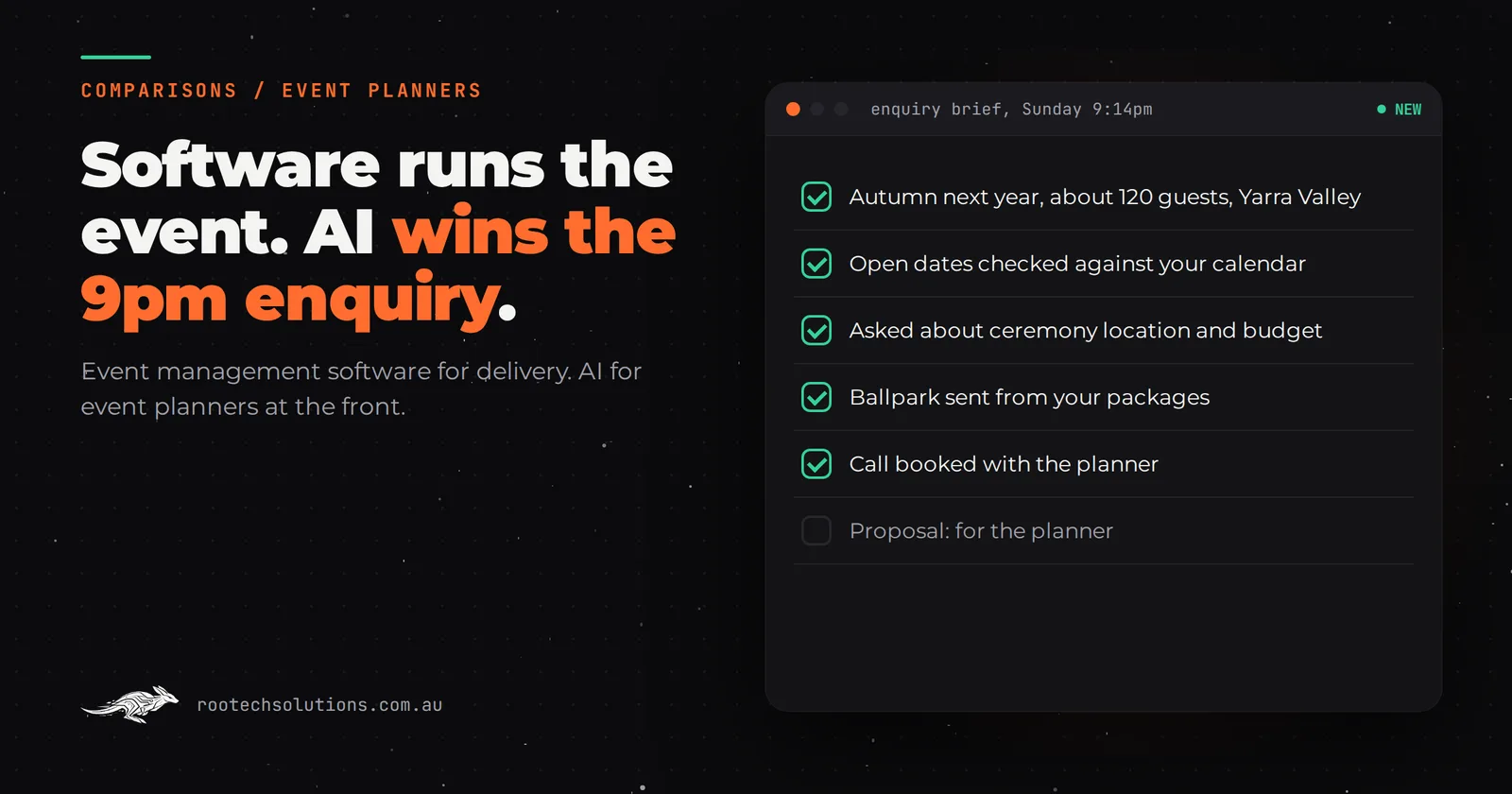
An event enquiry is rarely a simple question. "We're thinking autumn next year, about 120 guests, maybe the Yarra Valley, what would that cost?" arrives at 9pm on a Sunday, and the honest answer depends on dates, venues, packages and a dozen things the couple has not decided yet. By the time you reply on Monday, they have sent the same email to three other planners. So do you buy event management software, or use AI for event planners to answer that email properly while you sleep?
Short answer: Event management software is the right buy when details fall through the cracks during delivery: run sheets, floor plans, suppliers, payments. AI for event planners earns its keep at the front: reading vague enquiries, checking your date availability, giving a ballpark from your packages and following up over the months before a booking. Busy planners usually need both, with the AI feeding the software.
Why are event enquiries harder to answer than most?
Because the first question is almost always a date, the second is a budget nobody wants to state, and the booking might be eighteen months away. That shape is specific to events:
- Date-led. If you or your preferred venues are already booked on that Saturday, nothing else matters. Most of the back-and-forth is working out which dates are possible.
- Vague on purpose. "About 120, maybe more" and "somewhere rustic" are normal. A good planner asks the next three questions; a form just records the vagueness.
- Long and multi-person. A wedding involves the couple and often parents; a corporate event involves someone who needs a quote for procurement by Friday. Enquiries stall for weeks, then come back urgent.
- High value, low volume. You might take a handful of big events a month. Losing one enquiry to a slow reply is a big hole in the year.
What does event management software do well?
It runs the event once you have won it. Tools differ a lot by the kind of event business you run:
- Planning Pod covers lead capture forms, proposals, contracts, floor plans, event orders (BEOs), payments with instalments and automated reminders, aimed at planners and venues.
- EventsAir is built for conferences and larger events: registration journeys, attendee apps, budgets, speakers and logistics, with integrations to tools like Xero, MYOB and HubSpot.
- Enterprise platforms such as Cvent sit at the large corporate end.
The structure is the point. Run sheets, seating, supplier checklists and payment schedules stop living in five spreadsheets, and nobody forgets that the caterer needs final numbers. If your problem is delivery chaos, buy the software first. Check current pricing directly; most charge by user, event or plan.
Be fair to these tools on the front end too. Some, like Planning Pod, include lead capture forms, templated proposals and automated payment reminders. If your enquiries are clean and your packages are simple, those features may be all you need.
Where does event software stop?
At the conversation before the booking. A lead form captures the fields you ask for and puts the enquiry in a pipeline. It does not read "autumn next year, about 120, Yarra Valley, my mum wants a church" and work out which of your dates and venues fit, or ask the two questions that would make the quote possible, or answer "can you do a smaller version on a Friday?" at 9pm.
The other gap is the long middle. An enquiry that goes quiet for six weeks needs a well-timed, personal nudge, not the third identical template. And once an event is booked, chasing guests for RSVPs and dietary requirements, or a couple for a final headcount, is still somebody's afternoon.
What does AI for event planners actually do?
It acts like your best coordinator on the first contact and the follow-up, using your calendar, your packages and your rules. A typical setup:
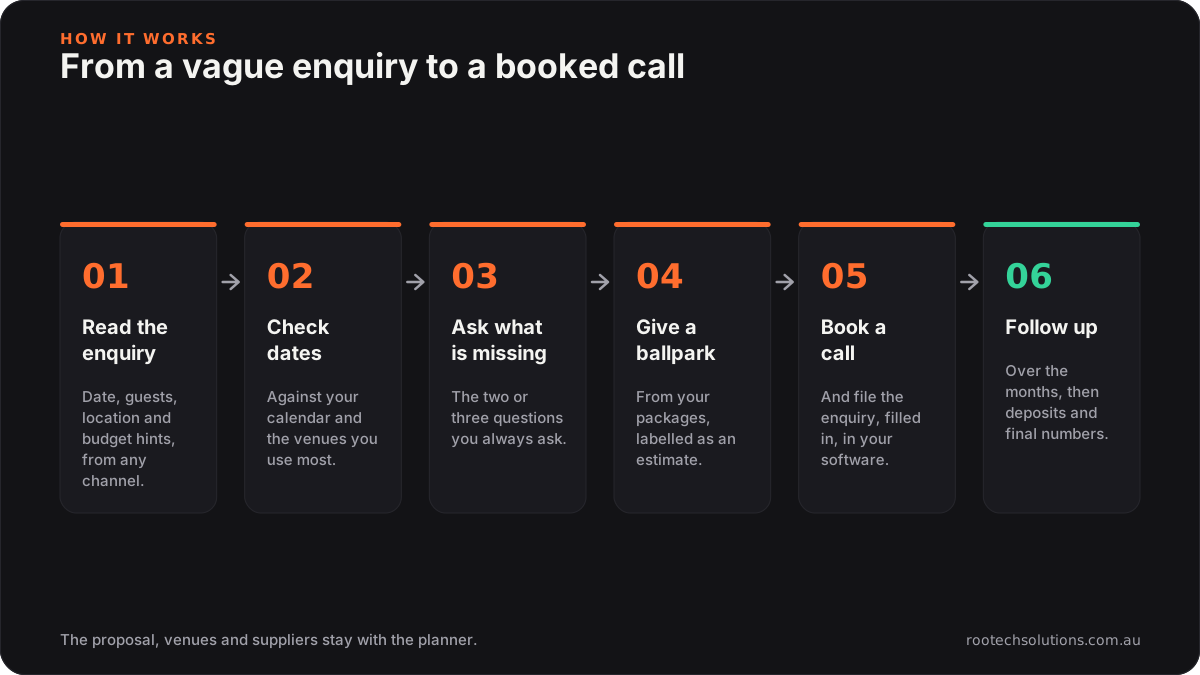
Caption: The AI handles first contact and the long follow-up; the planner handles the proposal and the event.
- Reads the enquiry, wherever it arrives (website, email, Instagram), and pulls out date, guest count, location, event type and budget hints.
- Checks dates against your own calendar and the venues you work with most, and says honestly which options are open.
- Asks what is missing, the two or three questions you always ask, in plain language.
- Gives a ballpark from your published packages, clearly labelled as an estimate, with what is and is not included.
- Books a call with you, and puts the enquiry into your event software or CRM with everything filled in.
- Follows up over the months that follow, then chases deposits, final numbers and dietary requirements once the event is booked.
It does not design the event, negotiate with venues and suppliers, or handle a nervous couple whose venue just fell through. Those come straight to you, with the full conversation attached.
Event software or AI: which should you choose?
Choose by where you are losing money: before the booking or after it.
| Where it hurts | Event management software | AI for event planners |
|---|---|---|
| Enquiries go cold before you reply | Lead form into a pipeline | Real reply with dates and a ballpark |
| Vague enquiries take five emails | Records what was typed | Asks the missing questions |
| Long gaps before booking | Triggered workflows | Personal, well-timed follow-up |
| Run sheets, floor plans, BEOs | Built for this | Not its job |
| Supplier coordination | Checklists and orders | Chases final numbers if asked |
| Payments and instalments | Built for this | Reminders, reading from your system |
| Setup | Days to weeks | Two to four weeks to build |
If quotes take three days and leads drift away, AI first. If your events are chaotic in delivery, software first. If both are true, start with whichever is costing you more this quarter, and make the second one feed the first.
What does a custom AI build cost an event planner?
Most event planner builds land between $3,000 and $8,000 as a one-off estimate and are live in two to four weeks. Running costs are hosting (usually under $50 a month) plus AI usage, typically $20 to $200 a month, which stays low for a business that handles dozens of enquiries a month rather than thousands.
- Week one: your packages and what they include, the dates you are already holding, the venues you work with and how far ahead they confirm, the questions you always ask, and the topics the AI must hand to you.
- Weeks two and three: build the enquiry assistant and follow-up, and connect them to your inbox, website, Instagram, calendar and whichever event software or CRM you use.
- Final week: run it against a season of your real past enquiries and check every ballpark it gives against what you actually quoted.
You approve the templates, every ballpark comes from your own packages, and proposals still come from you. If your business is a venue rather than a planner, the same thinking applies to availability: for Kaladi Kitchens we built a booking system where members book time across multiple locations from one calendar, with availability that updates the moment a slot is taken. For first steps that cost less, see the first AI automation for Melbourne event planners, and for why speed matters so much, stop losing leads to slow follow-up.
Frequently asked questions
Can an AI give a couple a price for their wedding?
It can give a ballpark from your published packages, clearly labelled as an estimate with what is included, and explain what would change it. The detailed proposal still comes from you after a call, because venue, styling and supplier choices move the number too much for a bot to commit to.
Will an AI double-book a date?
Not if it reads from the calendar you actually keep. It should only describe dates as open when your calendar shows them open, hold nothing without your say-so, and pass any request for a date you have tentatively held to you to decide.
Does it replace Planning Pod or EventsAir?
No. Event management software stays the system for proposals, run sheets, floor plans and payments. The AI sits in front of it, handling the conversation and writing a complete enquiry into it, so you are not retyping details from an email thread.
Is it worth it for a small planning business?
It depends on how many enquiries you lose. A solo planner who answers every enquiry the same day may not need it yet. If enquiries regularly sit overnight, or you spend hours a week asking the same first questions, an assistant usually pays for itself with one or two extra bookings a year.
Want to see what your enquiries are really asking?
Book a free AI workflow audit. Send us a season of enquiries and we will show you which ones an assistant could have answered that night, which ones needed you, and whether software, AI or both is the right next spend. The audit fee comes off your first project if you go ahead.