Hiring an Admin vs. AI Automation for Melbourne Landscapers
Part-time admin or AI automation for landscapers? Compare first-year cost, what each handles, and when a Melbourne landscaping business needs both.
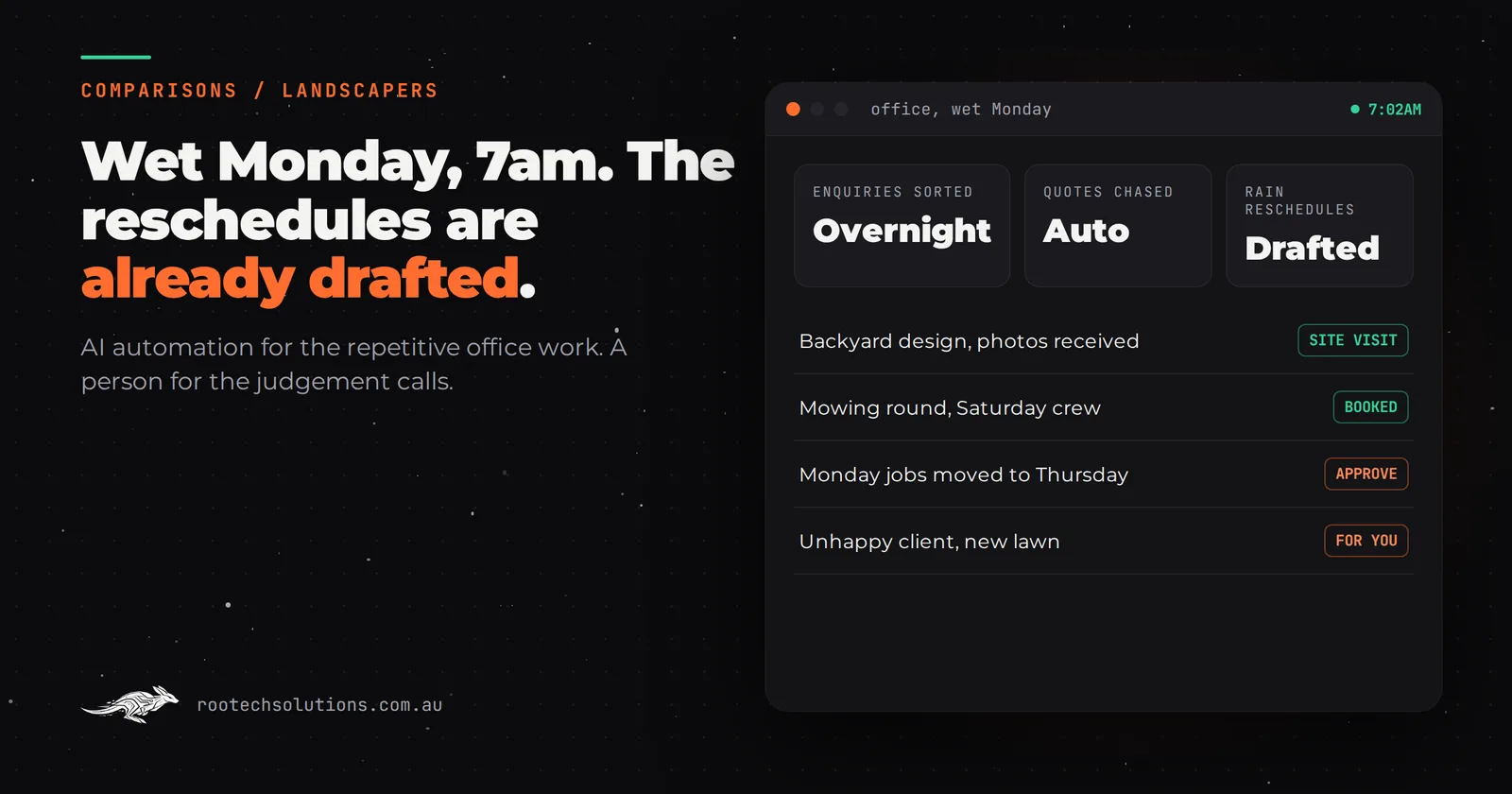
Somewhere around the second or third crew, a landscaping business runs out of evenings. Quote requests pile up while you are on site, a wet week means ringing twenty clients to move their jobs, and the photos of last week's finished garden are still on a crew member's phone. The usual next step is a choice: hire a part-time admin, or put AI automation for landscapers to work on the repetitive half of the office.
Short answer: For a landscaping business with one to four crews and fairly standard quoting, AI automation is usually the better first move: it handles enquiries, quote follow-up, rain-day rescheduling and job photos for a fraction of a wage. Hire a part-time admin when the work needs judgement every day: complex design jobs, supplier negotiation and unhappy clients. Larger businesses usually end up with both.
What makes landscaping admin different from other trades?
Three things: the weather, the site visit and the season. A plumber's day is rarely cancelled by rain; yours often is. A sparky can sometimes quote from a photo; a garden makeover almost always needs someone to walk the block. And the phones go quiet in winter and flat out from early spring, so any fixed staffing decision is either too much in July or too little in October.
That shapes which admin is worth paying a person for and which is worth automating:
- Enquiries that need sorting. A lawn-mowing round, a retaining wall and a full backyard design all arrive through the same contact form, and they need very different responses.
- Site visit booking. Matching the visit to where your crews already are that week saves hours of driving.
- Quote follow-up. The quote goes out after the site visit, then nobody chases it while the client gets two other prices.
- Rain-day rescheduling. Every wet day means working out which jobs move, where to, and telling each client.
- Proof of work. Before and after photos that clients love, and that rarely leave the crew's phone.
What does a part-time admin cost a landscaping business?
A part-time admin working 25 to 30 hours a week at $35 to $45 an hour is roughly $45,000 to $70,000 a year in wages, before super, leave, recruitment and the time you spend training them. Those are rule-of-thumb figures; the Fair Work pay calculator gives the current award minimums for the role you are hiring.
A good admin is worth it for the work only a person can do:
- reading an annoyed client's tone and fixing it before it becomes a review;
- chasing the supplier who is late with the pavers and negotiating a better price;
- juggling a design job with a retaining wall, drainage and a council question;
- becoming the name your regular clients ask for.
Where a person struggles is the pattern of the work. Enquiries arrive in the evening and on weekends, when people are standing in their own backyard thinking about it. A wet Monday needs twenty calls made by 7am. And the spring rush is exactly when a new hire is still learning your jobs.
What does AI automation for landscapers actually handle?
The repetitive, rules-based half of the office, around the clock. A typical setup for a Melbourne landscaping business:
- Enquiry triage. The AI reads each web form, email or Facebook message, works out whether it is maintenance, a small job or a design project, asks for photos and the suburb, and replies in minutes.
- Site visit booking. It offers visit times on days a crew is already nearby, and books them into your calendar or job management app.
- Quote follow-up. After you send the quote from Tradify, Fergus, ServiceM8, Jobber or whatever you use, it follows up at sensible intervals, answers simple questions about it, and tells you who is ready to go ahead.
- Rain-day rescheduling. When you mark a day as washed out, it works out which jobs move, drafts a message to each client with a new time, and sends them once you approve.
- Job photos to the client. When a job closes, the before and after photos go to the client automatically, with a review request.
That last one is not hypothetical. For Bugaboo Landscaping we built a booking system that gives each franchisee their own view of the day's jobs and lets crews upload before and after photos from site, which are sent to the client automatically when the job is closed.
What AI automation does not do: design the garden, decide whether a retaining wall needs an engineer, negotiate with suppliers, or calm down a client whose new lawn died in a heatwave. It captures those, flags them, and hands them to you.
Admin or AI automation: how do the first-year costs compare?
AI automation for a landscaping business typically costs $3,000 to $8,000 to build, plus about $200 to $600 a month to run. Across the first year that is roughly $5,400 to $15,200, against roughly $45,000 to $70,000 in wages for a part-time admin before super.
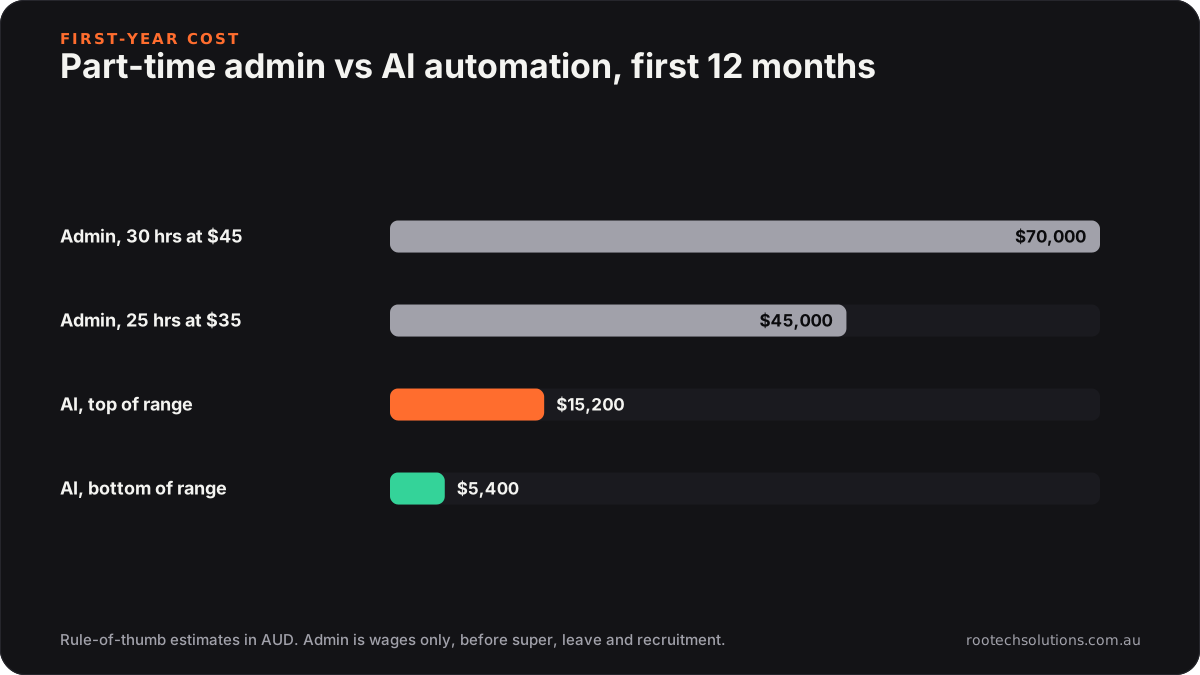
Caption: The gap is large, but the two do not do the same work, so compare tasks before you compare totals.
| What matters | Part-time admin | AI automation |
|---|---|---|
| Upfront | Recruitment and training | One-off build, $3,000 to $8,000 |
| Ongoing | Roughly $45,000 to $70,000 a year in wages, plus super | About $200 to $600 a month |
| Hours covered | 25 to 30 a week | Every hour, including the spring rush |
| Rain-day rescheduling | Phone calls, one at a time | Drafted for every affected job, you approve |
| Supplier and client judgement | Strong | None, it hands off |
| Spring rush | Same hours, more stress | Scales with volume |
| Best fit | Five or more crews, design-heavy work | One to four crews, standard quoting |
These are estimates. Your hours, award, channels and existing software move them.
Is off-the-shelf job management software enough?
For the job itself, usually yes. Job management apps such as Tradify, Fergus, ServiceM8 and Jobber are built for scheduling, quoting and invoicing, and they connect to accounting software (Tradify, for example, has a two-way sync with Xero). Some already send quote and invoice reminders, so switch those on before paying for anything. If you are still quoting from a notebook, start there; check their current plans and pricing.
Where they stop is the conversation around the job: sorting a vague enquiry, asking for photos, answering a client's question about the quote in plain English, rewriting a week of bookings after rain. A custom AI integration sits on top of your job management app rather than replacing it, reading from it and writing back to it. And when your business has a shape no app fits, such as franchisees who each need their own view, custom software is how you get it. We go through the smaller first steps in the first AI automation for Melbourne landscapers, and the general case for killing double entry in automating data entry for tradies.
What does the build look like?
Most landscaping builds are live in two to four weeks at a fixed price.
- Week one: write down how you actually sort, book and quote jobs. Which enquiries you will not take, which suburbs you cover, how long a site visit takes, how you decide a rain day. If it lives in your head, the AI has nothing to follow, so this step is valuable on its own.
- Weeks two and three: build the enquiry assistant, the follow-up and the rain-day rescheduler, and connect them to your website, inbox, calendar and job management app.
- Final week: test on a month of your real past enquiries and a pretend wet week before anything goes to a client.
Running costs are hosting (usually under $50 a month) and AI usage that rises in spring and drops in winter. You approve every rescheduling batch and every quote, and anything involving a complaint or a design decision lands with you or your admin.
Frequently asked questions
Can AI automation quote a landscaping job without a site visit?
For simple, repeatable work like a mowing round or a hedge trim, it can give an indicative price from photos and your rules. For design and construction work it should not try; its job is to gather the details and photos and book the site visit, so you arrive knowing what you are quoting.
What happens to bookings when it rains?
You mark the day as washed out. The automation finds every affected job, proposes new times based on crew availability, and drafts a message to each client. Nothing is sent until you approve the batch, and clients who reply with a problem come straight to you.
Do I still need an admin if I automate?
Maybe not yet. Many smaller landscaping businesses find that once enquiries, follow-up and rescheduling run automatically, the remaining admin fits into a few hours a week. Larger operations with design work, many suppliers and franchisees usually still need a person, who spends their time on the judgement work instead of the phone.
Will it work with Tradify or ServiceM8?
It is built around whichever job management app you use, through the integrations that app supports. Your quotes, jobs and invoices stay in that app; the automation handles the conversations around them and writes the results back.
Want to know which half of your admin is automatable?
Book a free AI workflow audit. We will look at a typical week of your enquiries, quotes and reschedules, show you which parts an automation can take and which still need a person, and tell you honestly whether the numbers work. The audit fee comes off your first project if you go ahead.