AI for Florists: What It Should Never Design
AI for florists won't design your bouquets. What a Sydney florist can safely automate, from after-hours enquiries to event briefs, and what stays human.
A bride messages at 9pm asking whether your peonies will be in season for a March wedding, and whether you can hold a Saturday. Nobody sees it until morning, and by then she has sent the same message to two other Sydney florists. You know AI could catch that message. What you actually worry about is what happens next: can a machine really talk to someone about the most emotional flowers they will ever buy?
Most florists have quietly dismissed AI for this reason, and the fear is reasonable. This post goes through what a Sydney florist can safely hand to AI, what should never leave your hands, and where the fear is right.
Short answer: AI should handle the routine messaging around your flowers, never the design. For a Sydney florist, that means after-hours enquiries, quote follow-ups, event brief collection and order capture, answered from your approved information and passed to a person whenever anything is emotional, unusual or expensive. Every arrangement stays a human decision.
Can AI actually design a bouquet?
No, and this is the fear most florists name first, so let us be blunt about it. An AI does not have taste. It cannot judge that a rose opens before Saturday and closes after, that the widow at the Leichhardt funeral parlour wants white and nothing else, that the colour palette on the mood board is going to fight with the venue's carpet. Those calls are your craft and your reputation.
The fear is right in one more way: anything involving taste is exactly what you get paid for, and you should keep it.
But most of the hours in a florist's week are not taste. They are logistics. Someone asks what you have available for a same-day delivery to Mosman. Someone wants a quote for 12 table centrepieces for a corporate event in the CBD. Someone messages on Instagram at 11pm to ask if you deliver to the Northern Beaches. Someone cancels a subscription and asks what that means for their standing order. None of that is design. All of it is messaging that a well-set-up AI can answer, accurately, from your own information: what you deliver, where, what is in season, how your quotes work, how to book a consult.
The honest framing is not "AI designs your bouquets". It is "AI takes the queue of routine messages off the counter so you can be at the bucket bench". The design work stays yours. The question a florist should ask is not "can AI do my job", it is "how many hours a week am I spending on messages that a well-informed assistant could answer".
What does AI actually handle for a florist?
Think of AI as handling the admin layer around the flowers, not the flowers. The realistic scope for a Sydney flower studio:
- After-hours enquiries. A customer messages at 9pm. The AI replies within seconds with what you stock, whether you deliver to their suburb, and how to book. You wake up to a booked consult, not an unanswered message.
- Event and wedding briefs. Collect the date, venue, guest count, budget range and colour preferences in a structured form, so the information is in front of you when you design, not scattered across texts and screenshots.
- Quote follow-ups. Two days after you send a wedding quote, a polite nudge goes out automatically. Most florists never send these at all.
- Order capture. Someone messages a photo of the arrangement they want for their mum's birthday. The AI captures the delivery address, card message and date, then asks what it cannot work out, and flags anything unusual for you to confirm.
- Seasonal and stock replies. Whether peonies are in, whether native substitutes work, what your standard price range is, all answered from your approved information, not invented.
Each of these is a real chunk of the week. A busy studio doing weddings plus daily delivery rounds can easily lose an hour or more a day to messages, half of which arrive when the shop is closed or your hands are in a bucket.
Where the fear is right
A myths post that only says "don't worry, AI is fine" would be dishonest. Here is what the fear gets right.
AI should never design, price complex bespoke work, or talk about sensitive orders. A funeral arrangement, a sympathy message for a family in grief, a dispute about a wedding order that went wrong: those all go straight to you. A customer writing about a death in the family does not want a fast, cheerful reply, they want a human who reads it. Good guardrails force that handover every time, not just when the AI feels like it. This is the same line we drew for salon clients in the personal touch question: speed and information are automatable, warmth and judgement are not.
Generic chatbots do make things up. A cheap chatbot that answers freely about flower availability, delivery times or prices will eventually invent something confident and wrong, and the customer drives to your shop expecting a peony bouquet in February. That fear is not paranoia. It is why the setup matters more than the technology: an AI wired to your approved information only, which says "I'll have someone confirm that" whenever it is unsure, behaves completely differently from a generic bot.
The impersonal feel is a real risk. Flowers are an emotional purchase. A customer messaging about a funeral does not want to feel like they are talking to a machine, and a bride planning the biggest flowers of her life wants to talk to the person who will make them. The fix is not to hide the AI. It is to use it only where speed and accuracy are what the customer wants (opening hours, suburbs, prices, stock), and to hand over early and visibly on anything personal. When it says plainly "I'm an assistant for [studio name], let me get the florist to answer that properly", most people are relieved, not annoyed.
The line: what stays human
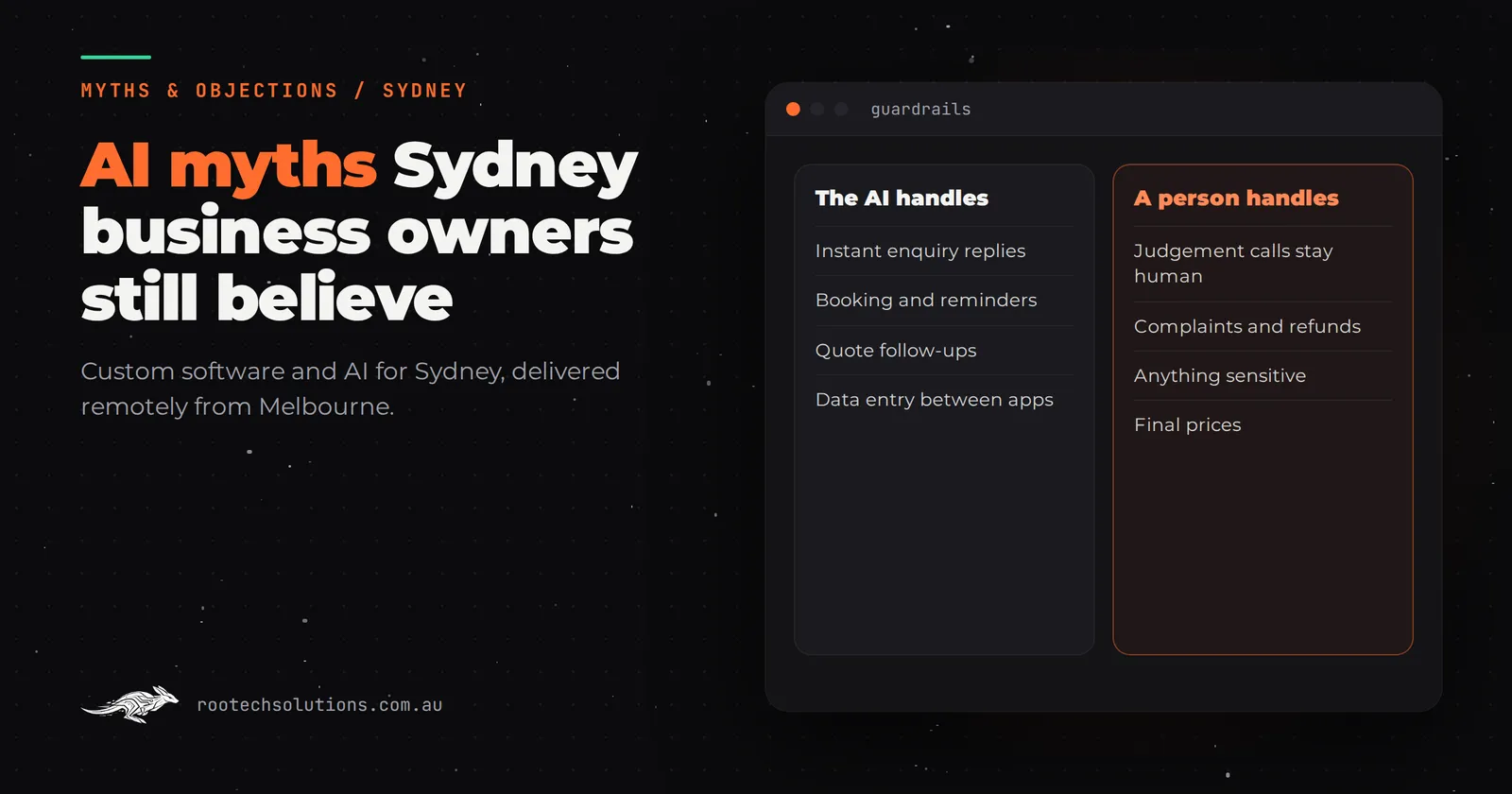
A simple split, which is roughly what we build for every client:
| The AI handles | Always goes to a person |
|---|---|
| After-hours availability, suburbs, opening hours | Design, colour and flower choice |
| Standard price ranges and delivery fees | Any complaint, dispute or refund |
| Event brief collection and reminders | Sympathy and funeral conversations |
| Order capture for standard arrangements | Anything over a set dollar amount |
| Quote follow-up nudges | Custom quotes for large weddings |
| Seasonal and stock questions | Refunds, time-critical changes, judgement calls |
Nothing that involves money, feelings or taste crosses the line without a person. That is not a compromise, it is the design.
What a handover actually looks like
Here is the kind of exchange you would see in a well-set-up system. Names are invented, but the pattern is real.
Customer: Hi, my grandmother passed away on Monday and we need something for the service on Thursday.
AI: I'm really sorry for your loss. I want to make sure this is handled properly, so I'm passing this straight to Priya, our florist. She'll reply this morning. Could I take your name and contact number so she can reach you?
That is the whole trick. The AI does not try to sell sympathy flowers. It recognises the situation, says so plainly, hands over, and collects the one detail you need to follow up fast. Done well, this is more considerate than a reply that sits unread until shop hours.
Off-the-shelf vs a custom build
You already run software that does part of this. Shopify handles online orders and standard product questions if you have a store. Instagram and Facebook have basic auto-replies. A generic chatbot subscription can be bolted onto a website in an afternoon for a modest monthly fee.
What none of these do is know your business. A generic bot cannot tell a customer whether you have ranunculus this week, whether you deliver to Kiama on a Sunday, or that your wedding minimum for a Saturday in November is already tight. It cannot capture a wedding brief in the structure you actually design from, or push a confirmed order into your workflow.
A custom AI integration is worth it when the routine questions have real business logic behind them: your delivery zones, your stock, your event minimums, your quoting rules, all connected to the tools you already run, such as your online store or booking calendar. If your questions are truly generic ("what are your hours"), the off-the-shelf option is fine, and we will tell you so. The custom layer earns its keep when the answer to a simple question depends on details only your business knows.
What it takes to build and what it costs
Most florist automations of this kind are straightforward builds. At Rootech, most projects ship in two to four weeks at a fixed price. Ongoing running costs are usually modest: hosting is typically under $50 a month, and AI usage typically runs $20 to $200 a month depending on message volume. Check current pricing with any platform you compare us against; we do not quote theirs.
The setup work is mostly yours, not the developer's: writing down your delivery zones, standard prices, seasonal stock, wedding minimums and the phrases you want used on sensitive conversations. That document becomes the AI's approved information, and it is also just a good business record to have.
If you are weighing AI against hiring front-of-house help, the same trade-off comes up for restaurants in the vibe question, and the answer there is the same as here: automate the queue, not the conversation. And if you want to know how Sydney customers find you in the first place, we have covered the search side on our Sydney software page.
Frequently asked questions
Will customers know they're talking to AI?
They should. The AI introduces itself as an assistant for your studio, and that honesty is what makes it acceptable. What customers actually dislike is not AI, it is a slow, wrong or evasive answer. Fast, correct and clearly a handover point is the combination that works.
What happens if the AI doesn't know an answer?
It says so and passes the question to you, with the customer's details attached. The guardrail rule is simple: answers only come from your approved information, and anything uncertain, sensitive or expensive goes to a person. It never invents availability, prices or delivery promises.
Can AI take deposits or payments?
It can capture an order and send a payment link, but anything involving money keeps a human in the loop at Rootech. Custom quotes above a set threshold, refunds and disputes always come to you for confirmation before anything is charged.
Is this worth it for a small studio, not a big shop?
The smaller the team, the more the after-hours and admin hours matter, because there is nobody else answering the phone. If routine messages cost you even five hours a week, an automation that reclaims most of them usually pays for itself in saved evenings and recovered orders. If your message volume is genuinely tiny, we will tell you honestly that it is not worth it yet.
Does the AI post to social media or write my captions?
It can, if you want it to, but that is a separate job from customer messaging and most florists prefer to keep their own voice on Instagram. Start with enquiries and order capture. Add content automation later only if you actually want it.
The takeaway
Your fear that AI cannot design flowers is correct, so do not ask it to. Use it for everything around the flowers: the 9pm enquiries, the brief collection, the follow-ups, the routine questions that eat your evenings. Keep design, sympathy conversations, disputes and money in your own hands, with guardrails that force that handover automatically.
If you want to see what that would look like for your studio, Rootech Solutions offers a free AI workflow audit, and the audit fee comes off your first project. Book a call at our contact page and we will map where your hours are going before you spend anything.