Will AI Ruin the Personal Touch in Your Sydney Salon?
Will AI in your Sydney salon scare clients off? Where AI booking, reminders and after-hours replies help, where the human stays, and how to set the line.
You built your salon, day spa or barbershop in Sydney on relationships. Clients come back to the same stylist, the same massage therapist, the same chair. So the idea of letting an AI anywhere near them feels wrong: cold, robotic, the opposite of what you sell.
The fear is worth taking seriously, because a badly set up AI really can damage a salon. But the fear is usually aimed at the wrong thing. The version of AI most salons actually need does not touch the client relationship at all. It handles the booking, the reminder and the 9pm enquiry that nobody answers, so you and your team have more time for the people in the chairs.
Short answer: AI will not ruin the personal touch in a Sydney salon if it is kept away from the work that is personal. It suits routine jobs: answering enquiries, taking bookings, sending reminders, rebooking regulars. Consultations, colour decisions, sensitive complaints and anything about money stay with a person. The AI should say it is an AI and hand over cleanly.
What salons actually lose when there is no AI at all
Walk through a normal Saturday at a busy salon. The phone rings while a stylist has foils in. A DM arrives asking about a first appointment next Thursday. Another asks what a balayage costs. The receptionist (if you have one that day) is checking in three people and running the till.
Here is where the leaks happen:
- The phone rings out. The caller tries one more salon down the street.
- The Instagram DM sits unanswered for six hours. Enquiries like that go cold fast.
- A client who came every five weeks for two years stops coming, because nobody reminded her the gap since her last visit had stretched to nine.
- Someone cancels at 8pm. The 2pm slot sits empty tomorrow because no one rebooked the waitlist.
None of that is a people problem. It is a capacity problem, and it happens at exactly the hours your clients are free to message you: evenings, weekends, lunch breaks. That is what AI automation fixes, and it fixes it without a human ever having to pretend to be available.
Where the fear is right: the mistakes a bad AI makes
Before defending the technology, be honest about what goes wrong when it is set up badly. These are real failure modes, not strawmen:
- The bot pretends to be a person. A client types "is this a human?" and gets "of course, how can I help?" That single lie costs more trust than any amount of fast booking wins back.
- The bot invents a price. Ask it what a full head of foils costs and it guesses a number. You then honour a price you never set, or you have an awkward conversation on arrival.
- The bot books things it should not. A 45-minute gap gets filled with a service that takes 90. Or a new client books a colour correction with a junior.
- The bot handles a complaint badly. Someone is upset about an allergic reaction or a result they hate. A canned reply at that moment turns a recoverable situation into a bad review.
If those are the risks, the fix is not "no AI". It is guardrails: an AI that only answers from approved information (your actual service menu and prices), says it is an AI, books only real availability, and hands anything sensitive to a person immediately.
The line: what AI handles, what always stays human
The line is simple to state and easy to hold if you design for it.
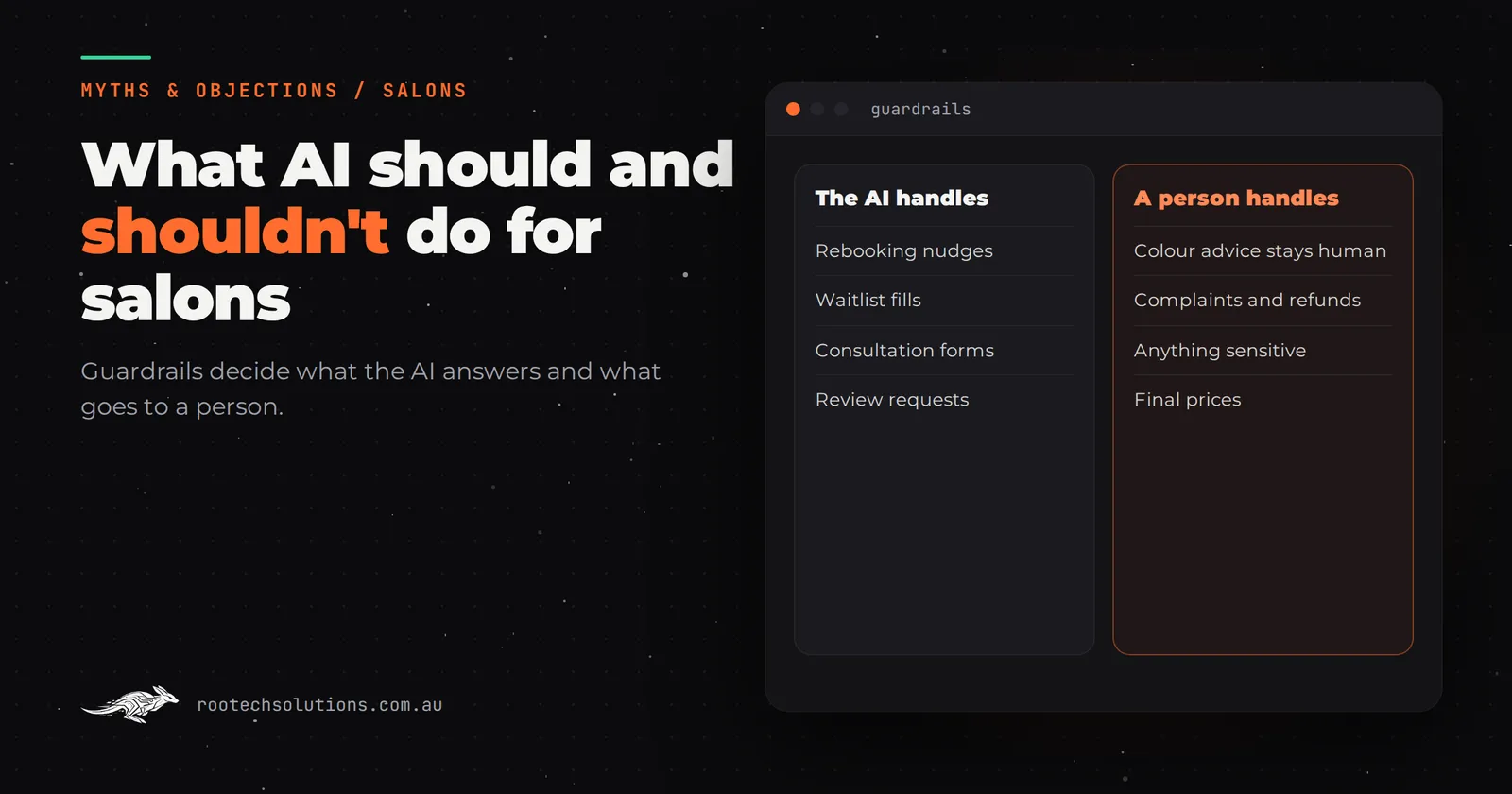
| The AI handles | Always goes to a person |
|---|---|
| Answering service, price and hours questions from your approved menu | Colour, treatment and skin consultations |
| Taking and changing bookings in real availability | Complaints, reactions and anything emotionally charged |
| Confirmation and reminder texts | Retail recommendations for a specific scalp or skin concern |
| Waitlist offers when a cancellation comes in | Refunds, credits and gift voucher disputes |
| First-response replies to DMs and after-hours enquiries | Anything a client asks to speak to a human about |
Notice what this does for the personal touch rather than against it. The stylist who was answering the phone mid-foil now stays present with the client in the chair. The receptionist stops retyping details and starts remembering names. Automation removes the interruptions that make service feel rushed, which is the opposite of cold.
What a guarded conversation looks like
Illustrative only, but this is the shape. Priya messages a Sydney day spa at 8:40pm about a facial.
Priya: Hi, do you have anything free on Saturday? Also how much is the 60-minute facial?
Assistant: Hi Priya, I'm the salon's AI assistant. Saturday has 10:30am and 2:15pm free with Maya. The 60-minute hydrating facial is $129 with our current prices. Would you like me to hold one of those times?
Priya: I had a reaction to a product last month, will that be a problem?
Assistant: That's important to talk through before booking, so I'll get the team to call you. I've flagged your message and one of our therapists will follow up in the morning.
That is the whole point. Fast, accurate, clearly an AI, and out of the way the moment the question turns personal. Compare it to the alternative: an unanswered DM, or a guess about a reaction that no booking system should make.
Off the shelf or custom: what suits a Sydney salon
Salon software is a mature category, and for most salons it is the right first stop. Platforms like Fresha, Timely and Kitomba handle appointments, reminders and payments, and you should check their current pricing and features yourself. If your booking stack already does the basics well, do not replace it.
The gap appears between the software and the conversations happening around it. Off-the-shelf tools do not answer the Instagram DM that arrived at 9pm, qualify whether that enquiry is a trim or a colour correction, or pull the waitlist together when a Saturday cancellation lands at 10pm. That is where custom automation earns its place, and where we work at Rootech Solutions: an AI assistant wired into the booking system you already run, answering only from your approved service menu and escalating to your team when a question is not routine. If you want the broader context, our comparison of salon booking software versus custom AI covers when each side wins, and our piece on stopping salons losing regulars to missed rebooking shows the retention side of the same problem.
What it costs to try this properly
Framed as estimates, because every setup differs. If you already have salon software, the automation layer usually lands in the low thousands of dollars to build, with running costs of hosting under $50 a month plus AI usage typically $20 to $200 a month depending on message volume. Most builds ship in two to four weeks. Set against one unfilled Saturday column, the maths is short: a single recurring client over a year is worth far more than the monthly running cost. We price fixed, so you know the number before anything starts.
The takeaway
The fear that AI will ruin your salon's personal touch has it backwards if the AI is built with the right line. Automate the routine: enquiries, bookings, reminders, waitlists. Keep the personal where the money is anyway: the consultation, the chair, the recovery call when something went wrong. A Sydney salon that does this answers every enquiry within seconds, keeps its team present with the clients in front of them, and loses nothing that made it worth choosing in the first place.
If you want to see where that line would sit in your salon, book a free AI workflow audit. We map your enquiries, bookings and no-shows, show you what is worth automating and what is not, and the audit fee comes off your first project. See our Sydney custom software page, the salon rebooking automation post, or how salons should start with AI to go deeper, then book your free audit.
Frequently asked questions
Will clients be annoyed to find out they were talking to an AI?
Not when you tell them upfront and the answer is fast and correct. What annoys clients is being deceived or being kept waiting. An assistant that says "I'm the salon's AI helper" and solves the problem in ten seconds is the acceptable version; one that pretends to be a receptionist is not.
Can AI handle colour consultations?
No, and it should not try. Choosing tone, assessing previous colour and discussing damage is exactly the judgement clients pay a stylist for. The AI's job is to get that consultation booked with the right person, not to have it.
What about a client with a skin reaction or allergy?
That always goes to a person, immediately. A good setup flags keywords like "reaction", "allergy" or "burn" and routes the message to your team with a note, rather than answering at all. Anything with a health dimension is not a routine enquiry.
Do we need to fire our receptionist?
No. Salons typically use AI to cover the hours a receptionist does not exist anyway: evenings, weekends, and the moments when the person at the desk is already busy. The role shifts from answering repetitive questions to doing the parts that need a human.
How fast can this be running in a Sydney salon?
Most builds of this kind ship in two to four weeks, working against your existing booking software. The first week is discovery: mapping your service menu, prices and escalation rules so the AI only ever answers from information you have approved.