Will AI for Restaurants Kill the Vibe in Melbourne?
AI for restaurants without losing warmth: the real risks (allergies, functions, canned replies), where staff still win, and what a safe booking AI does.
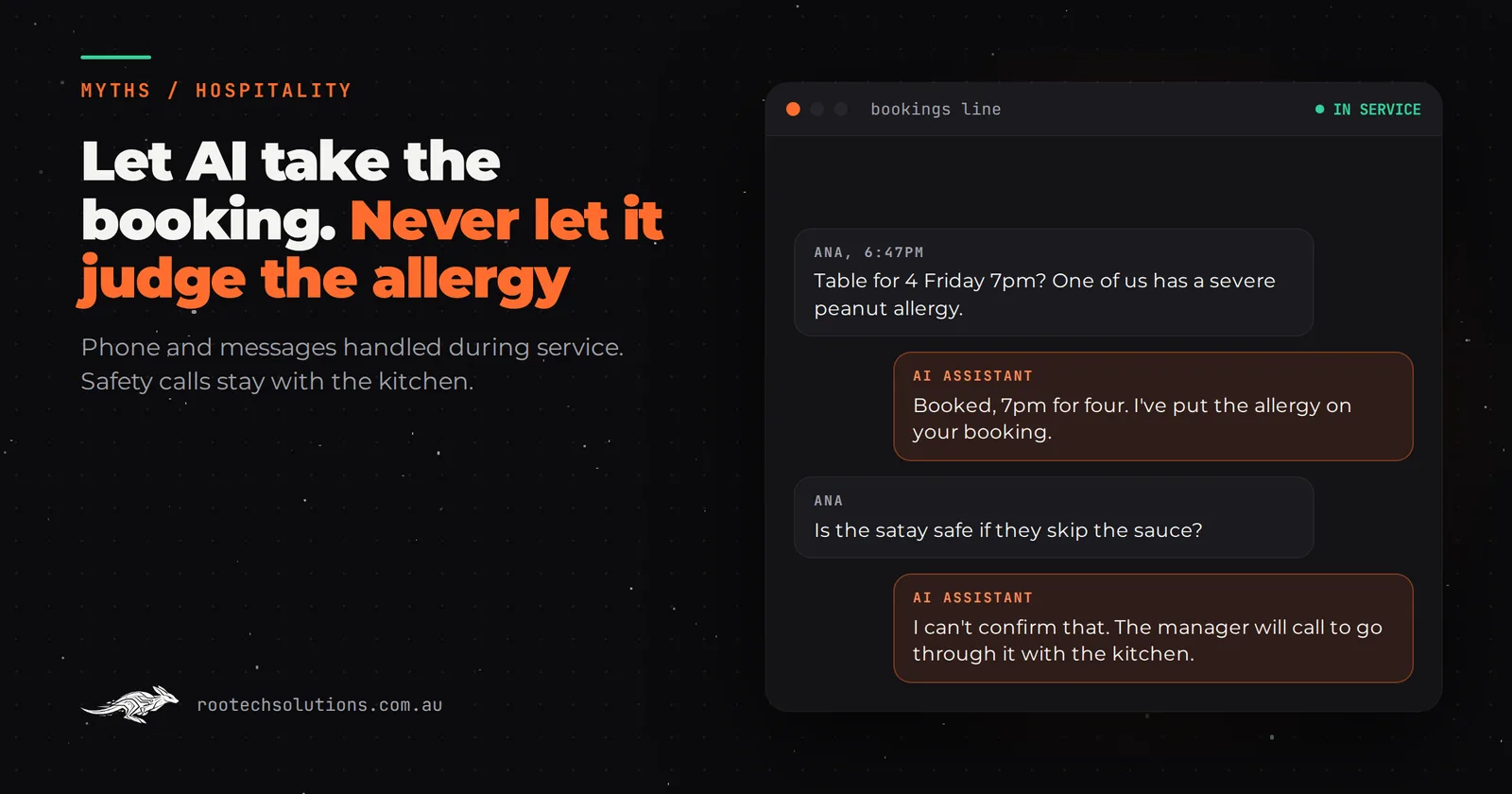
The phone rings at 6:45pm on a Friday, mid-service, and nobody can get to it. You know that's a lost table, maybe a lost function booking. But you've spent years making the place feel like somewhere people are known, and AI for restaurants sounds like the opposite of that.
Short answer: AI for restaurants doesn't kill the vibe when it stays off the floor. Let it answer the phone and messages during service, take bookings, and log dietary needs. Never let it tell a diner a dish is safe for their allergy, quote a function package it hasn't been given, or reply to reviews in a voice that isn't yours. Hospitality happens at the table, not on hold.
What are restaurant owners actually afraid of?
Restaurant owners aren't really worried about technology. Most already run online bookings, a POS and a delivery tablet. The fear is about three specific moments:
- The phone call from a regular. They ring because they like hearing "of course, Mrs Nguyen, your usual table". A robotic voice says the venue has stopped caring.
- The allergy question. "Is the satay sauce made in the same kitchen as the nut-free curry?" A wrong answer can put someone in hospital.
- The function enquiry. A 40-person birthday is worth more than a whole Tuesday. Owners worry a bot will fumble it, quote the wrong minimum spend, or lose it entirely.
There's a fourth, quieter fear: the canned reply. Every venue has seen another restaurant answer a heartfelt Google review with "Thank you for your feedback! We hope to see you again soon!" and winced.
Which of those fears are right?
The allergy fear is completely right, and it's the one that sets the rules for everything else.
An AI can read your menu, but it can't see your kitchen. It doesn't know that the fryer oil changed this week, that the chef swapped the dressing, or that sesame is in the bread crumb. Food businesses are expected to get allergen information right: Food Standards Australia New Zealand's guidance says that for food that isn't labelled, such as a meal at a café or a takeaway, allergen declarations must be displayed with the food or provided to the purchaser on request. That information has to come from the people who make the food. A chatbot guessing from a menu PDF isn't that.
The function fear is right too. Functions involve deposits, minimum spends, set menus, room hire and judgement about which Saturday to give away. An AI should collect the details fast and get them to you, not negotiate.
The canned-reply fear is right about generic tools. Review replies are part of your voice. An AI can draft them; a person should send them.
Where is the fear of AI for restaurants wrong?
The fear is wrong about the phone and the inbox during service. Most of what comes in is routine: a table for four on Saturday, are you open on the public holiday, do you have parking, can we bring a cake, is the kitchen open late. Those calls pull your floor staff off the floor at exactly the wrong time, and the ones nobody answers go to the place down the road.
It's also wrong about regulars, if the build is done properly. Recognised numbers can ring through to the venue during quiet hours, and the AI can greet returning guests by name and note their usual preferences from your booking system. Being remembered is a feeling software can support, as long as it isn't faking a person.
What does a safe AI booking assistant for restaurants do?
It takes the booking, records the need, and hands every judgement call to a person. Here's how an allergy note should travel:
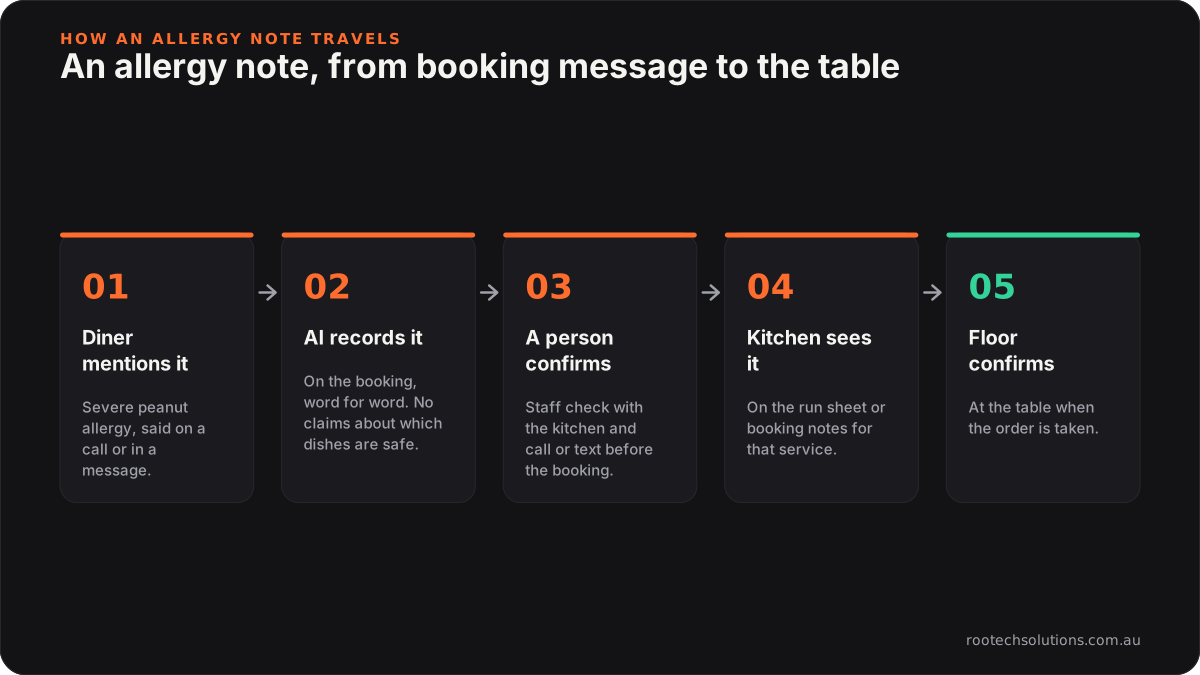
Caption: The AI's job is to make sure the allergy can't get lost, not to decide what's safe.
- The diner mentions it. "Severe peanut allergy" during a booking call or message.
- The AI records it on the booking in your booking system, word for word, and says plainly: "I can't confirm whether a dish is safe. I've noted the allergy and the team will go through the menu with the kitchen."
- A person confirms. For severe allergies, a staff member calls or texts before the booking with what the kitchen can do.
- It prints where the kitchen sees it, on the run sheet or booking notes for that service.
- The floor confirms at the table when the order is taken. The AI's note is the reminder, not the answer.
Everything else follows the same pattern:
| Request | What the AI does | What it hands to a person |
|---|---|---|
| Table for 4, Saturday 7pm | Books it in your booking system, confirms by SMS | Nothing |
| "Is the curry nut-free?" | Records the allergy, makes no claim about dishes | Kitchen confirmation |
| 40-person birthday | Takes date, numbers, budget, contact details | Packages, deposits, minimum spend |
| "Can we bring our own cake?" | Answers from your policy, word for word | Nothing |
| Complaint about last night | Apologises, takes details | The owner or manager calls back |
| New Google review | Drafts a reply in your voice | A person edits and posts it |
Should you use off-the-shelf booking software or a custom AI integration?
Start with off-the-shelf. Booking platforms such as OpenTable, SevenRooms, ResDiary and Now Book It already handle online reservations, waitlists, deposits and guest notes, and POS systems such as Square and Lightspeed handle orders. If most of your bookings already come through an online widget and the phone is quiet, you may not need anything more. Check their current features and pricing.
A custom AI integration earns its keep when the gaps are in conversation, not in the booking engine:
- The phone rings during service and the calls are mostly routine bookings and questions.
- Bookings arrive by Instagram, Facebook and text, and someone retypes them into the booking system later.
- Function enquiries go cold because nobody gets back to them until Monday.
In that case the AI sits in front of your booking platform. It answers the call or message, writes the booking and notes into the system you already use, and passes functions, complaints and allergies to the right person. If you're also weighing AI for takeaway orders, we compared that separately in AI ordering vs delivery apps for Melbourne restaurants.
What does the build look like and what does it cost?
Most venue builds are live in two to four weeks at a fixed price. As estimates, a booking and enquiry assistant typically costs $2,500 to $4,500 to set up and roughly $150 to $300 a month to run, covering hosting, AI usage and SMS. Phone answering adds voice minutes, which is usually the bigger running cost.
- Week one: your hours, policies, booking rules, function packages (if you want the AI to describe them), and the refusal list: no dish safety claims, no deposits or minimum spends it hasn't been given, no review posting.
- Week two: connections to your booking platform, phone line, SMS and social inboxes.
- Week three: testing on real past calls and messages, including allergy questions designed to trip it up.
- Week four: live during service, with the manager reading every conversation for the first fortnight.
You stay in charge of allergies, functions, complaints and anything a regular wants to say to a person. If your bigger time sink is back of house, what Melbourne cafés should automate first covers back-of-house wins like catering orders and supplier invoices. We're Melbourne-based and build for venues across Melbourne and remotely Australia-wide.
Frequently asked questions
Can an AI tell diners which dishes are gluten-free or nut-free?
It shouldn't make that call. It can say which dishes the menu marks, if you choose, but anything about safety for a specific allergy should be confirmed by staff who know what's happening in the kitchen that day. Recording the allergy accurately on the booking is where the AI helps most.
Will regulars be put off by an AI answering the phone?
Some might, which is why recognised numbers can be routed differently and the AI says up front that it's an assistant. Most regulars care more about getting their Friday table than about who confirmed it, and they still get the welcome at the door.
Can AI handle function and group bookings?
It can collect the enquiry properly and quickly: date, numbers, occasion, budget and contact details, then hand it to whoever manages functions. Packages, deposits and the decision to give away a Saturday stay with a person.
Should AI reply to Google reviews?
Let it draft, not post. A drafted reply saves time on the routine thank-yous, and a person edits it so it sounds like you and responds properly to anything critical.
Want the phone answered without losing the warmth?
We'll go through a week of your calls and messages with you, sort out what a guardrailed AI could book and what should always reach your team, and show you where it would plug into your booking system. Book a free AI workflow audit; the audit fee comes off your first project if you go ahead.