Custom Software vs SaaS: When Is Owning It Cheaper?
Custom software vs SaaS for Sydney businesses: a five-year worksheet for per-seat fees, what to always rent, and when owning your software costs less.
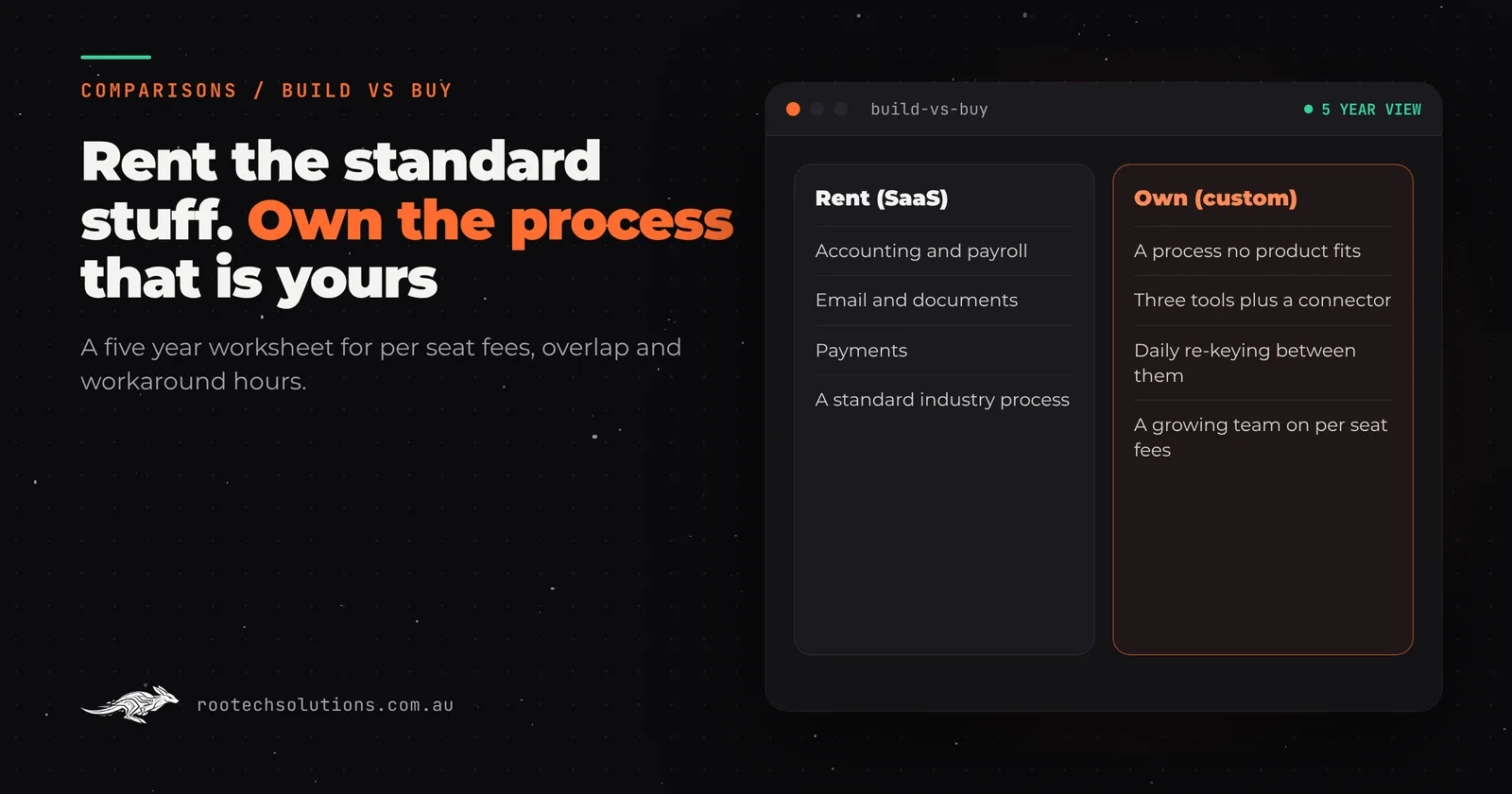
Every month the card statement has another software line on it: the job tool, the CRM, the forms app, the scheduling add-on, and the integration service that glues them together. Each one was cheap when you signed up. Now the team has grown, every tool charges per seat, and you are paying for three products that each do a quarter of what you need.
Short answer: Custom software is cheaper than SaaS when you are paying several per-seat subscriptions to cover one process that no single product fits, and your team is growing. SaaS is cheaper, and better, for anything standard: accounting, payroll, email and file storage. Compare five years of subscription fees and workaround hours against a fixed build price plus running costs, using your own numbers.
What are you really paying for with subscription software?
You pay for three things, and the monthly fee is only the first.
- The seats. Most business software charges per user per month, and the price tier often jumps when you need one more feature. Growth costs you twice: more seats, and a higher tier.
- The overlap. When no product fits your process, you end up with two or three that each cover part of it, and you pay for the parts that overlap.
- The workarounds. The time your team spends copying data between tools, fixing mismatched records and running the spreadsheet that sits in the middle of it all. This is usually the biggest cost and the one nobody puts on the budget.
None of that makes SaaS a bad deal. For a standard process, someone else carrying the product, the updates and the security is excellent value. The question is whether your process is standard.
When should a Sydney business always rent?
Rent anything where your business works the same way as everyone else's. Building it yourself would cost more and do less.
That list is longer than most software agencies admit:
- Accounting and payroll. Xero, MYOB and their peers keep up with tax and payroll rules so you do not have to. Never rebuild these. Connect to them instead.
- Email, calendars and documents. Google Workspace or Microsoft 365. Nobody needs a custom inbox.
- Payments. Stripe, Square and the banks' own tools carry the card security obligations for you.
- A standard process in a standard industry. If your trade has well-known job management or practice software and your process matches it, use it. Our comparisons of Buildxact and custom AI for builders and salon booking software versus AI both end with "keep the software" for a lot of businesses.
When does custom software cost less than subscriptions?
Custom software tends to win when three things line up: the process is specific to you, it is spread across several paid tools, and the team using it is growing.
Signs you are there:
- You pay for three or more tools to run one process, plus a connector service to keep them in sync.
- Someone spends part of every day moving data between them, or maintaining a spreadsheet in the middle.
- You are on a higher tier for one feature, and paying it on every seat.
- Your best ideas for improving the business are blocked by "the software does not do that".
When those line up, a custom system built around your process replaces the overlap, removes the workaround hours and has no per-seat fee. You still pay to run it, but the running costs are small: hosting is usually under $50 a month, and AI usage, if the system uses AI, typically $20 to $200 a month depending on volume.
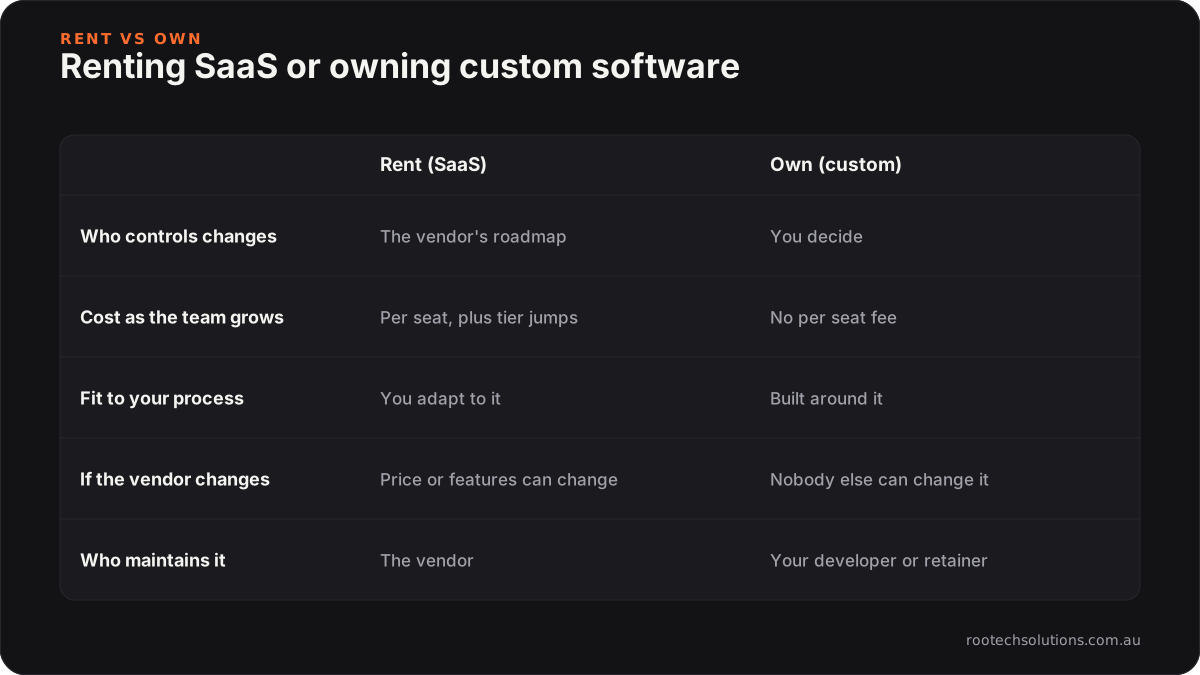
Caption: renting wins on standard processes; owning wins when the process is yours and the team keeps growing.
How do you compare five years of SaaS with a custom build?
Use five years, because a build is a long-term decision and one or two years flatters renting, and compare like with like. Fill in the "Yours" column with your own numbers; the build line is your fixed quote.
| Line | How to work it out | Yours |
|---|---|---|
| Subscriptions to be replaced | Monthly fee per seat x seats x 60 months, for each tool | |
| Expected growth | Extra seats you expect to add, and any tier jumps, over five years | |
| Connector and add-on fees | Integration services, extra modules, storage | |
| Workaround hours | Hours a week spent re-keying or reconciling x hourly cost x 52 x 5 | |
| Total cost of renting | Sum of the lines above | |
| Custom build | Your fixed quote | |
| Running costs | Hosting and any AI usage x 60 months | |
| Optional support retainer | Monthly retainer x 60, if you want one | |
| Subscriptions you keep | Xero, email and anything else that stays | |
| Total cost of owning | Sum of the lines above |
Two rules make this honest. First, only count subscriptions the new system would actually replace: you keep paying for your accounting software either way. Second, count the workaround hours at what that person costs you, not at zero. If the "owning" total is not clearly lower, or the difference only shows up in year five, renting is the right answer for now.
What do you give up when you stop renting?
You give up someone else doing the product work. With SaaS, the vendor ships new features, fixes bugs and handles security. With custom software, those are your decisions.
That cuts both ways. Nobody can raise your price, remove a feature you rely on or shut the product down. But nobody adds features you did not ask for either, so the system improves when you decide it should. In practice that means:
- Bug fixes on anything Rootech built are included after launch.
- Updates and improvements are covered by an optional monthly retainer you can cancel any time, or by any developer you choose, because you own the code.
- Security and backups are part of the build, not an extra.
If the idea of owning software makes you nervous, start with the part that hurts most. A lot of businesses keep their main platform and replace only the tangle of add-ons around it with one small custom piece.
Is there a middle ground between SaaS and fully custom?
Yes, and for many Sydney businesses it is the best answer: keep the subscriptions that do their job and build a custom layer that connects them and does the bit they cannot.
Examples of that middle ground:
- A custom quoting or intake tool that writes straight into the job software you already use.
- An automation that reads supplier invoices and enters them into Xero, as in our post on bookkeepers who stopped re-keying invoices.
- A single dashboard over three tools, so the team stops logging in to all of them.
This costs less than replacing everything, keeps the parts that work, and often removes most of the workaround hours on its own.
Frequently asked questions
Is custom software always more expensive up front?
Yes. A custom build has a real up-front cost where SaaS has none. The comparison only makes sense over several years, once you include seats, growth, overlapping tools and the hours your team spends on workarounds.
What if the company that built our custom software disappears?
That is why ownership matters. If the code, hosting accounts and data are in your name and you received a proper handover, any competent developer can pick it up. Check those three things before you sign with anyone.
Should we replace Xero or MYOB with custom software?
No. Accounting and payroll software tracks tax and payroll rules that change, and that is exactly the kind of work worth renting. Custom software should connect to your accounting system, not replace it.
How long does a custom replacement take?
Most Rootech builds ship in two to four weeks, at a fixed price agreed before work starts. Bigger platforms get a fixed timeline up front, and the old tools stay running until the new system is trusted.
If your software bill keeps growing and your team still works around it, book a free call. We will go through what you pay for, tell you plainly which subscriptions to keep, and give you a fixed price for anything worth replacing. Rootech is a Melbourne studio working Australia-wide, remotely for Sydney businesses; see custom software development in Sydney for how that works.