Salon Rebooking Automation: Stop Losing Regulars
Salon rebooking automation sends each client a personal nudge when their service is due and books the reply straight into your diary. Here's how it works.
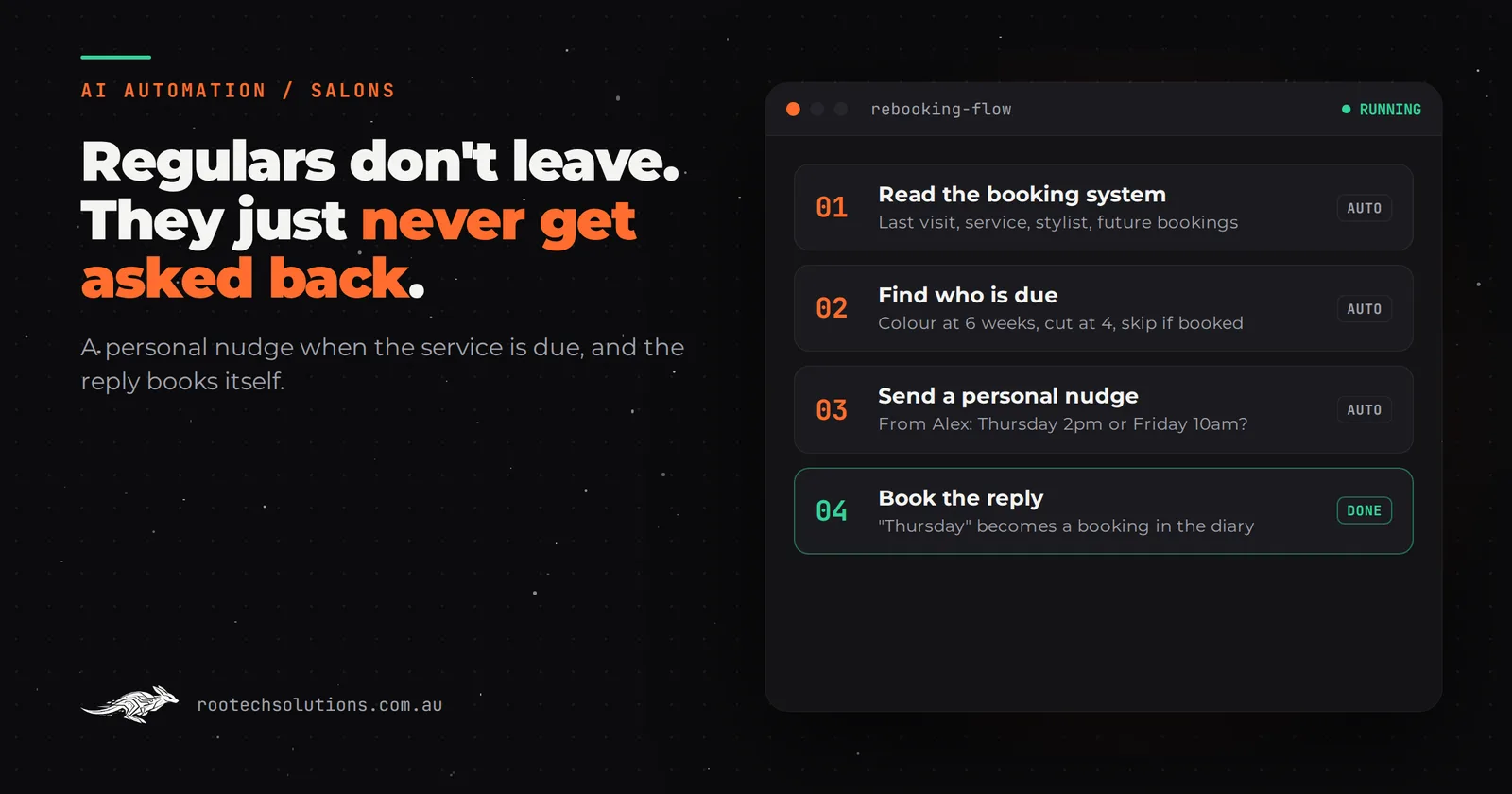
Most hair and beauty salons don't lose regulars to bad haircuts. They lose them to silence. A client leaves happy, says "I'll book in a few weeks", and eight weeks later she's sitting in a salon closer to her work because nobody got in touch first. Salon rebooking automation is the boring, reliable fix: every client gets a timely, personal nudge, and a reply books itself.
Short answer: Salons lose regulars when rebooking depends on someone remembering to follow up. Rebooking automation connects to your booking system, works out when each client's service is due (colour, cut, extensions), sends a personal message from their stylist at the right moment, and books the reply into a real slot. Your booking software keeps running; the automation fills the follow-up gap it leaves.
Why do regulars stop rebooking?
Because the next appointment was never made, and nobody noticed. The best rebooking moment is at the counter, card in hand, but plenty of clients aren't sure of their schedule and say they'll book later. After that, rebooking relies on a busy front desk remembering, and the front desk is dealing with whoever is standing in front of it.
Here's how it usually plays out:
- The client doesn't pre-book because her roster isn't out yet.
- Her stylist means to text her, but the next client is already in the chair.
- Six weeks pass. The regrowth shows. Nobody has been in touch.
- An Instagram ad for another salon appears at the right moment, and she books on impulse.
No complaint, no bad review. Just a regular who drifted. That's why it's worth fixing first: it's the quietest leak in the business, and the one you can measure most easily.
When should a rebooking reminder go out?
When the service is due, not on a fixed calendar blast. A colour client and a fringe-trim client run on completely different clocks, so the nudge should be timed by service and, ideally, by the client's own history.
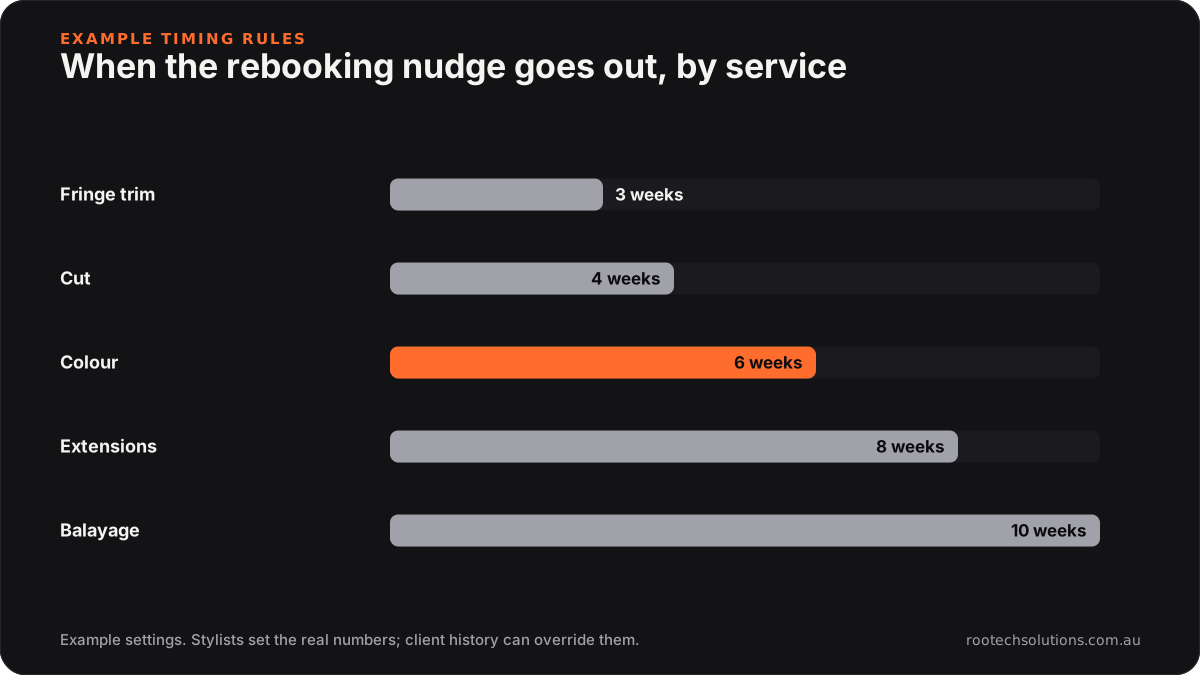
Caption: Example settings only. Your stylists set the real numbers, and a client's own history can override them.
Those numbers are a starting point, not a rule. Good rebooking automation also learns from each client: if Sarah has come in every five weeks for two years, she gets her nudge at five weeks, not six. A client who already has a future booking gets nothing at all, which matters more than it sounds: nothing annoys a regular like a "time to book!" text when she's booked.
What does salon rebooking automation actually do?
It reads your booking data, decides who is due, writes to them in your salon's voice, and handles the reply. The flow looks like this:
- Reads your booking system. Last visit, service, stylist and any future bookings, from the platform you already use.
- Works out who is due. Service timing rules plus the client's own pattern, skipping anyone already booked.
- Sends a personal nudge. "Hi Sarah, it's about six weeks since your balayage with Alex. She has Thursday 2pm or Friday 10am free. Want one?"
- Books the reply. Sarah texts "Thursday" and the booking lands in the diary against Alex, with a confirmation back to Sarah.
- Follows up once, then stops. One gentle second nudge if there's no reply, then the client is flagged for the stylist to call personally if she's a valued regular.
Two add-ons are worth having once that's running. A cancellation fill: when someone cancels tomorrow's 11am, the automation offers it to clients who are due and have said they're flexible. And after-hours enquiries: the Instagram DM at 9pm asking about a wedding trial gets an answer and a booking offer instead of sitting unread until morning. We cover the after-hours side for salons in more detail in where Melbourne salons should start with AI.
Doesn't my booking software already do this?
Partly, and you should check before paying anyone. Salon platforms such as Fresha, Timely, Phorest, Kitomba and Shortcuts handle online booking and appointment reminders well, and many include marketing tools of some kind. If yours already sends a decent "you're due" message and you're happy with it, switch it on and use it.
| What you need | Usually covered by your booking platform | Where a custom AI layer helps |
|---|---|---|
| Appointment reminders for booked clients | Yes | Not needed |
| A generic "time to rebook" campaign | Often, depending on plan | Not needed |
| Timing per service and per client history | Sometimes limited | Rules you set, per stylist and per client |
| A two-way conversation that books a real slot | Usually a link to the booking page | Replies in plain text and books the slot |
| Messages in each stylist's voice | Template-based | Written per client, approved tone |
| Instagram and Facebook DMs after hours | Varies | Answered from your price list and policies |
The custom piece earns its keep in the two-way conversation. A link to an online booking page is fine for a client who's ready; it loses the client who replies "can Alex do anything after 5 next week?" A custom layer reads that, finds the slot and books it. We go through the full trade-off in salon booking software versus custom AI.
What is a regular actually worth to your salon?
More than one visit, which is why losing them quietly hurts. A worked example, with round numbers to replace with your own: 200 active regulars, each visiting four times a year at about $120 a visit, is roughly $96,000 a year in repeat revenue. If better follow-up keeps 8% more of that revenue in the salon, that's about $7,680 a year, before counting the retail products and add-on services those clients buy.
These numbers are illustrative, not research. Your own figure is easy to find: pull a list of clients who visited regularly last year and haven't been back in three months. That list is the leak.
What does it take to build and run?
A rebooking automation for a single salon is usually a fixed-price build of roughly $3,000 to $7,000, depending on your booking platform and how many add-ons you want. These are estimates. Running costs are modest, typically $50 to $150 a month for a small salon, covering hosting, AI usage and SMS charges, which vary with how many messages go out.
A typical build runs three to four weeks:
- Week one: connect to your booking platform and read the visit history. No switching tools.
- Week two: set the timing rules with your stylists, per service and per stylist.
- Week three: write the messages in your salon's voice and build the reply handling, so "Thursday arvo?" becomes a booking.
- Week four: test with real clients on a small list, adjust the tone, then go live.
Where people stay in charge: stylists approve the message tone before anything goes out, consultations for big colour changes always go to a stylist, and any complaint or sensitive reply (a skin reaction, an unhappy client) is passed straight to a person with the conversation attached. The automation does the admin. The relationship stays with your team.
Frequently asked questions
Will clients find automated rebooking messages pushy?
Not if they're timed by service, sent once with one follow-up, and never sent to someone who's already booked. The messages that annoy people are generic blasts. A note that names their stylist and their service at the right time reads like good service, and every message should make it easy to opt out.
Do I need to change booking systems?
No. The automation sits on top of the platform you already use and reads and writes bookings through it. If your platform can't be connected, you'll find out in the audit, before any build starts.
What should a salon automate first?
Rebooking reminders, because they target your existing clients and the result is easy to measure. Once those run smoothly, add after-hours enquiry handling and then cancellation fills. Starting with all three at once makes it harder to tell what's working.
Can it handle clients who see more than one stylist?
Yes. The rules can follow the client's most recent stylist, their usual stylist, or offer whoever is free, and you choose which. Clients who see one stylist for colour and another for cuts can get separate nudges for each service.
See where your regulars are slipping
We build custom software and AI integrations for Melbourne businesses, and salon rebooking is one of the most reliable first projects we see. Book a free AI workflow audit and we'll look at your booking data, show you how many regulars have drifted, and tell you whether your current platform can fix it before you pay for anything. The audit fee comes off your first project if you go ahead.