How Melbourne Dental Practices Get Found in AI Search
AI search for dental practices runs into Ahpra's testimonial rules. How Melbourne dentists get found and cited with fees, funds and facts, not reviews.
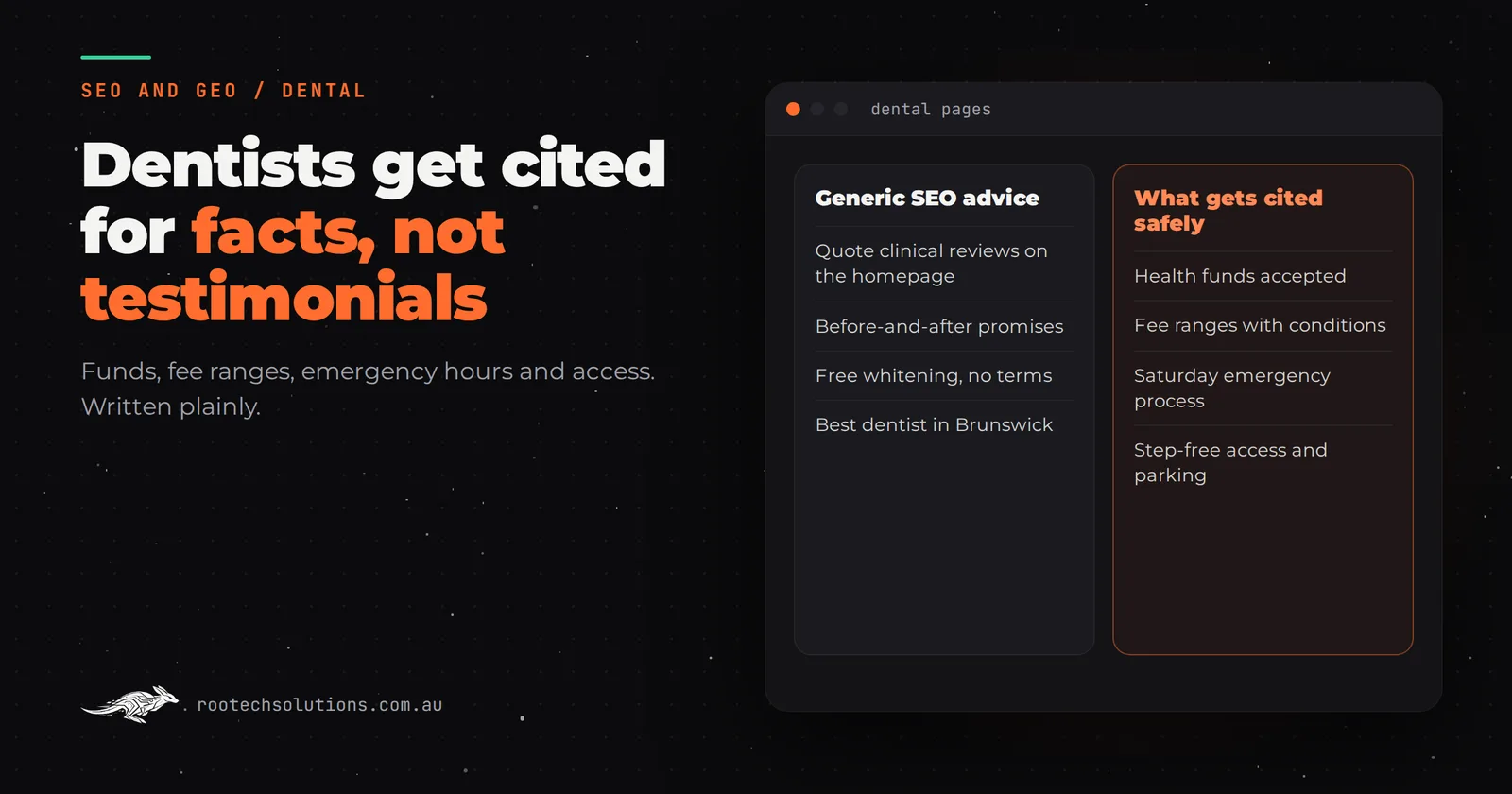
Most local search advice says the same thing: collect glowing reviews that mention the treatment, put them on your website and quote them everywhere. For a dental practice, that advice can put you in breach of the National Law. Dentists have to get found in Google and in AI answers with a narrower toolkit than a plumber or a café, and the practices that do it well lean on facts patients are actually searching for.
Short answer: AI search for dental practices is won with facts, not testimonials. Ahpra's advertising rules stop a practice using testimonials about clinical care on its website, profile or social accounts, so a Melbourne dentist gets cited by publishing what patients search for: treatments offered, fees as ranges, health funds accepted, emergency availability, after-hours options and accessibility, written as plain, current text.
Why is search different for a dental practice?
Because dental advertising is regulated, and your website, Google Business Profile and social accounts count as advertising. Under the National Law, advertising a regulated health service must not be false or misleading, must not offer a gift or discount without stating its terms, must not use testimonials, must not create an unreasonable expectation of beneficial treatment, and must not encourage unnecessary use of the service. Ahpra publishes a testimonial tool that walks through what counts.
The practical effect on search is large. Generic local SEO advice relies on reviews as content. For a dental practice:
- Reviews about clinical care cannot be used in your advertising. Copying a Google review that says "my root canal was painless" onto your homepage is using a testimonial.
- Reviews on sites you do not control are a different matter. Professional guidance, such as the ADA NSW information sheet on online reviews, notes you are not expected to remove reviews on third-party sites like Google that you cannot control.
- Replying can create a problem. The same guidance warns that responding to a review online may itself amount to a testimonial, particularly if it is about clinical treatment. A short, non-clinical thank you is the cautious approach.
This is general information, not legal advice. If you are unsure about a specific page, use Ahpra's tools or ask your indemnity insurer.
What do patients actually search for when choosing a dentist?
Patients search by constraint more than by reputation: whether you take their fund, whether you can see them today, what a treatment roughly costs, and whether the practice suits a child, an anxious adult or someone in a wheelchair. Those are facts, and facts are exactly what an answer engine can repeat safely.
| What the patient asks | What your page should state |
|---|---|
| "Dentist near me that takes Bupa" | Which health funds you accept, whether you are a preferred provider for any, and whether you offer on-the-spot claiming (HICAPS) |
| "Emergency dentist open Saturday" | Your actual emergency process, Saturday hours, and what to do after hours |
| "How much is a check-up and clean?" | Fee ranges for common items, with the conditions that change them |
| "Invisalign consultation cost Melbourne" | Whether you offer it, consult fee, and what happens at the first appointment |
| "Dentist for kids" | Whether you see children, from what age, and how the first visit works |
| "Wheelchair accessible dentist" | Step-free access, parking, nearest public transport |
Every one of those can be answered without a single testimonial, and every one is something most practice websites leave out or bury in a PDF.
How should a dental practice set up its Google Business Profile?
Treat the profile as a fact sheet. Set the primary category to the one that matches most of your work, add secondary categories only for services you genuinely provide, list your treatments in the services section, keep hours current including public holidays, and add accessibility attributes. Use your real practice name, without "Best" or a suburb tacked on.
What to skip: posting patient stories, before-and-after photos that imply a guaranteed result, and offers like "free whitening with every new patient check-up" unless the terms are stated in full. Those are the parts of a profile where the advertising rules bite.
Google's own help says local ranking comes down to relevance, distance and how well known the business is. A complete, accurate profile is the part of relevance you control.
How do you write treatment pages that answer engines can cite?
Write one page per treatment you actually want to grow, and open it with a direct, factual answer. A good opening sentence reads: "We provide Invisalign clear aligners at our Brunswick practice; a first consultation includes a scan and a written treatment plan with fees." That sentence names the treatment, the place and what happens, and it promises nothing about outcomes.
Then cover what a patient weighs up: the fee range and what changes it, how many appointments it usually takes, which health funds may contribute, who in the practice does it, and the risks and alternatives in plain language. Including risks is not just good ethics; it is the kind of balanced, specific content that both readers and answer engines trust.
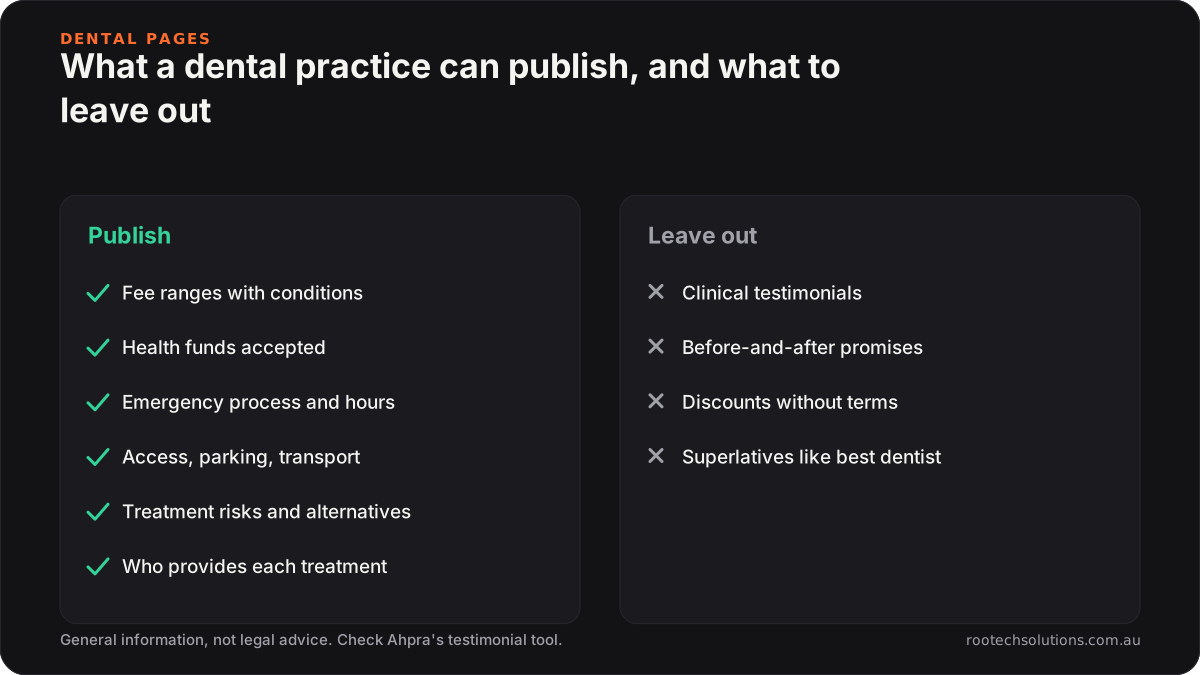
Caption: Everything in the left column is a fact a patient searches for; everything in the right is a compliance risk.
Does structured data matter in AI search for dental practices?
It helps Google read your basic details, and it does not need to be anything special. Schema.org has a specific Dentist type, and Google's AI features guidance is clear that there is no special markup required to appear in AI Overviews or AI Mode. Mark up your name, address, phone, hours and geo-coordinates, and keep them identical to your profile.
Two old tactics to drop. Google no longer shows FAQ rich results in search, so FAQ markup will not add expandable answers under your listing. And star ratings pulled from reviews on your own site are not eligible for review snippets, which, for a dental practice, is a mercy, because displaying them would have raised testimonial questions anyway.
Is practice software enough, or does a dental clinic need custom software?
For most practices, the practice management system and its booking add-ons cover the basics. Dental4Windows, Praktika, Core Practice and similar systems hold the appointment book, and online booking services such as HotDoc and HealthEngine let patients book from your site or a directory. If your gaps are only "we need online booking", start there.
Custom software or an AI integration earns its keep in the gaps those tools leave:
- An AI assistant on your website that answers fund, fee-range, parking and emergency questions from your approved information, at 9pm, and never comments on clinical outcomes.
- Emergency triage that hands off to a person, collecting symptoms and contact details, flagging urgent cases to the on-call dentist, and telling the patient what to do in the meantime from a script you approved.
- Fee and fund pages generated from your own fee schedule, so the ranges on your site update when your fees do, instead of drifting out of date.
We go through the operational side in how Melbourne dental practices start with AI automation and the costs in what AI automation costs a Melbourne dental practice.
What does an AI assistant for a dental practice involve?
Most builds take two to four weeks at a fixed price. As estimates:
- Build: a website assistant with booking handoff typically lands between $3,000 and $7,000, depending on whether it reads live availability from your practice software or hands bookings to reception.
- Running costs: hosting usually under $50 a month, plus AI usage of roughly $20 to $200 a month depending on volume.
- Guardrails written first: no clinical advice, no outcome promises, no testimonials, no discounts without terms. These are tested against real patient questions before launch.
- Human in the loop: anything clinical, any complaint and any emergency goes to a person, with the conversation attached.
Frequently asked questions
Can a dental practice ask patients for Google reviews?
Asking is not the problem; using clinical reviews in your own advertising is. Patients may leave reviews on Google, which you do not control, but copying clinical comments onto your site or social posts can breach the testimonial rules. Check Ahpra's testimonial tool before you run any review campaign.
Should dentists publish fees on their website?
Publishing fee ranges for common items, with the factors that change them, is helpful and is what patients search for. Make sure each range is accurate and current, because an out-of-date fee can be misleading. A single "from" price with no context is less useful than a range.
Does an AI chatbot count as advertising for a dental practice?
Treat it as if it does, because it speaks for the practice in public. It should answer only from approved information, avoid clinical claims and outcome promises, and never quote patient feedback. Write those guardrails before the build, not after.
Do suburb pages work for dental practices?
A page for the suburb you are actually in, with parking, transport and access details, is useful. Pages for ten surrounding suburbs with swapped names are thin content. If patients travel from a particular area, say so on your main location page instead.
Want patients to find the facts before they phone?
We build AI assistants and custom tools for dental practices with the compliance guardrails written in, connected to the practice software you already run. If your current booking tools already cover your gaps, we will tell you. Book a free AI workflow audit and we will look at the questions your front desk answers most. The audit fee comes off your first project.