AI Quoting Tool for Painters: Stop Losing Jobs On Site
An AI quoting tool for painters answers enquiries while you're up a ladder, collects photos and room counts, and sends an indicative range from your rates.
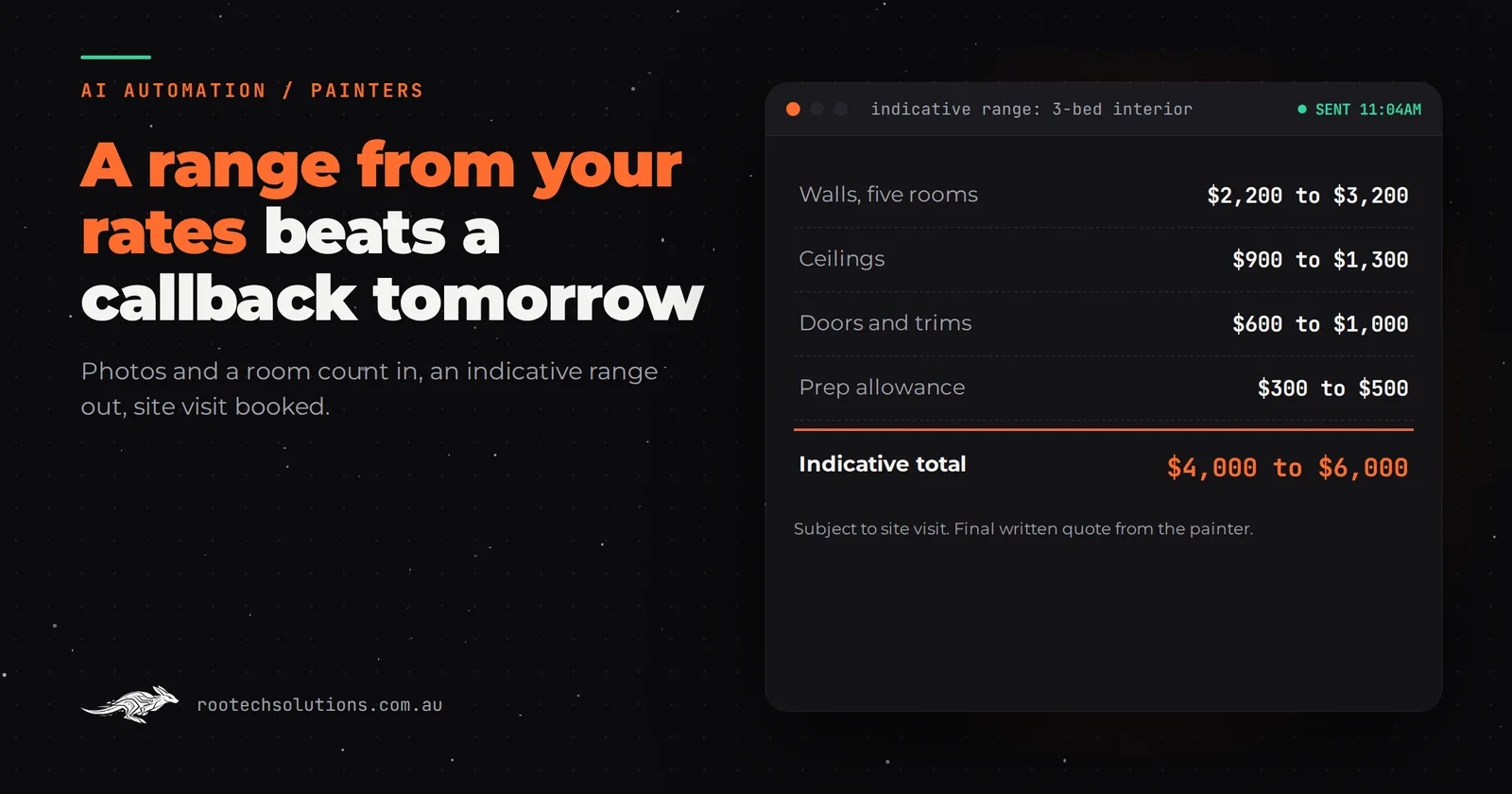
Most painters don't lose quote jobs to a better painter. They lose them to a faster one. A homeowner in Preston fills in your enquiry form at 11am, you're mid-coat on a ceiling in Footscray, and by the time you ring back at 7pm she's had two other painters reply. An AI quoting tool catches that enquiry the moment it lands, gathers what you need to price it, and gives the homeowner a sensible range while you keep painting.
Short answer: An AI quoting tool for painters replies to every enquiry within minutes, asks the questions you would (rooms, surfaces, condition, photos, age of the house), and sends an indicative price range calculated from your own rates, clearly marked as subject to a site visit. Simple repaints get a range and a booked visit the same day. Complex jobs come to you with photos attached. You still set the final price.
Why are painting enquiries easy to lose?
Because they're small, frequent and shopped around. A homeowner wanting a three-bedroom interior repaint often contacts several painters at once and goes with whoever gives them something concrete first. Unlike a big renovation, there's little reason for them to wait a week for one particular painter's quote.
The manual workflow makes the delay almost automatic:
- An enquiry arrives at 11am asking about an interior repaint.
- You see it at 7pm after packing up.
- You reply asking for photos or a time to look. She can't answer until tomorrow.
- By tomorrow she has two quotes, one with a price range already in it.
- You never hear back.
The work itself isn't the problem. The gap between "enquiry received" and "something useful in the homeowner's hands" is. We dig into that gap across trades in why slow follow-up loses leads.
Can a painter give a price without a site visit?
An indicative range, yes; a final price, no. Painting is one of the few trades where a homeowner's photos and a room count tell you most of what you need to know about a standard repaint. What you can't see in a photo, such as hidden damage, how far the old paint is failing, or what's under it, is exactly why the range stays a range until you've looked.
A good AI quoting tool builds the range from your rates, not from an internet average. A worked example, for a three-bedroom interior repaint, with numbers you'd replace with your own:
| Part of the job | How the AI prices it | Example range |
|---|---|---|
| Walls, five rooms | Your rate per room size, from the room list and photos | $2,200 to $3,200 |
| Ceilings | Your ceiling rate, adjusted for height if raked | $900 to $1,300 |
| Doors and trims | Count of doors and windows, your rate each | $600 to $1,000 |
| Prep allowance | Based on the condition the homeowner describes | $300 to $500 |
| Indicative total | Sent with "subject to site visit" | $4,000 to $6,000 |
That range does two jobs. It tells the homeowner you're a real option at a sensible price, and it filters out the people whose budget is a third of what the job costs, before you've driven to Preston.
What should the AI ask before you quote?
The same things you'd ask on the phone, in the order you'd ask them, by text or web chat. The conversation is short, and the homeowner answers at their own pace.
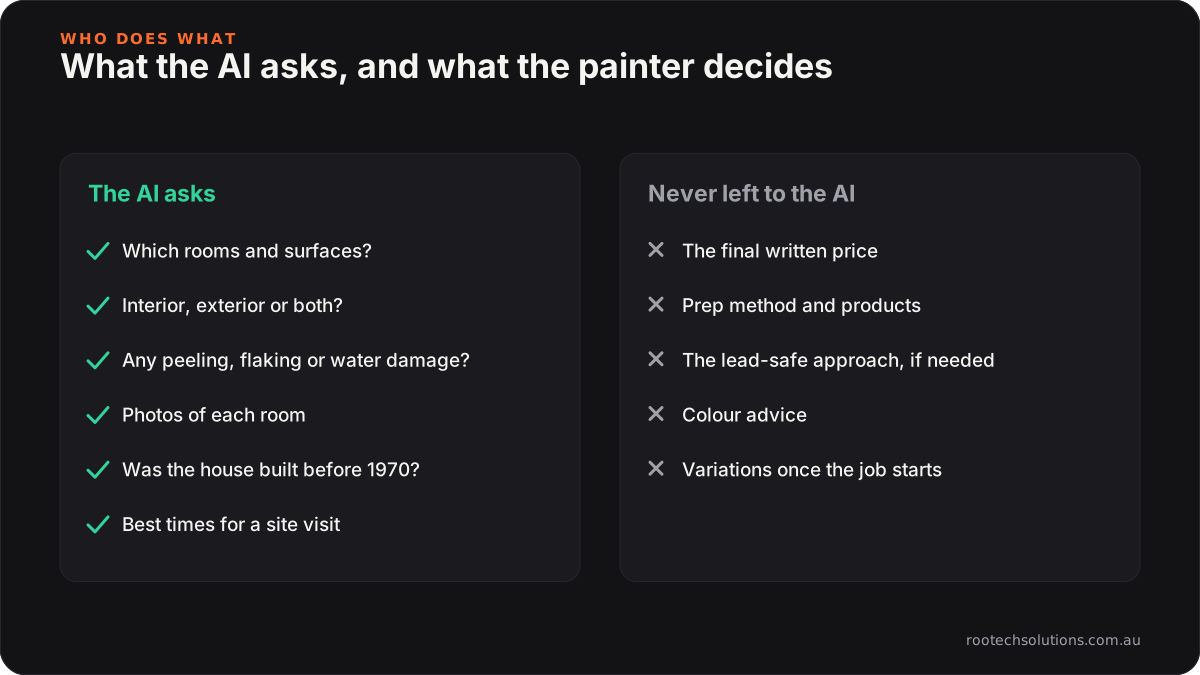
Caption: The AI gathers what you'd ask anyway. Everything that needs your eyes on the wall stays yours.
The age question matters more than it looks. Before 1970, paints containing high levels of lead were used in many Australian houses, and preparing old paint the wrong way creates a real hazard. Knowing the house is a 1950s weatherboard before you arrive changes your prep method, your quote and your safety gear. The AI doesn't advise on lead. It simply makes sure the question is asked every time, and flags those jobs for you.
Is painter quoting software enough, or do you need custom AI?
For the paperwork, quoting software is enough. Tradify, ServiceM8 and Fergus are widely used by Australian trades to build quotes, schedule jobs and invoice, and they do it well. If your problem is that quotes take too long to type up or look rough, start there and check their current pricing.
What job management software doesn't do is have the conversation. It waits for you to enter a job. A custom AI layer sits in front of it: answering the website form, Google Business Profile messages and missed calls, asking the questions, pricing a range from your rates, booking the site visit and then creating the lead or draft quote in the software you already use. One is the filing cabinet, the other is the front counter.
Painting also has a quirk worth knowing. In Victoria, a painting-only job doesn't require a major domestic building contract the way a $10,000-plus renovation does, though Consumer Affairs Victoria still recommends a written contract for all building work. That makes it even more important that your written quote, not the AI's indicative range, is what the homeowner agrees to. The AI always says "subject to site visit", and the binding price comes from you.
What does an AI quoting tool for painters cost?
For most painting businesses, a fixed-price build lands roughly between $2,500 and $6,000, with running costs of about $150 to $400 a month depending on enquiry volume and which tools are connected. These are estimates, not quotes, and we break them down in detail in what AI automation costs a Melbourne painter.
The payoff is easiest to see in jobs, not hours. A worked example: if faster, after-hours replies win you one extra interior repaint a month at $4,000 to $6,000, that's $48,000 to $72,000 of work a year against a few hundred dollars a month in running costs. Your own numbers will differ, so test it against your last three months of enquiries rather than taking ours.
The build usually takes two to three weeks:
- Your rates. We turn your pricing (per room, per square metre, per door, prep levels) into the rules the AI uses for ranges.
- Your channels. Website form, Google Business Profile messages and a missed-call text-back feed one conversation.
- Your calendar and software. Site visits book into your calendar; leads and draft quotes go into Tradify, ServiceM8, Fergus or whatever you use, where it has an API.
- Testing on real enquiries. We replay your past enquiries through it and compare its ranges with what you actually quoted, before it talks to a customer.
What stays with the painter?
The judgement. The AI doesn't set the final price, choose products, decide on prep, give colour advice or handle variations once the job's underway. Anything outside your normal work (heritage, strata, commercial, insurance jobs) goes straight to you with the photos attached.
A useful test for any task: if it's repetitive and follows a pattern, it's a candidate for automation. If it needs your eyes on the wall, it stays yours. We take on the common worries painters raise about this in AI myths for Melbourne painters.
Frequently asked questions
Won't customers hold me to the AI's price range?
Not if it's built properly. Every range is labelled as indicative and subject to a site visit, and your written quote is the price they agree to. If the site visit turns up rot or failing paint the photos didn't show, the range was never a promise.
What if the homeowner doesn't send photos?
The AI asks once more and explains why photos help, then works with what it has. Without photos it gives a wider range or skips the range and goes straight to booking a site visit. You'll see in the summary which jobs came with photos.
Does it work for exterior and commercial painting?
Exterior residential jobs work well with good photos and a height question. Commercial and strata work usually has specifications, tenders or access rules that need a person, so the AI captures the details and hands it to you rather than ranging it.
I'm a one-person painting business. Is this overkill?
Usually not, because you're the one who can't answer while painting. If you get a handful of enquiries a week and lose some to slow replies, an AI quoting tool pays for itself quickly. If you're booked out months ahead from referrals, you probably don't need it yet.
See what your enquiries are worth
We're a Melbourne studio building custom software and AI integrations for trades and service businesses. Book a free AI workflow audit and we'll map your enquiry-to-quote process, show you where jobs leak, and tell you what a quoting tool built on your rates would cost. The audit fee comes off your first project if you go ahead.