Who Owns the Code When You Pay a Developer?
Who owns the code when you pay a developer or agency in Australia: what copyright says, the lock-in traps, and an eight-point ownership checklist.
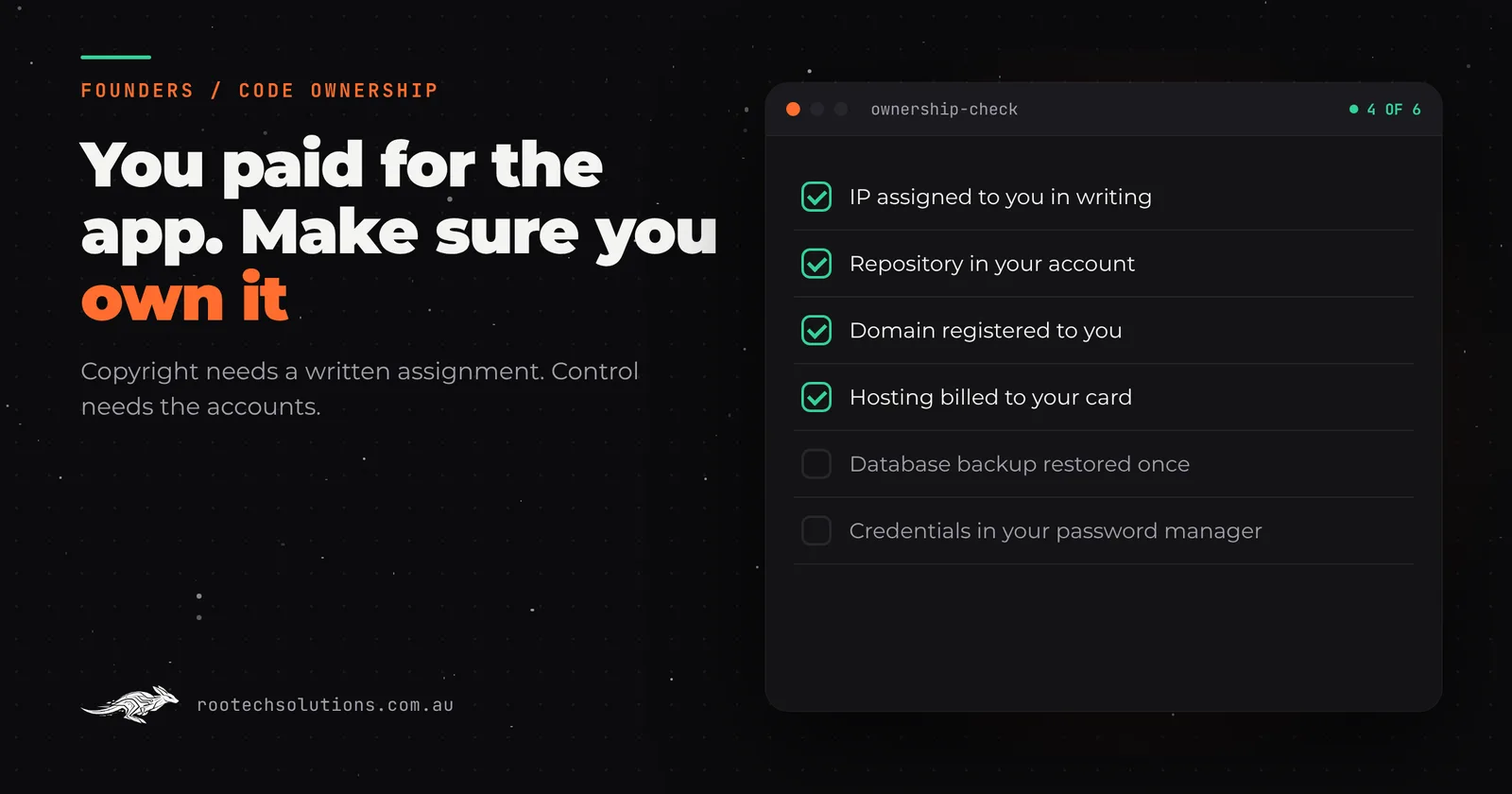
You paid for the app. You assume you own it. Then the developer goes quiet, or the agency doubles its monthly fee, and you discover the code sits in their account, the domain is in their name and the database password is in someone else's head.
Short answer: Paying for software does not automatically mean you own the code. In Australia, a contractor or agency who writes code generally owns the copyright unless the contract assigns it to you in writing. Owning it in practice also means the repository, domain, hosting accounts, data and credentials are in your name. Check all of them before you pay the final invoice.
Does paying a developer mean you own the code?
Not by default. Australian copyright law treats code as a written work, and the person who writes it generally owns it unless they are your employee or they assign it to you.
The Law Handbook published by the Legal Services Commission of South Australia sets out the general rule: for most commissioned work, the author owns the copyright, work made in the course of employment belongs to the employer, and copyright can be assigned in writing. A freelancer or agency is not your employee, so the contract is what decides who owns the code.
What that means in practice:
- No written assignment, no automatic ownership. You may have a right to use what you paid for, but that is not the same as owning it, and it can get murky the moment you want someone else to change it.
- Read the IP clause before you sign. Look for words that assign the intellectual property in the work to you, on payment. Watch for "licence" instead of "assignment": a licence lets you use something the developer still owns.
- Ask about their own building blocks. Most agencies reuse their own libraries and templates. That is fine, as long as the contract gives you a permanent licence to use them with your app.
This is general information, not legal advice. If the contract is large or unusual, have a lawyer read the IP clause; it is the cheapest legal review you will ever pay for.
Why is owning the copyright not enough?
Because copyright is a right on paper, and lock-in happens in accounts. You can own every line of code and still be stuck if you cannot get to it.
The usual traps are not malicious. A developer sets up the hosting under their own account because it is quicker. The domain gets registered on their card. The database lives in their cloud project. Then, a year later, you want to change developers and find that every piece of your product needs their cooperation to move.
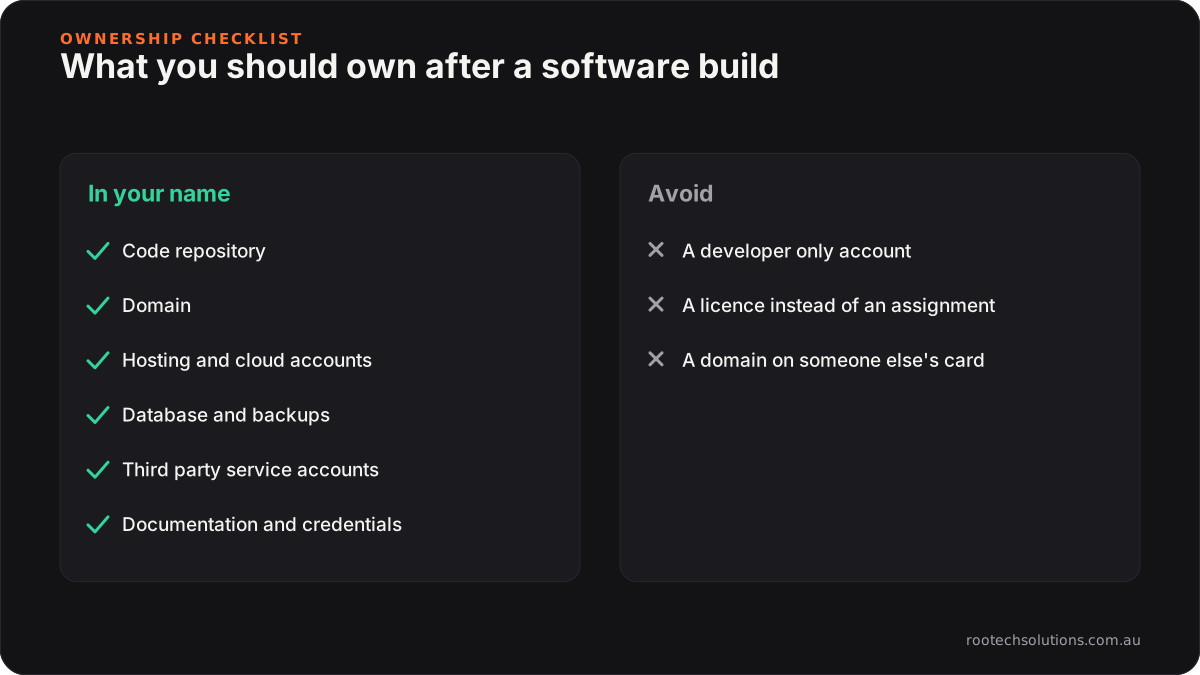
Caption: ownership is a contract clause plus a set of accounts in your name; check both.
The eight-point ownership checklist
Run this before you pay the final invoice, and again any time you change developers. Each point is a yes or no.
- The contract assigns the IP in the work to you on payment, in writing, and gives you a permanent licence to any of the developer's own reusable code inside it.
- The code repository is in your account. On GitHub, GitLab or similar, owned by your business, with the developer added as a collaborator you can remove.
- The domain is registered to your business, on your account, with your contact details.
- Hosting and cloud accounts are in your name, billed to your card, with the developer invited as a user.
- The database and its backups are yours, and you know how to download a copy. Better still, a backup has been restored once as a test.
- Every third-party service is on your account: payments, email sending, maps, AI services and anything else with an API key (the password a service gives your app).
- You have the documentation: how to run the app, how to deploy a change, and where every setting lives, written for a developer who has never seen it.
- You have every credential, stored in a password manager your business controls, and the developer's access can be removed without anything breaking.
If you can tick all eight, you can hire anyone to work on your software tomorrow. If you cannot, fix the gaps while the relationship is still good; it is much harder after it is not.
What about apps built with Lovable, Bolt or Replit?
AI app builders change the question rather than removing it. The question becomes: is your code in a repository you control, or only inside the builder's platform?
Most of these tools let you connect a GitHub repository or export the code, and it is worth doing early. If your app only exists inside the builder, a pricing change, a terms change or a closed account puts your product at risk. Check each tool's current terms for what they say about ownership and export, because they change.
The database matters just as much. Many AI-built apps run on Supabase or a similar backend that the builder set up for you; make sure that project is on your own account too. If your prototype now has real users, our post on what to do once a vibe-coded app has paying users covers the foundation work, and our vibe-code cleanup page explains how a rescue keeps your users and data.
What questions should you ask a developer before you sign?
Ask these five, and listen for straight answers. A good developer will not mind any of them.
| Question | A good answer |
|---|---|
| Who owns the code when the project is finished? | You do, assigned in the contract, on payment |
| Whose accounts will the code, hosting and domain live in? | Yours, from day one, with us invited in |
| What do we get at handover? | The code, documentation, credentials and a walkthrough |
| What happens if we want another developer to take over? | You remove our access; nothing else changes |
| Is ongoing support optional? | Yes, and you can cancel it |
Hesitation on any of these is worth taking seriously. It does not always mean bad faith, but it does mean you would be dependent on that developer for longer than you planned.
How does Rootech handle ownership?
Every Rootech build works the same way, and it is written into the scope before work starts. You own the code, the domain, the hosting accounts and the data, all in your name. Launch comes with a proper handover: code, documentation, credentials and a walkthrough for your team. Bug fixes on anything we built are included after launch, and ongoing support is optional, month to month, cancel any time.
We take over software other people built, too. Our software maintenance work usually starts with exactly this checklist, because a takeover is the moment the missing accounts and passwords come to light. And because every project is fixed price, as our post on fixed price versus hourly explains, nobody has a reason to keep you dependent.
Frequently asked questions
Does paying the invoice give me ownership of the code?
Not on its own. In Australia the author of commissioned work generally owns the copyright unless it is assigned in writing, so check that your contract assigns the intellectual property to you on payment.
What is the difference between an assignment and a licence?
An assignment transfers ownership to you. A licence gives you permission to use something the developer still owns, usually on conditions. For software you are paying to have built for your business, you want an assignment of the work, plus a licence to any of the developer's reusable code inside it.
My developer set everything up in their own accounts. What do I do?
Ask them, politely and in writing, to transfer the repository, domain, hosting and service accounts to accounts in your name, and to hand over documentation and credentials. Most developers will help while the relationship is good; do it now rather than when you need it.
Do I own an app I built with Lovable or Bolt?
Check the tool's current terms, which change. Either way, connect your app to a GitHub repository on your own account and make sure the database project is yours, so your product does not depend on one platform.
Do you work with founders outside Melbourne?
Yes. Rootech is a Melbourne studio working Australia-wide, including founders in Adelaide; outside Melbourne, discovery and reviews happen over video and the build is in the cloud.
If you are not sure who owns your software, send us what you have. We will run the eight-point check with you and tell you plainly what is missing and how to fix it, whether or not we end up working on it. For founders in South Australia, our page on custom software development in Adelaide covers how we work remotely.