What AI Automation Costs a Newcastle Flooring Business
What does AI automation cost a flooring business? Newcastle build and running costs in AUD, a worked payback on quoting, and when to skip it.
Flooring and tiling businesses quote for a living. Every job starts with a measure, and every measure costs you an hour or two before anyone has agreed to pay you anything. Between the measures, the material orders and the quotes that quietly go cold, the admin eats the margin. That is the gap AI automation for flooring businesses is built to close, and this post works out what it costs and whether it pays back for a Newcastle operator.
Short answer: A typical build for a flooring or tiling business costs $2,500 to $6,000 at a fixed price, then $150 to $400 a month to run. With two dead-end measure visits a week screened out and one extra job won a month through follow-up, a $4,000 build pays back in roughly three to four months. If you are booked solid and quoting only repeat builders, skip it for now.
How money actually works in a flooring business
Flooring installers and tilers earn on the job, but they win or lose the job days earlier, at the quote. Three things decide the margin:
- The measure. A residential flooring or tiling quote almost always needs eyes on the job. Subfloor condition, cuts around fixtures, stair treads, patterns and access all change the price. Unlike a plumber, you cannot reliably quote over the phone, so every enquiry drags a visit with it.
- The follow-up. Homeowners collect two or three quotes and take a week to decide. The installer who follows up politely gets the job; the one who sent the quote and got on with the next measure does not.
- Materials. Tile and flooring orders are placed against your measurements. An error in quantities means a return trip to the supplier, a colour batch that does not match, or stock sitting in your garage paid for out of your pocket.
Because quoting is the expensive part, the return on automation comes from fewer wasted measures, quotes that get chased, and material orders that match the job. Faster replies alone rarely justify the spend.
Where does a flooring quote leak, and what fixes it?
| Stage | What goes wrong | What the automation does |
|---|---|---|
| Enquiry | Arrives after hours, gets a reply next day | Replies in a minute, asks for photos, rough room sizes and timing |
| Before the measure | You drive to Charlestown for a job that was never real | Shares your price range and minimums so poor fits drop out early |
| After the measure | Quote goes out three days later from the ute | Drafts the quote from your site notes and rates the same evening, you approve |
| Quantities | Area miscalculated, wrong order placed | Checks your measurements, applies your wastage percentage, drafts the order list |
| Follow-up | Nobody chases the quote | Reminders on day two, five and ten, stopped the moment they reply |
| A year later | The client re floors and calls whoever they remember | A yearly check-in about wear, refreshes or matching repairs |
Every message comes from your number in your wording, and anything that needs judgement, such as a discount request or a scope change, comes straight to you.
What does AI automation for flooring cost to build?
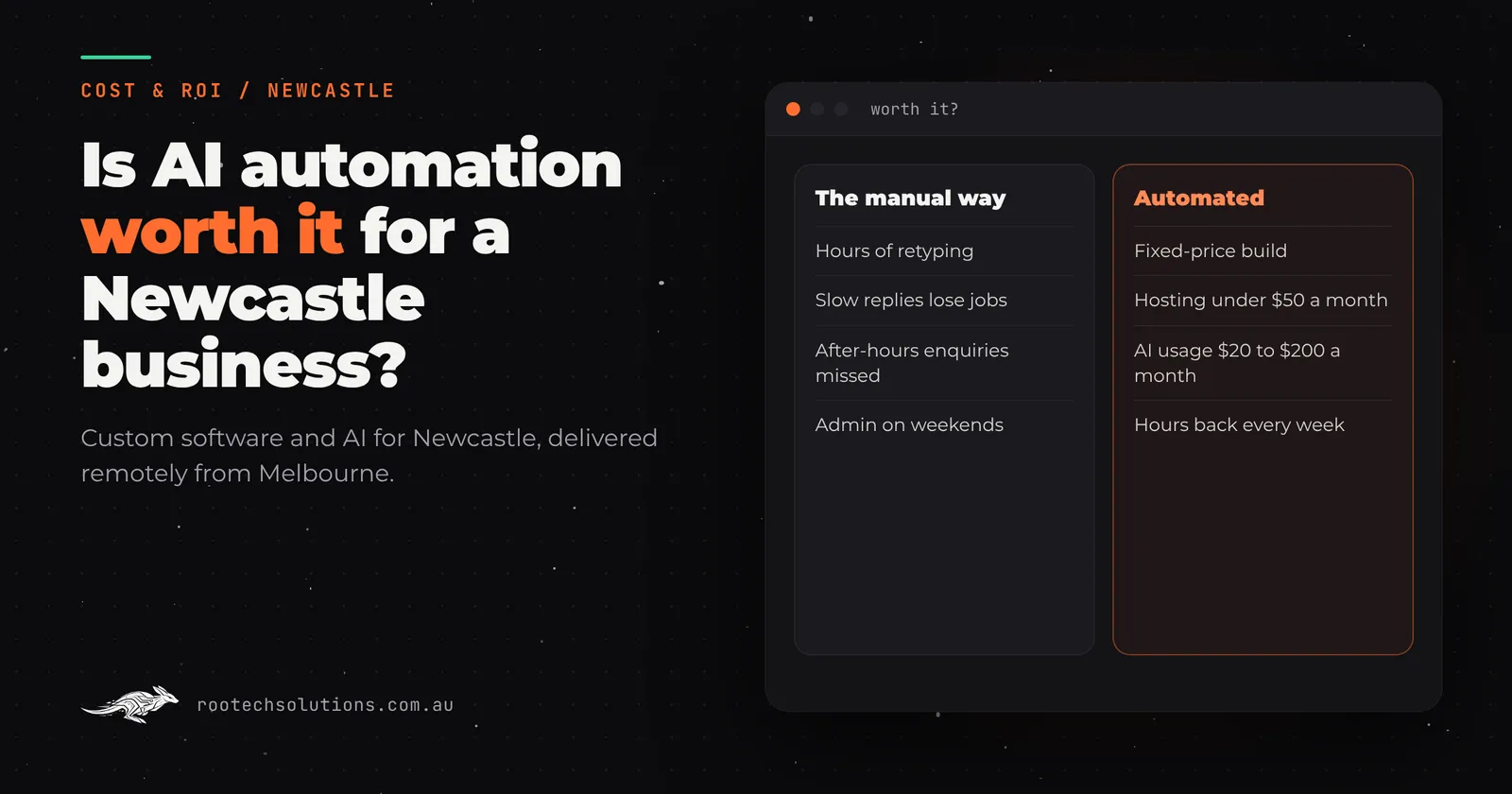
Flooring businesses have no separate published price list from us, so anchor on scope. A quoting and follow-up build for a flooring business is similar in scope to the quote drafting and follow-up build in our painter cost guide, which typically lands at $2,500 to $6,000 to build, then $150 to $400 a month to run. Hosting is usually under $50 of that, and AI usage typically runs $20 to $200 a month depending on volume.
What moves you up the range:
- Enquiry capture and qualifying only (web form, missed-call text-back, after-hours replies, photo collection): the low end.
- Quote drafting and follow-up from your site notes on your rates: mid-range.
- Material ordering and job sync, where the automation drafts supplier order lists from your measured quantities and writes jobs into your job management software or Xero: the upper end.
We quote after scoping, at a fixed price agreed before work starts, so the number you are given is the number you pay.
How do I work out my own payback?
Work on gross margin, not revenue. Every number below is an assumption; replace it with your own from last month's calendar.
A. Wasted measure visits screened out
- Measure visits a week: 6.
- Share that better pre-qualifying would have screened out: 1 in 3, so 2 a week.
- Time per visit including travel: 1.5 hours.
- What an hour of your time is worth on the tools, after costs: $60.
- Value: 2 x 1.5 x $60 = $180 a week, about $780 a month.
B. Jobs won back through follow-up
- One extra job a month at $3,500.
- Gross margin after labour and materials: 35%, so about $1,225 a job.
- Value: about $1,225 a month.
C. The sum
- Monthly gain: $780 + $1,225 = $2,005.
- Less running cost of $250: about $1,755 a month.
- Payback on a $4,000 build: roughly two to three months.
Line A only counts if those hours go somewhere useful: more quoting for real jobs, more installing, or an evening you actually get back. If they would just evaporate, use line B alone and the payback stretches to about four months, which is still fine. If you want the wider argument for why speed and follow-up decide who wins the job, see why slow follow-up loses leads.
Is job management software enough, or do I need something custom?
Start with what you pay for already. Tradify, Fergus and ServiceM8 handle quote templates, scheduling, job cards and invoicing, link to Xero or MYOB, and some send automatic quote reminders. Check your current plan before spending anything; if the built-in reminder closes your follow-up gap, turn it on and keep the money.
A custom AI integration earns its keep where those tools stop: reading a customer's photos and description and asking the right follow-up question before you burn a measure trip, drafting a quote in your own wording from your scrawled site notes, or checking quantities against your wastage rules before an order goes to the supplier. For measuring itself, if you quote new builds and commercial fitouts from plans, we built an AI takeoff estimator for Logic Building Co that turns plans into measured quantities and a costed estimate in about ten minutes; the same approach can produce floor areas from architectural plans before anyone visits.
When is it not worth it for a flooring business?
Be honest with yourself about three cases:
- You are booked out months ahead. Converting more enquiries just builds a waiting list you will disappoint. Put the money into a hire or a price rise instead.
- Your work is mostly repeat builder and shopfitter clients. They re-engage you directly, quotes are priced on rates, and a phone reminder does the job.
- You get two or three enquiries a week. At that volume there is little to lose to slow follow-up, and the build never pays for itself.
The honest test: count the quotes you sent in the last month and how many you followed up more than once by hand. If the answer is "almost none", you have a real gap. If you chase every one, you do not have a gap to automate.
What does the build look like?
Most builds in this range are live in two to four weeks at a fixed price.
- Week one: connect your enquiry channels, agree the qualifying questions and your price ranges, switch on missed-call text-back.
- Week two: quote drafting from your site notes, the follow-up sequence, and calendar sync.
- Weeks three and four: material order lists and job software sync, tested end to end on real enquiries before go-live.
You approve every quote and every order list. The AI never commits a price or a quantity you have not set, and if a customer asks something it is not sure about, it hands them to you.
One more Newcastle-specific point: flooring is a visible trade, and customers check your work before they call. Turning finished jobs into website pages is a separate, cheap add-on; see how job pages turn every finished floor into a local SEO asset, and the tiling business already running it at Blythe & Cahill Tiling.
Frequently asked questions
Can an AI quote a flooring job from photos?
It can collect photos, room sizes and timing, and draft a price range from your own rates, which is usually enough to screen out tyre-kickers before a measure. A firm quote still needs your eyes on the subfloor, and you approve every price before it leaves.
Do I need to change my job management software?
No. The automation works alongside Tradify, Fergus, ServiceM8 or a plain calendar and writes jobs into them where they allow it. Nothing about how you schedule or invoice has to change.
Will customers know the messages are automated?
They come from your number in your wording and stop the moment the customer replies, so most read as ordinary follow-up. If someone asks, tell them plainly; it has never cost a job.
What does the monthly cost cover?
Hosting (usually under $50 a month), AI usage (typically $20 to $200 depending on volume) and support. Bug fixes on anything we built are included after launch, and there is an optional retainer for ongoing improvements.
Does this work for a one-person flooring business?
Yes, if you get enough enquiries to lose some. A solo installer with steady demand often gains the most, because there is nobody back at the office answering the phone while you are on your knees with a trowel. Below a couple of quotes a week, wait.
Check your own numbers first
Run the payback sums with last month's diary before spending anything; the arithmetic above is deliberately simple so you can do it in ten minutes. If the numbers work and you want it built, we deliver for Newcastle businesses remotely at a fixed price, with video for discovery and reviews. Book a free AI workflow audit and we will go through your quoting process with you and tell you plainly whether it pays back. The audit fee comes off your first project.