Is AI Automation Worth It for Melbourne Driving Schools?
Is AI automation for driving schools worth it? Build and running costs in AUD, a payback based on refilled cancelled lessons, and when to hold off.
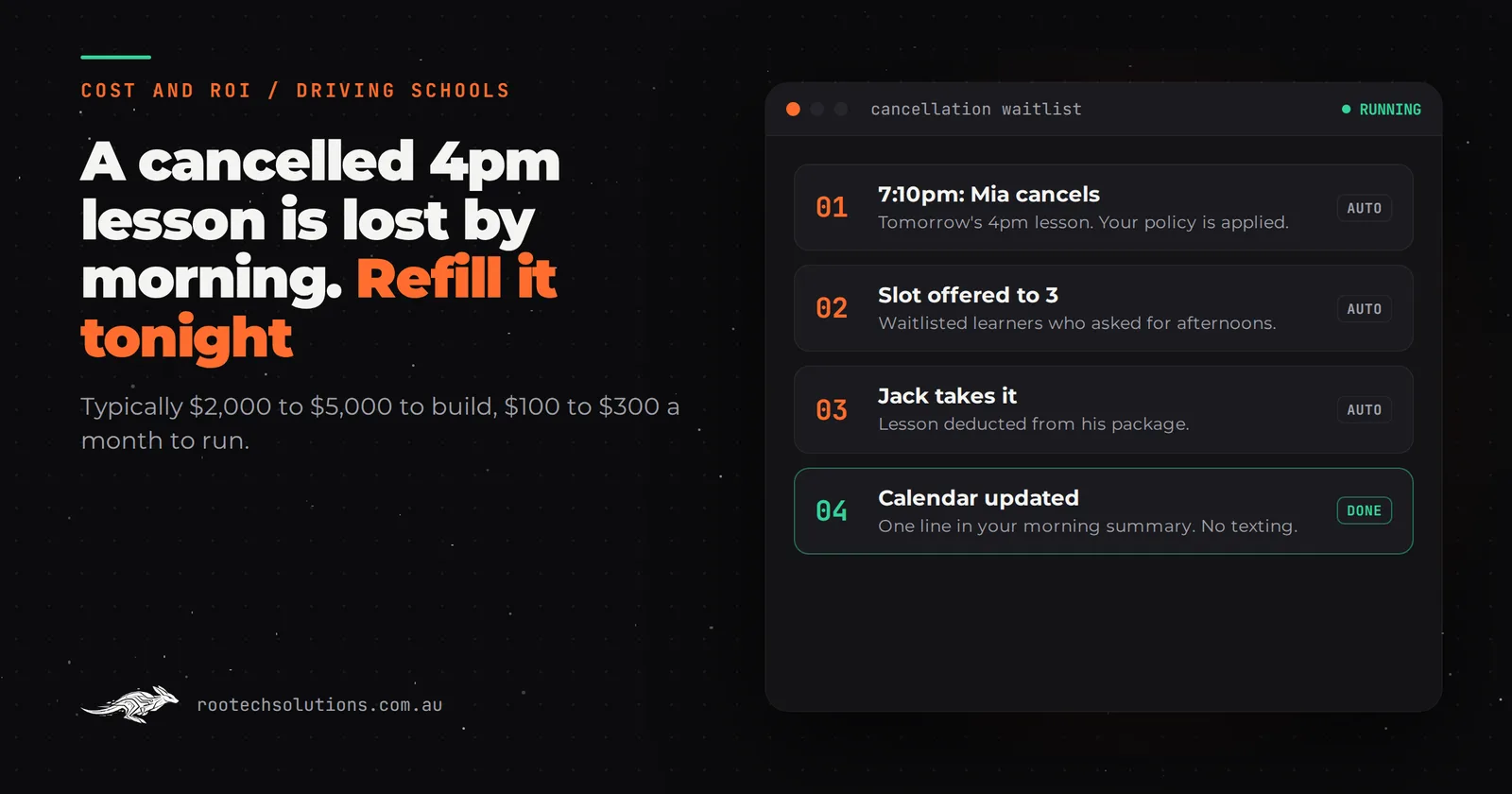
A driving instructor's stock is hours in the car, and an hour that goes unused can never be sold again. When a learner cancels tomorrow's 4pm lesson at 7pm tonight, that slot is gone unless someone fills it before morning, and you are usually the someone, texting your waitlist between dinner and the next day's bookings.
That is the real case for AI automation for driving schools. Answering enquiries faster helps, but the bigger and more reliable return is keeping the peak after-school and weekend slots full when learners cancel, reschedule or forget.
Short answer: AI automation is worth it for a Melbourne driving school with regular late cancellations or ten or more enquiries a month. It typically costs $2,000 to $5,000 to build and $100 to $300 a month to run. Refilling about two cancelled lessons a week and winning one extra package a month pays a $3,000 build back in about three months.
Why is the payback different for a driving school?
Because you sell time, not jobs. A plumber who misses a call loses one job; an instructor who fails to refill a cancelled slot loses an hour that was already rostered, with the car and the instructor sitting idle.
Three things make driving schools their own case:
- Demand is crushed into a few hours. After school, late afternoon and weekends are what everyone wants. A cancelled Tuesday 4pm slot is valuable; a cancelled Tuesday 11am may not be refillable at any speed.
- Revenue is often prepaid. Many learners buy lesson packages, so the money arrives up front but the hours are owed. Keeping an accurate count of lessons used and remaining is admin that has to be right.
- The customer is often two people. A teenage learner books, a parent pays and asks the questions. Messages have to reach the right one.
What does AI automation for driving schools cost?
These are estimates for fixed-price builds:
- Setup: $2,000 to $5,000. A single-instructor school with one calendar sits at the lower end. A multi-car school with several instructors, shared scheduling and package tracking sits at the higher end.
- Enquiry follow-up on its own: around $1,500 to $2,000, if you want to start with just one workflow.
- Running: $100 to $300 a month. AI usage, SMS (usually charged per message) and small changes when prices or packages change. Most schools land around $150, with hosting usually under $50 of that.
What that buys, in a typical build:
- an AI reply within seconds to website, SMS and social enquiries, with your prices, packages and a link to book a real slot;
- booking, rescheduling and cancelling by text against your live calendar;
- reminders the day before each lesson, sent to the learner, the parent or both;
- a cancellation waitlist that offers freed slots to learners who want that time;
- package tracking that logs each lesson and prompts a top-up when a package runs low.
How do I work out the payback for my school?
Count the slots you refill and the packages you win, at what they are worth after car costs. Swap in your own figures below; every one is an assumption.
| Input | Example | Why it matters |
|---|---|---|
| Instructors | 2 | Cancellations scale with cars on the road |
| Late cancellations a week, per instructor | 2 | Check your calendar for the last month |
| Share refilled from a waitlist | Half, so 2 slots a week in total | Peak slots refill easily, mid-morning ones may not |
| Lesson price | $75 | Use your single-lesson price |
| Fuel and car cost per lesson | About $10 | The instructor's time is already rostered |
| Extra 10-lesson packages a month from faster replies | 1, at $70 a lesson | Only counts if you have empty slots to put them in |
Working it through:
- Refilled slots: 2 a week x ($75 minus $10) = $130 a week, about $563 a month.
- One extra package: $700 less roughly $100 in car costs = $600 a month.
- Monthly gain: $563 + $600 = $1,163, less $150 running = $1,013 a month.
- Payback on a $3,000 build: about 3 months.
The refill line is the dependable one, because cancellations happen whether or not marketing is working. The package line depends on spare capacity: if you are booked out for weeks, an extra package just lengthens your waitlist, and the payback rests on refills alone (about $413 a month net, so seven or eight months).
What does the cancellation refill actually look like?
It runs in the gap between the cancellation and the next morning, without you.
A learner, Mia, texts at 7:10pm to cancel tomorrow's 4pm lesson. The system applies your cancellation policy, frees the slot and offers it to the three learners on your waitlist who asked for afternoons. Jack replies first, takes it, and the lesson is deducted from his package. Your calendar updates, and you see one line about it in the morning instead of an evening of texting. If nobody takes it by your cut-off, it tells you so you can decide what to do with the hour.
Anything the rules do not cover goes to you: a learner asking to waive a fee, a parent with a complaint, a question about a medical condition or licence eligibility, or a test-day request that needs your judgement.
Is a booking app enough, or do I need a custom booking system?
Often a booking app is enough to start. Online booking tools such as Square Appointments, general schedulers and booking platforms built for driving schools handle online booking, payments and basic reminders, and connect to Xero or MYOB. If your main problem is learners ringing to find a time, switching one on may solve it. Check their current plans and pricing.
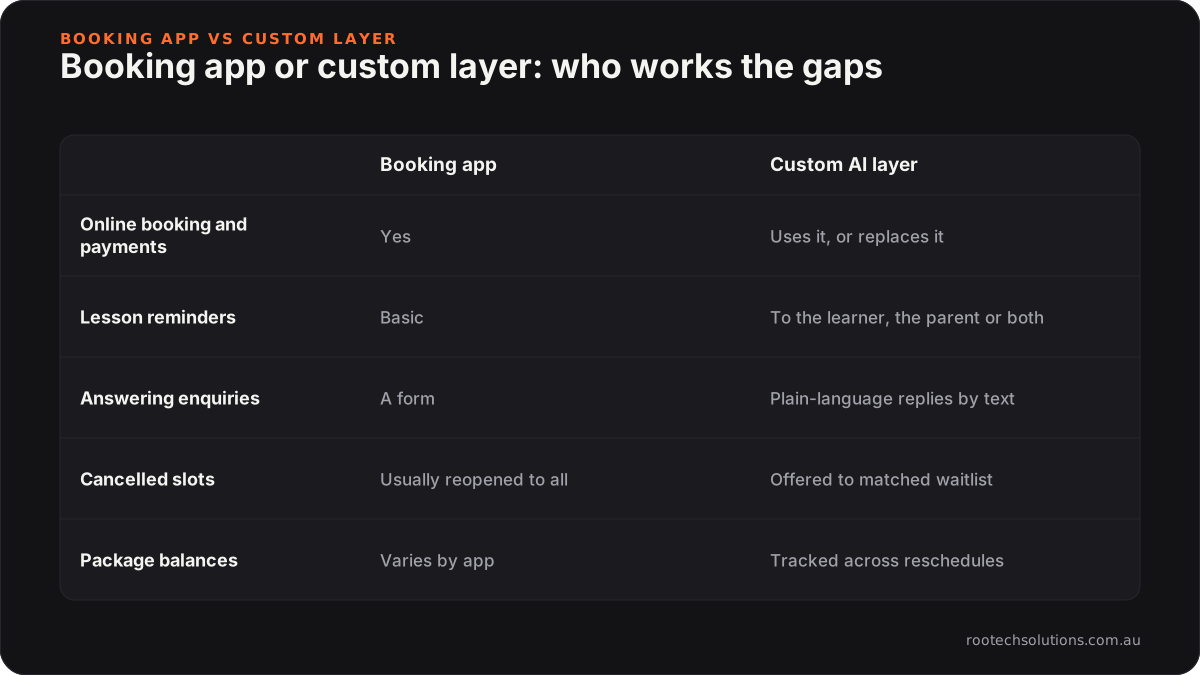
Caption: The booking app holds the calendar. The custom layer works the gaps in it.
A custom booking system or AI layer earns its keep when you need the parts a generic app leaves to you: answering "do you do automatic cars in Coburg?" in a text conversation, matching a cancelled slot to the right learner rather than blasting everyone, keeping package balances right across rescheduled lessons, and knowing whether a message should go to the learner or the parent. If your enquiries mostly arrive as calls, read AI phone answering vs a website chatbot before choosing a channel.
What should a driving school automate first?
Start with whichever leak is larger in your own records: unfilled cancellations or slow enquiry replies.
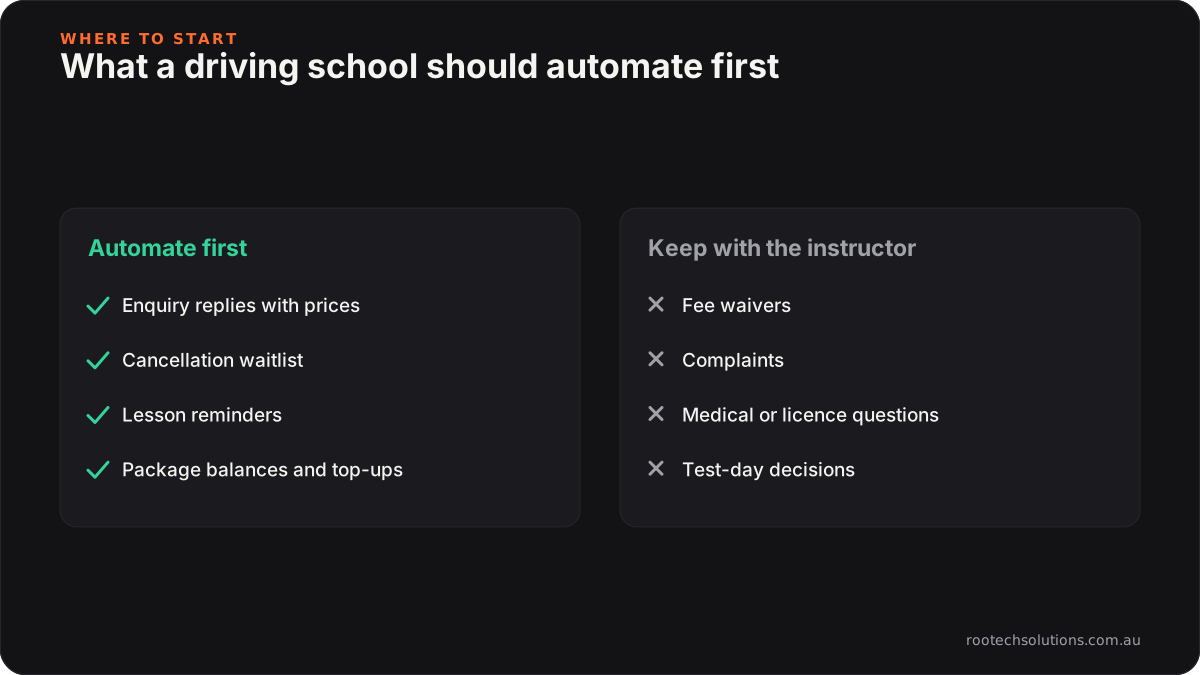
Caption: The left column is where the hours go. The right column is where your judgement matters.
If enquiries are the bigger problem, start with enquiry follow-up alone; we covered why replies win learners in driving schools losing learners to slow replies. If cancellations are, start with reminders and the waitlist, which are cheap to build and pay back on their own.
What does the build look like?
Most driving school builds are live in two to three weeks at a fixed price.
- Week one: collect your prices, packages, service area, car types, cancellation policy and the questions you are asked every day; connect your calendar and SMS.
- Week two: build enquiry replies, booking and rescheduling, reminders and the waitlist; test with real past enquiries.
- Week three: package tracking and go-live, with you approving the first week of waitlist offers before it runs on its own.
You stay in control of the calendar. The system never books outside the hours you set or into a slot you have blocked.
When is AI automation not worth it for a driving school?
- You are booked out weeks ahead from referrals and cancellations are rare. You have no slots to refill and no leads to chase.
- You get fewer than about ten enquiries a month and few late cancellations. Spend the money on getting found first, starting with local SEO for Melbourne driving schools.
- You reply to every enquiry within the hour and enjoy doing it, and your current booking app already handles reminders.
Frequently asked questions
Can learners book and reschedule lessons by text?
Yes. The system reads your live calendar, offers real times, and books, moves or cancels lessons in the same conversation, applying your cancellation policy. It only uses hours you have made available.
How does the waitlist decide who gets a cancelled slot?
By rules you set: usually the learners who asked for that day and time, in the order they joined the list, with a short window to accept. If nobody accepts, the slot goes back to open booking and you are told.
Will it message the learner or the parent?
Whichever you set per learner. Many schools send reminders to both for under-18 learners and send payment and package messages to whoever pays. Learners and parents can reply to change it.
Does it replace my booking app?
Not necessarily. If your app has an API, the automation works on top of it. If it does not, or it is the thing causing the trouble, a simple custom booking system can replace it as part of the build.
Find out how many lessons you are losing
We build enquiry, booking and waitlist automation for driving schools in Melbourne and, remotely, across Australia, at a fixed price agreed before we start. Book a free AI workflow audit and we will go through last month's cancellations and enquiries with you and tell you plainly whether the payback works. The audit fee comes off your first project.