My Lovable App Has Real Users: Fix It or Rebuild?
Your AI-built booking app has real users. Learn when to keep prompting and when a vibe code cleanup rebuilds the foundation, keeps your screens and moves.
You built a booking app with an AI builder. It works. People actually book through it, a few of them pay you, and one of them just asked what happens if the site goes down. You do not know. You did not write the code, and neither did anyone.
That is the moment every founder who vibe-coded an app hits: the thing that was perfect for showing people now has to survive being a real business. The question is whether to keep patching what you have or rebuild the parts underneath.
Short answer: If real users, payments or private records run through the app, patching is not enough: check the foundation. Data permissions, backups and server-side checks are usually the weak parts of an AI-built prototype. You can often keep every screen your users know and rebuild only the foundation underneath, then move users and records across in a planned switch-over.
Why an AI-built prototype struggles with real users
AI builders like Lovable, Bolt and Replit are good at what they are built for: turning an idea into something you can put in front of people fast. The gap is not the screens. It is everything that has to be true before strangers trust the app with their money and their details.
Four patterns cause most of the trouble. None of them are visible on the surface.
Permissions checked in the wrong place. If the app decides who can see what only in the browser, someone who knows how to open the developer tools can often read another user's records by changing a number in the web address. The check needs to happen on the server, where the user cannot touch it. For apps built on Supabase, the equivalent is database access rules: if row level security is missing or too loose, every row in the database is effectively open.
Secrets shipped to the browser. API keys and passwords that sit in front-end code are readable by anyone who visits. It is not an attack you need to invite; it is visible to anyone curious enough to look.
No backups and no tests. A prototype with no backups has no undo. One bad prompt that changes the database shape, or one deleted table, can take user records with it. And with no tests, every change you prompt for can silently break something that worked yesterday, which you find out from a customer.
Hand-made changes with no record. AI builders encourage you to change the database by clicking. There is nothing written down about what changed, so nothing can be reproduced or rolled back. After a few dozen prompts, the data model has drifted into something nobody, including the AI, fully understands.
When to keep prompting and when to rebuild
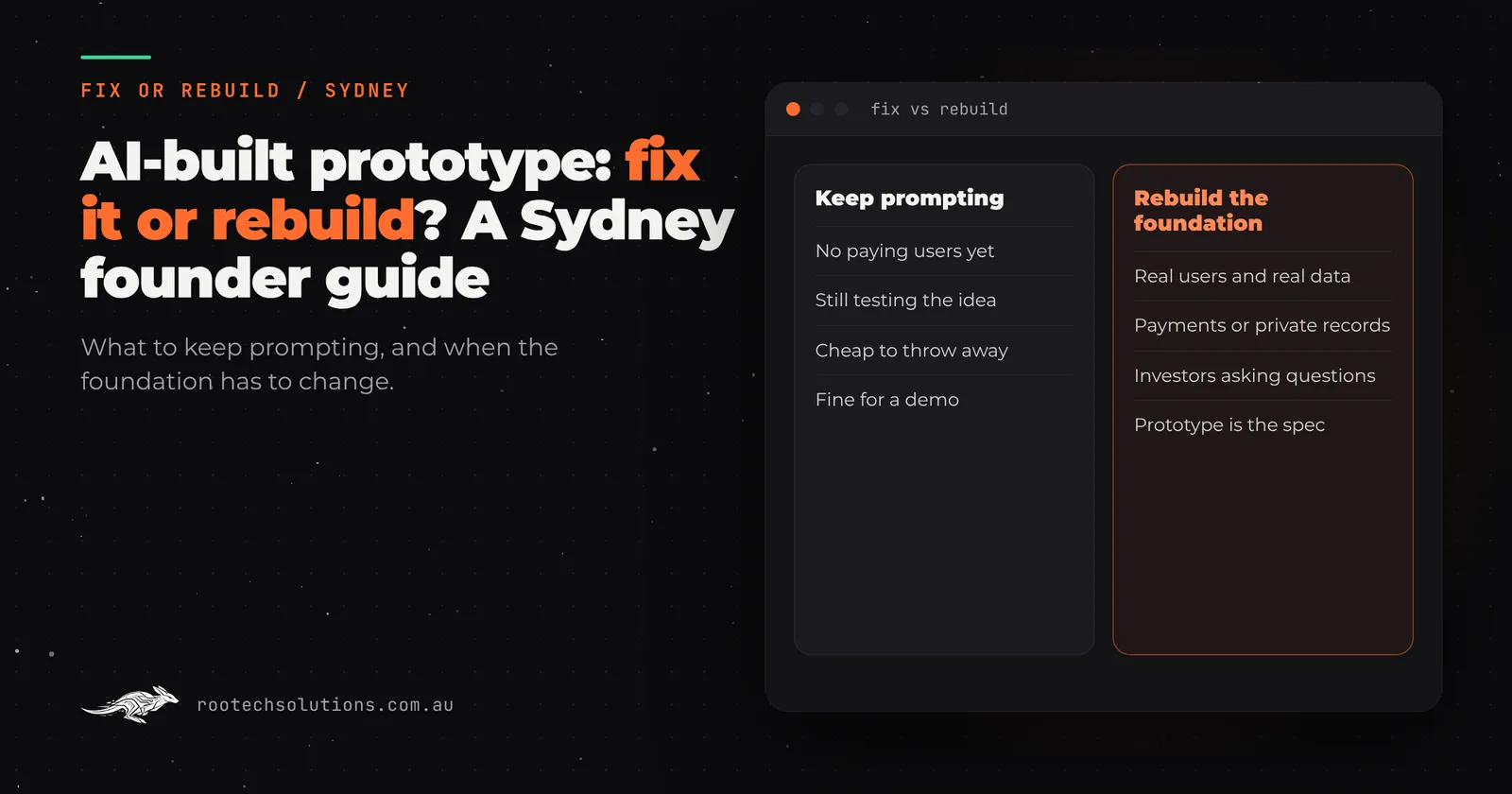
You do not always need a rebuild. Sometimes the honest answer is "keep prompting, it is fine for now."
| Your situation | What to do |
|---|---|
| No paying users, still testing the idea | Keep prompting. The prototype is cheap to throw away, and that is its job. |
| Real users but nothing sensitive or paid | Tighten the basics: access rules, backups. Keep building on it. |
| Payments flowing through the app | Rebuild the foundation before you scale. Payment errors and duplicates cost real money and trust. |
| Private records: health, addresses, minors | Rebuild. You are carrying obligations you cannot meet with browser-only checks and no backups. |
| An investor or an enterprise customer is doing due diligence | Rebuild. "It was vibe-coded and we do not control the data layer" is a hard conversation. |
| The platform changed its pricing or direction | Rebuild or migrate. You want the app to run somewhere you chose, not somewhere you inherited. |
The pattern in that table: prompting is fine while the app is disposable. The moment it holds money, private records or other people's livelihoods, the foundation has to be under your control. That is the gap a vibe code cleanup closes, and we have written before about what to do when a vibe-coded app gets paying users.
What "fix it" actually means
Here is the part founders usually do not know: fixing the foundation does not have to mean changing what users see. A rescue separates the two.
Your prototype becomes the specification. The screens, the flows, the wording your users already know stay exactly as they are. What gets rebuilt is underneath: the data model tidied up, permission checks moved to the server, backups and monitoring set up, tests written, and deploys made repeatable so a change goes out the same way every time.
During the rebuild, the old prototype keeps running on its current address. The new version runs on a private staging address, which is simply a copy of the site only your team can open, so you can test each change safely. When it is ready, users, records, files and payment subscriptions move across in a planned switch-over, ideally without making a single person sign up again or update a card.
That is what a cleanup does in practice. It starts with a review of the prototype and a fixed price, so you know the cost before you commit, and you keep the code and every account when it is done.
The self-check you can run this week
Before you pay anyone, spend thirty minutes answering these five questions. Every one is checkable without writing code.
- Open the app, log in, and change the number in the web address of a record page. If you can see another user's booking or details, permission checks are happening in the browser only. This is the single most important finding.
- Open the browser's developer tools and look at the network tab. If you can see any key, token or password that is not a short-lived public one, a secret is shipping to every visitor.
- Ask: when was the last backup actually restored and tested? A backup nobody has restored is a hope, not a backup. Most prototypes have none at all.
- Ask: what happens if the AI builder's platform changes its pricing, or shuts the feature I depend on? If the honest answer is "the app stops", you are renting your business.
- Try to list every change made to the database in the last month. If the list is "I clicked some things in the builder", changes are being made with no migrations, which means no reliable way back.
If all five come back clean, keep going. If two or more fail, the foundation is not ready for the business you are running on it.
Can I keep using AI tools afterwards?
Yes, and honestly you should. The problem was never the AI; it was building on a base with no tests and no review step. On a codebase with tests and a human review, prompting is a genuinely fast way to work: you describe the change, the AI drafts it, the tests confirm nothing broke, and a person checks it before it goes live.
That is the end state worth aiming for: the speed of AI-assisted building with the safety rails of professional software. Founders in Sydney and around Australia work with Rootech on exactly this, and Rootech offers in-person meetings for Melbourne clients and video-based delivery everywhere else. If your app needs a rebuild rather than a patch, the same question of control applies as when you pay a developer and wonder who owns the code.
Frequently asked questions
How much does a cleanup cost?
It depends on how much the prototype grew and what the foundation looks like, so Rootech quotes a fixed price after reviewing the code. You see the number before any work starts. Ongoing hosting for an app like this is usually under $50 a month, and AI usage typically runs $20 to $200 a month depending on volume.
How long does it take?
Most Rootech builds ship in two to four weeks; a bigger platform rebuild gets a fixed timeline up front. The prototype keeps running the whole time, so your users are never locked out.
Will my users notice anything?
Not on day one. The screens and flows stay the same. What changes is that the app stops breaking, backups exist, and problems get noticed by monitoring before a customer tells you.
Do I own the code afterwards?
Yes. On every Rootech build the client owns the code, and the hosting and database accounts stay in the client's name. You get the code, documentation and credentials at handover, so you are never locked to us or anyone else.
What if I would rather rebuild from scratch?
Sometimes that is right, especially if the data model has drifted too far. But if you have users who know your screens and records you need to keep, rebuilding around the prototype you have is usually faster and cheaper, because the expensive part, learning what users actually need, is already done.
Send us what you built
If your AI-built booking app is carrying real users and real money, get the foundation checked before it decides for you. Send us what you built for a fixed-price prototype review, or book a free call and we will scope it with you. Use the contact form at Rootech Solutions; the review costs nothing and the audit fee comes off your first project if you go ahead.