What AI Automation Costs a Perth Pool Builder
What does AI automation cost a Perth pool builder? Build and running costs in AUD, a worked payback on quoting and follow-up, and when it is not worth it.
A backyard pool is a five-figure sale, and most Perth pool builders lose more of them to slow paperwork than to a competitor's price. Enquiries arrive at night, site visits get booked days later, quotes go out late, and the homeowner signs with whoever followed up first. That is the gap AI automation for pool builders is built to close. This post works out what a build costs, how the payback works for a Perth operator, and when to skip it.
Short answer: A quoting and follow-up build for a pool builder typically costs $2,500 to $6,000 at a fixed price, then $150 to $400 a month to run. On a conservative worked example, one extra pool a quarter at a 30% gross margin pays back a mid-range build in under a year; two extra pools pays it back in months. If your spring calendar is already full and you quote mostly repeat referrals, skip it for now.
How money actually works in a pool building business
Pool builders sell big-ticket jobs with long consideration. A family researching a pool collects three or four quotes, takes weeks to decide, and signs in the season before they want to swim. Three things decide whether your margin survives that:
- The site visit. Almost every residential pool quote needs eyes on the block. Access for excavation, soil type, slope, retaining walls and service locations all move the price, so every enquiry drags a drive across Perth with it.
- The follow-up. Homeowners decide slowly and pick the builder who stays in touch. A quote sent and never chased is a quote that quietly dies.
- Payment stages. Pool jobs run on staged progress payments: deposit, excavation, shell, equipment, handover. Each stage has an invoice, a claim and a follow-up, and missed stage claims are the margin leak nobody notices until the EOFY.
Because the visit is expensive and the decision is slow, the return on automation comes from screening out tyre-kickers before the drive, chasing every quote, and keeping stage payments moving. Faster replies alone rarely justify the spend, but they are what stops the enquiry going cold before the visit.
Where does a pool quote leak, and what fixes it?
| Stage | What goes wrong | What the automation does |
|---|---|---|
| Enquiry | Arrives after hours, gets a reply next day | Replies in a minute, collects pool size, block access, timing and budget range |
| Before the visit | You drive to Clarkson for a block that was never buildable | Asks the qualifying questions (access, slope, budget) so poor fits drop out early |
| After the visit | Quote sits half-written for days | Drafts the quote from your site notes and rates the same evening; you approve it |
| Between quote and sign | Nothing happens for three weeks | Polite reminders on day two, five and ten, stopped the moment they reply |
| During the build | Stage invoices and claims get sent late | Flags each stage as it completes and drafts the invoice for your sign-off |
| Years later | The past client wants a heater or a renovation and calls whoever they remember | Occasional check-ins about upgrades, salt chlorinators and equipment servicing |
Every message goes out in your wording from your number, and anything involving a price or a commitment comes to a human first.
What does AI automation for a pool builder cost to build?
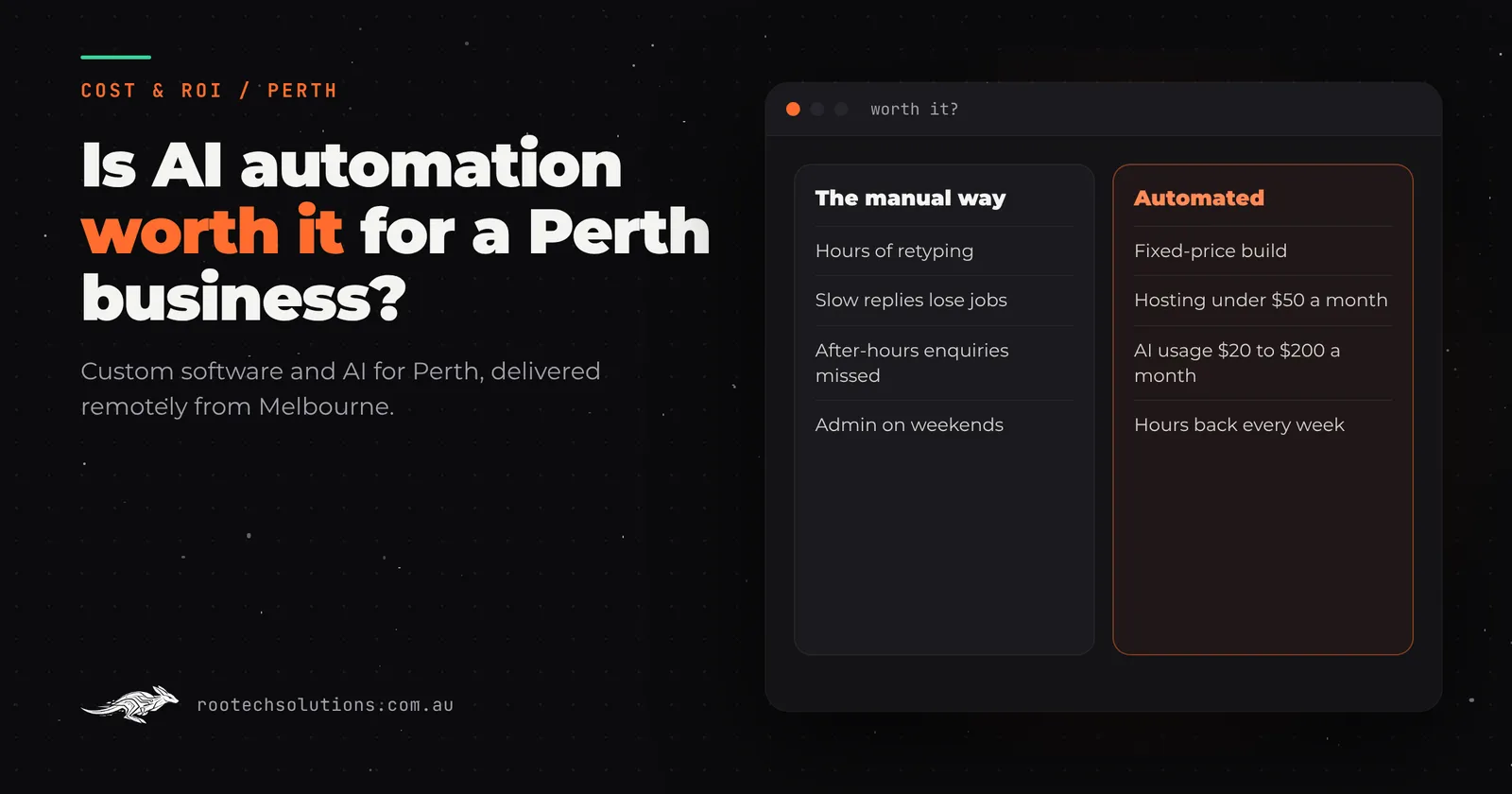
Pool builders have no separate published price list from us, so anchor on scope. A quoting and follow-up build for a pool builder is similar in scope to the quote drafting and follow-up build in our painter cost guide, which typically lands at $2,500 to $6,000 to build, then $150 to $400 a month to run. Hosting is usually under $50 of that, and AI usage typically runs $20 to $200 a month depending on volume.
What moves you up the range:
- Enquiry capture and qualifying only (web form, missed-call text-back, after-hours replies, photo collection): the low end.
- Quote drafting from your site notes plus a follow-up sequence: mid-range.
- Stage-payment tracking and job sync, where the automation watches job stages and drafts invoices into Xero or your job management software: the upper end.
We quote after scoping, at a fixed price agreed before work starts, so the number you are given is the number you pay.
How do I work out my own payback?
Work on gross margin, not revenue. Every number below is an assumption; replace it with your own from last season's jobs.
| Lever | Assumption | Your number |
|---|---|---|
| A. Visits screened out | 6 site visits a week, 1 in 3 screened out, 1.5 hours each, your time worth $60 an hour = about $180 a week, roughly $780 a month | |
| B. Extra jobs won | One extra pool a quarter at a $65,000 sale price and a 30% gross margin = about $6,500 a quarter, roughly $2,165 a month | |
| C. Faster stage payments | Stage claims sent two weeks earlier on average improves cash flow; the benefit depends on your overdraft or loan costs | |
| Running cost | $250 a month |
On those assumptions, line B alone covers the running cost many times over and pays back a $4,000 build after the first extra pool, roughly four to six months in. If line A's hours just evaporate instead of going into more quoting, drop it and the payback still holds. If you want the wider argument for why speed decides who wins the job, see why slow follow-up loses leads.
Is pool software enough, or do I need something custom?
Start with what you pay for already. Pool-industry CRMs and general job tools such as PoolBrain or Buildertrend handle lead tracking, quoting, scheduling and progress billing; check their current pricing and whether your plan already includes automatic quote reminders. If the built-in reminder closes your follow-up gap, turn it on and keep the money.
A custom AI integration earns its keep where those tools stop: reading a customer's photos and description and asking the right question before you burn a site visit, drafting the quote in your own wording from your scrawled notes taken on the block, or keeping stage invoices in step with what is actually finished on site. If you build pools as part of larger landscaping or renovation projects, the same quoting approach carries over; see what we built for a landscaping business and its franchisees at Bugaboo Landscaping.
When is it not worth it for a pool builder?
Be honest about three cases:
- Your calendar is already full for the season. Converting more enquiries just builds a waiting list you will disappoint. Put the money into a subcontractor crew, a second excavator or a price rise instead.
- Most of your work is repeat referrals and display-home partnerships. Those clients re-engage you directly, and a phone call does the job.
- You get a handful of enquiries a week in winter. At that volume there is little to lose to slow follow-up, and the build never pays for itself before the season catches up.
The honest test: count the quotes you sent in the last three months and how many you followed up more than once by hand. If the answer is "almost none", you have a real gap. If you chase every one, you do not have a gap to automate.
What does the build look like?
Most builds in this range are live in two to four weeks at a fixed price.
- Week one: connect your enquiry channels, agree the qualifying questions and your price ranges, switch on missed-call text-back.
- Week two: quote drafting from your site notes, the follow-up sequence, and calendar sync.
- Weeks three and four: stage-payment tracking and job software sync, tested end to end on real enquiries before go-live.
You approve every quote and every stage invoice. The AI never commits a price you have not set, and if a customer asks something it is not sure about, it hands them to you.
One Perth-specific point: pool buyers research heavily before they call, and they judge a builder by the pools on its website. If your site is a photo gallery with no pages per service and suburb, that is a cheaper fix with a bigger payoff than automation; our custom software for Perth businesses page covers what a website build includes. And if you quote pool builds inside wider construction projects from plans, we built an AI takeoff estimator for Logic Building Co that turns plans into measured quantities and a costed estimate in about ten minutes.
Frequently asked questions
Can an AI quote a pool from photos?
It can collect photos, pool size, block access and timing, and draft a price range from your own rates, which is usually enough to screen out tyre-kickers before a site visit. A firm quote still needs your eyes on the block, and you approve every price before it leaves.
Do I need to change my quoting or job software?
No. The automation works alongside PoolBrain, Buildertrend, JobPanda, a plain calendar or a spreadsheet, and writes jobs into your software where it allows it. Nothing about how you schedule or invoice has to change.
Will customers know the messages are automated?
They come from your number in your wording and stop the moment the customer replies, so most read as ordinary follow-up. If someone asks, tell them plainly; it has never cost a job.
What does the monthly cost cover?
Hosting (usually under $50 a month), AI usage (typically $20 to $200 depending on volume) and support. Bug fixes on anything we built are included after launch, and there is an optional retainer for ongoing improvements.
Does this work for a small two-builder operation?
Yes, if you get enough enquiries to lose some. A small crew with steady demand often gains the most, because there is nobody back at the office answering the phone while you are both on site. Below a couple of serious enquiries a week, wait.
Check your own numbers first
Run the payback table with last season's numbers before spending anything; the arithmetic is deliberately simple so you can do it in ten minutes. If the numbers work and you want it built, we deliver for Perth businesses remotely at a fixed price, with video for discovery and reviews and installations set up with your team over a call. Book a free AI workflow audit and we will go through your quoting process with you and tell you plainly whether it pays back. The audit fee comes off your first project.