Vibe Code Cleanup in Melbourne: Fix Your AI-Built App
Built an app in Lovable, Bolt, Replit, v0 or Cursor and now it has real users? How a Melbourne vibe code cleanup works, in person or anywhere in Australia.
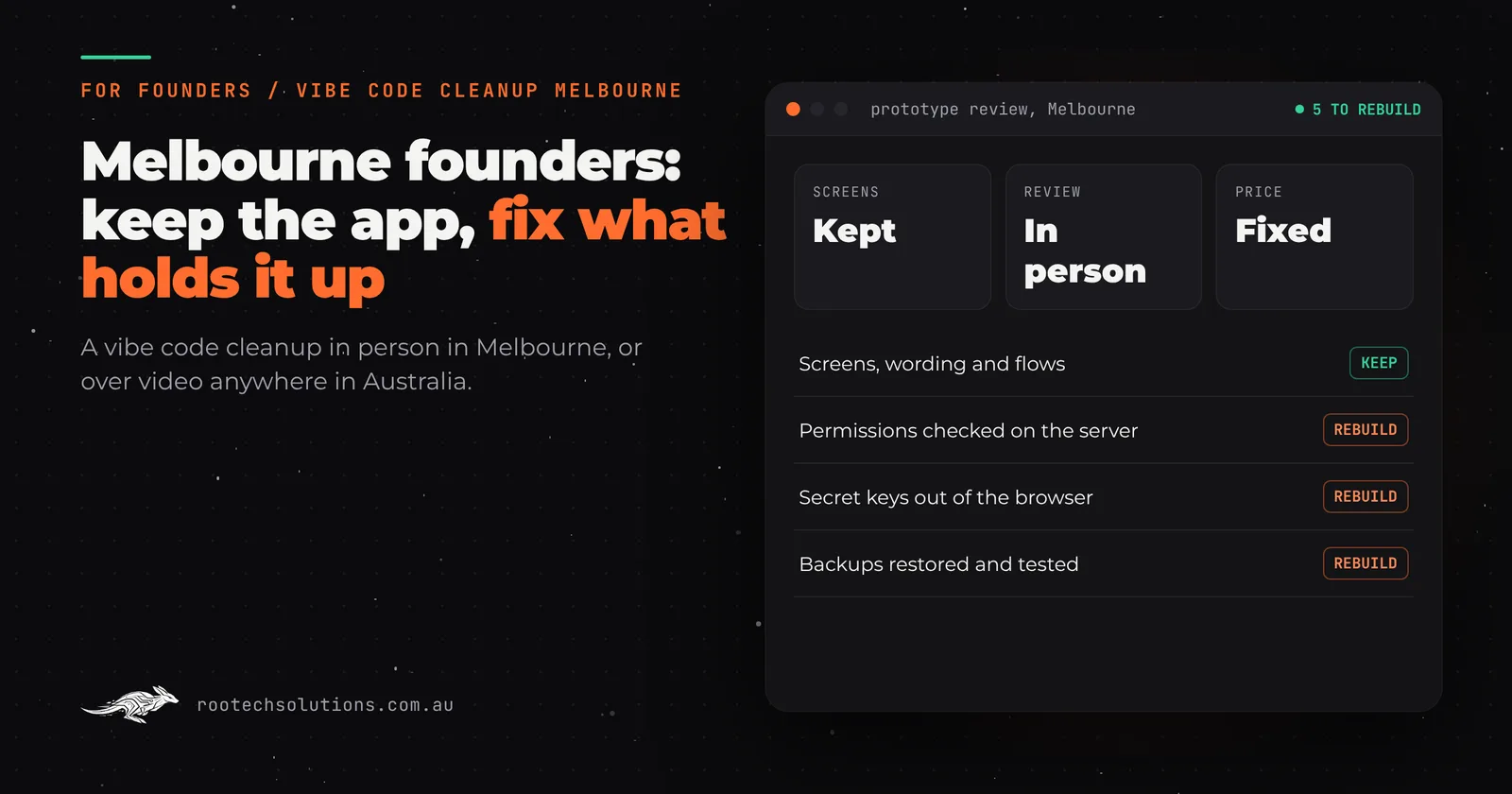
You built it on a weekend in Fitzroy, or between shifts, or on the train in from the south-east. A few prompts in Lovable, Bolt, Replit, v0 or Cursor and you had sign-ups, a dashboard and a payment button. Then people started using it. Some of them are paying. One of them just asked where their data is stored, and you are not completely sure.
That is the moment a vibe code cleanup is for. This guide is written for Melbourne founders first, because Melbourne is where we can sit at the same table and go through your app together. The same process runs for founders anywhere in Australia, over video.
Short answer: A vibe code cleanup keeps the screens and flows of your AI-built app and rebuilds what sits underneath: the data model, permissions checked on the server, secrets kept out of the browser, tested backups, tests, monitoring and repeatable deploys. Rootech is a Melbourne software studio. We review your prototype, quote a fixed price before any rebuild work, keep your prototype live while we work, and move your users across in one planned switch-over. Melbourne founders can do the review in person. Everyone else in Australia does it over video, with the same result.
Why Melbourne founders end up needing a cleanup
Melbourne has a deep pool of people building their first product: hospitality owners who want their own booking app, tradies tired of paying for software that half fits, allied health practitioners, teachers, designers and students turning a side project into a business. Victoria even has a government agency, LaunchVic, whose whole job is backing the state's startup ecosystem.
AI builders have made that first step dramatically cheaper. You no longer need a technical co-founder to put something real in front of customers. What has not changed is the second step. An app that works on screen is not the same as an app that is safe to run a business on, and the gap is invisible until something goes wrong.
None of that is the founder's fault. The prototype did exactly what it was meant to do: prove people want the thing. It just was not built to be the finished product.
What we find when we open a prototype
The first job in every cleanup is a review. We read the code, the database, the hosting and every third-party account the app relies on, and write down plainly what is sound and what is not. Here is what that looks like for an illustrative music lesson booking app built in Lovable on Supabase.
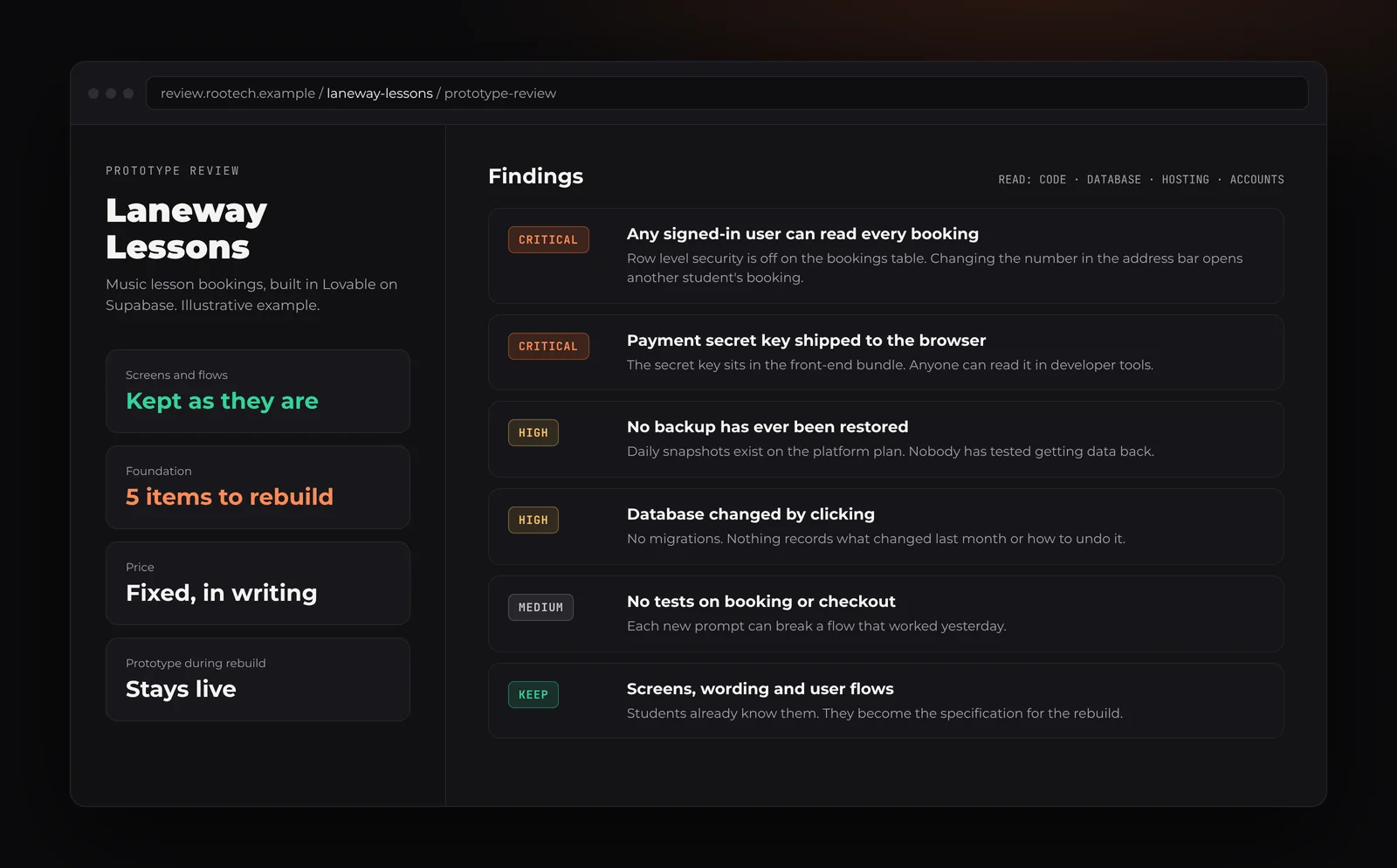
Caption: Illustrative, for a fictional app. The screens and flows stay; the foundation underneath gets rebuilt.
The specifics change from app to app, but the pattern is remarkably consistent:
- Permissions only checked in the browser. The app hides other people's records on screen, but the server will hand them to anyone who asks. On Supabase-backed apps this is usually row level security that is off or far too loose.
- Secret keys in the front end. Payment, email and AI keys bundled into code that every visitor downloads.
- Backups nobody has restored. A backup you have never restored is a hope, not a backup.
- Database changes made by clicking. No migrations, so nothing records what changed, and nothing can be rolled back.
- No tests on the flows that make money. Every new prompt can quietly break checkout, and the first person to notice is a customer.
The good news sits at the bottom of every review: the screens, the wording and the flows your users already understand. They took real customer conversations to get right. They become the specification for the rebuild.
The one test to run tonight
If you only do one thing after reading this, do this. Log in to your app as a normal user, open a record that belongs to you (a booking, an order, a profile) and change the number in the web address by one.
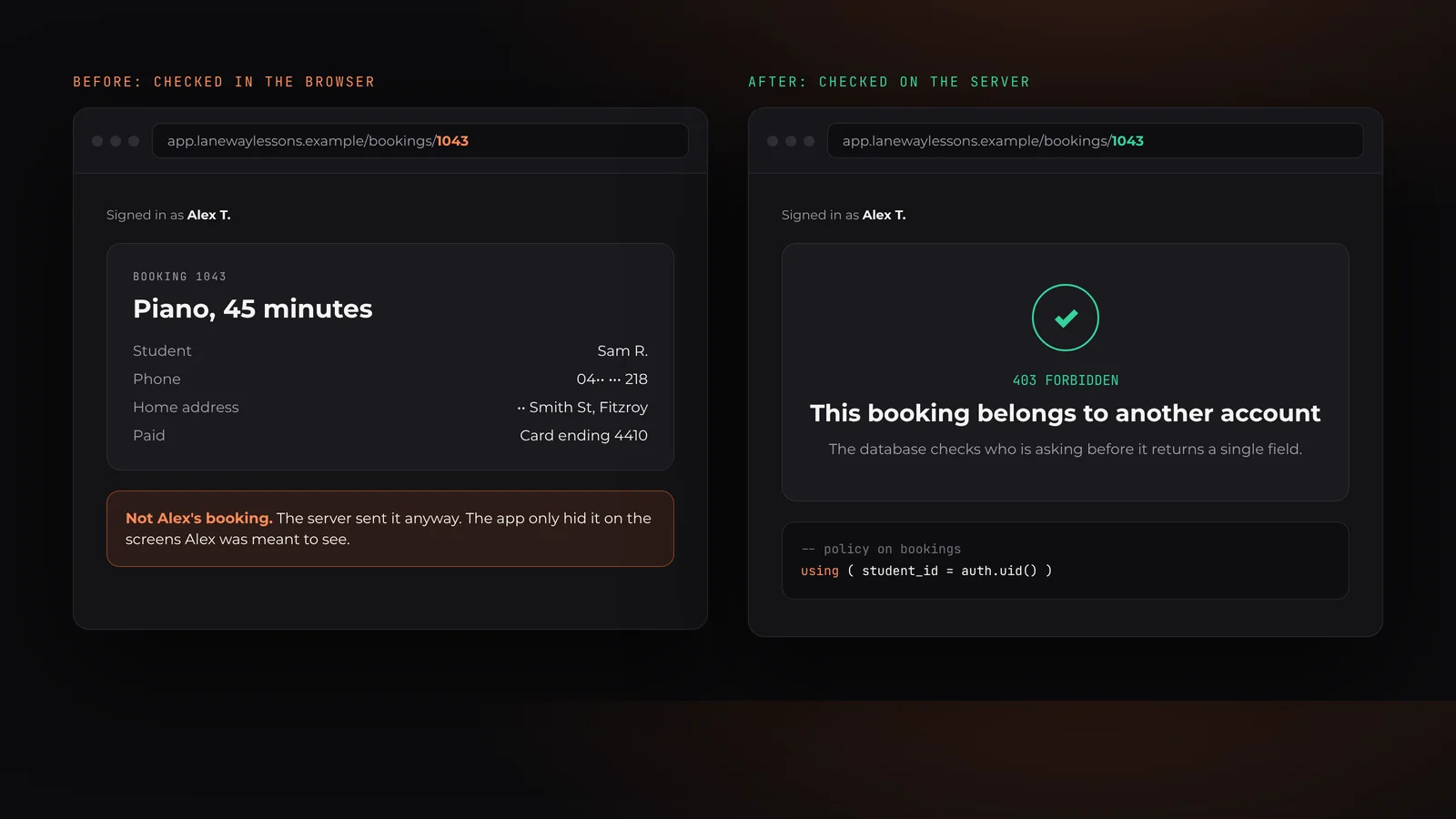
Caption: Illustrative. On the left the server sends someone else's booking and the app merely hides it. On the right the database refuses before a single field leaves the server.
If someone else's record appears, your app is checking permissions in the browser, not on the server. That is the single most common serious problem in AI-built apps, and it is the one that turns into a privacy incident. Fixing it properly means writing access rules into the database and the server, then testing them, not adding another prompt that hides the screen.
How a cleanup runs when you are in Melbourne
The process is the same for every founder. Being in Melbourne just means more of it can happen face to face if you want it to.
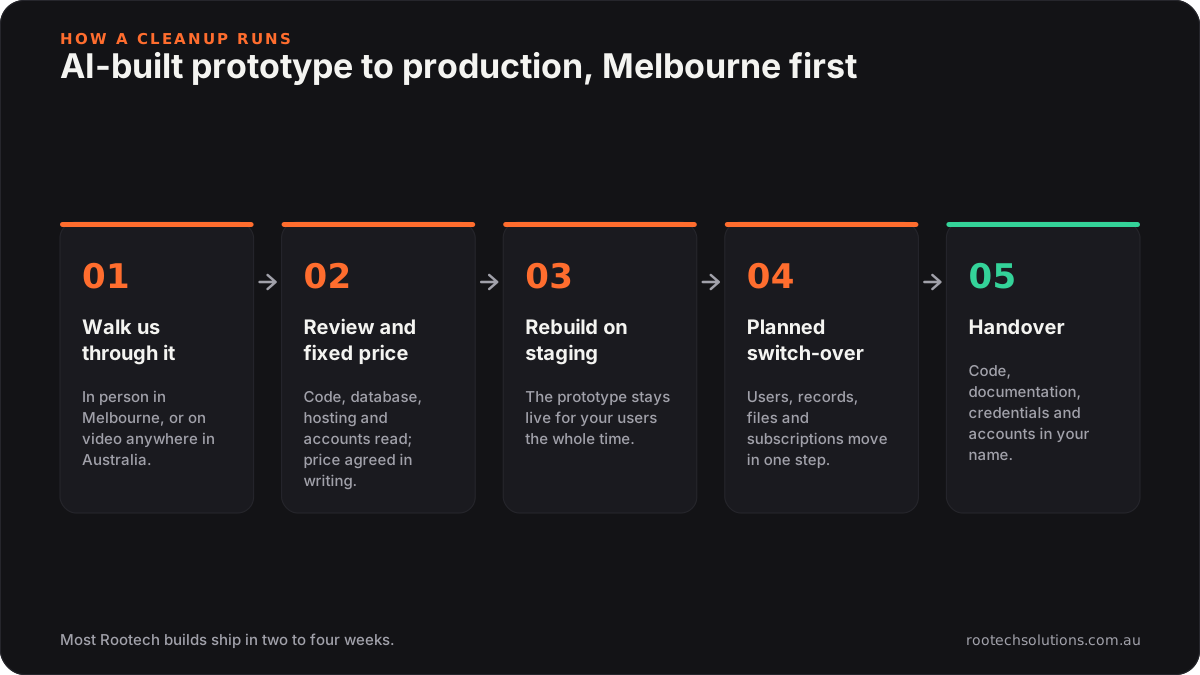
1. Walk us through it. Melbourne founders can do this in person: you show us the app the way your customers use it, and tell us what is keeping you up at night. Elsewhere it is a video call. Either way, we want to see the product before we see the code.
2. Review and a fixed price. We read the code, the database, the hosting and the accounts, and give you the findings in plain English with a fixed price in writing. No rebuild work starts until you have agreed the number.
3. Rebuild on a private copy. The foundation is rebuilt on a staging copy only your team can open. Your prototype keeps serving real users on its current address the whole time, so nobody is locked out and nothing changes for them yet.
4. One planned switch-over. When the new version has passed testing, users, records, files and payment subscriptions move across in one planned step, ideally without anyone signing up again or re-entering a card.
5. Handover. Code, documentation, credentials and a walkthrough. Melbourne founders can do the walkthrough at a table with their team.
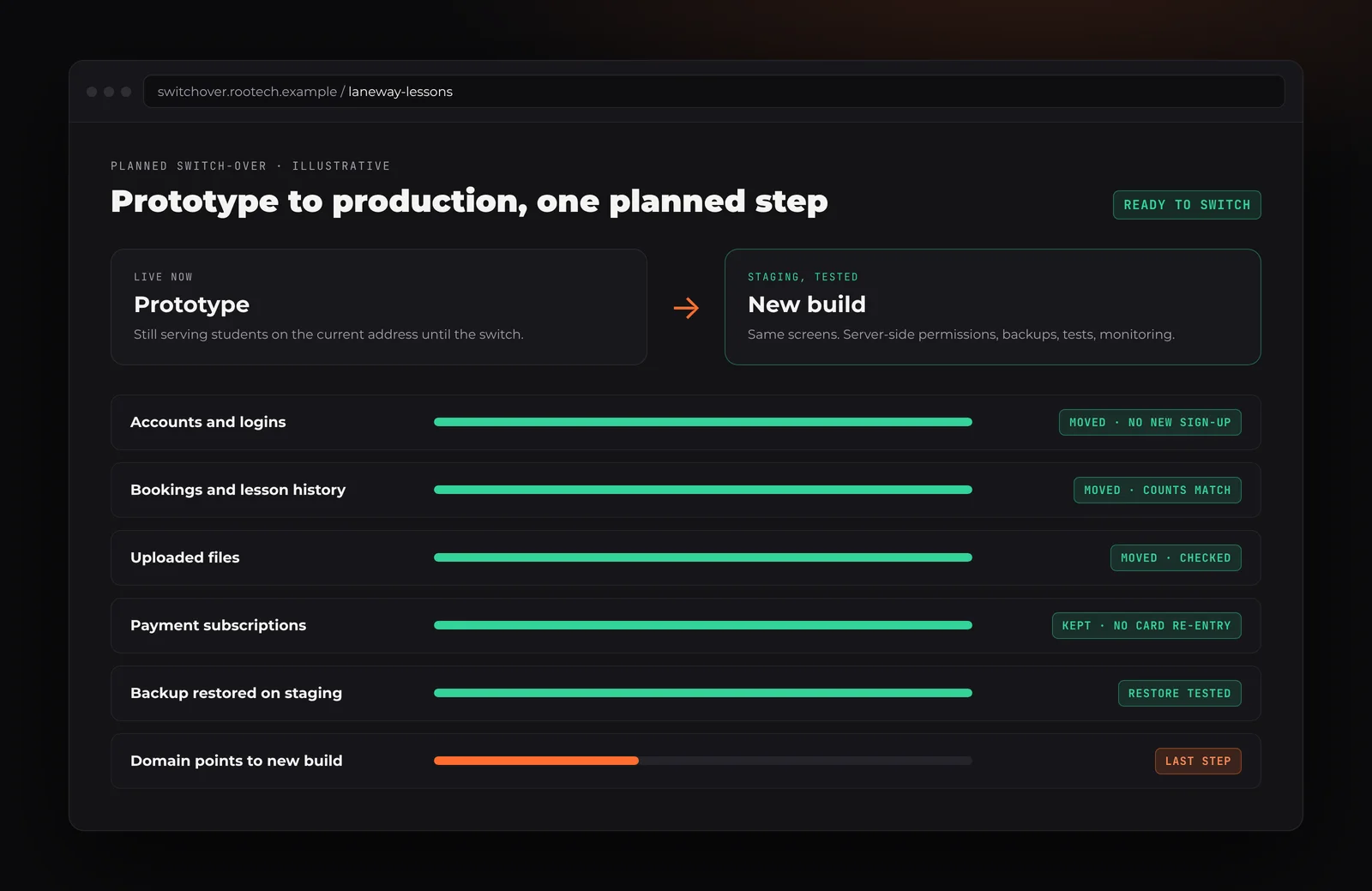
Caption: Illustrative. Everything is moved and checked before the domain changes, so the switch itself is the smallest step.
Most Rootech builds ship in two to four weeks. A bigger platform rebuild gets a fixed timeline up front, so you can plan a launch, a pitch or a grant application around a real date.
Clean up, or rebuild from scratch?
Sometimes the honest answer is not a cleanup. If the prototype was a quick experiment and the product has since changed shape, rebuilding from the screens you have learned from can be cheaper than untangling the old foundation. The review tells you which side of that line you are on.
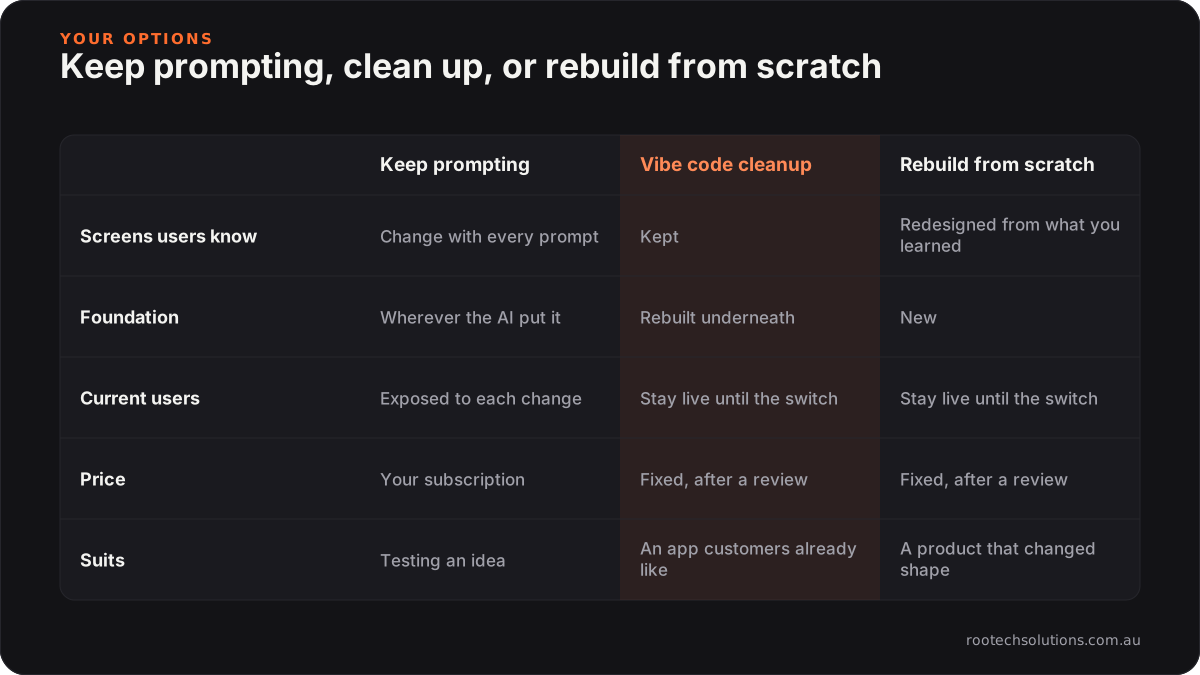
The rule of thumb we use:
- Keep prompting while nobody is paying and nothing private is stored. The prototype is cheap to throw away; that is its job.
- Clean up when users like the product as it is and the problem is what is underneath it. This is most AI-built apps that have found real customers.
- Rebuild when the product itself has changed so much that the old screens no longer match what customers need.
For a deeper look at the decision on one specific builder, read fix or rebuild a Lovable app with real users. If your app is a two-sided marketplace, what to do when a vibe-coded marketplace gets paying users covers the extra traps around payouts.
Privacy, data and the questions Australian customers ask
An AI-built app that stores names, phone numbers, addresses or anything about health or children is holding personal information. The Australian Privacy Principles, published by the Office of the Australian Information Commissioner, set out how organisations covered by the Privacy Act must collect, use and secure it, and the Notifiable Data Breaches scheme sets out what covered organisations must do when a breach is likely to cause serious harm. Whether these apply to your business depends on things like your turnover and what you do, so check with the OAIC or a lawyer.
The practical point holds either way. If a customer can read another customer's booking by changing a number, you have a problem whether or not the law says so. And when a bigger customer, an investor or a bank asks where the data lives, who can access it and how it is backed up, a cleanup gives you a clear answer instead of "the AI set it up".
Founders outside Melbourne
Rootech is based in Melbourne and works with founders across Australia. Outside Melbourne the work runs remotely by default: the walkthrough and review over video, the build in the cloud, and check-ins at times that suit your time zone. Sydney, Canberra and Hobart share our hours; Brisbane matches us outside daylight saving and is an hour behind in summer; Adelaide is thirty minutes behind; Perth is two to three hours behind, so our morning covers your whole working day.
If you want to see what else we build in your part of the country, the city pages cover Sydney, Brisbane, Perth, Adelaide and Hobart. For a broader, Australia-wide explainer on this topic, start with vibe code cleanup in Australia: what it is and how Rootech helps.
What it costs, and what you get either way
A cleanup is quoted as a fixed price after we have read your code, because the honest price depends on what is in it. You see the number before any rebuild work starts. Once the app is in production, running costs are usually small: hosting under $50 a month for an app like this, and AI usage typically $20 to $200 a month depending on volume.
Every Rootech project, cleanup or not, comes with the same promises:
- A fixed price before you sign. Scope and price agreed in writing up front.
- Bug fixes included after launch. If something we built does not work the way we agreed, we fix it at no cost.
- You own all of it. The code, the domain, the hosting accounts and the data, in your name.
- A proper handover. Code, documentation, credentials and a walkthrough for your team.
- No lock-in. Ongoing support is optional, month to month, and you can cancel any time.
More on how we work with AI-built apps is on our vibe code cleanup page, and our Melbourne page covers the rest of what we build here.
Frequently asked questions
What is a vibe code cleanup?
It is a rebuild of the foundation of an app made with AI builders or AI coding tools, so it is safe for real users and real money. The screens and flows your users know stay the same. The data model, server-side permissions, secrets, backups, tests, monitoring and deploys are rebuilt underneath.
Can I meet you in person in Melbourne?
Yes. Melbourne founders can do the walkthrough, the review findings and the handover in person if they prefer. Most of the build still happens in the cloud, and check-ins can be in person or over video, whichever suits you.
Which AI builders do you work with?
Apps built with Lovable, Bolt, Replit, v0, Cursor and Base44, and Supabase-backed apps generally. If your app was built with another tool, send it anyway: the foundation problems are much the same whichever tool wrote the code.
How much does a vibe code cleanup cost in Melbourne?
It is a fixed price quoted after we review your code, because the cost depends on how far the prototype has grown and what the foundation looks like. You see the number before any rebuild work starts. Hosting afterwards is usually under $50 a month, and AI usage typically $20 to $200 a month depending on volume.
How long does it take?
Most Rootech builds ship in two to four weeks. A larger platform rebuild gets a fixed timeline up front. Your prototype stays live the whole time, so your users are never locked out.
Can I keep using Lovable or Cursor after the cleanup?
Yes. The problem was never the AI; it was building without tests or a review step. On a codebase with tests, server-side permissions and a human check before anything goes live, AI tools are a fast and sensible way to keep improving the app.
Do you work with founders outside Melbourne?
Yes, Australia-wide. Outside Melbourne the review, check-ins and handover run over video and the build happens in the cloud, so where you are makes no difference to the result.
Send us what you built
If your AI-built app is carrying real users, real money or real customer details, get the foundation checked before it decides for you. Send us what you built for a fixed-price prototype review, or book a free call to scope it. In Melbourne, we are happy to do it over a coffee. Start through the contact form at Rootech Solutions.