Who Keeps Your Adelaide App Running After Launch?
Your app is live and the developer has moved on. What Adelaide founders need: monitoring, backups, updates, bug fixes and a plan for when things break.
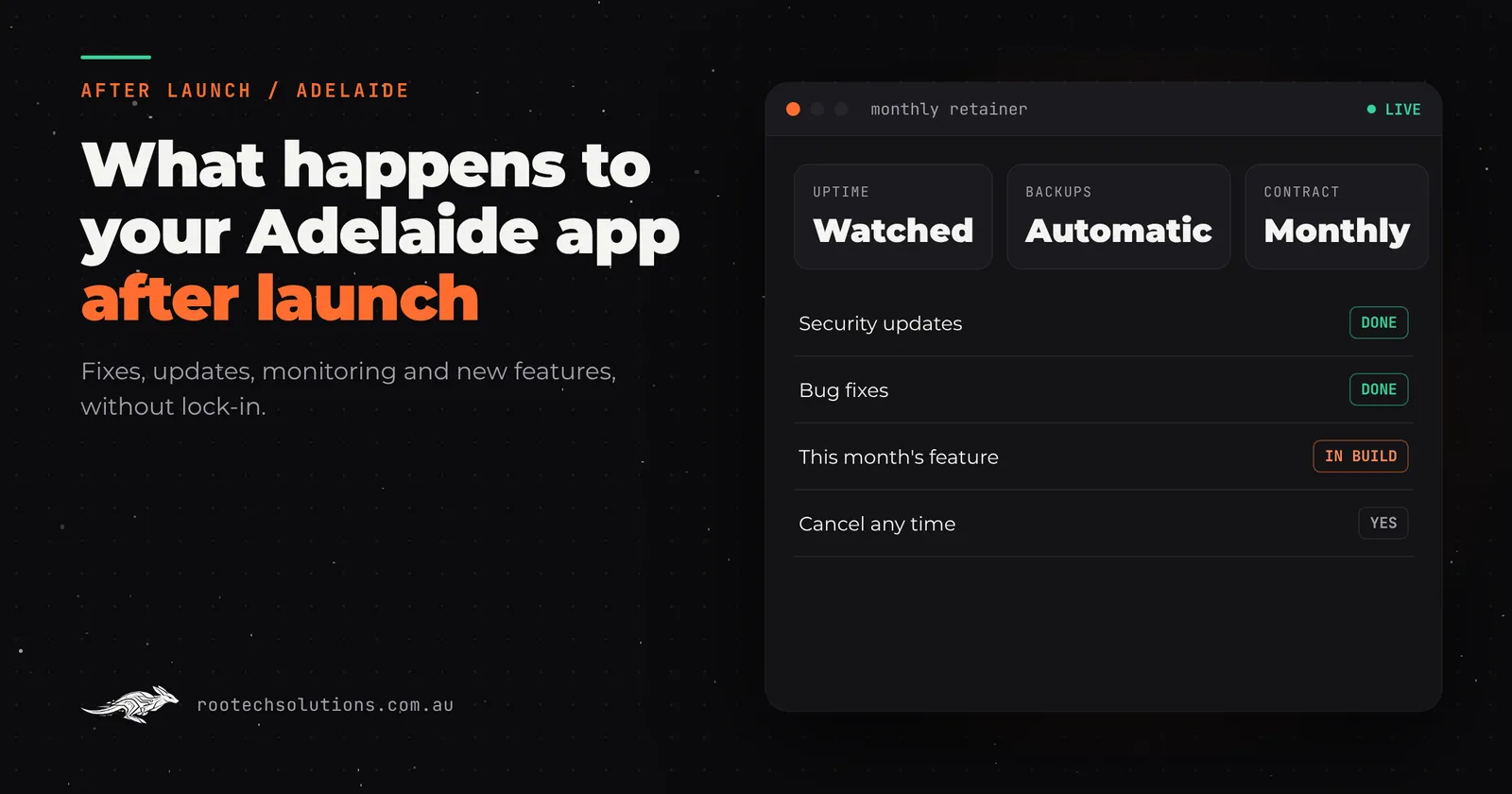
Your app launched. Customers are using it, payments are coming through, and for the first week you check the dashboard ten times a day. Then the developer who built it finishes up, and you are left with a live product, paying users and no one on call if something goes wrong. This is the part most Adelaide founders never plan for, and it is where good first versions quietly die.
Short answer: A live app needs three things forever: someone watching for breakage (monitoring and backups), someone applying updates (security patches and dependency upgrades), and someone on hand for bug fixes and small changes. A monthly maintenance retainer with a studio covers all three, usually for far less than hiring anyone, and you can switch providers any time if you own the code.
Launch day is the start, not the finish
There is a version of your app that exists on launch day, and it will not stay that way. Everything it touches changes underneath it: the hosting platform updates, the database engine patches, the payment provider deprecates an API version, the browser on your customers' phones changes how it renders something. None of this is your fault and none of it shows up as a bug report. It just accumulates until one day a checkout fails or a report comes out blank.
Software is more like a car than a house. A house mostly sits there. A car needs servicing even if you never drive it, because the world around it moves. The founders who get this right are not the ones who budget for more features. They are the ones who budget for keeping the thing they already built working.
What actually needs doing every month
Here is the honest list of what "keeping an app running" means. Most of it is small. All of it matters.
- Monitoring. Something should tell a human when the app is down or throwing errors, before a customer does. A monitoring tool watching your site costs a few dollars a month; the important part is that someone actually reads the alerts.
- Backups, tested. A backup nobody has ever restored is a hope, not a plan. Once in a while, someone should confirm the backup exists and can actually be brought back.
- Security updates. The libraries your app is built on publish fixes continuously. Applying them is routine work, but skipping it for a year is how small products get breached.
- Bug fixes. Real users find edge cases you never imagined: a date format, a postcode with a space, a double-clicked button that charges twice. Each fix is small. Left alone, they pile up.
- Small changes. A new report, a tweak to an email, a field added to a form. This is not new development, it is the normal drip of a product that people use.
- Renewals and credentials. Domain, SSL certificate, hosting account, API keys. None expire dramatically; they just quietly lapse and take the app with them.
If you have no developer, every one of these becomes your job, done with guesswork.
Your three options, honestly compared
| Option | What you get | Where it bites |
|---|---|---|
| Do it yourself with AI tools | Free-ish, and you learn a lot | Updates get skipped when you are busy; an AI can fix a symptom while missing the cause; no one notices when the monitoring alert fires at 2am |
| Hire a developer (full time or freelance) | Deep knowledge of your app | A full-time salary for maybe ten hours of real work a month; a single freelancer is one illness away from unavailable |
| A maintenance retainer with a studio | A team that already knows software like yours, fixed monthly cost, cancel any time | They need a handover to learn your code first |
For most non-technical founders running one product, the retainer wins on cost and on resilience: you are not dependent on one person's calendar or health. For a product with heavy daily change, an in-house developer starts to make sense, but that is a different stage of the company.
Rootech runs exactly this as software maintenance: we take over custom software, including code another developer or studio built, then keep it running and improving on a monthly retainer you can cancel any time. Taking over someone else's code is normal work for us; the first step is a review of what you have.
The handover: what to ask for before anyone leaves
If your original developer is still reachable, get these sorted now, while it costs you one polite email. If they are already gone, a new studio can recover most of it, but it takes longer.
- The code. The full source in a repository your account controls, not a copy on their laptop.
- The credentials. Hosting, domain registrar, database, payment provider, email service. Every account should be in your name with your card on it.
- Documentation. Even a page of notes: what the app talks to, how deployments happen, where the database lives.
- How it deploys. The exact steps to publish a change, so any future developer can do it without archaeology.
- A fresh backup. Taken on the day they hand over.
If you are reading that list and realising you have none of it, do not panic, but do not put it off either. Owning your code and accounts is the single thing that keeps you free to choose who works on your app next. We wrote about what ownership looks like when you are building version one in our founders guide to a first product, and the same principles apply to a rescue.
When "keep it running" turns into "fix it properly"
Sometimes maintenance reveals a deeper problem: the app was a prototype that never got a real foundation, and every month brings another patch on a patch. Signs include the same bug returning in new costumes, fear every time anyone touches the code, and fixes that break something else. If that is your app, the honest answer is that no amount of retainer patching makes it stable, and the foundation needs rebuilding while the screens your users know stay the same. That is the vibe code cleanup conversation, and it is worth having before you pay for a year of patches.
A useful self-check you can run this week:
- Write down what would happen today if the app went offline for a full day. Who notices, what does it cost, who fixes it?
- Check whether you personally hold the logins for hosting, domain and database.
- Ask (or check) when the last backup restore was tested.
- Look at the last three bugs you hit. Were they fixed, or worked around?
Two or more uncomfortable answers means the app needs a plan, not just goodwill.
What this costs, roughly
A maintenance retainer for a small product is typically a few hundred dollars a month, scaled to how much the app does and how much change you want. Running costs sit on top: hosting is usually under $50 a month, and AI features that process text or images typically add $20 to $200 a month depending on volume. Compare that with a full-time developer or with the cost of one week offline, and the retainer usually pays for itself the first time something breaks on a Sunday.
Every engagement is fixed price where work is quoted, and the scope of a retainer is agreed up front so there are no surprise invoices for asking a question.
What a good first month looks like
If you hand a live app to a studio, the first month should look like this: they review the code and infrastructure and report what they found, monitoring and tested backups go in place, the urgent backlog of bugs gets triaged and knocked over, and you get a plain-English summary of what the app needs over the next six months. You should finish the month able to say who is watching your app, what happens when it breaks, and what it costs. Anything less is just a slower way of being on your own.
Takeaway
Launch is the beginning of the maintenance story, not the end of the build. Monitoring, backups, updates and a named person on call are not optional extras for a product with real users; they are the product. Set them up once, review them twice a year, and your app keeps earning while you get back to the parts only you can do.
Frequently asked questions
How much does app maintenance cost?
For a small product, most studios charge a fixed monthly retainer of a few hundred dollars, depending on how much change you want each month. Rootech quotes after reviewing the code, and the retainer can be cancelled any time.
Can you take over an app another developer built?
Yes. This is normal work. The first step is a review of the existing code and accounts so we can tell you honestly what shape it is in, then we take over running it. You own the code either way.
Do my users notice anything during a handover?
Done properly, no. The app, the URL, the logins and the data all stay as they are. The only thing that changes is who is behind the scenes.
What if the original developer left nothing documented?
It happens often. A review will recover most of it by reading the code and the accounts. Documentation can be rebuilt from the code, and it is worth doing once so the next handover takes days instead of weeks.
Should I just ask AI to maintain it myself?
AI tools are genuinely useful for small, contained changes, and on a codebase with tests and backups that is safer than it used to be. But monitoring alerts, security patches and diagnosing why a payment failed at 11pm need a responsible human. Use AI inside a maintenance plan, not instead of one.
Rootech Solutions is a Melbourne studio working Australia-wide, including Adelaide founders: video for discovery and reviews, cloud builds, everything shipped with a proper handover. If your app is live and nobody is on call for it, book a free call through our contact page and we will tell you honestly what it needs.