Fixed Price or Hourly for a Perth Founder's First App?
Fixed price or hourly for version one of your app? A plain-English guide for Perth founders building a first product, with what a fair fixed quote must.
You have an idea for a course platform, you have maybe talked to two people who might pay for it, and every developer you speak to quotes differently. One says fixed price. One says hourly, "because scope always changes". One says sign up for a monthly retainer and see where it lands. You cannot judge any of them, and the wrong choice can eat your whole budget before anyone uses the product.
This is written for founders in Perth and anywhere else in Australia who are about to pay someone to build version one of an app, using a course or coaching platform as the worked example. The same logic applies to a booking app, a marketplace or an internal tool.
Short answer: For version one of a product, a fixed price usually beats hourly billing, because the risk of a blown budget sits with the studio that quoted it instead of you. Fixed works when you scope one painful job tightly and freeze it. Hourly works when nobody can honestly define the scope yet. If a studio cannot quote fixed, that itself is information about how clearly they understand your idea.
Why hourly billing quietly punishes first-time founders
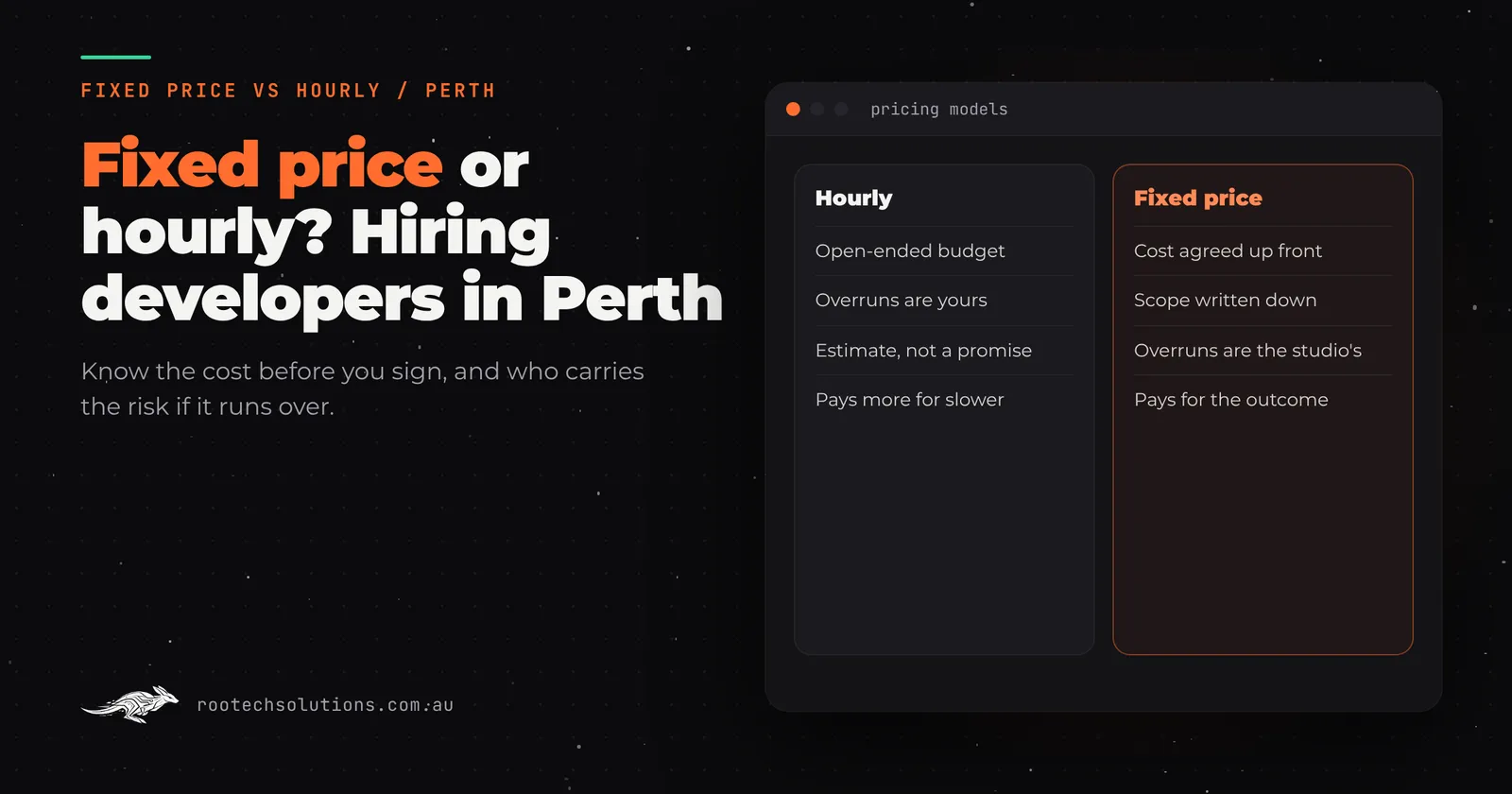
On hourly, the developer carries no risk of overrun. You carry all of it. Every misunderstanding, every vague requirement and every "while we're in here" change becomes your invoice.
It is not that hourly developers are dishonest. It is that scope is fuzzy at the start of any first product, and fuzzy scope plus a clock equals a bill nobody predicted. A founder on hourly billing typically has no idea what the final number will be until the final invoice arrives.
Fixed price flips the risk. The studio has to actually understand your idea before quoting, because if their estimate is wrong, that is their problem, not yours. That is also why a fixed quote is such a useful signal: a studio that can price your version one fixed has thought it through.
What fixed price protects, and what it does not
Fixed price is not a magic shield. It protects the budget for a defined scope. It does not protect you from changing your mind.
Fixed price protects: the agreed feature list, the agreed timeline, and you from the cost of the studio underestimating the work.
Fixed price does not protect: features you add mid-build, a pivot in what the product is for, or "small" extra ideas that arrive in week two. Those are scope changes, and every studio handles them differently. Ask before signing how change requests are priced. A fair answer is a written variation, quoted before the work starts, never a vague "we'll sort it out later".
The discipline fixed pricing forces on you is the point. To get a fixed quote, you have to write down what version one actually is. That document is worth more than the discount you might have got from hourly.
What version one of a course platform should actually contain
Here is the trap most founders fall into: they scope version one as the finished product they see in their head, minus a few features. A course platform in their head has video hosting, quizzes, progress tracking, certificates, community forums, a mobile app, payment plans and affiliate links.
Real version one is the smallest thing a paying customer will use and pay for again. For a coaching platform, that is honestly small:
- A coach creates a client and a simple program.
- The client logs in and sees what to do this week.
- The client checks things off and maybe uploads one file.
- The coach sees what happened.
That is it. No video, no certificates, no community. One painful job, done properly, proves whether anyone will pay. Everything else is version two, and you should not pay a cent for it until version one has paying users.
If you are at the stage of writing that list, we have a fuller guide on what belongs in version one of your app, written for founders in the same position.
The honest case for hourly, and when to choose it
To be fair to the other side: there are situations where fixed price is the wrong tool.
Choose hourly when: you are genuinely still discovering what the product is, and you expect the definition to change weekly. Pretending that is a fixed scope produces friction: every change becomes a renegotiation, and someone stops talking straight.
Choose a time-boxed arrangement when: you want a prototype to put in front of ten people, not a product. Some studios will quote a fixed-price prototype review or a fixed-price discovery first, then quote the build. That is often the best of both.
Choose fixed when: the scope above is written down, the painful job is clear, and the budget matters more to you than flexibility. That describes most first products from non-technical founders.
One more honest note: a fixed quote that comes back suspiciously low is a red flag, not a bargain. If your five-feature platform is quoted at a tenth of what other studios quoted, someone has not understood the work, and you will meet that misunderstanding later as missed deadlines or a "please top up" email.
What a fixed-price build should include before you sign
The price is the easy part of the quote. The inclusions are where founders get caught. Before you sign anything, this list should all be explicitly covered:
- You own the code. The repository, the hosting account, the database and the domain sit in your name, not the studio's. If you pay for it, you own it, and every credential should be handed over at launch.
- A live URL you can test on as it is built. You should be able to click through the real product during the build, not wait for a reveal at the end.
- Bug fixes after launch. Software ships with defects. Find out who fixes them and for how long.
- A handover pack. Documentation, credentials, and how to run the thing. If the studio disappeared tomorrow, could a new developer pick it up?
- What happens next. A launch date is not a maintenance plan. Ask what monitoring, updates and improvements look like afterwards, and what they cost.
Rootech's product development service works this way: a fixed price agreed before work starts, built on a live URL you test as it goes, with the code and accounts in your name. If you want the deeper reasoning on the ownership side, we wrote a plain-English guide on who owns the code when you pay a developer.
Fixed price versus the other options: a straight comparison
You have more than two options. Here is how they stack up for a first product.
| Option | Who carries the overrun risk | Best for | Watch out for |
|---|---|---|---|
| Fixed price studio | The studio | A defined version one with a real budget | Scope creep you cause, and quotes that are too good |
| Hourly freelancer | You | Early discovery, unclear product | No end point in sight; you are the project manager |
| Offshore agency | Shared, at best | Budgets that cannot stretch | Time zones, communication overhead, variable quality |
| No-code / AI builder, yourself | You | Testing the idea cheaply | The gap between prototype and production |
| Monthly retainer | Unclear until it is too late | Ongoing work after launch | Using it as a substitute for a scoped build |
The no-code and AI-builder route deserves its own line of respect. Tools like Lovable, Bolt and Replit are genuinely good at getting an idea in front of people fast. If that is where you are, do not pay anyone to build anything yet. But once real users, payments or private data arrive, that prototype needs a different foundation, and that is the point where our vibe code cleanup work usually starts.
How to brief a studio so a fixed quote is even possible
Studios quote fixed when they understand the idea. Help them get there and you will get a better, tighter price:
- Write one paragraph: who uses this, and what painful job it does for them.
- List the steps of that job, in order, from the user's point of view.
- Mark which steps are in version one and which are not.
- Say what "done" means: what a user can do on launch day.
- Bring any prototype, spreadsheet or mock-up you already have. Even rough ones stop a hundred misunderstandings.
A studio that responds to that brief with questions, not a number, is a good sign. The questions are how they avoid underestimating your build, which is the exact mistake that kills fixed-price projects.
What happens after the fixed-price build ships
Launch is a beginning, not an ending. Expect three categories of ongoing work: bug fixes on what was built (which should be included for a period after launch), security and platform updates, and the improvements real users will ask for within the first month.
You do not need to hire anyone for this on day one. What you need is clarity: know what is included post-launch, know who to call, and know how to take the work elsewhere if you ever need to. We keep a guide on software maintenance and keeping a product running that covers the retainer-versus-in-house question. And if the product grows to where it is replacing spreadsheets and subscriptions across a team, that drifts towards custom business software territory, which is a different conversation.
The takeaway
For a Perth founder building version one of a course platform, a booking app or anything else: get the scope written down, get it priced fixed, own the code and the accounts, and treat an oddly cheap quote as a warning rather than a win. Hourly billing is honest when the product itself is still unclear. Once you know what version one is, fixed price puts the budget risk where it belongs, on the people who estimated the work.
If that sounds like where you are, book a free call with Rootech and we will scope version one with you: what it should contain, what it should cost, and what to leave out. Rootech is a Melbourne studio working with founders Australia-wide, mostly over video. Or if you have already built something, send us what you built for a fixed-price review.
Frequently asked questions
Is a fixed price always cheaper than hourly for an MVP?
Not always, but it is usually more predictable. If scope is tight and the studio estimates well, fixed tends to cost the same or less than hourly, because there is no incentive to stretch. If scope keeps changing, fixed can end up more expensive through paid variations. The scope, not the pricing model, is what decides the bill.
How long does version one take to build?
Most first versions are small: one painful job, four or five screens, one login. At Rootech, most builds ship in two to four weeks; bigger platforms get a fixed timeline agreed up front. Anyone promising a serious product in days is selling you a prototype, not a product.
Do I own the code if I pay a fixed price?
You should, and you should confirm it in writing before signing. Ownership means the repository, hosting, database, domain and every credential are in your name and handed over at launch. If a quote is silent on ownership, ask. For a full explanation, see our guide on who owns the code when you pay a developer.
What if I want to change a feature mid-build?
You will. Agree the change process before signing: changes get written up and quoted as variations before the work starts. Small changes get absorbed by a good studio. The dangerous ones are the unquoted "quick additions" that arrive verbally and show up on the invoice later.
Can I build version one myself with an AI tool instead?
For testing an idea with a handful of friendly users, yes, and it is often the right move. Once real users, payments or private customer data are involved, the prototype needs a production foundation: server-side permissions, backups, tests and monitoring. That is the point to get a review and a fixed-price quote for making it real.