How Melbourne Businesses Get Recommended by AI
How to get recommended by AI and cited by ChatGPT: the crawler settings, pages and local signals each engine relies on, and how to test where you stand.
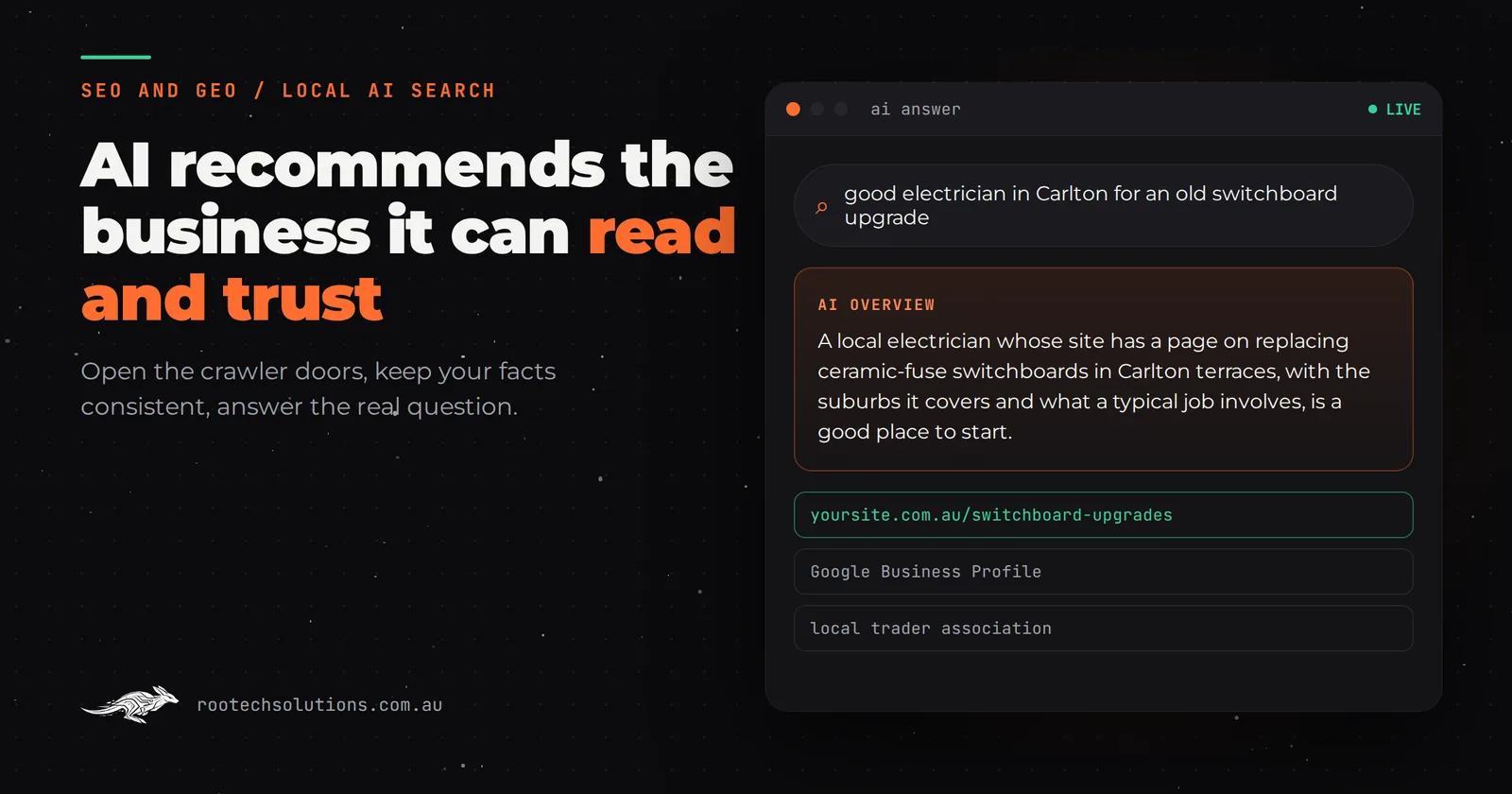
A customer asks ChatGPT for "a good electrician in Carlton who can upgrade an old switchboard", gets three names, and rings the first one. You do switchboards in Carlton every week, but you were not on the list, and you have no idea why. To get recommended by AI, it helps to stop thinking of "AI" as one thing. Google's AI Overviews and ChatGPT search find businesses in different ways, and each has a door you can check is open.
Short answer: To get recommended by AI, a local business needs three things: pages the engines are allowed to crawl and quote, consistent facts about who you are and where you work across the web, and pages that answer the questions customers ask before they choose. Google's AI Overviews draw on its Search index and Business Profiles; ChatGPT search relies on its own crawler, OAI-SearchBot.
Do AI assistants keep a list of "the best" local businesses?
No. There is no hidden ranking of the best plumber in each suburb. When someone asks, the assistant searches, reads a handful of sources and writes a summary from what it found.
Google describes its own version in its guide to generative AI features: AI Overviews and AI Mode use its core Search ranking systems to retrieve pages from the Search index, and often run several related searches at once (it calls this query fan-out) before writing the answer with links to the pages that support it. In other words, the recommendation is assembled from search results. If you are not findable in search for the questions behind the request, you are not in the answer.
That is good news for a small business. Being recommended is not about size. It is about being the clearest, most consistent source for a specific question in a specific place.
Is your website even allowed into the answer?
Check this first, because it is the one problem no amount of content fixes. Each engine has its own door.
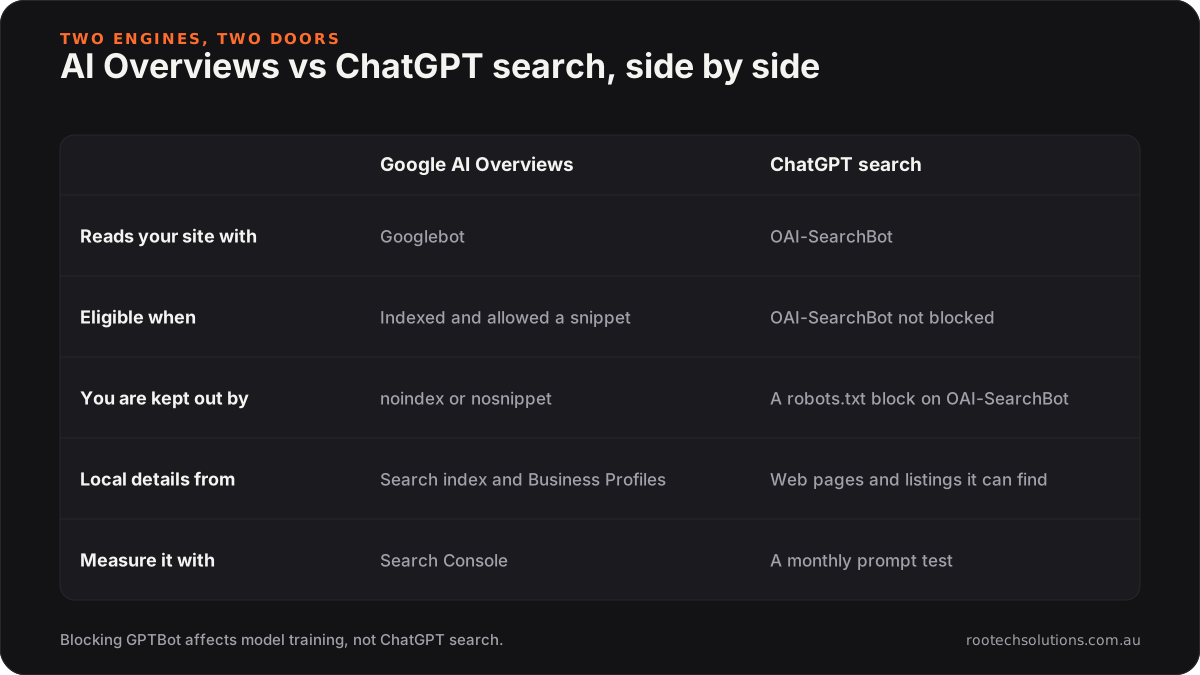
Caption: Two engines, two doors. Check both before you write a single new page.
Google AI Overviews. Google says a page must be indexed and eligible to show in Search with a snippet to appear as a supporting link. A nosnippet tag, a noindex left on from the last redesign, or a page Google has never indexed all keep you out. The URL Inspection tool in Search Console tells you which. There is no separate AI crawler to let in: AI Overviews work from the same Googlebot crawl as normal Search. Google's crawler documentation also says the Google-Extended robots.txt token, which controls use of your content for Gemini, does not affect inclusion in Google Search.
ChatGPT search. OpenAI's crawler documentation lists separate bots. OAI-SearchBot surfaces websites in ChatGPT's search features, and OpenAI states that sites opted out of OAI-SearchBot will not be shown in ChatGPT search answers. GPTBot is different: it crawls content that may be used to train OpenAI's models. Blocking GPTBot is a choice about training. Blocking OAI-SearchBot is a choice about being found.
Open yoursite.com.au/robots.txt and look for either name. Some hosting, CDN and security tools also include settings that block AI crawlers, so if you use one, check what it is set to. It is easy to block every AI bot with one switch and not notice that a search crawler was on the list.
What gets a business recommended by AI?
Consistency and specificity. An assistant names a business when several sources agree on what it does and where, and at least one page answers the exact question asked.
- The same facts everywhere. Business name, suburb, phone, services and hours should read identically on your site, your Google Business Profile and the directories you are listed in. If your site says Preston and your profile says Reservoir, a summary has to pick one or hedge. We cover the profile side in why your Google Business Profile is your best GEO tactic.
- A page for the question, not just the trade. "Electrician Melbourne" is a category. "Do you upgrade old ceramic-fuse switchboards in Carlton terraces?" is a question, and the page that answers it plainly is the one that gets quoted.
- Genuine mentions, not bought ones. Google's guide says AI features can show what is said about businesses across the web, but that chasing inauthentic mentions is not as helpful as it seems, because the same spam systems apply. A real write-up from a local trader association or a customer's renovation blog counts. Fifty directory submissions do not.
- Specifics a competitor cannot copy. Your actual service area, the work you do most, what a typical job involves, and honest price ranges framed as estimates. Google's guide calls this non-commodity content: information that comes from doing the work, not from summarising other websites.
Is ChatGPT different from Google for local businesses?
In the details, yes. In what it rewards, mostly no.
Google has your Business Profile, Maps data and its full index, so a well-kept profile can carry you a long way even with a thin website. ChatGPT search has to find you through the web pages it can crawl and the search results it draws on, so your own site and your listings elsewhere carry more of the load. OpenAI does not publish a list of the local data sources it uses, and anyone who tells you exactly how it ranks businesses is guessing.
What both reward is the same: pages they can reach, facts that agree with each other, and answers worth quoting. A business that gets those right does not need a separate "ChatGPT strategy".
Does a template website hold you back?
Sometimes. Off-the-shelf builders such as Wix, Squarespace and WordPress with a page builder are fine for plenty of local businesses, and if yours lets you write proper service pages, control your titles and keep your content in plain HTML, keep it.
They start to cost you when:
- your services are hidden in one long page or a tab widget that only loads on click;
- every page shares the same title and description;
- a plugin or theme you cannot see into is blocking crawlers or adding
noindex; - your booking or quote form lives on a third-party domain, so your site never shows what you actually offer.
Google says it can process JavaScript as long as it is not blocked, but recommends following its JavaScript SEO practices because these sites are more complex to get right. Our own rule of thumb: if the words that answer a customer's question are in the page's HTML when it loads, every engine can read them.
A custom website built around how your customers actually ask (one page per service, a small number of genuinely useful area pages, structured data that matches the visible text, and quoting or booking on your own domain) typically takes three to four weeks. As an estimate, most land between $5,000 and $15,000 at a fixed price depending on page count and integrations, with hosting usually under $50 a month. See our Melbourne custom software page for how we scope that work.
How do you check whether AI recommends you now?
Run the same set of questions every month and write down the answers. It takes 20 minutes and it is the only honest measure most small businesses have.
- Write five real questions a customer would ask, with a suburb and a job in each: "who can replace a hot water system in Pascoe Vale this week?"
- Ask each one in Google (note whether an AI Overview appears and who it links), in ChatGPT with search on, and in one other assistant your customers use.
- Record who is named and which pages are linked. The links tell you which page the engine trusted, yours or a competitor's.
- Check Search Console. Google says traffic from AI features is included in your Search Console data, and its guide points to a Generative AI performance report for this.
- Fix one thing, then re-run next month. One page, one listing, one robots.txt line. Changing everything at once tells you nothing.
Frequently asked questions
Should I block AI crawlers to protect my content?
That is a trade-off, not a rule. Blocking a training crawler such as GPTBot does not stop you appearing in ChatGPT search, but blocking OAI-SearchBot does. Most local service businesses want to be found, so they leave search crawlers open and decide separately about training.
Can I pay to be recommended by ChatGPT or Google's AI Overviews?
Not in the organic answer. Google states there is no way to request or pay for a better local ranking, and its AI Overviews draw on the same ranking systems. Be wary of anyone selling guaranteed AI placement.
How long does it take before AI assistants start naming my business?
There is no fixed timeline. A crawler setting fixed today can matter within weeks, because it removes a block. New pages and consistent listings build up more slowly, the same way search rankings do, so judge progress over a few months of the monthly test rather than day to day.
Do I need a different website for AI search?
No. Google says optimising for its generative AI features is still SEO, and there are no extra files or special markup required. The site that answers customers well for Google is the same site an assistant quotes.
Want to know where you stand?
We will run the monthly test with you on your own suburbs and services, check your crawler settings and listings, and tell you what to fix first, whether or not that involves building anything. Book a free AI workflow audit. The audit fee comes off your first project.