How Melbourne Trades Get Cited by ChatGPT and AI Overviews
How tradies get cited by AI Overviews and ChatGPT: the questions that trigger AI answers, the job write-ups that get quoted, and what to stop doing.
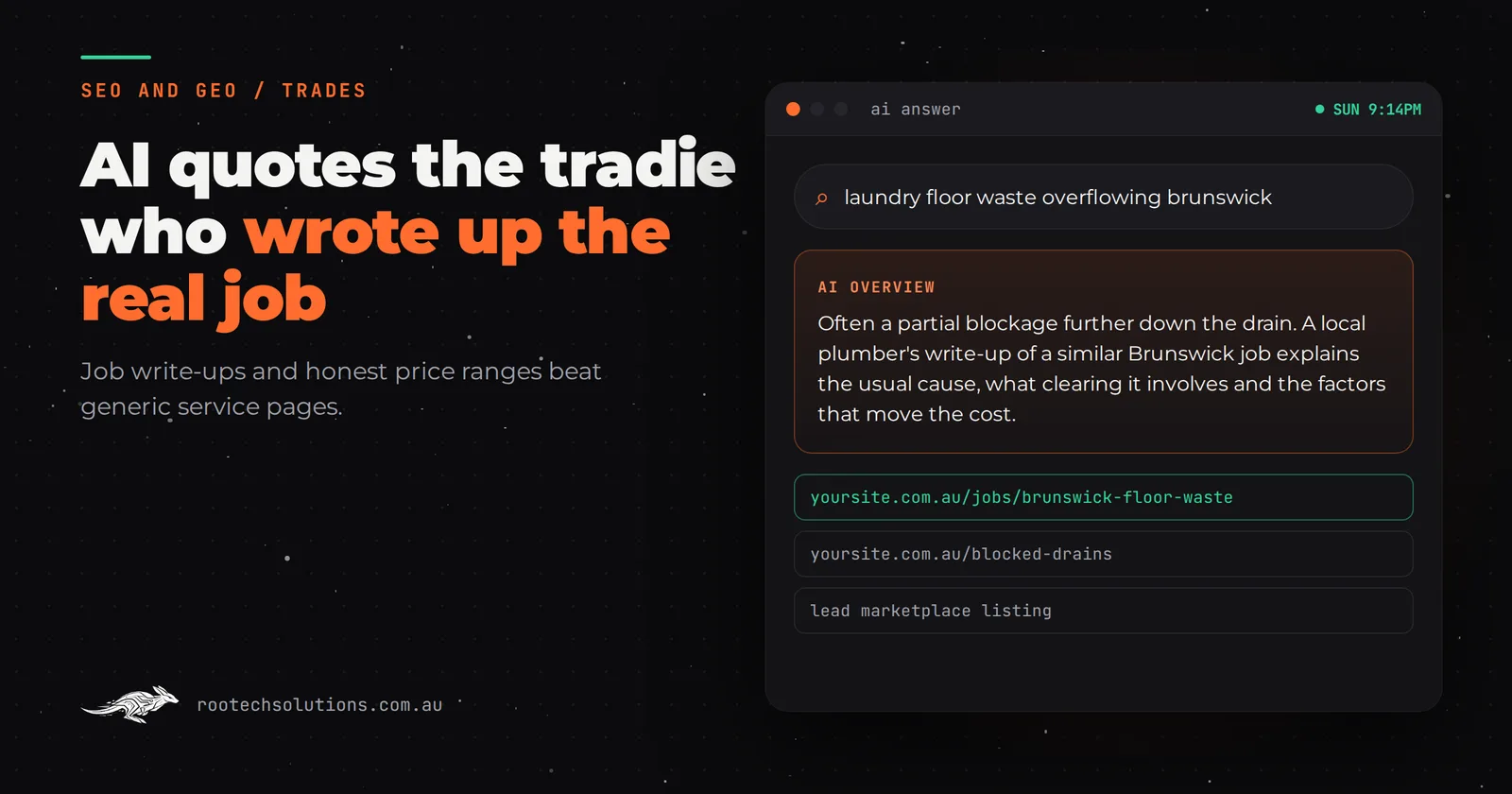
A homeowner in Brunswick finds water pooling around the laundry floor waste on a Sunday night. They do not browse ten trades websites. They ask Google or ChatGPT what is going on and who can fix it, read the AI answer, and ring someone it mentions. To get cited by AI Overviews in that moment, a trades business needs something most trades websites do not have: pages written from the actual work.
Short answer: Trades businesses get cited by AI Overviews and ChatGPT when their site answers the specific questions homeowners ask (what is wrong, what it costs, whether it is urgent, who covers my suburb) with first-hand detail from real jobs. Generic service pages rarely get quoted. Honest price ranges, job write-ups with photos and plain licence details usually do.
What do AI Overviews look for in a trades website?
The same things Google Search looks for, with more weight on content only you could have written. Google's guide to its generative AI features says AI Overviews and AI Mode are built on its core ranking systems, so the SEO basics still apply. Then it draws a line most trades sites fall on the wrong side of.
It calls a page like "7 Tips for First-Time Homebuyers" commodity content: common knowledge anyone could write. Its example of the opposite is "Why We Waived the Inspection & Saved Money: A Look Inside the Sewer Line", a first-hand account from someone who did the thing. Google says content like that, with a unique point of view from real experience, is likely to influence your presence in generative AI search more than any other suggestion in the guide.
For a plumber, electrician or roofer, that is an unfair advantage you probably are not using. You see more real jobs in a month than a content writer sees in a career. A page called "Hot water systems" is commodity content. A page called "What we found inside a 15-year-old gas storage unit in Thornbury, and what replacing it cost" is not.
Which homeowner questions trigger an AI answer?
Questions, not trade names. "Plumber Melbourne" mostly returns the map pack and ads. The longer questions people type or speak when something has gone wrong are where AI Overviews and ChatGPT do most of the talking.
| Question type | What the homeowner asks | The page that answers it |
|---|---|---|
| Diagnosis | "Why is my floor waste overflowing?" | A short guide written from your jobs, with photos |
| Urgency | "Is a tripping safety switch an emergency?" | A plain answer plus when to call you now |
| Price | "How much to replace a hot water system?" | Honest ranges, what moves the price, framed as estimates |
| Compliance | "Do I need a licensed electrician to move a power point?" | A direct yes or no and why |
| Coverage | "Who services Glenroy on a Saturday?" | Service area and hours stated plainly on every page |
Each row is one page or one clearly headed section, not one page for the lot. Open each with a one or two sentence answer, then the detail. That shape is easy for a person to scan, and it gives an AI summary a clean passage to lift.
What is a job write-up, and why does it get quoted?
A job write-up is a short page about one real job: the suburb, the problem, what you found, what you did, roughly what that kind of job costs and how long it took, with your own photos. Four hundred words and three photos is plenty.
They get quoted because they contain things no competitor's page contains: a specific fault, a specific house type, a specific fix. They also answer the follow-up questions an AI runs in the background. Google says AI Overviews often fire off several related searches at once to build an answer, and a write-up about a Thornbury hot water replacement can match "gas vs heat pump hot water", "hot water replacement cost" and "plumber Thornbury" all at the same time.
The catch is obvious to anyone who has run a trade business: nobody on the tools wants to write blog posts at 7pm. The write-ups that exist are the ones that are nearly free to produce.
Can job software produce the write-ups for you?
Partly. Job management tools such as ServiceM8, Tradify, Fergus and simPRO already hold most of the raw material: the job address, the notes, the photos the crew took, the invoice. They are built to run jobs and get paid, not to publish anything, and that is the right call for them.
A small custom integration can close the gap:
- The crew does what they already do. Photos and a line or two of notes go into the job app on site.
- The job closes. The integration picks up the suburb, the job type, the photos and the notes, and leaves out the customer's name and street.
- AI drafts the write-up. A short draft in your voice, built only from the job's own details, with a price range taken from your approved price list rather than invented.
- You approve or bin it. Ten seconds on your phone. Nothing is published without a person reading it, and jobs with privacy concerns never leave the system.
- It publishes to the right page. The write-up lands under the matching service page, so your hot water page grows a list of real hot water jobs.
We built the field-capture half of this for Bugaboo Landscaping: crews upload before-and-after photos from site and every closed job sends the client their own photos. The same capture step can feed your website.
As an estimate, an integration like this is $3,000 to $8,000 at a fixed price, built in two to four weeks depending on which job system it connects to. Hosting is usually under $50 a month and AI usage sits at the low end of $20 to $200 a month for a typical trades business's job volume.
Should you use a lead marketplace, a template site or a custom website?
Use what fits how you win work. Lead marketplaces such as hipages and Oneflare send you enquiries you pay for in one way or another (check their current pricing), and they are useful when you are starting out. They also build the marketplace's visibility, not yours: the AI answer cites their page.
A template website is fine for a trade with a handful of services and no plans to publish job write-ups. A custom website earns its keep when you want:
- a quote form that asks the questions you need answered (photos, access, the age of the unit, the suburb) so you can price before you drive out;
- an AI quoting tool that turns those answers into a ballpark from your own price list, for you to check and send;
- job write-ups flowing in from your job software instead of being written by hand.
Blythe & Cahill Tiling is an example of the simpler end: a fast, mobile-first site with the portfolio up front and a quote request that takes seconds. The construction end looks like the AI takeoff estimator we built for Logic Building Co, where plans go in and a draft estimate comes out for a person to review. A custom trades website of the first kind typically lands between $5,000 and $15,000, as an estimate, depending on page count and integrations.
What should you stop doing?
Some common trades SEO habits do nothing for AI answers, and a few work against you.
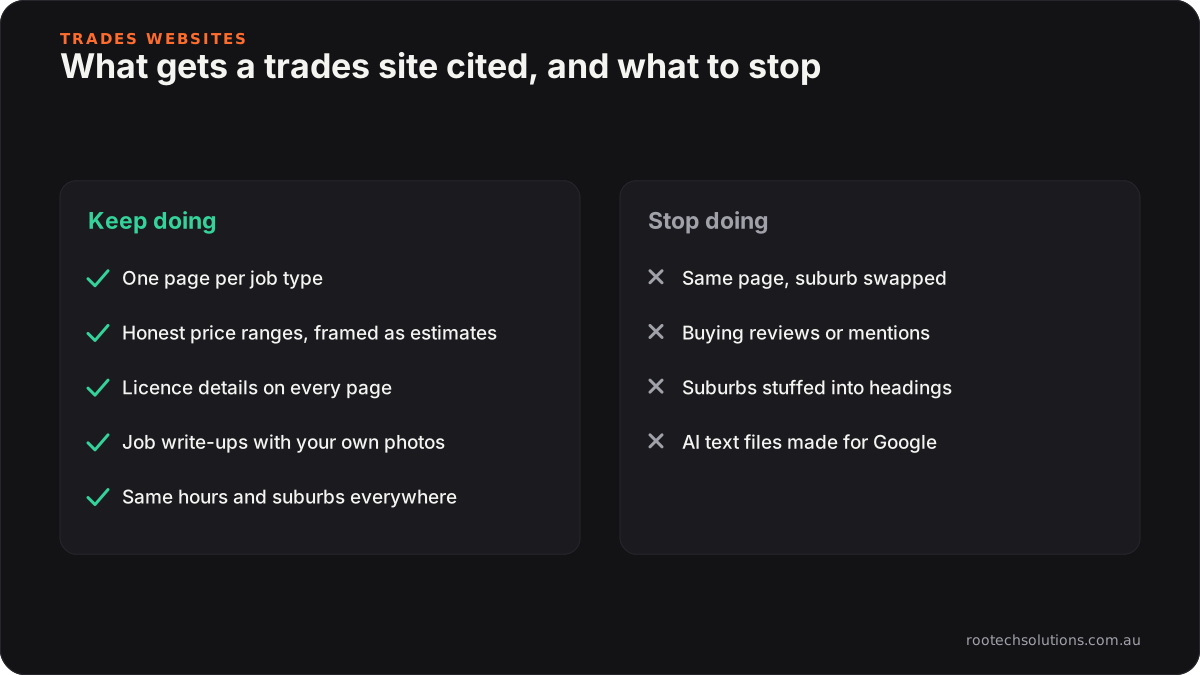
Caption: The keep list is mostly work from the field. The stop list is mostly shortcuts.
Buying reviews or mentions breaks Google's review policies and, for fake reviews, Australian consumer law. Stuffing suburb names into every heading reads badly to people, and Google says its AI systems understand synonyms and meaning, so exact-match repetition buys nothing. And Google's guide says Google Search ignores llms.txt and other AI text files, so creating one for Google's benefit is wasted effort.
The suburb-swap habit deserves a special warning. Fifty copies of the same page with only the suburb changed is what Google's spam policies call doorway abuse, and Google has made clear those policies apply to its AI responses too. We cover how to do area pages properly in how suburb landing pages get landscapers cited by AI.
Frequently asked questions
Should I publish prices if every job is different?
Publish ranges, not quotes. A range plus the two or three things that move it (access, the type of unit, whether the gas line needs work) is useful to the homeowner and quotable by an AI. A page that says only "call for a quote" gives an AI nothing to repeat.
Do I need to put my licence number on my website?
It is good practice for any licensed trade. Homeowners check it, and stating your licence or registration plainly on your service pages is the kind of verifiable detail that separates a real business from a lead-generation site. Check what your regulator requires you to display in advertising.
Will AI answers send me fewer calls because people get the answer without clicking?
For simple questions, sometimes. For trades, the answer to "why is my floor waste overflowing" is usually "call a plumber", and the business whose page explained it is the obvious one to call. Being the cited source is better than being absent from the answer.
How many job write-ups do I need before it makes a difference?
There is no magic number. A few good write-ups for your most profitable job types do more than dozens of thin ones, and one a week from real jobs builds up quickly over a year.
Want your jobs to do the writing?
We will look at your site, your job software and the questions your customers actually ask, then tell you which pages to write and whether an integration is worth building yet. Book a free AI workflow audit. The audit fee comes off your first project.