What AI Automation Really Costs a Vet Clinic
AI automation cost for a vet clinic: build and running costs in AUD, a payback sum you can redo with your own numbers, and where ezyVet-style systems stop.
The phone rings while your only receptionist is holding a dog still for a nurse. It rings out, and the owner of a vomiting cat tries the next clinic on Google. You know AI can answer that call, but you want the real AI automation cost for a vet clinic, and proof it pays back, before you sign anything.
Short answer: AI automation for a single vet clinic typically costs $3,000 to $7,000 to build and $150 to $600 a month to run, depending on whether it handles chat only or real phone calls. Most clinics with a busy phone and overdue reminders recover the build in two to four months. It pays back slowest where a full reception team already answers every call.
Why are vet clinic AI costs different from other clinics?
Two things make a vet clinic unusual: the phone doubles as a triage line, and most of the revenue comes back through reminders over a pet's lifetime rather than from one-off visits. Both change what you should build first and how you measure the return.
A human clinic can send every worrying call to triple zero. A vet clinic has to decide, call by call, whether "my dog ate a sock" is a book-tomorrow job, a come-in-now job or a send-to-the-emergency-hospital job. That decision must stay with a person. So the AI's main job on the phone is not to answer clinical questions. It is to recognise urgency fast, put a vet or nurse on the line or point the owner to the after-hours hospital, and handle everything routine without tying up the desk.
The second difference is where the money sits. Owners pay out of pocket, there is no rebate to nudge them back, and a puppy that starts its vaccinations with you can be a client for fifteen years if the reminders keep landing. Annual vaccinations, dental checks, weight rechecks and post-op reviews are where a lot of quiet revenue leaks, and they are cheaper to automate than a voice agent.
What does AI automation cost a vet clinic, workflow by workflow?
Most clinics pick from three builds. The ranges below are Rootech estimates in AUD, excluding GST, for a single site.
| Workflow | What it does | Build (estimate) | Running (estimate) |
|---|---|---|---|
| Website and social chat | Answers hours, fees, desexing and vaccination questions, books routine visits, flags anything urgent | $3,000 to $4,500 | $150 to $300 a month |
| AI phone agent | Answers overflow and after-hours calls, books into the diary, transfers urgent calls to staff or gives the emergency hospital's details | $5,000 to $7,000 | $250 to $600 a month |
| Reminder and recall layer | Finds overdue vaccinations and rechecks in your practice system, texts the owner, books the slot | $2,500 to $4,000 on its own, less as an add-on | Mostly SMS costs |
Voice costs more than chat because call minutes and speech processing are billed by use. A multi-site group with shared rosters and different emergency arrangements per clinic sits above these ranges, because every rule has to be written and tested per site.
Hosting is usually under $50 a month on top. AI usage typically runs $20 to $200 a month, depending on how many conversations it handles.
How do I work out the payback for my clinic?
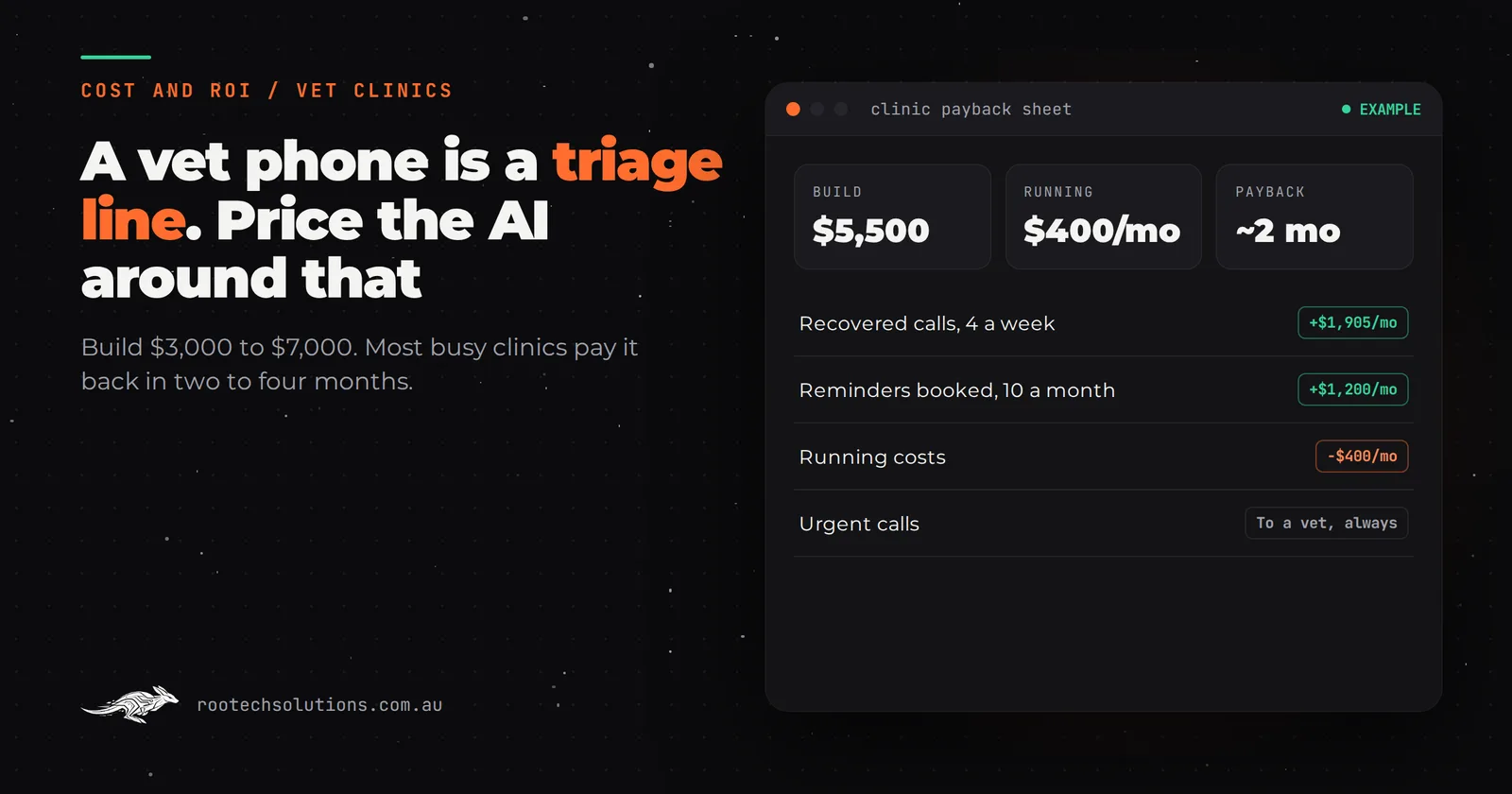
Take the cost of the build and divide it by the extra money each month brings in after running costs. That is the whole calculation. The work is in choosing honest inputs, so here is a worked example with every assumption shown. Replace each one with your own figure.
| Assumption | Example value | Your number |
|---|---|---|
| Build cost (phone agent plus reminders) | $5,500 | |
| Running cost a month | $400 | |
| Calls currently missed that were real booking requests | 4 a week | |
| Average consult value | $110 | |
| Overdue reminders that turn into a booking each month | 10 | |
| Average value of a reminder visit | $120 |
Working it through:
- Recovered calls: 4 a week x $110 x 4.33 weeks = about $1,905 a month.
- Recovered reminders: 10 x $120 = $1,200 a month.
- Total extra each month: $3,105. Minus $400 running costs: about $2,705 a month.
- Payback: $5,500 / $2,705 = about two months.
Halve both recovery numbers and the payback stretches to roughly four and a half months. That spread is why the honest range is two to four months for a busy clinic, not "instant". To get your "calls currently missed" number, check your phone system's missed-call report for a normal fortnight, then ask the desk how many of those were new bookings rather than results calls or repeat scripts.
Is ezyVet or my current practice system enough on its own?
Often it is, at least for reminders. Cloud practice systems such as ezyVet, Provet Cloud and RxWorks, and the booking tools that plug into them, already send standard vaccination reminders and confirmations, and some offer online booking. If yours does that well and owners actually book from it, do not pay anyone to rebuild it. Check what your plan includes before you buy anything.
A custom AI layer earns its place in three situations:
- Your reminders go out but nobody books. A message that says "Bella is due" and links to a phone number converts worse than one where the owner replies "Thursday after work" and gets a confirmed slot back.
- Your phone is the bottleneck. Practice systems manage the diary; they do not answer a ringing phone at 7pm. That needs a voice agent or a missed-call text-back that writes into the diary.
- Your triage rules are specific. Which symptoms go straight to a nurse, which suburbs go to which emergency hospital, which vet takes exotics. Generic tools cannot hold rules like these. A custom build can, and it can be tested against your real call notes.
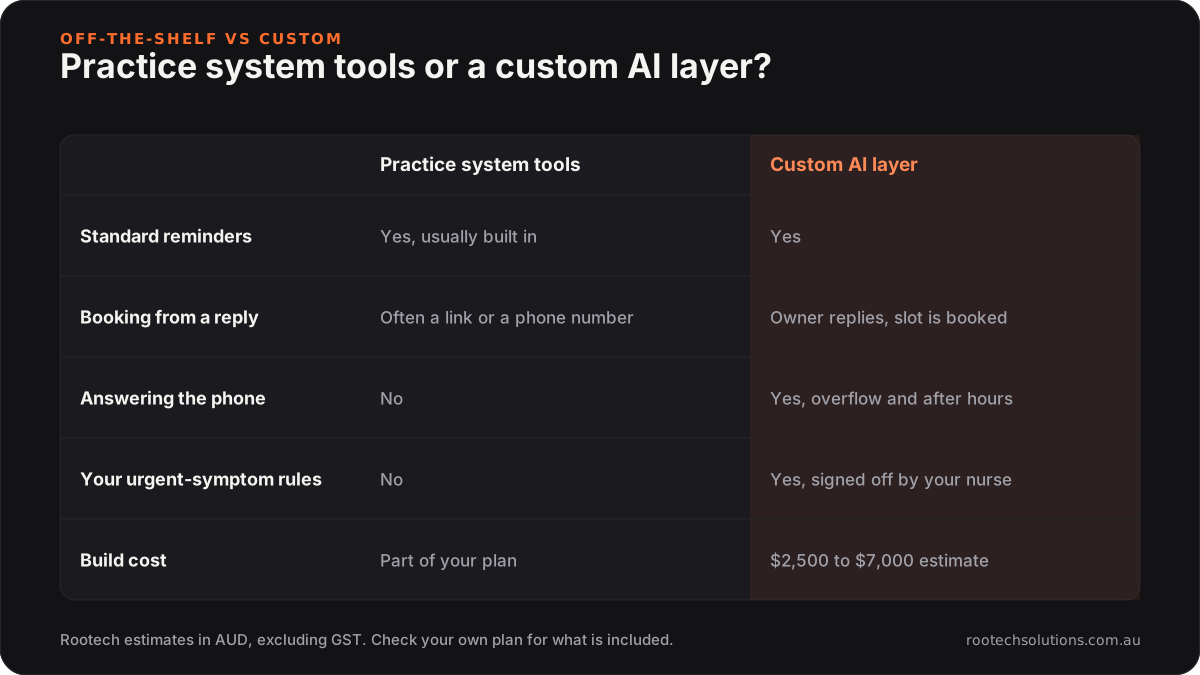
Caption: Your practice system covers the standard reminders; a custom AI layer earns its keep on the phone, on replies and on your triage rules.
Before any build, confirm your system offers an API or an approved integration path. Older on-premise software sometimes does not, and that is the line item that can double an estimate. We explain the general trade in chatbot platform vs custom AI agent.
What does the build look like?
A vet clinic build usually ships in two to four weeks at a fixed price.
- Week one: your rules. Services and fees, booking lengths per appointment type, which vet sees what, and the urgent-symptom list your senior nurse signs off. This list decides when the AI stops talking and hands over.
- Weeks two and three: build and connect. The agent is connected to your practice system's diary and client records, your phone number (it overlays your existing number, you do not change it) and your SMS provider.
- Final week: testing. It is run against a few weeks of your real enquiries and past call notes before an owner ever hears it.
A person stays in the loop at every point that matters. The AI never gives medical advice, never quotes a treatment price beyond your published consult fees, and passes any call about breathing trouble, bleeding, poisoning or collapse to a staff member or the emergency hospital straight away. Staff see every booking it makes and every conversation it hands over, so the morning starts with a list rather than a voicemail backlog.
Victorian vets are registered by the Veterinary Practitioners Registration Board of Victoria, and clinical advice stays with registered people. Building the AI to refuse clinical questions is the simplest way to keep it on the right side of that line.
When is it not worth it for a vet clinic?
It is not worth it if you already have a well-staffed desk that answers nearly every call and you refer all after-hours work to an emergency hospital. Then the phone agent automates a problem you have solved with people, and only the reminder layer is worth costing.
It is also hard to justify under about 30 calls a week, where the running cost eats most of the gain, or when your practice software cannot be connected at all. In that case, upgrading the practice system first and adding AI later is usually cheaper. If you are not sure whether your reminders are the real leak, our guide to the repeat visits vets lose walks through how to check.
Frequently asked questions
Can an AI receptionist for a vet clinic handle emergencies?
It should recognise them, not handle them. A well-built agent listens for urgent signs you define, then transfers the call to a staff member or gives the owner the details of your after-hours emergency hospital immediately. It should never try to assess the animal itself.
Will clients mind talking to an AI about their pet?
Some will, so the AI should say what it is up front and offer a person whenever asked. In practice most owners care that the call was answered and the booking was made. Owners who are upset or worried should reach a human quickly, and the handover rules are built for exactly that.
Does the AI need access to clinical records?
Only what the job needs. A booking agent needs the client, the pet and the diary. A reminder layer needs due dates. It does not need clinical notes, and keeping it away from them reduces both the risk and the build cost.
How much do the SMS reminders add to running costs?
It depends on how many owners you text each month and your SMS provider's rates, so check their current pricing. For most single clinics, message costs are a small share of the monthly figure. Ask for a usage cap or alert so a large recall run never surprises you.
Want the numbers for your clinic?
Book a free AI workflow audit. We look at your missed-call report, your reminder conversion and your practice system, then give you a fixed-price estimate and an honest payback figure, including the answer "not yet" if that is what the numbers say. The audit fee comes off your first project if you go ahead.