Chatbot Platforms Compared: When to Go Custom Instead
Which chatbot platform fits your business? Compare Tidio, Intercom, Chatbase and custom AI agents on cost, integrations and when a custom build pays off.
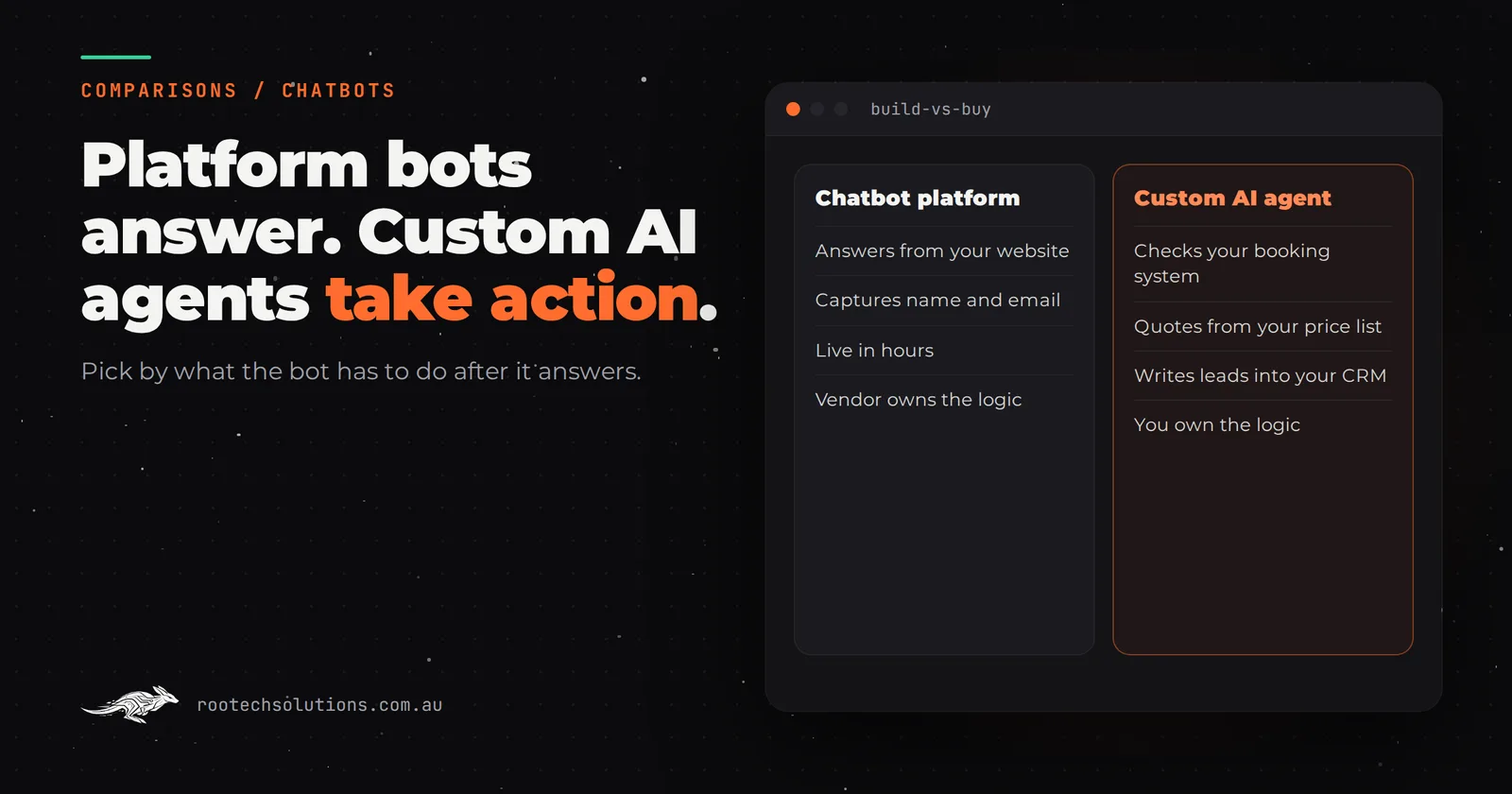
You want a chatbot on your website, and every search sends you two ways at once: sign up to a chatbot platform this afternoon, or pay someone to build a custom AI agent that plugs into your systems. The platform demos look great. The custom quote looks expensive. Neither sales page tells you which one your business actually needs.
Short answer: Choose a chatbot platform vs a custom AI agent by what the bot has to do. If it only answers questions from your website content and collects contact details, a platform such as Tidio or Chatbase is cheaper and live this week. If it has to read or write your real systems (bookings, job status, quotes, a CRM) under your rules, a custom AI agent is the better buy.
What is the real difference between a chatbot platform and a custom AI agent?
A chatbot platform is rented software that talks. A custom AI agent is software built for you that talks and then does something in your business. Everything else follows from that.
Modern platforms are good. Most now let you upload your website and documents and get an AI that answers questions in plain English, instead of the old button-menu bots. Where they differ from a custom agent is what happens after the answer:
- A platform answers, captures a name and email, and hands the conversation to a person or a connected inbox. Integrations exist, but they are the ones the platform chose to build, and they move a limited set of fields.
- A custom AI agent answers, then checks your actual booking system for a free slot, looks up a job number in your job management software, prices a request from your real price list, or writes a qualified lead into your CRM with every field filled. It follows rules you set, such as "never quote a price for anything over 50 square metres" or "anyone mentioning a complaint goes straight to the owner".
Think of it as the difference between a receptionist who can only take messages and one who has a login to your systems.
Which chatbot platforms are worth looking at?
There are good off-the-shelf options for almost every small business use, and for plenty of businesses one of them is the right answer. Described in general terms (check each vendor's current plans and pricing, which change often):
| Platform | What it is built for | Where it is strong |
|---|---|---|
| Tidio | Live chat plus an AI bot for small business websites | Fast setup, common with online stores |
| Intercom | Customer service suite with its Fin AI agent | Support teams answering from a help centre |
| Chatbase | An AI chatbot trained on your site and documents | FAQ answering with almost no setup |
| ManyChat | Automation for Instagram, Facebook and WhatsApp messages | Social DMs and comment replies |
| Voiceflow | A builder for chat and voice agents, with API steps | Teams with a technical person who want control |
Voiceflow sits closest to custom: it can call your systems through API steps, but someone still has to design the flows, write the integrations and maintain them. That is often the point where businesses realise they are building custom software anyway, just inside someone else's editor.
If you are choosing between platforms, match the tool to where your customers actually talk to you and what you need the bot to do, not to the feature list:
- Website enquiries and FAQs: Chatbase or Tidio. Fast to set up, priced low, fine for answering from your site content.
- A support team with a shared inbox: Intercom. The AI agent works inside the help desk your staff already live in.
- Customers who message you on Instagram or Facebook: ManyChat. Social DMs are a different workflow from website chat and it handles them best.
- "It needs to connect to my booking system or CRM": none of the above will do it well out of the box. This is where a custom agent, or Voiceflow with real integration work, enters the picture.
What does each option cost?
A platform costs a monthly subscription and an afternoon of setup. A custom AI agent costs a one-off build plus low running costs.
| Chatbot platform | Custom AI agent | |
|---|---|---|
| Upfront | Your setup time | Fixed-price build, typically $3,000 to $15,000 depending on integrations |
| Ongoing | Monthly subscription, often priced per seat or per AI resolution | Hosting usually under $50 a month, plus AI usage of roughly $20 to $200 a month |
| Time to live | Hours to days | Most builds ship in two to four weeks |
| Connects to your systems | Through the platform's own integrations | Whatever your software's API allows |
| Who owns the logic | The vendor | You |
| Price changes | The vendor decides | You pay for what you use |
Our build figures are estimates from the work we scope; your number depends on how many systems the agent touches and how many rules it has to follow. The thing to compare is not month one but year two: a subscription you will pay forever against a build you pay for once.
How much does an AI chatbot cost a small business in total?
Rough AUD figures, framed as estimates, for a typical Australian small business. Plan on three cost layers, and ask any vendor which layers their quote covers:
- Setup. A platform is mostly your time, plus maybe a few hundred dollars if you pay an agency to configure and brand it. A custom AI agent is a one-off fixed-price build, commonly $3,000 for a simple FAQ agent with one integration, up to $15,000 or more when the agent reads and writes several business systems.
- Monthly running costs. Platform subscriptions commonly run from about $40 to a few hundred dollars a month depending on seats and AI usage. A custom agent's hosting is usually under $50 a month, plus AI usage of roughly $20 to $200 a month based on conversation volume.
- Your staff time. This is the layer nobody prices. A platform that leaves leads to be re-keyed into your CRM can cost an hour or two a week of admin, which at typical wages is often more than the subscription itself.
So a platform is cheaper in year one for almost everyone, and the custom agent pulls ahead in year two or three when the job involves taking action in your systems, not just answering questions.
When is an off-the-shelf chatbot the right call?
Buy the platform when the job is answering questions, not taking action. Specifically:
- Your customers mostly ask the same questions: hours, service area, what is included, how to book.
- A good answer plus a link to your existing booking page or contact form is enough.
- You have under a few hundred conversations a month and no strong opinion about the workflow behind them.
- You are not yet sure customers will use chat at all.
That last one matters. Running a platform for a couple of months is a cheap way to find out what people actually ask. Export those conversations and you have the best possible brief for a custom build later, if you need one.
What are the signs you have outgrown a chatbot platform?
You have outgrown the platform when staff are re-doing what the bot started. Five signs we see:
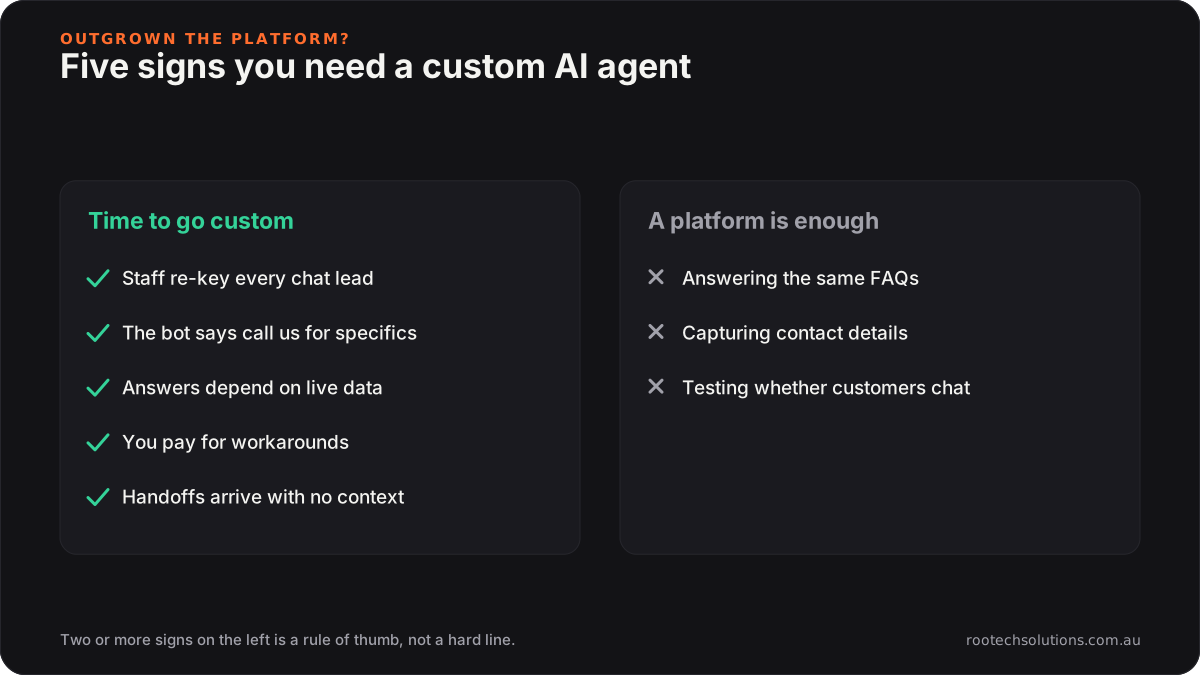
Caption: If two or more of the left-hand signs are true, the platform is costing you staff time it was meant to save.
- Someone re-keys every chat lead into your CRM, job system or booking software because the integration does not carry the fields you need.
- The bot says "please call us" for anything specific: a price, a slot, an order status. Customers asked a real question and got a contact form.
- The right answer depends on live data, such as whether Thursday is free, whether a part is in stock, or what stage a job is at.
- You are stacking workarounds: a Zapier or Make automation to move data out of the platform, a second tool to tidy it, a premium tier for one feature.
- Handoffs arrive with no context. A staff member opens a ticket that says "customer wants to talk to someone" and has to start the conversation again.
What does building a custom AI agent involve?
A custom AI agent is a small piece of software: a chat window (or a phone line, or an SMS number), an AI model that does the talking, and integrations that let it read and write your systems. A typical fixed-price build looks like this:
- Week one: the rules. Your services, prices, booking logic, service area, and the list of things the agent must never answer on its own. This is the part that makes it accurate.
- Weeks two and three: the build. The chat interface, the AI instructions, and connections to your tools, for example Cliniko or Nookal for clinics, ServiceM8 or simPRO for trades, Shopify for retail, HubSpot or Pipedrive for a sales pipeline, Google Calendar for nearly everyone.
- Testing against real history. We replay your past enquiries through it before a customer ever sees it, and fix every answer that is wrong or vague.
- Live, with a human in the loop. Anything outside the rules (complaints, refunds, unusual jobs) goes to a named person with the full conversation attached.
A custom agent does not have to replace a platform you already like. A common pattern is to keep Intercom or Tidio as the chat window and inbox your team knows, and build a custom AI layer behind it that does the lookups and writes the data. You keep the familiar tool and add the part it cannot do.
For a sense of what "AI that takes action" looks like outside chat, our Logic Building Co estimator reads construction plans and produces a costed estimate for a person to review: the same idea, applied to quoting.
How do I stop a chatbot making things up?
Restrict what it answers from and test it before launch. Both platforms and custom builds can do this; the question is how much control you get.
A well-built agent answers only from your approved content and live system data, says "I'm not sure, I'll get someone" when it does not know, and never commits you to a price, a date or a refund outside its rules. Ask any vendor or builder to show you exactly how that is enforced. If they cannot, that is your answer. And tell customers they are talking to an AI: misleading people about who they are dealing with can run into the Australian Consumer Law.
Should I build it myself instead?
If you have a technical person who enjoys it, building on Voiceflow or wiring a platform to Zapier or n8n is a reasonable path for a simple agent. We compare that route honestly in DIY no-code vs hiring an AI automation agency. If you decide to hire someone, read fixed price vs hourly for AI and software projects before you sign anything, and if the real question is whether you need a person at all, see should I hire a receptionist or use AI.
Frequently asked questions
How much does an AI chatbot cost to set up and run?
For a small business: a platform is a subscription of roughly $40 to a few hundred dollars a month plus an afternoon of setup, while a custom AI agent is a one-off build of roughly $3,000 to $15,000 (all AUD, estimates) plus $70 to $250 a month in hosting and AI usage. The custom build pays off when the bot has to act in your systems, not just answer questions.
Can I move from a chatbot platform to a custom AI agent later?
Yes, and it is often the smartest order. A few months on a platform gives you a record of what customers really ask, which becomes the brief for the custom build. Export your conversation history before you cancel, because it is the most useful thing the platform leaves you with.
Who owns a custom AI agent once it is built?
You should. Ask for the code, the AI instructions and the hosting accounts to sit in your name, so you can change builders without starting again. If a quote does not say this in writing, ask before you sign.
Is a custom AI chatbot only worth it for big businesses?
No. Size matters less than how much staff time the chat creates. A five-person clinic or trade business where every chat lead is re-typed into another system can justify a small custom build; a large business whose customers only ask opening hours does not need one.
Does a custom AI agent work on Facebook, Instagram and the phone too?
It can. Because the logic is yours, the same agent can sit behind your website chat, social messages, SMS and a phone line, giving the same answers everywhere. Platforms usually cover one or two channels well and the rest through add-ons.
Not sure which side of the line you are on?
Send us a few weeks of your enquiries and we will tell you plainly whether a platform will do the job or a custom AI agent will pay for itself. Book a free AI workflow audit: we map what your customers ask and what your staff do with it, and if you go ahead, the audit fee comes off your first project.