Will an AI Chatbot Replace Your Melbourne Retail Staff?
An AI chatbot for retail answers stock, sizing and order questions so floor staff can sell. The fears Melbourne shop owners have, and the guardrails.
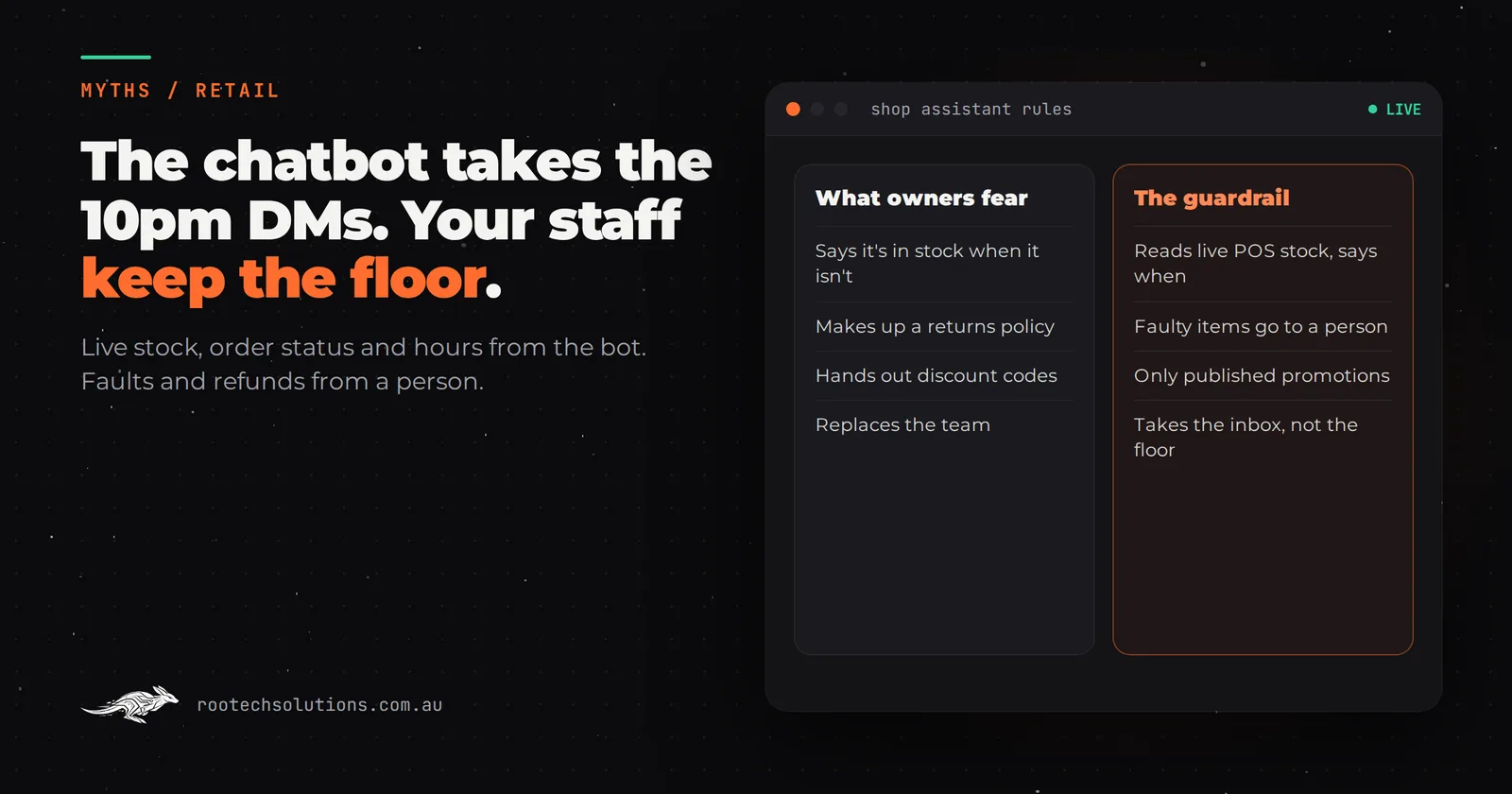
A customer messages your Instagram at 10pm asking if the navy linen shirt comes in a medium and whether she can pick it up from the Fitzroy store tomorrow. Nobody answers until 11am, and by then she has bought it somewhere else. You know an AI chatbot could have answered. You also worry it would have said "yes" when the last medium sold at 4pm.
Short answer: No. An AI chatbot for retail replaces the after-hours inbox, not the people on your shop floor. It answers stock, sizing, order status and opening-hours questions from your live systems, and hands off anything involving a fault, a complaint or a discount. Built with those limits, it frees staff to sell. Built without them, it embarrasses you.
What do retailers actually fear about AI chatbots?
Not robots at the till. Retail owners worry about five specific failures, and each one has happened to someone with a badly built bot.
| The fear | Is it fair? | The guardrail |
|---|---|---|
| It says an item is in stock when it isn't | Yes, if stock data is stale | Reads live stock from your POS, and says when the count was last checked |
| It invents a returns policy | Yes, for a generic chatbot | Answers only from your written policy, and sends every faulty-item question to a person |
| It hands out discounts | Yes, if it can create codes | Can only mention promotions you have already published |
| It sounds nothing like your brand | Partly | Trained on your product copy and tone, reviewed before launch |
| It replaces staff | Mostly not | It replaces hours spent on messages, which is a change worth being honest about |
The last row deserves a straight answer. If one of your team spends half a shift answering DMs and order-status emails, that half shift changes. In most small shops it moves to the floor, to visual merchandising, or to the online orders that need packing. It is still a change, and it is better to say so to your team than to pretend nothing moves.
Can an AI chatbot tell customers what's in stock?
Yes, accurately, if it reads your live inventory and admits its limits. Shopify, Lightspeed and Square all hold stock levels by location, and a custom chatbot can check them in the moment rather than relying on a product feed that refreshes once a day.
The wording matters as much as the data. "We're showing two in medium at Fitzroy as of a few minutes ago. Want me to ask the store to hold one?" is honest. "Yes, it's in stock!" is a promise. And a hold request goes to staff to confirm, because the last medium might be in someone's hands at the fitting room.
| Customer question | Where the answer comes from | Hands to staff when |
|---|---|---|
| "Do you have this in a 12?" | Live stock by store from your POS | The customer wants it held or sent from another store |
| "Where's my order?" | Order and tracking data from your store platform | The parcel is late, lost or damaged |
| "Will this run small?" | Your size guide and product notes | The customer needs fitting advice for a specific body or occasion |
| "Can I return this?" | Your written returns policy | The item is faulty, or the customer is unhappy |
| "Are you open Easter Monday?" | Your published hours | Never, this one is easy |
Can AI handle returns and refunds without breaking the law?
It can explain your change-of-mind policy. It should never be the one to say no to a refund. Under the Australian Consumer Law, the ACCC is clear that it is illegal for businesses to rely on policies such as "no refunds" to deny consumer guarantee rights, and that a major problem with a product entitles the customer to choose a refund or a replacement.
That gives a clean rule for the build. Change of mind: the assistant explains your policy as written, because change-of-mind refunds are a store choice. Anything faulty, damaged, not as described or "it broke after a week": the assistant apologises, collects the order number and photos, and passes it to a person the same day. It never argues, never decides, and never quotes a policy back at an upset customer.
Will customers feel fobbed off by a bot?
Only if the bot traps them. Customers in shops are used to self-checkouts, order tracking links and size guides. What annoys them is a chatbot that loops, cannot understand a plain question, or blocks them from a person.
Three design choices prevent that:
- Say it is an assistant, in the first message.
- Offer a person in one step, with a realistic reply time ("the team is back at 10am").
- Hand over with context, so the staff member who picks it up does not ask the customer to repeat themselves.
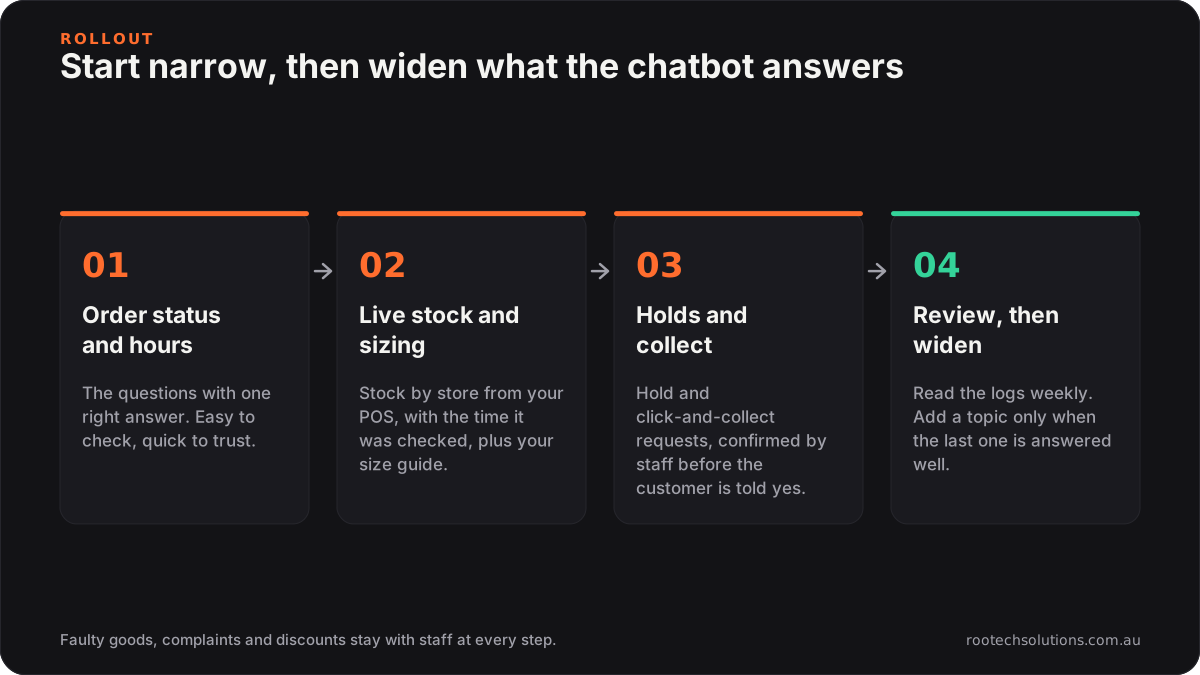
Caption: Start with the questions you can get right every time, and widen the assistant only when the logs show it is earning trust.
Where do your staff still win?
On the floor, and in every moment where a customer is deciding rather than asking:
- Reading hesitation. Noticing that someone is torn between two jackets and helping them choose.
- Fit and styling. "This cut suits you better" is advice an AI cannot give honestly.
- Regulars. Remembering that a customer bought the same candle for her mum last Christmas.
- Fixing problems. Faulty items, delayed orders and complaints, handled with discretion and a bit of goodwill.
The point of the chatbot is to protect that time. If your staff spend Monday morning clearing the weekend's DMs, they are not on the floor.
Is Shopify's built-in tooling enough, or do you need a custom chatbot?
For an online-only store with one warehouse, often yes. Shopify, and helpdesk apps that plug into it, already offer chat inboxes, order lookups and AI-assisted replies. Check their current features and pricing before you commission anything. If most of your questions are "where is my order?", an off-the-shelf app is probably the right call.
A custom AI integration earns its keep when your shop is more complicated than the app assumes:
- Several stores plus online, where stock sits in Lightspeed or Square across locations and customers want to know which store has it.
- Holds, click-and-collect and special orders with your own rules about who confirms what.
- One assistant across Instagram, Facebook, website chat and email, with the same answers and the same hand-off rules everywhere.
- Your own guardrails, such as the faulty-goods rule above, enforced in every channel.
We go through that trade-off in general terms in chatbot platform vs custom AI agent, and the after-hours sales side in how Melbourne retailers stop losing after-hours sales.
What does a guarded retail chatbot cost and take to build?
Most retail builds are live in two to four weeks. The first week goes on your information: product data, size guides, returns policy, hours, and the list of things the assistant must never do. Then it is connected to your store platform and POS, tested against a few hundred of your real past messages, and switched on for one channel first.
As an estimate, a retail chatbot with live stock, order status and hand-off typically costs $3,000 to $6,000 to build at a fixed price, more if it spans several stores and a custom hold workflow. Running costs are usually hosting under $50 a month plus AI usage of $20 to $200 a month, depending on message volume. Staff review handed-off conversations daily, and a weekly look at the logs decides what the assistant is allowed to answer next. If you are only getting a handful of messages a week, it is not worth building yet. For where else to start, see the first AI automation for Melbourne e-commerce.
Frequently asked questions
Can an AI chatbot recommend products?
Yes, within limits. It can suggest items from your catalogue that match what a customer describes, such as a gift under a budget or a size that is in stock. Keep recommendations to products you actually carry, and leave styling advice to staff.
Will it work on Instagram and Facebook messages?
Yes. Instagram and Facebook direct messages can be connected so the same assistant answers there and on your website. Many shops start with Instagram, because that is where after-hours questions pile up.
What happens if a customer is rude or upset?
The assistant stays polite, does not argue, and hands the conversation to a person with the history attached. Complaints are exactly the moment a human should take over, and the assistant's job is to make that hand-off quick.
Do I need to tell customers they are chatting with AI?
Yes. Say so in the first message. Customers are generally fine with a fast, accurate assistant, and being upfront avoids any suggestion that you misled them about who they were dealing with.
Want to know what is worth automating first?
Book a free AI workflow audit. We will look at a few weeks of your messages, sort them into what an assistant can answer safely and what needs your staff, and give you a plan either way. The audit fee comes off your first project if you go ahead.