What AI Automation Costs a Melbourne Physio Clinic
AI automation cost for a Melbourne physio clinic: build and running costs in AUD, a payback sum built on finished courses of care, and Cliniko integration.
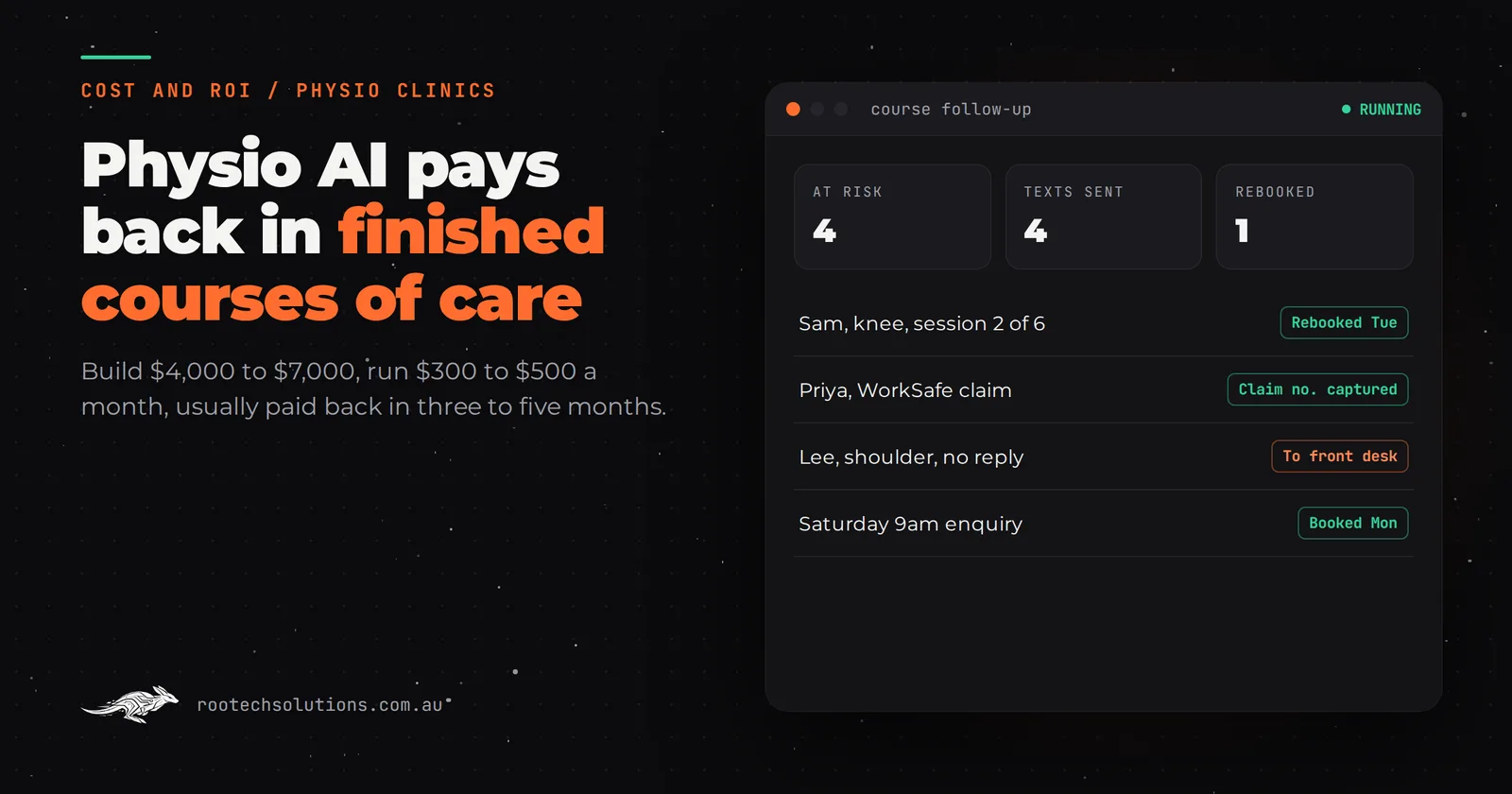
A patient comes in with a sore shoulder, you recommend six sessions, and they never book the second one. Nobody notices for a month because the desk was flat out. Before you pay for AI to fix that, you want the real AI automation cost for a Melbourne physio clinic, and whether finished courses of care cover it.
Short answer: AI automation for a Melbourne physio clinic with two to six practitioners typically costs $4,000 to $7,000 to build and $300 to $500 a month to run. Multi-site clinics can reach $10,000. For a clinic seeing 50 or more patients a week, payback is usually three to five months, driven mostly by patients who finish their course instead of dropping off.
Why is the payback different for a physio clinic?
A physio clinic earns across a course of care, not a single visit. The biggest leak is not the unanswered phone; it is the patient who was told to come back next week and quietly did not. That shifts where the money is.
A dental practice measures AI in refilled chair time, and a tradie measures it in jobs won. A physio clinic should measure it in sessions completed per new patient. If your average patient attends three sessions and your treatment plans usually recommend five, the gap between those two numbers is the size of your opportunity. An AI that notices a patient has no next appointment two days after their session, texts them in your clinic's voice, and books the reply straight into the diary closes some of that gap without anyone on the desk lifting a finger.
The second difference is funding. Physio clinics juggle private patients, health fund claims, and injured workers and transport accident clients whose treatment is paid by an insurer. Those funded patients come with paperwork. WorkSafe Victoria's invoicing instructions say every invoice must include the claim number and the worker's name, address, date of birth, date of injury, employer and WorkSafe agent, and that invoices without a claim number take longer to process. An intake agent that collects those details at booking, instead of at the third visit, is a small build that speeds up cash flow.
What does AI automation cost a physio clinic?
Most clinics land between $4,000 and $7,000 for the build and $300 to $500 a month to run. Here is how that splits. These are Rootech estimates in AUD, excluding GST.
| Component | What it does | Build (estimate) | Monthly (estimate) |
|---|---|---|---|
| AI receptionist (phone and web chat) | Answers calls and chats, books new patients, answers fee and health fund questions from your approved list | $1,500 to $4,000 | $150 to $400 |
| Rebooking and course follow-up | Spots patients with no next appointment, texts them, books the reply | $800 to $2,000 | $50 to $150 |
| Funded-patient intake | Captures claim numbers, insurer and referral details before the first visit | Included or $500 to $1,000 | Nil extra |
| Practice software integration | Connects everything to your diary and patient records | $500 to $1,500 | $100 to $300 maintenance |
A single-site clinic with one practitioner type sits at the bottom of each range. A multi-site practice with physios, exercise physiologists and remedial therapists, each with different appointment lengths and booking rules, sits at the top, and the total can reach $10,000 with running costs up to $850 a month.
How do I calculate payback from finished courses of care?
Work out how many patients drop off mid-course, estimate how many a follow-up text would bring back, and value each at the sessions they would have attended. Add admin time saved and after-hours bookings, subtract running costs, and divide the build by the result. Here is a worked example. Replace every number with your own.
| Assumption | Example | Yours |
|---|---|---|
| Build cost | $6,000 | |
| Running cost | $450 a month | |
| Patients a week who drop off with sessions still recommended | 4 | |
| Share a follow-up text brings back | 1 in 4 | |
| Extra sessions each returning patient attends | 2 at $95 | |
| Front-desk hours saved a month | 15 at $38 an hour | |
| New patients booked after hours | 1 a week at $110 |
- Rebooked courses: 1 patient a week x 4.33 weeks x $190 = about $823 a month.
- Admin time: 15 x $38 = $570 a month.
- After-hours bookings: 4.33 x $110 = about $476 a month.
- Total $1,869, minus $450 running costs: about $1,419 a month.
- Payback: $6,000 / $1,419 = a little over four months.
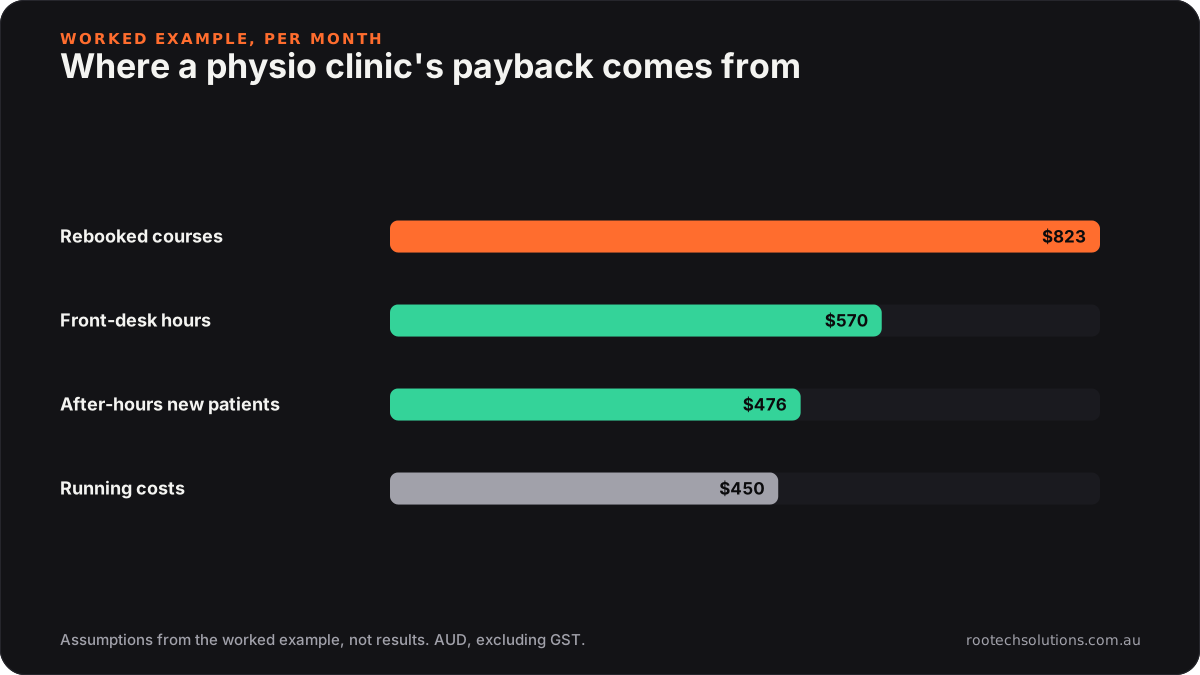
Caption: In a physio clinic the rebooking piece usually earns the most, and it is also the cheapest to build.
To find your drop-off number, run a report in your practice software of patients whose last appointment was more than two weeks ago and whose treatment plan had sessions left. Count a normal month. If it is close to zero, your clinicians already rebook well at the desk, and the AI receptionist is the piece to cost instead.
Can Cliniko, Nookal or Halaxy do this already?
Some of it, and you should use what you pay for. Practice systems such as Cliniko, Nookal, Halaxy and Power Diary handle online booking, reminders, forms and invoicing, and several have an API that outside software can use. If online booking and reminders cover your needs, a custom build is not worth it for those jobs. Check your plan's current features before buying anything.
A custom AI layer on top earns its keep where the practice system stops:
- Answering the phone and chats. Practice software takes bookings from people who already chose to book online. It does not answer "Do you treat jaw pain, and can I claim on the spot?" at 8pm.
- Course follow-up that reads the treatment plan. A generic reminder fires on a schedule. A custom workflow knows a patient is on session two of six with no next booking and sends one well-timed, personal message.
- Funded-patient rules. Which details to collect for WorkSafe or transport accident clients, which practitioners take them, and what to do when a claim number is missing.
If you are still booking on paper or a spreadsheet, move to a proper practice system first. AI has nothing to book into otherwise.
What does the build look like for a physio clinic?
Most builds ship in two to four weeks at a fixed price. Week one is your appointment types and lengths, practitioner rules, fees, health fund answers, funded-patient requirements and the follow-up timing your senior physio signs off. Weeks two and three connect the AI to your practice software, phone number and SMS provider. The final week tests it on your real enquiries and a sample of past drop-offs.
Running costs are hosting (usually under $50 a month), AI usage (typically $20 to $200 a month) and SMS. A person stays in the loop for everything clinical. The AI never assesses an injury or suggests exercises, sends red-flag symptoms to a clinician immediately, and passes billing disputes and complaints to the practice manager. Because the clinic is a health service provider, the OAIC says the Privacy Act covers it regardless of turnover, so the AI should collect only what booking and claims need and store it in your practice software.
If you are deciding which piece to build first, what Melbourne physios should automate first goes through the order.
When is it not worth it for a physio clinic?
It is not worth it for a sole practitioner with a full book, no waitlist and no wish to grow, because recovered patients have nowhere to go. It is marginal under about 30 patients a week, where a fixed monthly cost eats a thin return. And it is the wrong time if your clinicians already rebook every patient before they leave the room, which is the cheapest follow-up system there is. If staff are worried the AI is coming for the clinical work, can AI replace physiotherapists is a useful read for the team.
Frequently asked questions
Can an AI receptionist for physio clinics handle health fund questions?
It can answer general questions from your approved list, such as whether you offer on-the-spot claiming. It should not tell a patient what their fund will pay back, because that depends on their policy. The safe answer is to bring their card and the clinic will process the claim.
Will patients find follow-up texts pushy?
Not if there is one well-timed message that sounds like the clinic, and it stops when they reply or book. Patients who say they are fine are marked as finished so they are not contacted again. Your senior physio sets the timing and wording.
Do I need a separate build for each practitioner type?
No. One build handles physios, exercise physiologists and other practitioners, but each type needs its own appointment lengths and booking rules defined. More practitioner types mean more testing, which is why multi-discipline clinics sit higher in the range.
Can the AI capture WorkSafe claim details before the first visit?
Yes. The intake asks funded patients for the details your invoices need, checks nothing is missing and writes them into the patient record. If a claim number is not available yet, it flags the booking for the front desk to follow up.
Want your clinic's real payback figure?
Book a free AI workflow audit. We look at your drop-off rate, phone data and funded-patient paperwork, then give you a fixed-price estimate and a payback figure built on your own numbers. The audit fee comes off your first project if you go ahead.