What AI Automation Costs a Melbourne HVAC Business
AI automation cost for a Melbourne HVAC business: build and running costs, a payback sum for peak and shoulder months, and why launch timing matters.
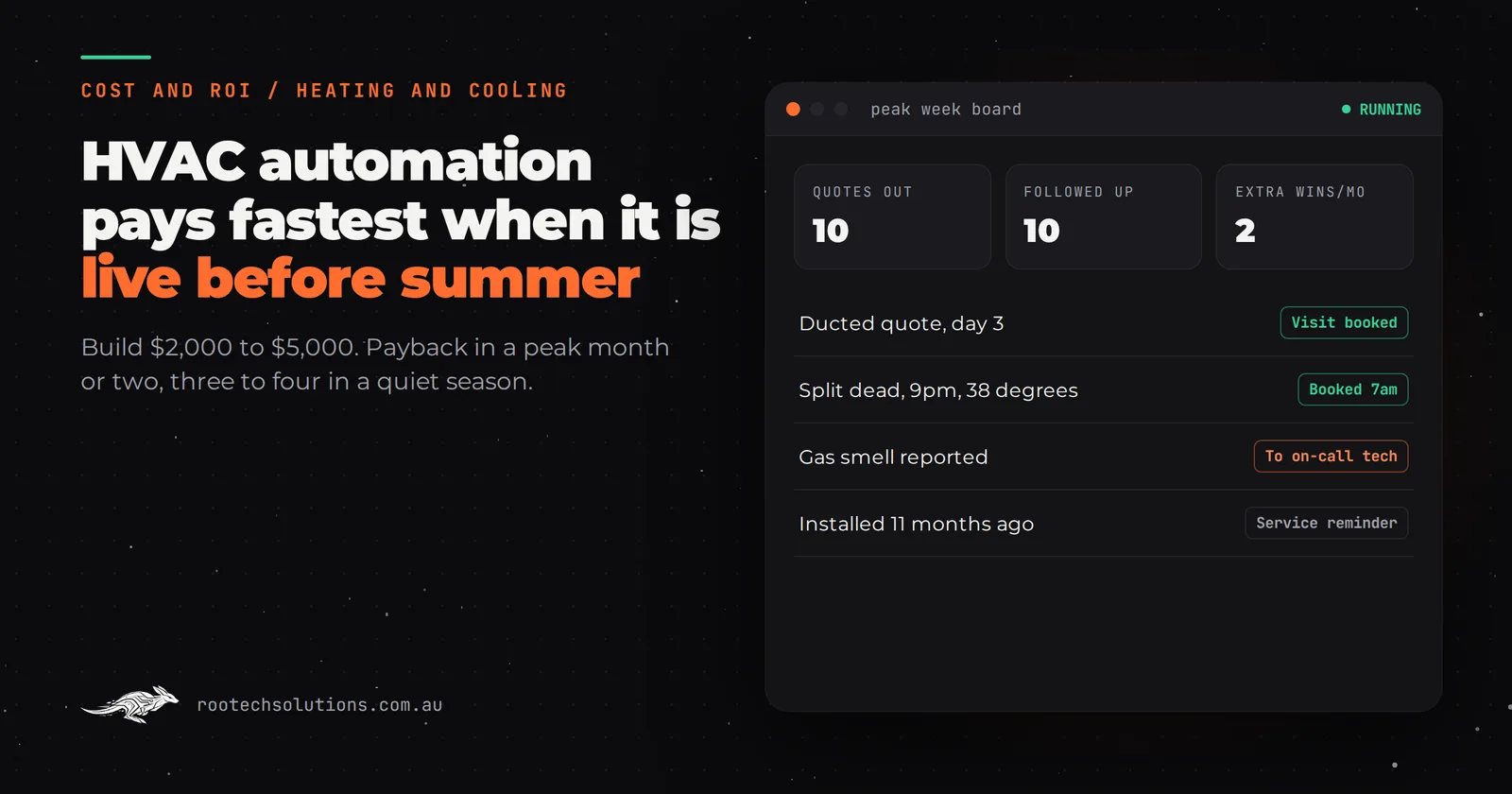
It is 38 degrees, the phones have not stopped since 7am, and the quote you sent for a ducted system last Tuesday has gone quiet. In July it is gas heater faults instead. Before you put AI on any of it, you want the real AI automation cost for a Melbourne HVAC business, and when in the year it pays back.
Short answer: AI automation for a Melbourne heating and cooling business typically costs $2,000 to $5,000 to build one or two focused workflows and $200 to $400 a month to run. A business that goes live before summer can recover the build within its first peak month or two. Launched in a quiet season, the same build usually takes three to four months.
Why does HVAC payback depend on the calendar?
Because HVAC demand comes in waves. Summer brings breakdowns and install enquiries all at once, winter brings heating faults, and autumn and spring are quieter. An automation earns most when it is live before a wave, not halfway through one.
That makes heating and cooling different from most trades. A plumber's emergencies are spread through the year. Your busiest fortnight might produce more enquiries than a quiet month, and it is exactly when nobody has time to call back. The two leaks that cost the most are specific to the trade:
- Install quotes that go cold. A ducted or multi-head quote is a big decision. Customers collect several quotes and often pick the business that followed up and answered their questions, not the cheapest. When the office is flat out with breakdowns, quote follow-up is the first thing dropped.
- Breakdown calls on a hot night. Someone whose system died at 9pm calls until a business answers. If yours goes to voicemail, the job is gone before morning.
A third, quieter leak is maintenance. Annual services are steady work you can schedule into the slow months, but only if somebody reminds customers whose systems were installed or serviced a year ago.
What does AI automation cost an HVAC business?
A single focused workflow costs $1,500 to $3,000 to build; two or three connected workflows $4,000 to $8,000; a full integration across phones, quoting and job management $6,000 to $12,000. These are Rootech estimates in AUD, excluding GST.
| Workflow | What it does | Build (estimate) |
|---|---|---|
| After-hours call capture | Answers overflow and after-hours calls, collects the fault, unit type and address, books the next slot or flags an urgent job to the on-call tech | $1,500 to $3,000 |
| Install quote follow-up | Follows up every open quote on a schedule, answers common questions from your approved list, books the site visit, flags hot leads to you | $1,500 to $3,000 |
| Service reminders | Finds installs and services from about 11 months ago in your job system and books the annual service into quiet weeks | $1,000 to $2,000 |
| Job data entry | Carries the enquiry details into the job, the quote and the invoice so nobody types them three times | $1,500 to $3,000 |
Running costs are typically $200 to $400 a month: hosting (usually under $50), AI usage ($20 to $200 depending on call and message volume), call minutes and SMS. If you want changes handled for you, a managed plan adds roughly $100 to $200 a month.
How do I work out payback for a peak month and a quiet one?
Count the extra jobs the automation wins each month, value each at its gross profit (not its price), subtract running costs, and divide the build by the result. Do it twice: once for a peak month and once for a shoulder month. Here is a worked example. Every number is an assumption, so use your own.
| Assumption | Peak month | Shoulder month | Yours |
|---|---|---|---|
| Build (after-hours capture plus quote follow-up) | $4,500 | $4,500 | |
| Running cost | $300 | $300 | |
| Install quotes sent a week, all followed up | 10 | 4 | |
| Extra installs won through follow-up | 2 | 1 | |
| Gross profit per install | $1,500 | $1,500 | |
| Extra breakdown jobs captured after hours | 4 | 1 | |
| Gross profit per breakdown job | $200 | $200 |
Peak month: (2 x $1,500) + (4 x $200) = $3,800. Minus $300 running: $3,500. The build is covered in about a month and a half.
Shoulder month: (1 x $1,500) + (1 x $200) = $1,700. Minus $300: $1,400. The build takes a little over three months.
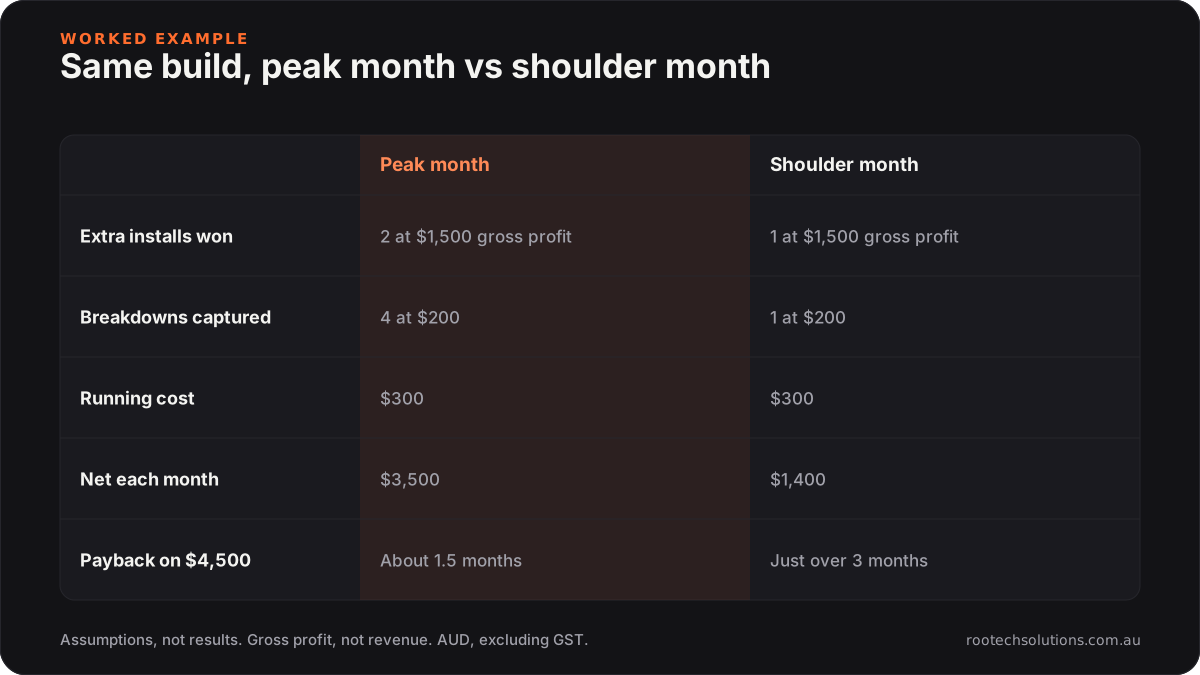
Caption: The same build pays back about twice as fast when it is live before the rush.
Use gross profit rather than the job's price because installs carry a lot of equipment cost. A recovered install worth thousands in revenue may only add a fraction of that to your bottom line, and payback sums built on revenue look far better than they are. Your job management system can give you average gross profit by job type for last summer.
Is simPRO or ServiceM8 enough, or do I need custom?
For scheduling, job cards, quoting templates and invoicing, your job management software is the right tool. Systems such as simPRO, ServiceM8, AroFlo and Fergus run the job from booking to invoice, and many send automatic reminders and quote notifications. If you use those features well, keep them. Check your plan's current features and pricing first.
Custom AI on top earns its keep where the software stops:
- The phone. Job software does not answer a ringing phone on a hot night. An AI phone agent or missed-call text-back that creates the job does.
- Conversations about quotes. A quote reminder is a template. An AI follow-up answers "Does the ducted quote include zoning, and can you do it before Christmas?" from your approved answers, then books the site visit.
- Your seasonal rules. Which jobs are urgent in a heatwave, which suburbs each tech covers, when to push services into quiet weeks. Rules like these live in your head and rarely fit a standard setting.
One trade-specific detail: the Australian Refrigeration Council administers refrigerant handling licences for technicians and refrigerant trading authorisations for businesses, and lists purchase-record templates for authorisation holders. If you automate job data entry, have it carry the technician's licence details and refrigerant used onto the job record, so your records are complete without anyone retyping them.
What does an HVAC build look like?
Most builds ship in two to four weeks at a fixed price, which is why timing matters: start in August or September and you are live well before summer. Week one captures your services, call-out rules, quoting questions, service areas and what counts as urgent. The middle weeks connect the AI to your phone number (you keep your number), your job management system and your SMS. The final week tests it against real calls and old quotes.
A person stays in the loop where it counts. The AI never quotes an install price it was not given, never diagnoses a fault over the phone, and passes anything involving a gas smell, an electrical burning smell or a vulnerable person in extreme heat straight to a person. You approve which quotes get chased and how often. If you are working out which piece to build first, what Melbourne HVAC businesses should automate first walks through the order. Rootech is Melbourne-based; more on how we work locally is on our Melbourne custom software page.
When is it not worth it?
It is not worth it if you do fewer than 15 to 20 jobs a month, because the volume will not cover the build; a basic missed-call text-back is enough. It is not worth it if you already follow up every quote within a day and answer every call, because there is no leak to plug. And if you run the business from a paper diary and a spreadsheet, move to a job management system first so the AI has somewhere to put the work. If the problem is that customers are not finding you at all in summer, start with how heating and cooling businesses show up in AI search instead.
Frequently asked questions
Can an AI quoting tool for HVAC price installs on its own?
It can draft a ballpark from rules you set, such as a standard split system install in a single-storey home, but a person should approve every quote before it goes out. Ducted and multi-head jobs usually need a site visit, so the AI's job there is to book the visit and collect photos and details first.
When should an HVAC business start an AI project?
Ideally in late winter or early spring. Most builds take two to four weeks, plus a little time to tune on real calls, so starting by September means the system is settled before the first heatwave.
Will customers accept an AI answering at night?
Most care that someone answered and that a technician is booked. The AI should say it is an AI, take the details accurately and confirm the booking by text. Anyone who wants a person can be flagged for a callback first thing.
What does the AI do with a genuine emergency?
It follows your rules. Typically that means a direct transfer or text to the on-call technician, plus clear safety instructions you have approved, such as advice for a gas smell. It should never try to talk someone through a repair.
Want your peak-season numbers?
Book a free AI workflow audit. We look at last summer's missed calls and open quotes, then give you a fixed-price estimate and a payback figure for both peak and quiet months. The audit fee comes off your first project if you go ahead.