Is AI for Personal Trainers a Threat or a Tool?
AI for personal trainers: where fitness apps really do compete, where coaches still win, and what a guardrailed AI does in a Melbourne PT studio.
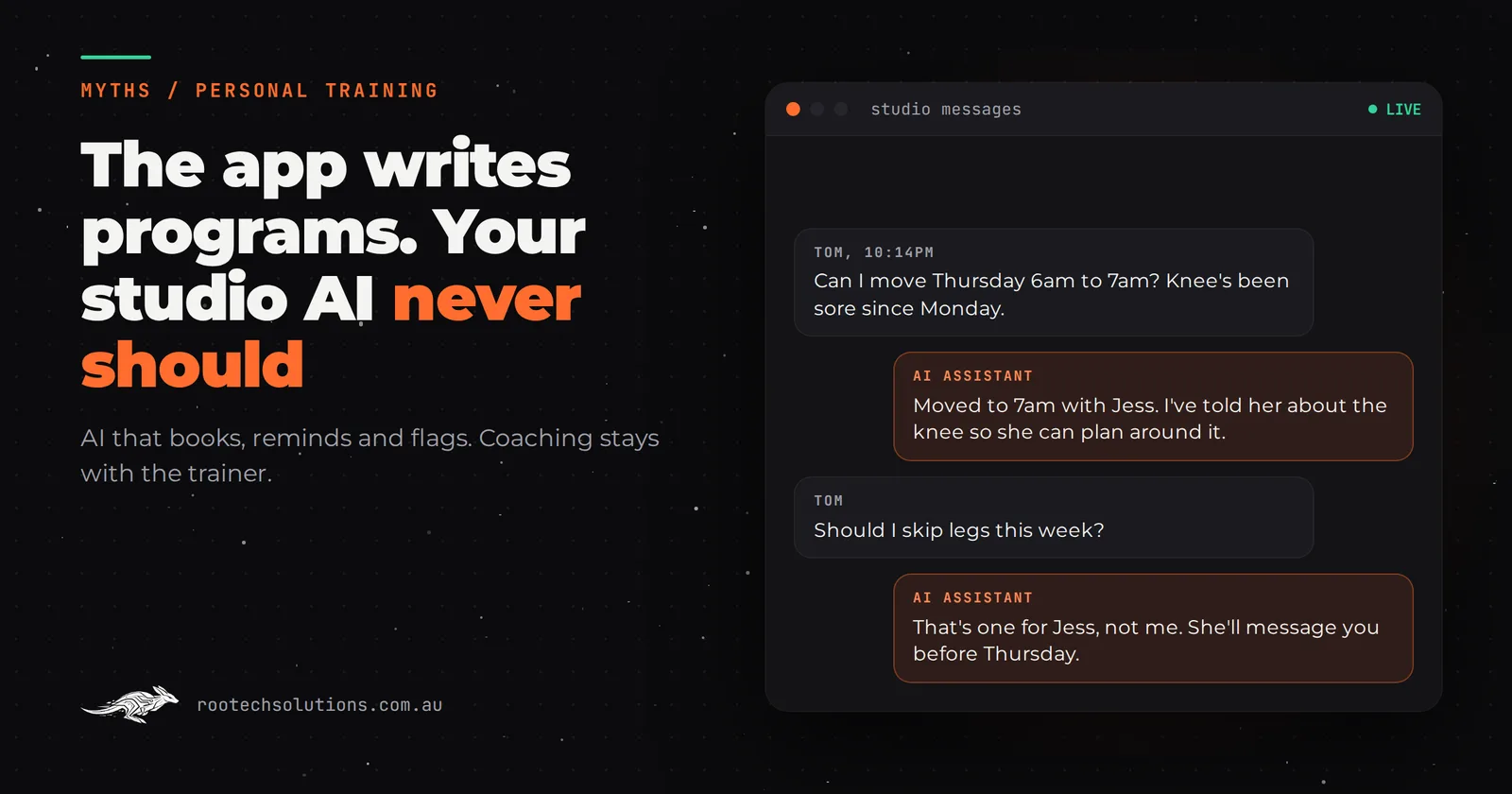
Your clients can now get a twelve-week program from an app for less than one session with you, and some of them have asked why they're still paying for a trainer. So when someone pitches you AI for your studio, it sounds like inviting the competition in.
Short answer: AI for personal trainers won't replace good coaches, but AI fitness apps already compete with trainers who only hand out programs. Coaches still win on form correction, injuries, beginners and accountability. A guardrailed AI in your studio should do the opposite of an app: never write programs or give health advice, and only handle bookings, reminders, enquiries and lapsed-member check-ins.
Is the fear of AI replacing personal trainers justified?
Partly, and it's worth being straight about which part. There are two different things called "AI" in fitness, and they threaten you differently.
AI fitness apps sell straight to your clients. They generate programs from a questionnaire, adjust weights from logged sets, and some attempt form feedback through the phone camera. For an experienced, self-motivated lifter who mainly wanted a program, an app is a real substitute. If your offer is "I write you a spreadsheet and check in by text", that offer is under pressure, AI or not.
AI in your business is a tool you control. It answers enquiries, moves bookings, chases forms and notices when a member stops turning up. It doesn't talk to clients about training at all, if it's built properly. That kind of AI doesn't compete with your coaches; it takes the admin off them.
The mistake is treating these as the same thing, either by fearing the second because of the first, or by building the second to behave like the first.
Where do trainers still win?
Trainers win wherever the session depends on being in the room or on knowing the person. An app can count reps. It can't do these:
- Correct form in real time. A trainer sees the knee cave on rep six and fixes it before rep seven.
- Work around injuries and pain. "My shoulder's been weird since Monday" needs someone who can assess, modify and, where needed, refer to a physio or GP.
- Coach beginners. The first deadlift, the first time in a gym, the client who is nervous about being watched.
- Read the day. A member who slept three hours and had a terrible week needs a different session than the one on the plan.
- Accountability. Many clients pay a trainer because someone is expecting them at 6am. A push notification is easy to swipe away; a person waiting is not.
If you lean your offer into those, apps become a feeder for your studio rather than a replacement. People try the app, plateau or get hurt, and come looking for a coach.
What should a studio's AI never do?
It should never coach. That's the guardrail that makes AI safe to put in front of your members, and it needs to be written into the build, not left to the AI's judgement.
Concretely, a studio AI should refuse to:
- Write or change a training program. Requests go to the member's trainer.
- Give injury, pain or medical advice. It acknowledges, tells the trainer before the next session, and suggests the member speak to a health professional if they're worried.
- Give nutrition plans or supplement advice. Out of scope for the bot, and often for the trainer too.
- Promise results. No "lose 5kg in six weeks", in chat or anywhere else.
- Handle cancellations of memberships or complaints. These go to the owner, because the conversation is often how you keep the member.
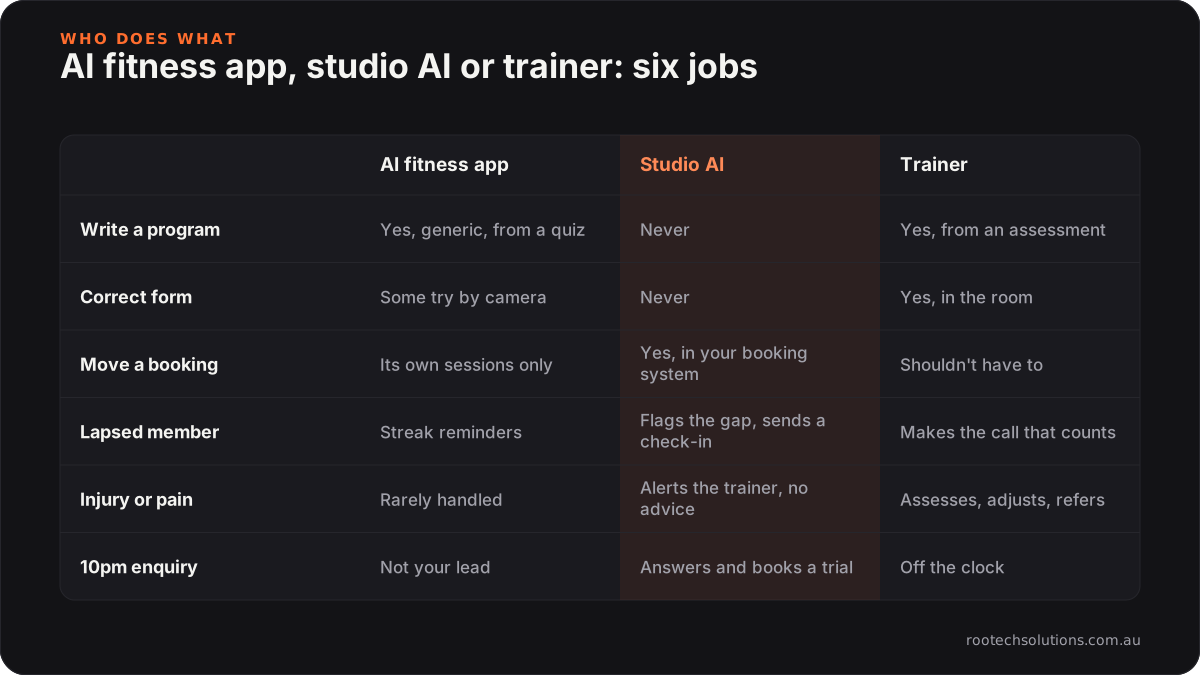
Caption: The app competes with the trainer. The studio AI should only ever compete with the admin.
What does AI for personal trainers actually handle in a studio?
It handles the messages that arrive between sessions and after hours, which is where trainers lose their evenings and studios lose leads.
| Job | What the AI does | Where the trainer comes in |
|---|---|---|
| New enquiry at 9pm | Answers price and timetable questions from your info, books a trial | Runs the trial and the assessment |
| "Can I move Thursday?" | Moves the booking in your booking system, confirms by SMS | Nothing, unless the slot is full |
| Pre-exercise screening | Sends the questionnaire before the first session, chases it if it's missing | Reads it, especially anything flagged |
| Injury mentioned in a message | Logs it and alerts the trainer before the session | Assesses and adjusts, or refers |
| Member hasn't attended in two weeks | Sends a friendly check-in in your words, offers a session | Calls the members who don't reply |
| Membership cancellation | Acknowledges and books a call with the owner | Has the conversation |
The two-week trigger is a rule of thumb; set it to whatever "unusual" looks like for your members. The point is that someone notices before the cancellation email arrives.
Is off-the-shelf gym software enough, or do you need a custom AI integration?
For most studios the booking and membership software is the right foundation, and you shouldn't replace it. Platforms such as Mindbody, Glofox, Clubworx and PTminder handle class timetables, PT bookings, memberships and payments, and coaching apps such as Trainerize and TrueCoach deliver programs to clients. Many include automated reminders and basic marketing emails. Check their current features and pricing before building anything.
A custom AI integration earns its keep in the gaps between those tools:
- Conversations, not forms. Members text "can I swap to 7?" rather than opening an app. The AI handles the message and updates the booking system.
- Your rules for handoff. Off-the-shelf automations send the same email to everyone. A custom build knows that "my knee hurts" goes to the trainer and "can I pause my membership?" goes to you.
- One view across tools. If bookings live in one system and programs in another, the AI can join them up so the trainer sees attendance, screening flags and messages in one place.
If your studio is small, your members book through the app without fuss, and your trainers aren't answering messages at night, you probably don't need a custom build yet. We set out the full numbers in what AI automation costs a gym or PT studio.
What does the build look like?
Most studio builds are live in two to four weeks at a fixed price. As an estimate, a first build typically lands between $3,000 and $7,000, with running costs around $150 to $450 a month for hosting, AI usage and SMS, depending on volume.
- Week one: your timetable, prices, policies, trainer rosters, and the refusal list above, written down.
- Week two: connections to your booking platform, SMS and the channels members actually use (website chat, Instagram and Facebook messages, text).
- Week three: testing against real past messages, including deliberate attempts to get it to write a program or give injury advice. It has to refuse every time.
- Week four: live, with the owner reading every conversation for the first fortnight.
Health information needs care. The privacy regulator says a gym is a health service provider when it collects health information, and screening questionnaires and injury notes are exactly that. Keep screening answers in your booking system or a secure form, not in chat logs, and limit what the AI can see to what it needs to route a message.
We're Melbourne-based and build for studios across Melbourne and remotely Australia-wide. If your studio is also trying to be found by people searching for a trainer, how Melbourne gyms rank on Google and AI search covers that side.
Frequently asked questions
Will members be annoyed that they're messaging an AI?
Members mostly want a quick, correct answer to "can I move my session?", and they get one at 10pm instead of the next morning. Tell them it's an AI assistant in the first message and make it easy to reach a person. The relationship stays with their trainer.
Should my studio offer AI-generated programs to compete with apps?
Only if a trainer reviews every one before the client sees it. An unreviewed AI program under your studio's name carries your reputation without your judgement, and it competes with your own coaching. Positioning your coaching as what the apps can't do is usually the stronger play.
Can AI help keep members from cancelling?
It can notice the early sign, a member who has stopped attending, and send a check-in while there's still time. Whether they stay usually comes down to a conversation with a trainer or the owner, which the AI can book but shouldn't attempt.
What if a member tells the AI they're injured?
The AI should acknowledge it, avoid giving any advice, and alert the trainer before the next session so it can be adjusted. If the member sounds unwell or in serious pain, it should tell them to seek medical help and flag it to the owner straight away.
Want your trainers coaching instead of answering messages?
We'll look at where your studio's admin actually goes, what your booking platform already covers, and what a guardrailed AI would take off your trainers' phones. Book a free AI workflow audit; the audit fee comes off your first project if you go ahead.