What AI Automation Costs a Gym or PT Studio
AI automation cost for a gym or PT studio in AUD: build and running costs, a membership payback sum you can redo with your numbers, and the Spam Act catch.
A message lands on your studio's Instagram at 9pm: "Do you have a 12-month deal, and can I try a class Friday?" By the time anyone replies at 9am, they have booked a free trial down the road. Before you fix that with AI, you want to know the AI automation cost for a gym, and how long a recovered trial takes to pay it back.
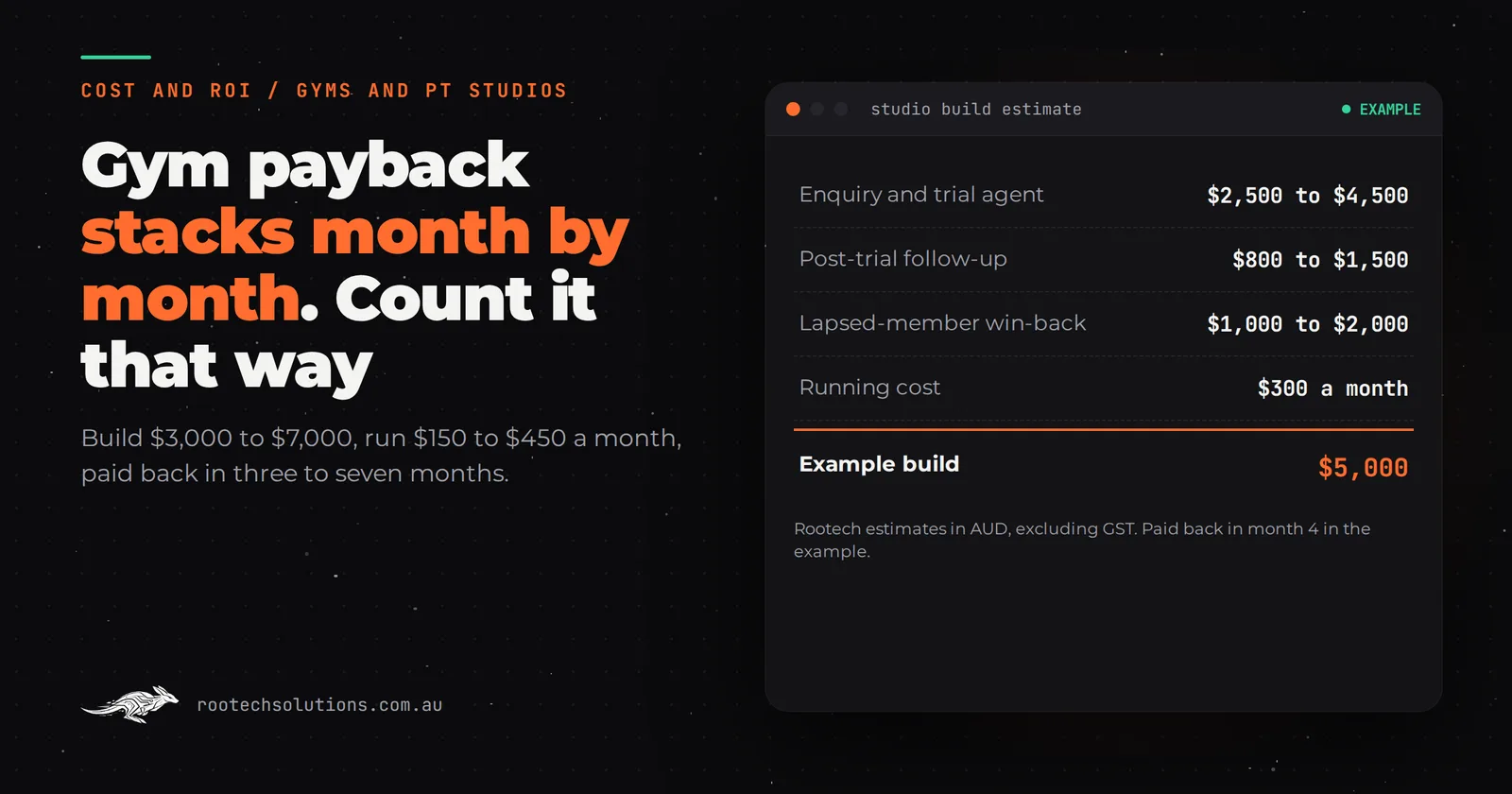
Short answer: AI automation for an independent gym or PT studio typically costs $3,000 to $7,000 to build and $150 to $450 a month to run. Because members pay monthly, the money arrives as a growing stack rather than a lump, so payback usually takes three to seven months. It is fastest when the build answers trial enquiries instantly and also wins back lapsed members.
Why does payback work differently for a gym?
A gym earns from members who stay, not from one-off visits. A recovered enquiry at a clinic is one consult. A recovered trial at a gym is a membership that pays every month it lasts, so each month's recoveries add to the last.
That has two consequences. First, the payback curve starts slowly and then steepens, so judging the system after four weeks will make it look worse than it is. Second, the two workflows that matter most are the two ends of the membership: getting a prospect from "how much?" to a booked trial while they are still keen, and getting a member who has stopped coming back before they cancel. Timetable questions and class bookings matter too, but your booking platform already does much of that.
The failure modes are specific. A prospect asks about a 12-week challenge price at 10pm and gets no answer. A trial is booked but nobody follows up after the session, so the "I'll think about it" never turns into a sign-up. A member's visits drop from three a week to none in February, and the first anyone notices is the cancellation email.
What does AI automation cost a gym to build and run?
Most independent gyms and PT studios land between $3,000 and $7,000 for the first build, then $150 to $450 a month. These are Rootech estimates in AUD, excluding GST.
| Piece | What it does | Build (estimate) | Monthly (estimate) |
|---|---|---|---|
| Enquiry and trial agent | Answers DMs, website chat and missed-call texts, explains memberships, books the trial into your platform | $2,500 to $4,500 | $100 to $250 |
| Post-trial follow-up | Checks in after the session, answers objections from your approved offers, hands warm leads to a coach | $800 to $1,500 | SMS costs |
| Lapsed-member win-back | Spots members whose visits have dropped, sends a comeback offer, books the class | $1,000 to $2,000 | $50 to $150 |
A single studio with one membership type sits at the low end. A multi-site operator, or a studio with PT packs, class passes and challenge programs that all have their own rules, sits at the high end, because every product needs its own answers and booking logic.
How do I calculate payback on recovered memberships?
Count the new paying members each month, multiply by your average monthly fee, and add each month's total to the last. Payback is the month the running total passes the build cost plus running costs to date. Here is a worked example. Every input is an assumption, so swap in your own.
| Assumption | Example | Yours |
|---|---|---|
| Build cost | $5,000 | |
| Running cost | $300 a month | |
| Trials currently lost to slow replies | 2 a week, about 9 a month | |
| Trials that convert to a membership | 1 in 3, so about 3 a month | |
| Lapsed members won back by a comeback offer | 4 a month | |
| Average membership | $100 a month | |
| Members recovered who leave in the first few months | Ignored here, for simplicity |
With 7 extra paying members a month at $100, the extra revenue in month one is $700, month two $1,400, month three $2,100, and so on. The running totals:
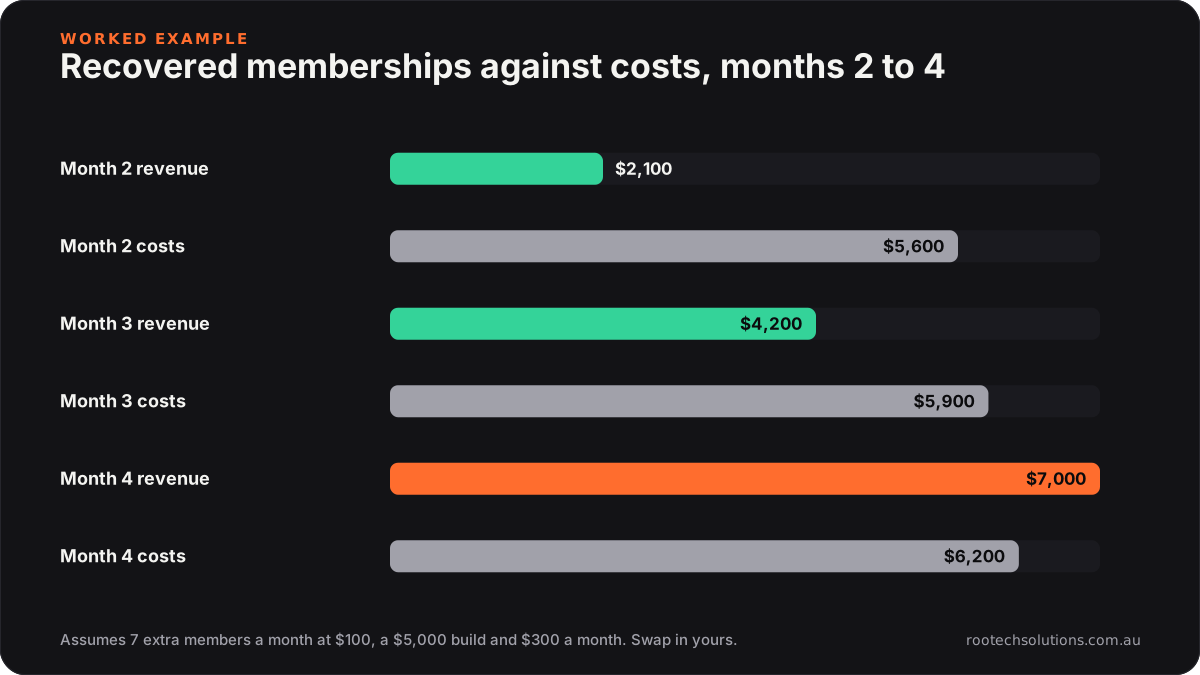
Caption: Membership revenue stacks, so a slow first month is normal; in this example the build is paid off during month four.
Drop the win-back piece and keep only the 3 recovered trial members a month, and the running total does not pass costs until month seven. That is the honest range: three to seven months, depending on whether you automate both ends of the membership or only the front door. If your members typically leave sooner than that, the payback stretches, so pull your average membership length from your platform before you trust any calculation, ours included.
Can Mindbody, Glofox or my current platform do this already?
Partly, and you should use what you already pay for. Platforms such as Mindbody, Glofox, Xplor and TeamUp handle timetables, class booking, payments and standard automated emails, and many have a lead pipeline. If your platform's built-in tools already reply to enquiries fast enough and your team actually works the lead list, you may not need anything custom. Check your plan's current features and pricing before buying anything new.
Where an AI integration on top of your platform earns its keep:
- Conversations, not forms. Platform automations send a template. An AI agent answers "Is the 6am HIIT class OK for a beginner with a dodgy knee?" in your words, then books the trial and flags the knee for the coach.
- Every channel in one place. Instagram, Facebook, website chat and missed calls feeding one agent that books into one system.
- Your win-back rules. Which members to contact, after how many missed weeks, with which offer, and who never gets a discount. Generic tools rarely hold logic that specific.
If your platform has no way for outside software to create bookings or read attendance, the AI cannot book anything and becomes an expensive FAQ page. Confirm that first. We compare the general trade in DIY no-code tools vs an AI automation agency.
What are the rules on win-back texts?
A comeback offer is a marketing message, and the Spam Act 2003 sets three rules for commercial electronic messages: do not send them without consent, include accurate sender information, and include a working unsubscribe option. Build all three in from day one.
In practice that means the win-back workflow only messages members whose sign-up terms include marketing consent, every text names your gym, and "STOP" or an unsubscribe link actually removes them from future offers. A trial reminder the prospect asked for is a different matter from an unsolicited discount blast, but the system should still record who agreed to what, because you will want that record if a member complains.
What does a gym build look like?
Most builds ship in two to four weeks at a fixed price:
- Week one: your memberships, prices, timetable, trial rules, approved offers, and the questions coaches must answer personally (injuries, pregnancy, medical conditions).
- Weeks two and three: the agent is connected to your booking platform, your Instagram and Facebook inboxes, your website and your phone's missed-call text-back.
- Final week: testing against your real past DMs, then a soft launch on one channel.
Running costs are hosting (usually under $50 a month), AI usage (typically $20 to $200 a month with message volume) and SMS. A person stays in the loop: the AI never gives exercise or health advice, never invents a discount, and hands anything about injuries, refunds, contract cancellations or complaints to a staff member with the chat attached. Coaches see every trial it books.
If your scheduling is unusual enough that no platform fits, a custom booking system is an option, as with the multi-location booking platform we built for Kaladi Kitchens. Most gyms do not need that and should keep their platform.
Who should skip it for now?
Skip it if you get a handful of enquiries a week and already reply within minutes, or if every new member is hand-onboarded by the owner and prospects expect a personal call. Skip it, too, if nobody will keep prices and timetables current, because a confident wrong answer about a membership price is worse than a slow right one. For many small studios a missed-call text-back is enough to start, and the debate about whether AI belongs in personal training at all is covered in will AI replace Melbourne personal trainers.
Frequently asked questions
Does an AI chatbot for gyms replace the front desk?
No. It covers the hours nobody is at the desk and the repeat questions that interrupt staff during busy classes. Your team still runs tours, sells memberships face to face and handles anything personal.
How quickly should a gym reply to a trial enquiry?
As fast as you reasonably can, because a prospect comparing gyms often books with whoever answers first. An AI agent replies within seconds at any hour, which is the main reason gyms build one. Your own data will show how many enquiries currently wait overnight.
What happens if a prospect mentions an injury?
The agent should not give advice. It books the trial if that is appropriate, flags the injury for the coach, and suggests the prospect check with their health professional where your policy says to. Those rules are written with your head coach before launch.
Can it handle PT packs and class passes as well as memberships?
Yes, provided each product's price, terms and booking rules are set down clearly in week one. More products mean more rules to test, which is why multi-product studios sit at the higher end of the build range.
Want to see your own payback month?
Book a free AI workflow audit. We look at your DMs, trial conversion and attendance data, then give you a fixed-price estimate and the month your build should pay for itself. The audit fee comes off your first project if you go ahead.