Is AI Automation Worth It for Melbourne Cleaners?
Is AI automation for cleaning businesses worth it? Build and running costs in AUD, a payback based on contract lifetime value, and when to hold off.
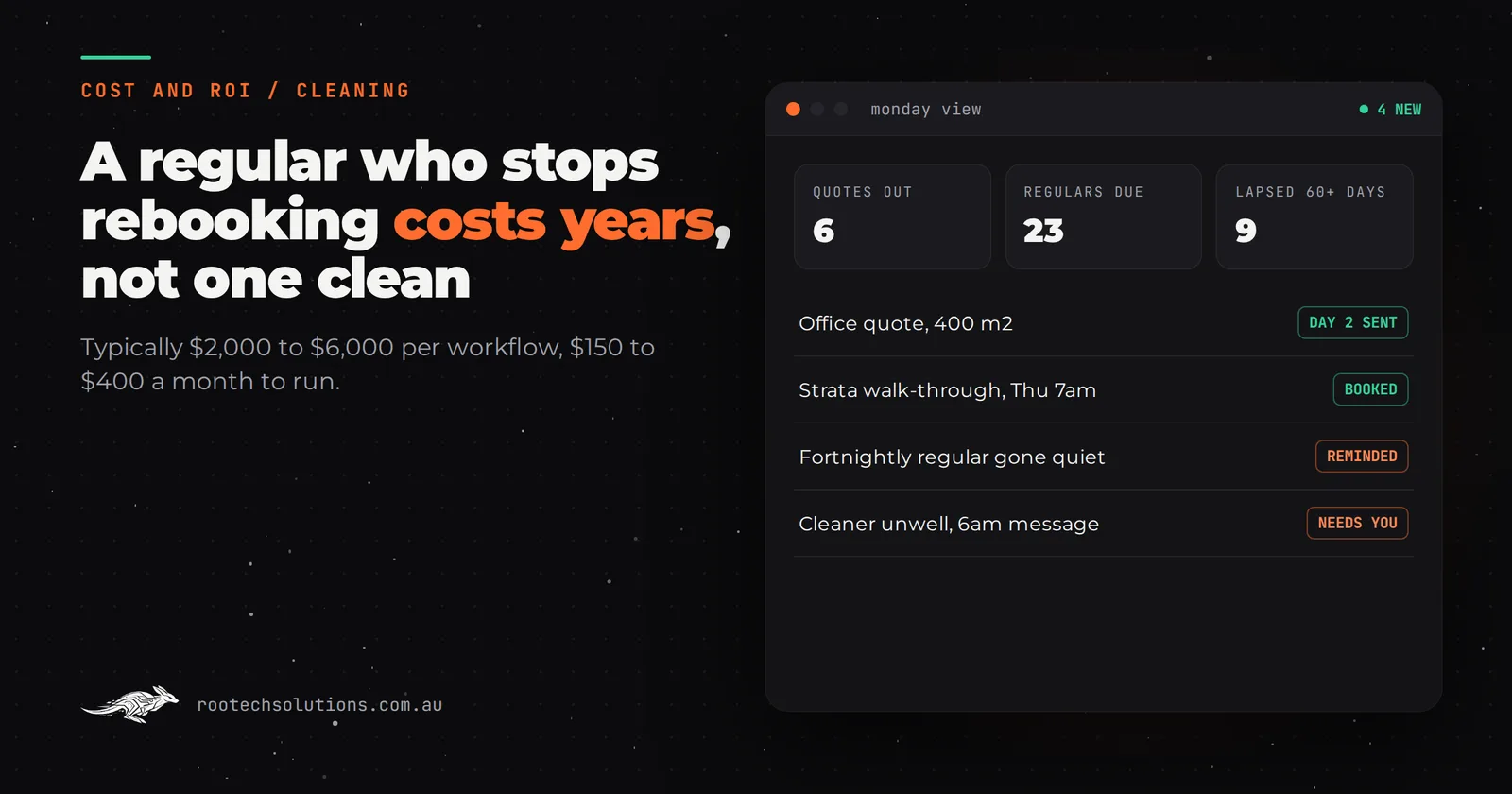
A cleaning business earns very little on any single visit and a great deal on a client who stays for years. That is why the regular who quietly stops booking in March, or the office tender you quoted three days late, costs far more than it looks on the day.
So the question of whether AI automation for cleaning businesses is worth it comes down to one number most operators never write down: what a retained client is worth over their whole life with you. Get that number and the cost decision mostly makes itself.
Short answer: AI automation is worth it for a Melbourne cleaning business that quotes commercial work regularly or keeps 50 or more residential regulars. Builds typically cost $2,000 to $6,000 per workflow and $150 to $400 a month to run. One extra commercial contract usually pays a quoting build back in about seven months. Below 15 regulars, wait.
Why does a cleaning business need a lifetime-value sum?
Because the margin per visit is thin and the value is in repetition. A $160 fortnightly clean is not a $160 sale; at 26 visits a year it is more than $4,000 of revenue, and the client might stay for several years. A commercial contract is the same idea at a larger scale.
That changes how you judge any automation:
- Losing a regular costs years, not one visit. Clients rarely cancel; they just stop rebooking, and nobody notices until the diary has gaps.
- Commercial work is won on speed and completeness. A facility or strata manager sends the same request to several companies, and the complete, itemised quote that arrives first is the one that gets a walk-through.
- Your margin, not your price, pays for the build. Wages, super, travel and supplies take most of each invoice. Use gross margin in the sum, or it will flatter everything.
What do the different client types actually earn you?
Very different amounts, which is why the right first automation depends on your mix. The figures below are illustrative assumptions: replace them with your own prices and margins.
| Client type | Example revenue | Example gross margin | What loses it | Automation that protects it |
|---|---|---|---|---|
| One-off or end-of-lease clean | $250 a job | 30%, about $75 | Slow reply to the enquiry | After-hours enquiry handling |
| Fortnightly residential regular | $160 a visit, 26 a year | 30%, about $1,248 a year | Forgotten rebooking, quiet drift | Rebooking and lapse reminders |
| Commercial office contract | $3,000 a month | 25%, about $750 a month | A slow or incomplete quote | Quoting automation and follow-up |
Kept for 24 months, that commercial contract is worth about $18,000 in gross margin, against a quoting build of around $4,000.
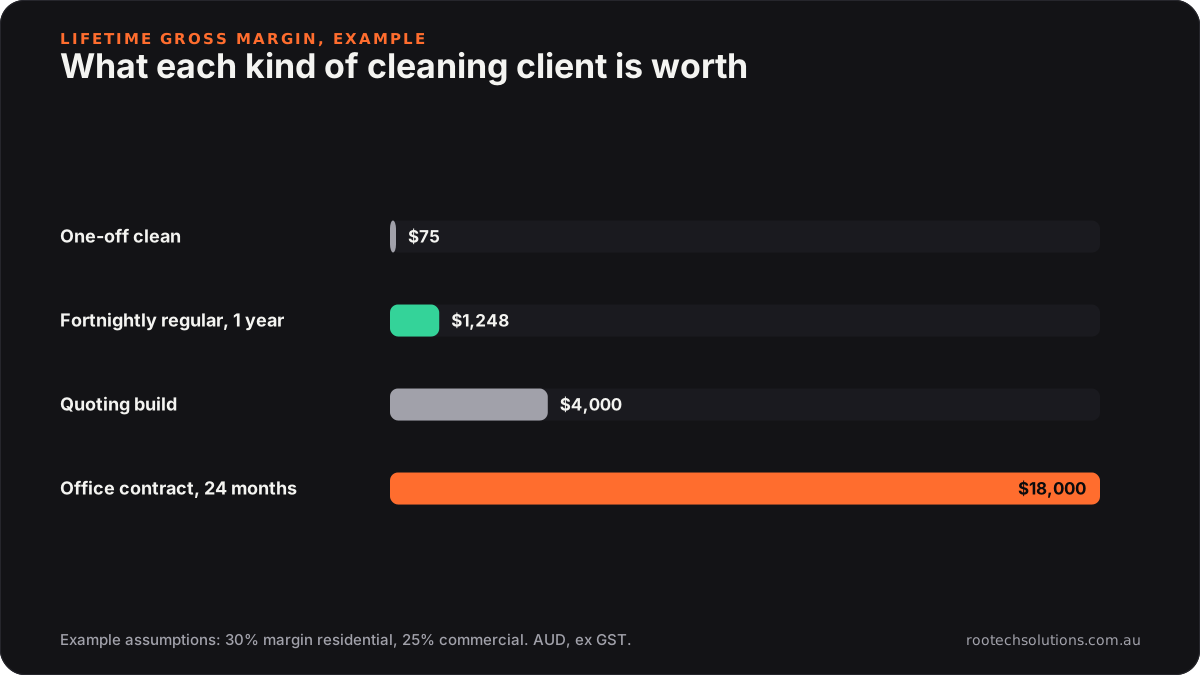
Caption: A one-off clean barely registers. One retained commercial contract dwarfs the cost of the build.
What does AI automation for cleaning businesses cost?
Most operators start with one workflow and add others once the first is paying. These are estimates for fixed-price builds:
- Quoting automation: takes an enquiry by email or web form, asks the follow-up questions (floor area, frequency, access hours, type of clean, current provider), and drafts an itemised quote from your rate card for you to approve. Roughly $3,000 to $5,000.
- Rebooking and lapse reminders: tracks when each regular is due, reminds them by SMS, lets them confirm or move the date without a call, and flags anyone who has gone quiet. Roughly $2,000 to $4,000.
- After-hours enquiry handling: answers web chat or calls outside business hours, captures details, answers basic questions from your approved information and books a callback or a quote visit. Roughly $3,500 to $6,000, depending on whether it covers the phone.
All three together run $8,500 to $15,000, though few businesses need all three at once. Running costs are typically $150 to $400 a month across AI usage, SMS and hosting (hosting alone is usually under $50); a system handling 50 quotes a month costs less to run than one handling 200.
How do I work out the payback for my business?
Use the monthly margin of the clients you win or keep, minus running costs, against the build. Here are two worked examples. All numbers are assumptions to swap for your own.
Commercial quoting
- Build: $4,000. Running: $200 a month.
- Extra office contract won through faster, complete quotes: one, at $3,000 a month.
- Gross margin at 25%: $750 a month.
- Net gain: $750 minus $200 = $550 a month.
- Payback: $4,000 / $550 = about 7 months. Win two contracts and it is about three months.
Residential rebooking
- Build: $3,000. Running: $150 a month.
- Regulars who would have lapsed but rebook after a reminder: 5 a year.
- Margin each: about $1,248 a year, so $6,240 a year or about $520 a month across the five.
- Net gain: $520 minus $150 = $370 a month.
- Payback: $3,000 / $370 = about 8 months, then it keeps compounding while those clients stay.
Neither is an overnight win, and that is the honest picture. The case gets strong when you have enough volume that these numbers multiply: several commercial quotes a month, or a large residential book where a handful of lapses a year is normal. Your job software's client list will tell you how many regulars have not booked in 60 days; that is the place to start counting.
How does a commercial quote get out first?
By asking the right questions before anyone drives to site, so the walk-through confirms a quote rather than starts one.
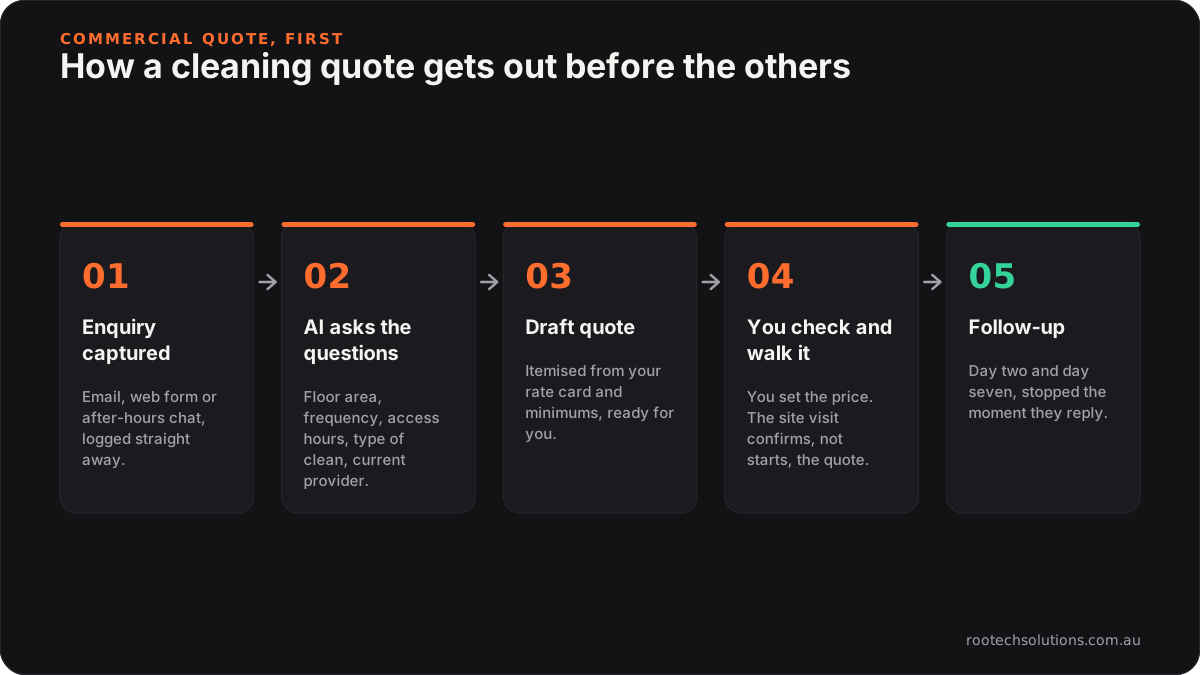
Caption: You still price the job and walk the site. The automation removes the wait on either side of you.
A typical Monday morning view once this runs: 6 quotes out, 23 regulars due this fortnight, 9 who have not booked in more than 60 days. The office quote for a 400 square metre fit-out had its day-two follow-up sent automatically, a strata common-areas walk-through is booked for Thursday at 7am, a lapsed fortnightly client got a friendly reminder, and a 6am message from a cleaner who is unwell is waiting for you to reassign the job. That last one stays with a person: the system flags it, you decide.
Is cleaning software enough on its own?
Often, for the basics. Job management tools such as ServiceM8 and Jobber handle quoting templates, scheduling, job notes and invoicing, connect to Xero, and some include online booking and automated reminders. Rostering tools such as Deputy manage shifts. Check current plans and pricing; if a built-in reminder covers your rebooking problem, switch it on and save the build.
Custom AI integration earns its keep where those tools wait for you:
- reading a free-text enquiry and asking the follow-up questions a template form cannot, such as access after hours, bathroom count or a carpet steam clean add-on;
- drafting the quote from your own rate card and history rather than a blank template;
- spotting regulars drifting before they are gone, not after;
- writing everything back into your job software so nothing is retyped.
If your residential customers worry about talking to a bot, we tackled that in will AI scare off cleaning customers. For getting found in the first place, see how Melbourne cleaners get cited by AI search.
What does the build look like?
A single workflow is typically live in two to three weeks; two or three together take about four.
- Week one: we collect your rate card, quoting rules, minimums and the questions you always ask, plus your client list with last-visit dates.
- Weeks two and three: build, connect to your job software and SMS, and test against real past enquiries and quotes.
- Go live: you approve every quote before it is sent for the first month, then decide what can go automatically.
Pricing, complaints, damage claims and staff matters always stay with you.
When is AI automation not worth it for a cleaning business?
- You have fewer than about 15 regular clients and little commercial work. Grow the base first.
- Your work is mostly one-off, low-value cleans. The lifetime value in the sum is too small to carry a build.
- You already turn complete quotes around within an hour and your regulars rebook without prompting.
- You plan to sell or step back within six months. These paybacks are measured in months.
Frequently asked questions
Can an AI quote a commercial cleaning job without a site visit?
It can draft one from the enquiry details and your rate card, which is often enough for a small office. Larger or unusual sites still need a walk-through, and the draft simply makes that visit faster and the final quote quicker to send. You approve every price.
Will automated reminders annoy my regular clients?
Not if they are timed to the client's own schedule and easy to act on: one message a couple of days before they are due, with a one-tap confirm or reschedule. Clients who prefer a call can be flagged so the system leaves them alone.
Do I need to change my job management software?
No. The automation works alongside tools like ServiceM8 or Jobber and writes into them where they allow it. If your software already handles reminders well, the build focuses on quoting and enquiries instead.
What does it cost to run once the build is paid off?
Typically $150 to $400 a month, depending on how many enquiries, quotes and messages it handles. There are no salaries, leave or recruiting costs, and you can pause or change it as your mix of clients changes.
Work out what a retained client is worth to you
We build quoting, rebooking and enquiry automation for cleaning businesses in Melbourne and, remotely, across Australia, at a fixed price agreed before we start. Book a free AI workflow audit and we will go through your client list, quoting and follow-up with you and tell you plainly which workflow, if any, pays back. The audit fee comes off your first project.