Will AI for Cleaning Businesses Scare Off Customers?
AI for cleaning businesses: the customer fears that are real (surprise prices, door codes, bond promises), where people still win, and what a safe AI does.
Someone finds your cleaning business at 9pm, sends an enquiry about a bond clean, and waits. You don't want to put a bot in front of them because you've built the business on trust: these people hand you their keys. But by 8am they've booked whoever replied first.
Short answer: AI for cleaning businesses doesn't scare customers off when it gives an honest price range, books a real time and hands anything unusual to a person. It does scare them off when it quotes a firm price for a home it hasn't seen, asks for door codes in chat, or promises a bond-back outcome. Set those three rules and AI keeps the jobs you lose overnight.
Why is AI for cleaning businesses a different problem?
Cleaning sells trust before it sells tidiness. A customer is letting a stranger into their home, often while they're out, sometimes with pets, kids' rooms and a home office full of paperwork. A plumber gets let in for an hour; a cleaner gets a key.
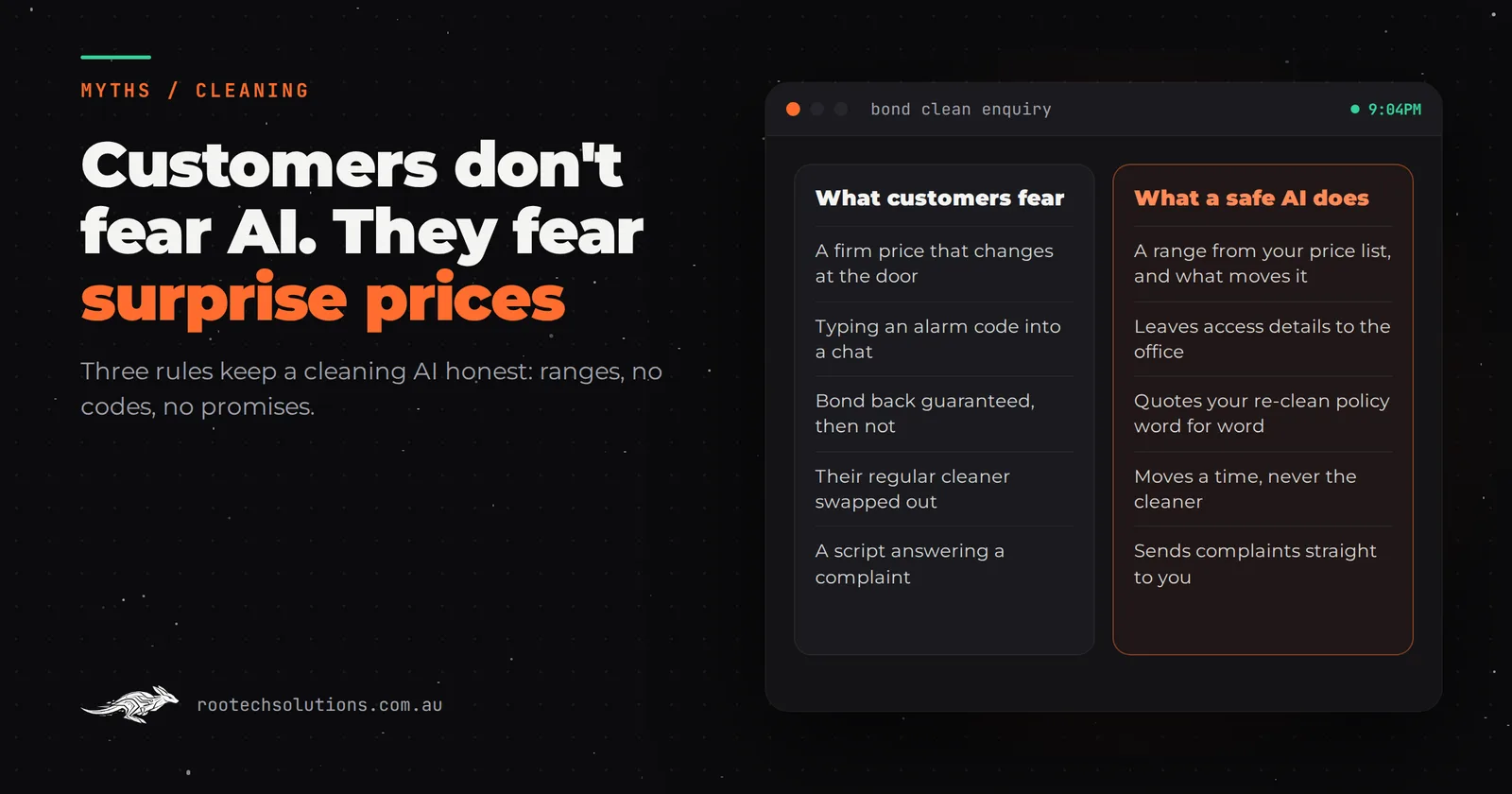
That changes which AI fears are rational. Customers aren't worried a bot is "impersonal" in the abstract. They're worried about three concrete things:
- The price will change at the door. They got $180 in a chat and the cleaner says the oven alone is another $60.
- Their access details will leak. A lockbox code or alarm PIN typed into a chat window feels like leaving the key under the mat.
- Someone will promise what the cleaner can't deliver. "Bond back guaranteed" is the classic. Whether a property manager returns a bond depends on their inspection, not your checklist.
And one fear that owners have, more than customers: "My regulars will think I've stopped caring." The Tuesday client who has had the same cleaner for three years does not want to negotiate a reschedule with software.
Which of those fears are right?
All four are right about badly built AI, and that's the useful part. Each one points to a rule.
| Customer fear | When it comes true | The rule that prevents it |
|---|---|---|
| Price changes at the door | AI gives a firm price from three chat answers | AI gives a range from your price list and says what moves it |
| Access codes leak | AI asks for keys, codes or alarm PINs in chat | AI never collects access details; the office does, by phone or in your job system |
| Over-promising on bond cleans | AI says "bond back guaranteed" | AI quotes your actual re-clean policy, word for word |
| Regulars feel dropped | AI reassigns their cleaner to fill a gap | AI can move a time, never the cleaner, without asking you |
| Complaints get a script | AI tries to resolve a breakage or a missed room | Anything about damage, quality or refunds goes straight to you |
If a chatbot vendor can't tell you how their product enforces the right-hand column, the fear is justified.
Where is the fear wrong?
The fear is wrong about speed and routine questions. Most cleaning enquiries are variations on a handful: how much for a three-bedroom, can you do a bond clean this week, do you do fortnightly, what's included, can we move Wednesday to Friday. Answering those instantly, with a range and a real available slot, doesn't feel cheap. It feels organised.
What customers complain about is the bad bot: the loop that says "I didn't understand that", the widget that ends with "please call during business hours", the price that turns out to be fiction. Silence until morning is worse than a good bot, and a bad bot is worse than silence. The point is to build the good one.
Where do people still win in a cleaning business?
People win wherever the job can't be described in a form:
- Walk-throughs for commercial, strata and office contracts. Scope, frequency, after-hours access and induction requirements need a site visit.
- Specialist work. End-of-construction, hoarding, mould, trauma cleaning. The AI should recognise these words and hand off immediately, without guessing at a price.
- Complaints and breakages. A broken vase or a missed bathroom needs an apology from someone accountable.
- The relationships that send repeat work. Property managers and real estate agents who send bond cleans every month want to deal with you.
- Your regulars. They should have your number, and the AI should recognise them and route them to you or their cleaner.
What does a guardrailed AI quoting tool for cleaners actually do?
It turns a 9pm enquiry into a priced, booked job without inventing anything. Here's the path a bond clean takes:
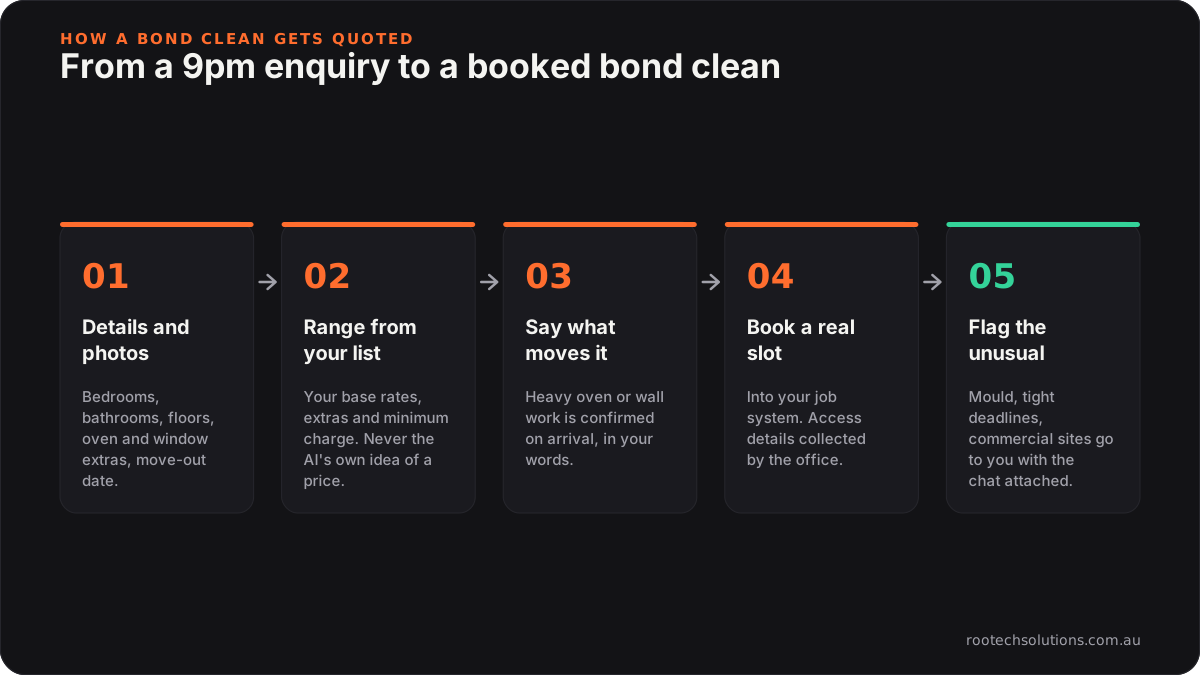
Caption: The AI quotes from your price list and your words. Anything it can't price from a form goes to you.
- Details and photos. Bedrooms, bathrooms, storeys, carpet or hard floors, oven and window extras, move-out date. Photos are optional but help for bond cleans.
- A range from your price list. Not the AI's idea of a fair price. Your base rates, your extras, your minimum charge.
- What moves the price, in plain words. "Final price is confirmed on arrival if the oven or walls need heavy work. Here's what counts as heavy." Customers accept a range they understand.
- A real slot. It books into your job system and sends a confirmation. Access details are left for the office to collect by phone or in your secure job notes.
- A flag for anything odd. Mould, pets that can't be moved, a two-day deadline, commercial sites. These go to you with the chat attached, and the customer is told when to expect a call.
The AI also says up front that it's an AI assistant. Customers letting someone into their home are the last people you want to mislead about who they're talking to.
Is off-the-shelf cleaning software enough, or is custom worth it?
Start with off-the-shelf. Job management tools such as ServiceM8 and Jobber, and cleaning-specific booking platforms such as Launch27 and BookingKoala, already handle scheduling, recurring jobs, online booking forms and invoicing. If your work is mostly standard residential cleans at fixed prices, an online booking form in one of these may be all you need. Check their current features and pricing.
A custom AI integration earns its keep when your enquiries don't fit a form. Bond cleans with a dozen variables, a mix of residential and commercial, enquiries that arrive by SMS and Facebook rather than your website, or quoting that depends on photos. In those cases the AI sits in front of your existing job system: it has the conversation, works out the range, and writes a clean job into the software you already use. Your scheduling stays where it is.
What does the build look like and what does it cost?
Most builds are live in two to four weeks at a fixed price. As estimates: a quoting tool typically costs $3,000 to $5,000 to build, and after-hours enquiry handling $3,500 to $6,000. Running costs, including hosting, AI usage and SMS, usually sit around $150 to $400 a month depending on volume. We broke those numbers down in is AI automation worth it for Melbourne cleaners.
The build includes:
- Your price list as data, not as text the AI paraphrases.
- Your exact wording for re-clean policies, cancellations and what's included.
- A banned list: access codes, guarantees, discounts you haven't approved, specialist work.
- Connections to your job system, calendar and SMS, plus the channels customers use (website chat, missed-call text-back, Facebook messages). If most of your enquiries are calls, read AI phone answering vs a website chatbot before choosing.
- A review period where you read every conversation for two weeks before it runs unsupervised.
You stay in the loop on every quote outside the normal range, every complaint and every new commercial lead. We're Melbourne-based and build for cleaning businesses across Melbourne and remotely across Australia.
Frequently asked questions
Should an AI give cleaning customers a fixed price?
Only for jobs that are genuinely fixed-price, like a standard fortnightly clean of a known home. For one-off and bond cleans, a range with the reasons it might move is more honest and causes fewer arguments on the day. Plenty of cleaners confirm the final price after the first visit and say so in the quote.
Is it safe to collect keys and alarm codes through an AI chat?
Don't. Access details should go through a phone call or straight into your job system's secure notes, handled by the office. The AI's job is to book the time and tell the customer how access will be arranged.
Will my regular clients have to talk to the bot?
They don't have to. A good setup recognises existing clients by phone number and either routes them to you or limits the AI to simple changes like moving a time, with their usual cleaner kept on the job.
Can the AI handle complaints?
It can acknowledge the complaint, collect photos and details, and get it to you within minutes. It shouldn't try to resolve it, offer refunds or argue about what happened. A complaint handled quickly by a person often keeps the client.
Want to see where AI would help without spooking anyone?
We'll go through your recent enquiries with you, mark which ones a guardrailed AI could price and book, and which should always come to you. Book a free AI workflow audit; the audit fee comes off your first project if you go ahead.