Hobart Salons: Stop Losing New Client Enquiries
AI automation for salons: how a Hobart hair or beauty salon can answer every enquiry in minutes, log it properly and fill the gaps in the week.
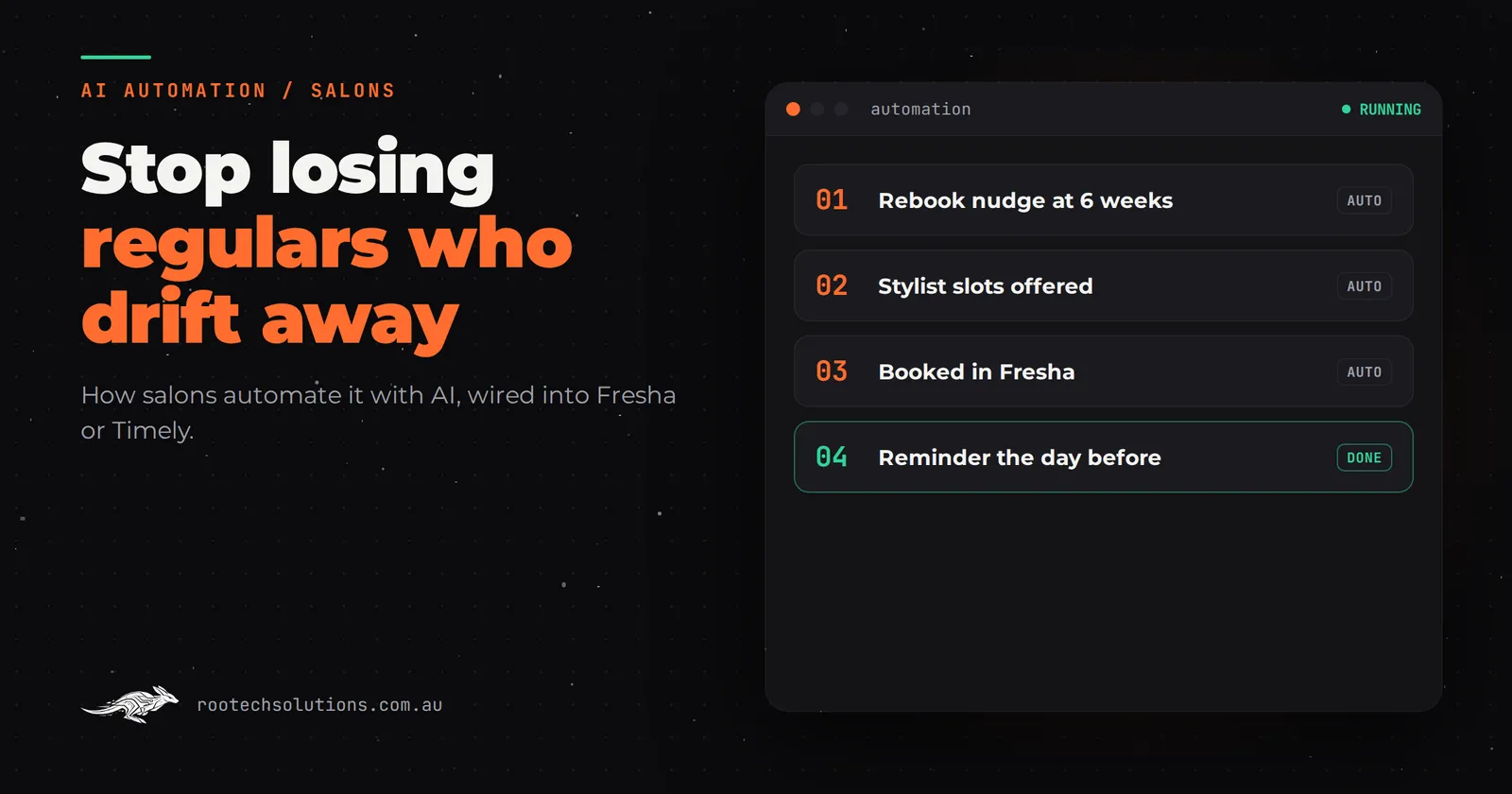
A new client texts your Hobart salon at 7:40 on a Tuesday night. She wants a colour and a cut before a wedding on Saturday. Nobody answers, because everyone has gone home. By Wednesday lunchtime she has booked somewhere else, and your Thursday has a two-hour hole in it that nobody will ever fill. That is the quiet tax every salon pays, and AI automation removes most of it without changing how your salon feels.
Short answer: Most Hobart salons lose new clients not to bad work but to slow replies. An AI automation answers every enquiry within minutes, day or night, asks the three questions a stylist needs, offers real available times and writes the details into your booking system. Anything tricky goes to a human with the full history attached. Build time is usually two to four weeks at a fixed price.
Where the enquiries actually leak out
Walk through what happens to one enquiry today. Someone sees your Instagram at 8pm, fills in the contact form or sends a DM. The reply lands in an inbox someone checks "when things are quiet". By then the person has messaged two other salons, and the first one to answer with a real time usually wins.
The leaks look like this:
- After-hours enquiries sit until morning. Hobart clients book hair and beauty around shifts, kids and weekend plans. A large share of enquiries arrive outside opening hours, exactly when nobody is watching the inbox.
- DMs, texts, emails and forms live in different places. One enquiry in Instagram, one in a text, one in the form nobody reloads. There is no single list, so nothing gets followed up.
- The reply asks questions it shouldn't need to. "Can you call us?" adds a whole extra round trip. Most people won't.
- Nothing is logged. Even the enquiries you win leave no trail, so you can't tell whether Instagram or Google actually brings people in.
Each leak is small. Together they are the difference between a full Saturday and a quiet one.
What an automated front desk actually does
This is not a chatbot bolted onto your website answering random questions. It is a workflow that handles the boring half of reception:
- It replies in minutes, on every channel. Form, email, DM or missed call, the enquiry gets a response fast, in your salon's tone of voice.
- It asks what a stylist actually needs. Service, hair length and history for colour work, preferred days and times. Those answers are the difference between quoting a time you can keep and a booking that unravels on the day.
- It offers real times. It reads availability from your booking system, so the options it gives are ones you can actually honour.
- It writes everything down. Name, service, notes and conversation land in your booking system or CRM, tagged by source. Your team walks in and sees a tidy list, not a mystery.
- It follows up the ones that went quiet. A gentle nudge after a day, once, then it stops.
A person stays in the loop where it matters. Anything involving money, a tricky colour correction or a question the AI isn't sure about goes to your team, with the whole conversation attached so nobody asks the client to repeat themselves. The AI never invents prices or promises a service; it only answers from what you've approved and hands over the rest.
Off-the-shelf booking software already does some of this
Fresha, Timely and similar tools are genuinely good, and plenty of Hobart salons should just use them well before building anything. They handle online booking, reminders and deposits, and they cut no-shows.
What they don't do is chase enquiries that never became bookings. The gap is the front half of the funnel: the person who messaged at 9pm with four questions and never opened your booking link. Off-the-shelf tools wait for the client to act. An automation meets them where they started, gathers what's needed, and only then hands them a booking link with sensible times in it. That's the layer worth building custom, and it plugs into the booking system you already run rather than replacing it.
What it's worth, roughly
Here's an estimate for a small Hobart salon, with the assumptions labelled so you can swap in your own numbers.
| Step | Today (estimate) | Automated (estimate) |
|---|---|---|
| New enquiries a month | 60 | 60 |
| Replied within an hour | 25 | 60 |
| Enquiries that become bookings | 18 | 30 |
| Extra clients a month | 12 | |
| Average first visit | $120 | |
| Extra monthly revenue | about $1,440 | |
| Admin hours saved | 10 to 15 a month |
Twelve extra first visits a month assumes the automation converts about a third of the enquiries you currently miss or answer too late. If only half of that is real, the numbers still work for most salons, because the build is a one-off cost and the running costs are typically modest: hosting usually under $50 a month and AI usage often $20 to $200 a month depending on volume.
What a week looks like afterwards
The change is easier to see in a week than in a table. Monday morning, instead of an inbox full of unanswered DMs, your senior stylist opens one list: eight enquiries came in over the weekend, six have already been answered and given times, one wants a big colour change and is flagged for a consultation, one is chasing a price for a bridal party and is marked for a call. The team starts the day on hair, not on typing.
Midweek, someone cancels a Thursday slot. In the old world that slot dies. Now the automation can text the waitlist of people who asked for Thursday and couldn't get it, offer the slot, and confirm the first person who takes it. Nobody on the floor lifts a finger.
And on Saturday night, when the wedding-party enquiry lands at 9pm, the reply is already out: a couple of questions, a realistic answer about timing, an offer of Sunday consultation slots. Your competitor across town answers on Monday. You already have the booking.
This is the same pattern working in other industries, by the way. A Canberra electrician's after-hours calls get answered the same way, and gyms use it to stop new trial members drifting off after day one, as this Sydney gyms post explains. The tooling changes, the principle doesn't: the first business to reply with a real answer usually wins.
What it takes to build
A focused build like this is usually two to four weeks at a fixed price agreed before work starts. It connects to your existing booking system, your inbox and your socials, and your team gets a simple daily view of what came in and what still needs a human. After launch, bug fixes are included and the code is yours, with an optional monthly retainer if you want it monitored and improved.
Rootech is a Melbourne software studio that builds this kind of automation for salons and clinics Australia-wide; for Hobart clients everything is done remotely over video calls, with the build and testing happening in the cloud. We've written more about how custom software works for Hobart businesses on our Hobart custom software page, and our services page lists the kinds of builds we take on. If you'd rather start by seeing where your own enquiries leak, a free AI workflow audit maps it for you, and the audit fee comes off your first project. Book a free call at Rootech's contact page and we'll walk you through it.
Frequently asked questions
Will clients know they're talking to an AI?
Usually the reply just looks fast and helpful, and it can say who it is if you want. What clients notice is getting a real answer at 8pm instead of nothing until Tuesday. The judgment calls still reach a human, which is what actually builds trust.
We already use Fresha. Does this replace it?
No. It sits in front of it. The automation catches and qualifies enquiries, then books into Fresha or Timely. You keep the booking system, reminders and deposits you already rely on.
What happens when the AI doesn't know an answer?
It says so and hands the enquiry to your team with the full conversation attached. It never makes up prices, services or availability, and anything involving money or commitments keeps a person in the loop.
Is this worth it for a two-chair salon?
Often the smaller salons feel it most, because there's no one spare to watch the inbox. The maths that matters is simple: a few extra first visits a month at your average ticket, against a modest monthly running cost. Run your own numbers against the table above.
Can it help fill quiet weekdays too?
Yes. Beyond answering enquiries, the same workflow can text a waitlist when a cancellation opens a slot, or send a gentle nudge to people who asked about a service but never booked. Salons in Hobart often find weekday gaps fill faster from follow-up than from any advertising.