Why Sydney Gyms Lose Trial Members After Day One
Sydney gyms and PT studios lose trial signups to slow replies and dead follow-up. See what AI automation fixes and what it costs to build.
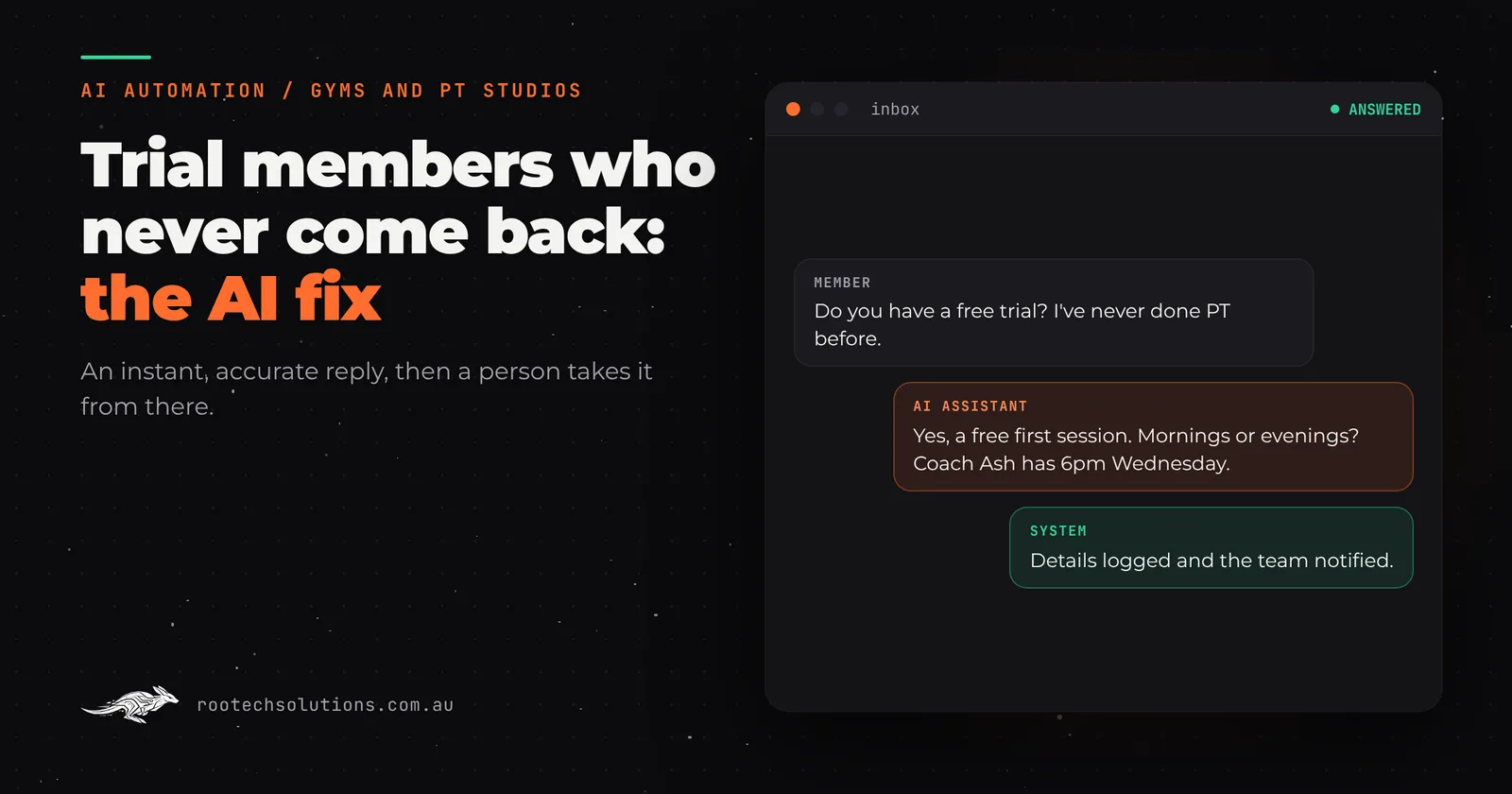
A Sydney gym owner checks their phone at 7pm and finds four trial enquiries from the day, none answered. Two were from this morning. One asked if the 6am class on Thursday has spots. By the time anyone replies tomorrow, those people have booked a free week somewhere closer to the office.
That is the pattern this post is about. Sydney gyms and PT studios are good at getting people interested and bad at the follow-up, because the follow-up happens between coaching sessions, and coaching always wins. It is the same leak we saw with Canberra electricians and after-hours calls, just with running shoes on.
Short answer: Most Sydney gyms lose trial members not to a better gym but to slower replies and follow-up that stops after one message. AI automation can answer enquiries in minutes, book trials into your timetable, and chase the ones that go quiet, while you and your coaches stay in control of who gets contacted and what gets promised. Build time is usually two to four weeks at a fixed price.
Why trial members go cold in the first week
A trial pass is the highest-value lead a gym gets. Someone who asked for a free week is closer to joining than someone who liked an Instagram post. But the journey from "interested" to "member" runs through a stretch of admin nobody owns:
- The enquiry arrives via web form, DM, text or a missed call. It lands in three different inboxes.
- Someone replies when they get a break between classes. If that break is tomorrow, the lead has already compared two other gyms.
- If the person books a trial, great. If they go quiet, nothing happens. There is no second message, because nobody has time to chase a stranger.
- The few who do start the trial get one welcome message and then nothing until the trial ends. Decision day arrives and the gym has had three conversations; the competitor down the road has had eight.
The maths is blunt. Say a Sydney studio gets 60 trial enquiries a month, 30 book a trial, and 10 convert. If faster replies and a proper follow-up sequence lift conversions to 15, that is five more memberships a month. At a $60 to $90 a week membership, five extra members is roughly $1,200 to $1,800 a month of recurring revenue, every month, from fixing follow-up. Those are estimates, but the shape holds: conversion improvements on trial leads compound, because the advertising spend stays the same.
What AI automation actually does here
Not a chatbot bolted to the homepage for the sake of it. Three jobs, wired into what the gym already runs (Mindbody, Glofox, Trainerize, a booking calendar, Google Workspace):
1. Answer every enquiry in minutes, not mornings. The AI reads the enquiry wherever it lands, replies with real answers from your approved information: class times, trial terms, pricing ranges, parking. If the question needs a human (an injury, a corporate enquiry, "can I bring my kids"), it flags a coach immediately instead of guessing. It never invents a price or promises a result. Those guardrails are the difference between an assistant and a liability.
2. Book the trial straight into the timetable. The conversation ends with an actual booking in your scheduling system, not "we'll be in touch". The lead's details land in your CRM with the source, the class they asked about and what they said, so no coach re-types anything.
3. Run the follow-up sequence a human never gets to. If a lead goes quiet: a nudge the next day, a second one three days later, a final one a week after that, each written by you so it sounds like your gym. Trial members get check-ins on days two and five and a reminder on decision day. Every message is a text or email a person at the gym can read and reply to. The AI does the chasing; the coach does the relationship.
Where a person stays in the loop: anything about money or commitment. If someone asks "can you do a discount for two of us?", the AI passes it to the owner with the conversation attached. Sales conversations with terms stay human, always.
Off-the-shelf gym software vs a custom layer
Your existing software already does part of this. Mindbody and Glofox handle bookings and memberships well, and many have automated email flows for new leads. Use them for what they are good at.
Where the gaps show up:
| Job | Off-the-shelf software | A custom AI layer |
|---|---|---|
| Booking classes and memberships | Does this well | Leave it alone |
| Answering enquiries across text, DM and web in minutes | Partial, often email only | Does this, in your words |
| Writing replies that sound like your gym and only use your facts | No | Yes, with approved answers only |
| Following up quiet leads across SMS and email | Generic templates, if any | A sequence you write, per lead source |
| Flagging injury or sales questions to a human | No | Built in |
If your current software's follow-up is working and trials convert, do not change anything. The custom layer earns its keep when enquiries arrive in more than one place, replies take more than an hour, and quiet leads simply disappear. Studios closer to the group-fitness end of the market face the same enquiry leak; we wrote about why Adelaide yoga studios lose new students, and the fix looks very similar.
The payoff, with the assumptions on the table
Worked example for a mid-sized Sydney gym, all numbers labelled as assumptions:
- 60 trial enquiries a month (assumption)
- Replies currently take an average of half a day (assumption)
- Trial-to-member conversion of 17% (assumption, roughly the band for well-run studios)
- Membership at $75 a week (assumption)
Faster replies and consistent follow-up typically lift trial conversions by a few percentage points; call it 17% to 22% here. That is three extra members a month, about $900 a week in new recurring revenue once they settle in, against running costs of hosting under $50 a month and AI usage typically $20 to $200 a month. If the build pays for itself in two to four months on those assumptions, it is worth doing. If your gym only gets eight enquiries a month, the honest answer is that a spreadsheet, a saved SMS template and a bit of discipline will do more for you than software. Fix the process first.
What it takes to build
A build like this is two to four weeks at a fixed price agreed before work starts. Discovery is a video call (we work remotely across Australia; Melbourne clients can meet in person). We map where enquiries arrive, write the answer library with you, set up the escalation rules, and connect your booking system and CRM. You test it on real enquiries before it goes live. After launch, bug fixes on what we built are included, and an optional monthly retainer covers monitoring and improvements. You own the code and the accounts it runs on.
Frequently asked questions
Will members know they are talking to an AI?
They should never have to wonder. The replies come from your approved information and your tone, and anything personal, medical or about money goes to a coach. If a member asks directly, the assistant says so. In practice most trial enquiries are simple questions about times, parking and trial terms, which is exactly the work you want off your plate.
Is this the same as a chatbot?
No, and the difference matters. A chatbot sits on your website and waits. This is an automation layer: it reads enquiries wherever they arrive, books trials into your existing system, and runs the follow-up sequence on quiet leads. A customer-facing chat is one part you can include, not the headline.
What happens when the AI gets something wrong?
It is built to escalate rather than guess. Answers come only from the information you approve, and anything outside that goes to a person with the conversation attached. During the first weeks you review what it sent, and we tighten the rules from what you see.
How much does it cost for a Sydney gym?
Every project is fixed price, scoped before work starts, so you know the number upfront. Running costs are usually hosting under $50 a month plus AI usage typically $20 to $200 a month depending on volume. Ask us for a quote based on how many enquiries you actually get.
We only get a handful of enquiries a month. Is this worth it?
Probably not yet, and we will say so. Automation pays when volume makes manual follow-up unreliable. Under about ten enquiries a month, saved reply templates and a simple checklist do the job. Come back when the volume grows, or start with a free AI workflow audit and we will tell you honestly where the leverage is.
Most Sydney gyms do not have a lead problem. They have a follow-up problem, and it is fixable in weeks. If you want to see where your enquiries leak, book a free AI workflow audit with Rootech Solutions: we will map the flow with you, and the audit fee comes off your first project if you go ahead. You can also read about custom software in Sydney or how we handle AI for skip bin hire bookings in other industries.