Same-Day AI Follow-Up for Adelaide Food and Wine Expos
Food and wine exhibitors in Adelaide lose orders to slow follow-up. How same-day AI follow-up after an expo works, what it costs, and how to brief it.
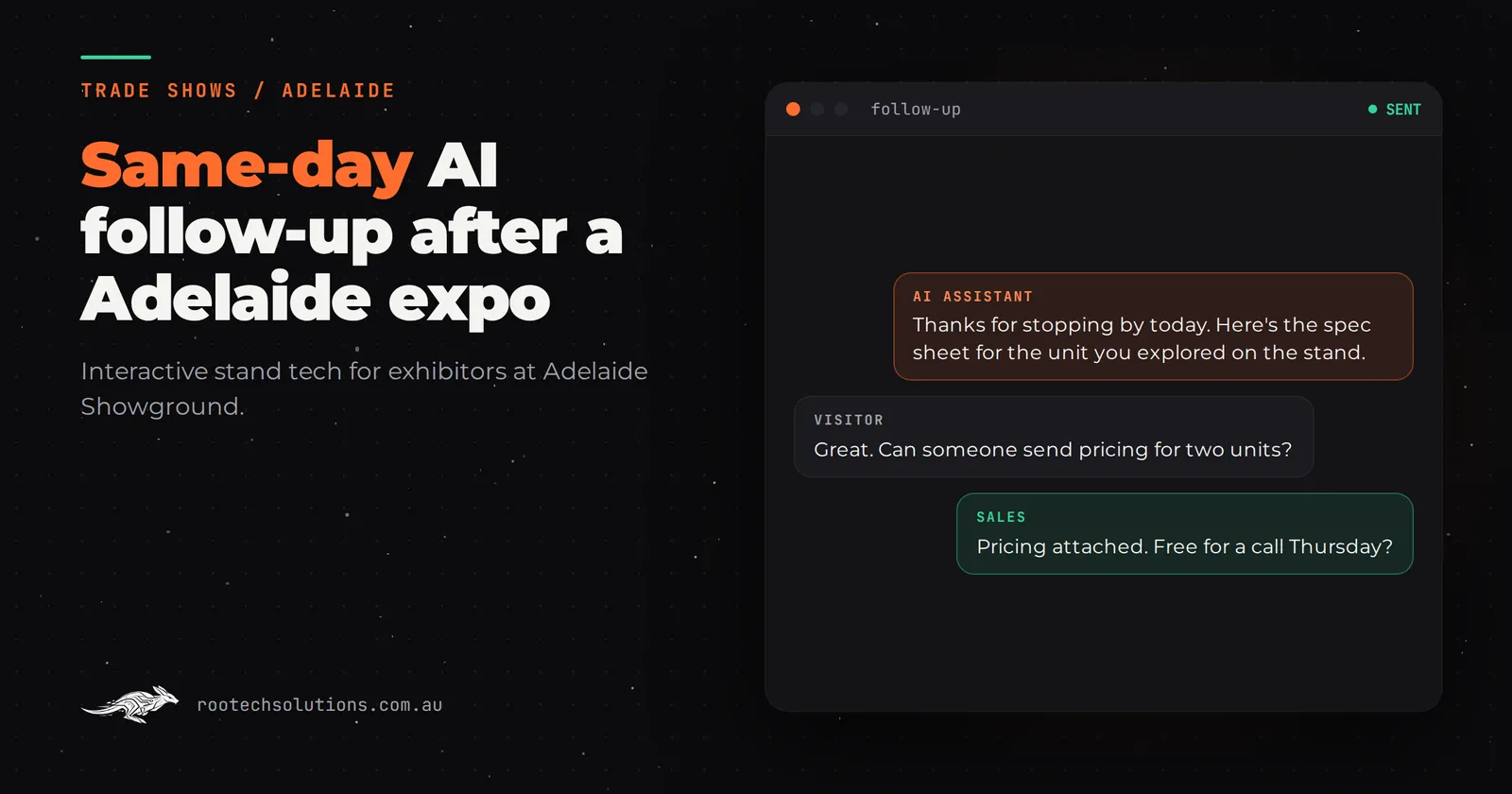
A food and wine exhibitor at an Adelaide expo can taste-test three hundred visitors in a day and still walk away with a paper bowl of business cards. By the time someone works through them the following week, the visitor has forgotten which stall poured the shiraz. The follow-up is where these stands win or lose, and most of them lose it.
Short answer: Same-day AI follow-up means every lead captured on your Adelaide stand gets a personalised email or text before the show closes, written from what the visitor actually did at your stand. Build lead capture with CRM integration first (an add-on, typically $4,000 to $12,000 in software), layer AI follow-up on top, and send while the memory is fresh.
Why does follow-up decide food and wine stands?
Because tasting is memorable but names are not. At a food and wine expo your product does the selling: visitors try it, like it, and mean to find you at a stockist or the farmers market next weekend. What they do not do is stand at your counter while someone types their details into a spreadsheet.
That creates a specific leak. The visitor who tasted three products and asked about wholesale pricing is worth ten times the visitor who grabbed a free sample and walked on, but on paper they look identical. A week later you cannot tell which card in the bowl was which, so everyone gets the same generic "thanks for visiting our stall" email, and the serious buyers go quiet.
Same-day follow-up fixes this because it strikes while the context is alive. The visitor gets a message that afternoon that mentions the exact product they asked about, maybe with the stockist nearest their suburb, and the wholesale enquiry goes to your sales list with the details attached. Food and wine is a relationship category: the follow-up is not admin, it is the sale.
What does the visitor actually do at the stand?
The visit is short, often under a minute, so the capture has to happen inside the tasting, not after it. A typical flow:
- The visitor tries a product. A tablet at the counter shows three or four quick taps: which product, are they buying for home or trade, which suburb.
- They type a name and mobile number, or scan a badge if the show runs badge scanning. Ten seconds, no more.
- The system tags the lead with everything just captured: product interest, home versus trade, suburb, and any note the staff member added.
- On the screen, the visitor sees their sample or a small thank-you confirmation. The interaction feels like part of the stall, not a survey.
Trade visitors get flagged immediately, so your team can pull the serious ones aside for a proper conversation while they are still standing there. That is a quiet benefit people miss: the capture screen tells your staff who to spend the next five minutes on.
How does the AI follow-up actually work?
It reads the lead record and drafts the message, a human approves or it sends from approved content, and it all happens the same day. The pieces:
- Drafting from context. The AI writes from the lead data, not a template with the name swapped in. "Thanks for trying the chilli relish, here are the two stockists near Glenelg" beats "thanks for visiting our stand" every time.
- Routing. Trade enquiries go to whoever handles wholesale, with a summary of what the visitor asked. Consumer enquiries get the retail message.
- Guardrails. Customer-facing AI should only send what you have approved, never invent prices or commitments, and hand anything uncertain to a person. Rootech builds that rule in on every integration: the AI drafts, your approved content and your team decide anything that involves money or a promise.
- Compliance. Marketing messages in Australia have to follow the spam rules for email and SMS; check the current requirements with ACMA and get consent at capture. The capture screen is where you do it.
What makes it survive a show floor?
Show floors kill software in boring ways, so assume the venue Wi-Fi will be shared with thousands of people and plan for the afternoon it drops out. Capture must work offline and sync when connectivity returns; a message going out at 9pm instead of 3pm still counts as same-day. Add an obvious home screen and idle reset so the tablet is always ready for the next visitor, and make the product list and message templates editable by your team between shows without calling a developer. If your staff cannot change a stockist in five minutes, they will stop trusting the system.
What does it cost, roughly?
Software only, excluding GST, with hardware hired separately. A lead capture app wired into your CRM runs about $4,000 to $12,000 as an add-on to a stand build; same-day AI follow-up layers onto that, with ongoing AI usage typically $20 to $200 a month depending on volume. Compare that against the cost of the stand space itself and the three hundred samples you gave away: the capture and follow-up is usually the cheapest part of the stand and the only part that keeps working after the doors close.
| Piece | What it does | Rough cost |
|---|---|---|
| Lead capture app | Taps, details, tagging, CRM integration | $4,000 to $12,000 as an add-on |
| Same-day AI follow-up | Drafts and sends personalised email or SMS per lead | Layered on capture; AI usage $20 to $200 a month |
| Ongoing | Hosting, monitoring, tweaks between shows | Monthly retainer, cancellable |
Ask for the follow-up metrics that matter: leads captured per day, percentage messaged same day, and replies or orders traced back to the message. If a provider cannot show you those numbers from a previous show, keep looking.
How far ahead should we brief it?
Three to four weeks is comfortable for a follow-up layer on top of a capture app you are already building. The work is mostly the content: the message templates for consumer and trade leads, the product list, the stockist data, and the routing rules. Rootech builds and tests the software remotely from Melbourne on the same screen models you will use, ships what is needed pre-configured, and sets it up with your team over a video call before doors open. If your show is sooner than that, ask anyway: a simpler capture-and-message version can come together quickly when the content is ready.
Should we reuse it across shows?
Yes, and this is where the build pays for itself twice. The capture app, message templates and CRM wiring are the same at every food and wine show; only the product list and any show-specific offer change between events. If you exhibit at the Adelaide Showground or the Adelaide Convention Centre a few times a year, one build that gets tuned between shows beats buying something new each time. The same logic applies to quizzes and touchscreens; we wrote about what a stand quiz should ask if you want a companion format on the stand.
Takeaway
At a food and wine expo, the tasting wins the visitor and the follow-up wins the order. Capture the lead inside the tasting, tag it with what they actually asked about, and get a personalised message out the same day while the sample is still on their mind.
Frequently asked questions
Do we still need paper or a fishbowl for business cards?
No. Digital capture at the counter is faster, records what the visitor was interested in, and feeds the follow-up automatically. A fishbowl tells you someone attended; a tagged lead record tells you what they wanted.
What if the venue internet drops out?
The capture app runs offline and syncs when connectivity returns, so messages may go out hours later but still land the same day. Never build a stand feature that assumes reliable venue Wi-Fi.
Can the AI invent prices or offers in the follow-up?
Not if it is built properly. The AI drafts only from content you have approved, never makes up prices or commitments, and escalates anything uncertain to a person before it sends.
Does this work for a small producer with one person on the stand?
Yes, and it suits them especially well. A single staffer pouring samples cannot also type leads into a phone between customers. Ten seconds of taps does the work, and the follow-up happens without anyone sitting down at a laptop that night.
What do we need to have ready before the build starts?
Your product list, the consumer and trade message drafts, your stockist or purchase locations, consent wording for SMS and email, and whichever CRM or spreadsheet the leads should land in. Content ready is the difference between a three-week build and a six-week one.
If you are exhibiting at an Adelaide food and wine expo and want the follow-up handled the same day, book a free call with Rootech. The AI workflow audit is free, and the audit fee comes off your first project. See our custom software work for Adelaide and how Adelaide caterers handle lead follow-up, or read how trade show lead capture works at Perth expos.