In-Room Tablets for Luxury Hotels: Off the Shelf vs Custom
In-room tablets for luxury hotels: what SuitePad, INTELITY and Crave let you brand, where a shared platform shows through, and when custom software fits better.
A luxury hotel spends years on the details a guest notices without being told: the weight of the key, the typeface on the room service card, the way the concierge says good evening. Then a tablet goes on the bedside table, and the first screen the guest sees is a grid of square tiles that would look the same in a business hotel at the airport, with the logo in the corner changed.
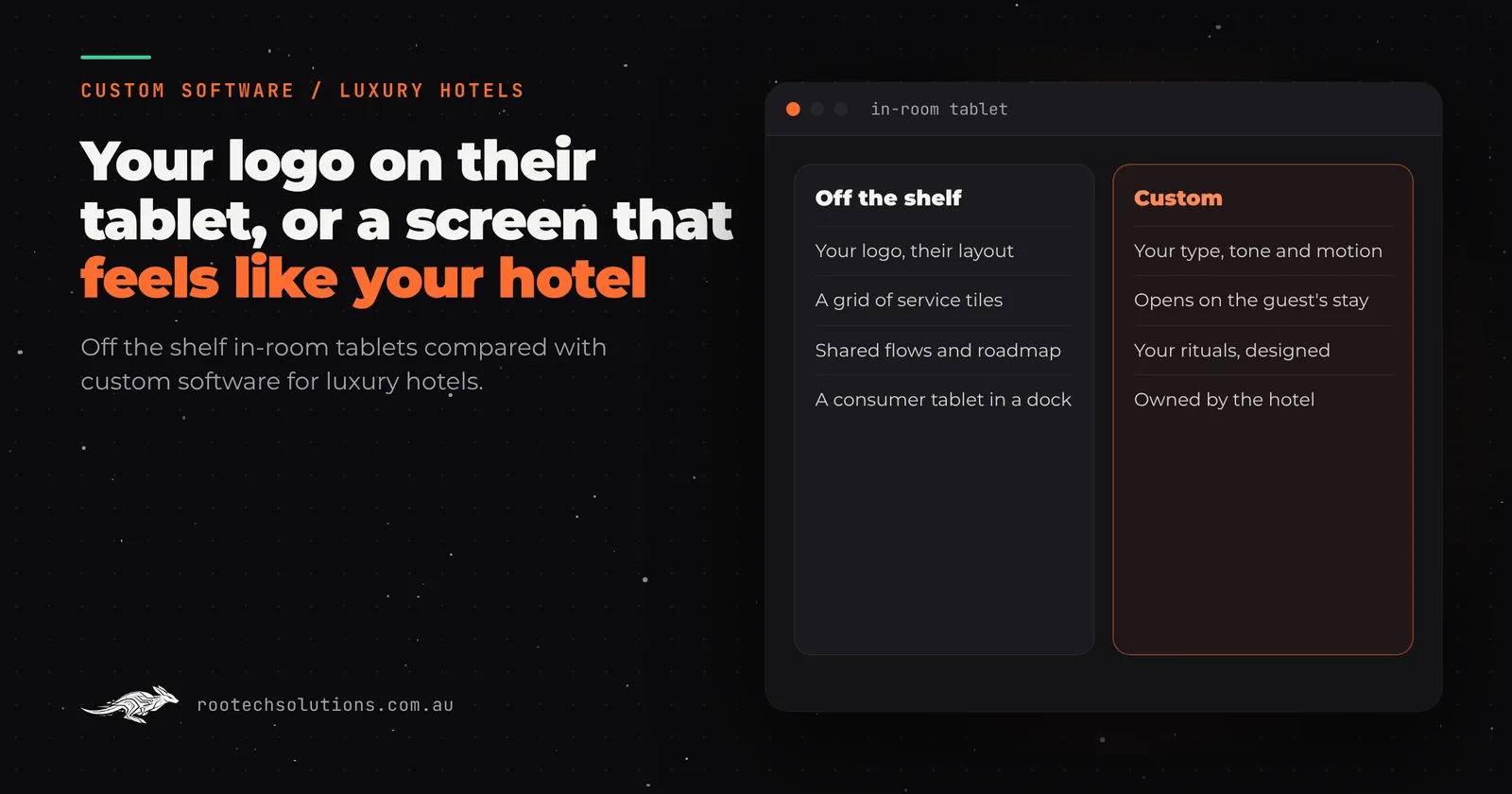
Short answer: Off the shelf in-room tablet platforms such as SuitePad, INTELITY and Crave Interactive are capable products that let a hotel add its logo, colours, icons and content. What they cannot change is the platform underneath: the tile layout, the flows, the device and how it talks to your systems are shared with every other hotel on it. Custom in-room software is designed around your brand and your rituals from the first screen, knows the guest from your property management system, and is owned by the hotel. It suits signature properties where the brand is the product.
What are the main off the shelf in-room tablet platforms?
There are a handful of established vendors that build in-room tablets for hotels, and most luxury properties that have a tablet are running one of them. Three you will come across:
- SuitePad, a German company, says its tablets align their visuals with the hotel's brand "through fully tailored layouts, icons, and colors", with an animated splash screen and tiles whose size, layout and background image can be set per service.
- INTELITY offers an 8 inch Lenovo Smart Tab M8 and a 10 inch Lenovo Smart Tab M10 with a Bluetooth speaker dock. Staff manage menus and promotions through a content management system in its GEMS platform, and it says the platform integrates with more than 100 property management, point of sale, room control and ticketing systems.
- Crave Interactive describes its tablets as giving guests access to hotel services and local information, and says its Crave AI uses a large language model to answer guest requests.
Each of these does a real job: room service ordering, a digital compendium that replaces the printed folder, spa and restaurant bookings, messages to the front desk. If you need those things across a few hundred rooms next quarter, a platform is the fastest way to get them. Check each vendor's current features and pricing, because both change.
Why do off the shelf hotel tablets feel off brand?
Because branding a platform is not the same as designing an experience. A platform lets you change the skin: the logo, the colours, the photos, the icons and the words. The structure is the vendor's, because the vendor has to ship one product to every hotel it serves.
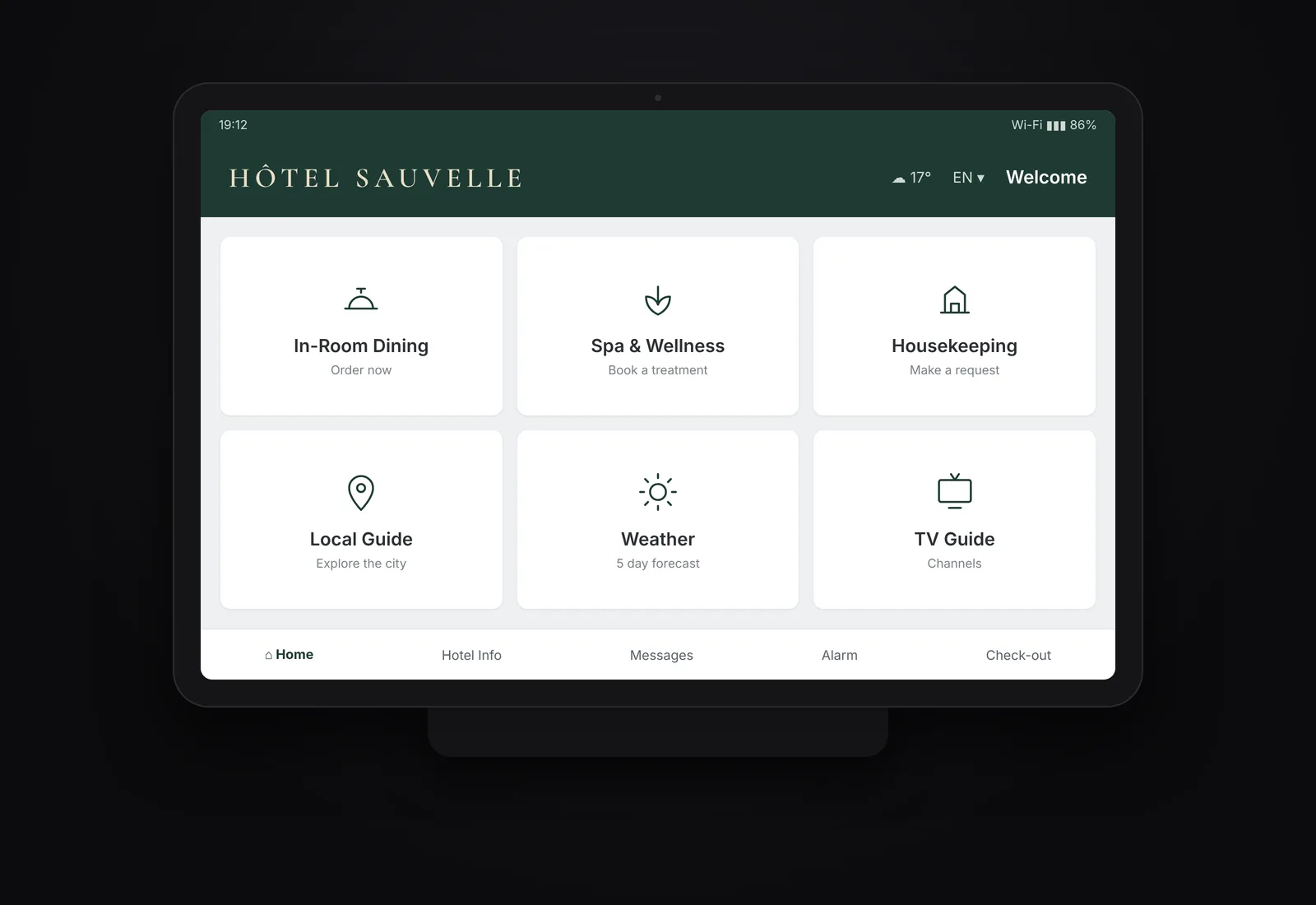
Caption: Illustrative, for a fictional hotel. The logo and colours are the hotel's; the grid of tiles, the device and the flows behind each tile are the platform's.
That shows up in a few places a luxury guest will notice:
- The home screen is a menu. Almost every platform opens on a grid of services. It is a sensible default and it is also what every other hotel's tablet looks like, so the guest reads it as hotel technology, not as your hotel.
- The flows are generic. Ordering a club sandwich, booking a massage and requesting extra towels follow the same shopping cart pattern, because the platform has to work for a resort and a motel. Your butler service, your pillow menu or your evening turndown ritual becomes another tile.
- The device is a consumer tablet. A dock and a case help, but a guest who owns the same tablet at home knows it on sight. The hardware is part of the brand whether you choose it or not.
- Type and motion are approximate. You can supply colours and icons, but your brand's typeface, its spacing and the way things move are often the first things a shared template gives up.
- The roadmap is someone else's. New features arrive when the vendor builds them, for all of its hotels at once. If your brand needs something no other hotel has asked for, you wait or go without.
None of this makes a platform a bad choice. It makes it a shared one, and for a hotel whose rate depends on feeling like nowhere else, shared is the problem.
What does custom in-room software do differently?
It starts from the guest's stay instead of from a list of services. A custom in-room system is designed in your typeface, your palette and your tone, and it is built around the moments your brand cares about, then wired into the systems you already run, so the screen knows who is in the room and what is happening in their stay.
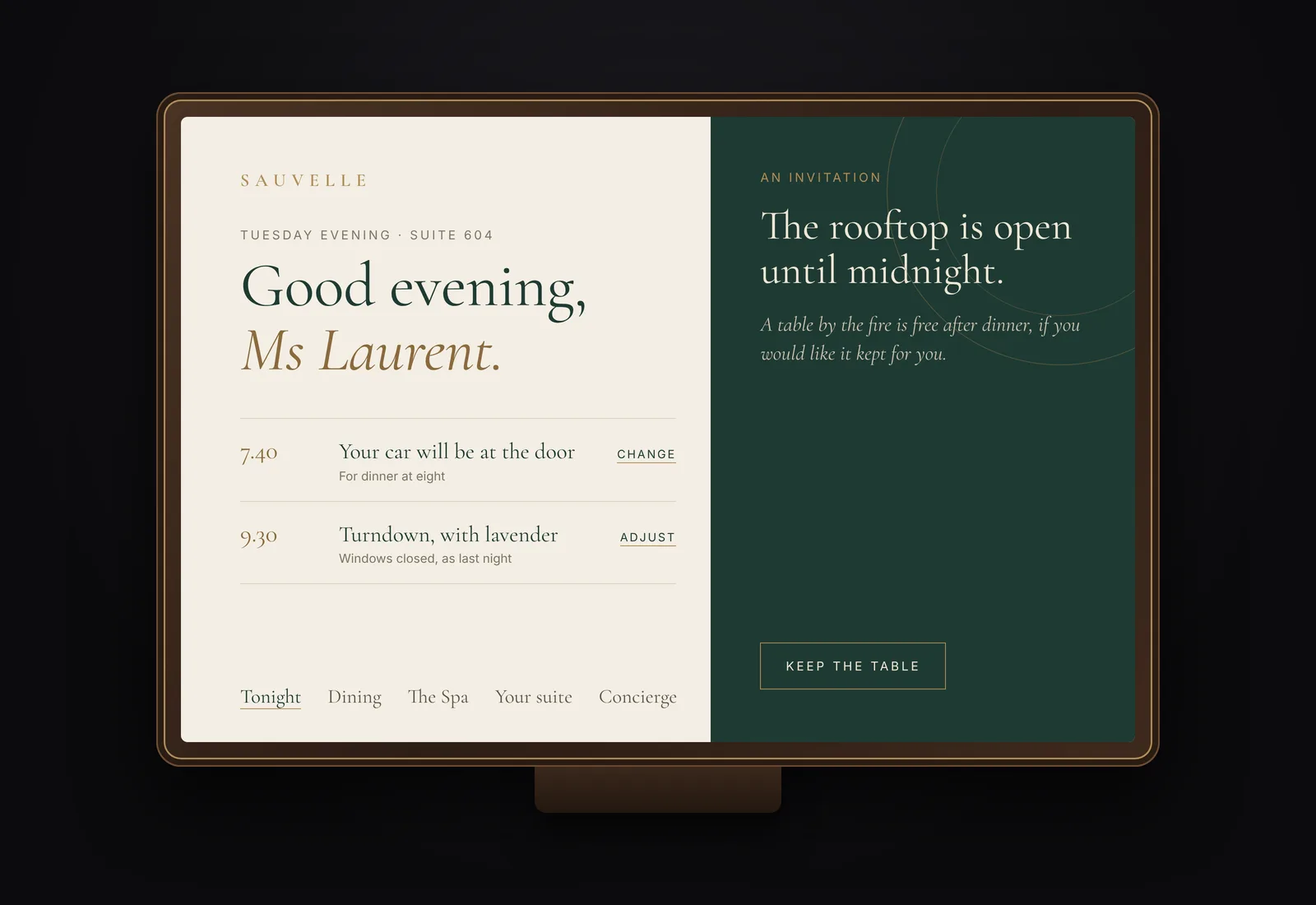
Caption: Illustrative, for the same fictional hotel. The screen opens on the guest's evening, not a menu, and every word and transition is the hotel's own.
In practice that means:
- It opens on the stay, not the menu. "Good evening, Ms Laurent. Your car will be at the door at 7.40 for dinner at eight." The services are still there, one tap away, but the first thing the guest sees is something only your hotel could show them.
- Your rituals get their own flows. A pillow menu that is a short conversation, a turndown preference that goes straight to housekeeping's list, an in-room wine selection written by your sommelier. Each one is designed, not dropped into a tile.
- It knows the guest, with care. Pulled from your property management system: their name, language, check-out time and bookings. Most modern systems, such as Oracle OPERA Cloud, Mews and Cloudbeds, publish APIs for this. The screen wipes back to a clean state at check-out, and what it stores is handled under the Australian Privacy Principles.
- One system across every screen. The same design and back end can drive the bedside tablet, the in-room TV, a guest's own phone through a link or QR code, and a lobby screen, so the brand does not change from one device to the next.
- It can use AI without sounding like a chatbot. If you want guests to ask questions in their own words, the answers come only from information you approve, in your voice, and anything the system is unsure of goes to a person on your team.
- You own it. The code, the content and the guest data stay with the hotel. You can add a feature next month because your general manager asked for it, not because it is on a vendor's roadmap.
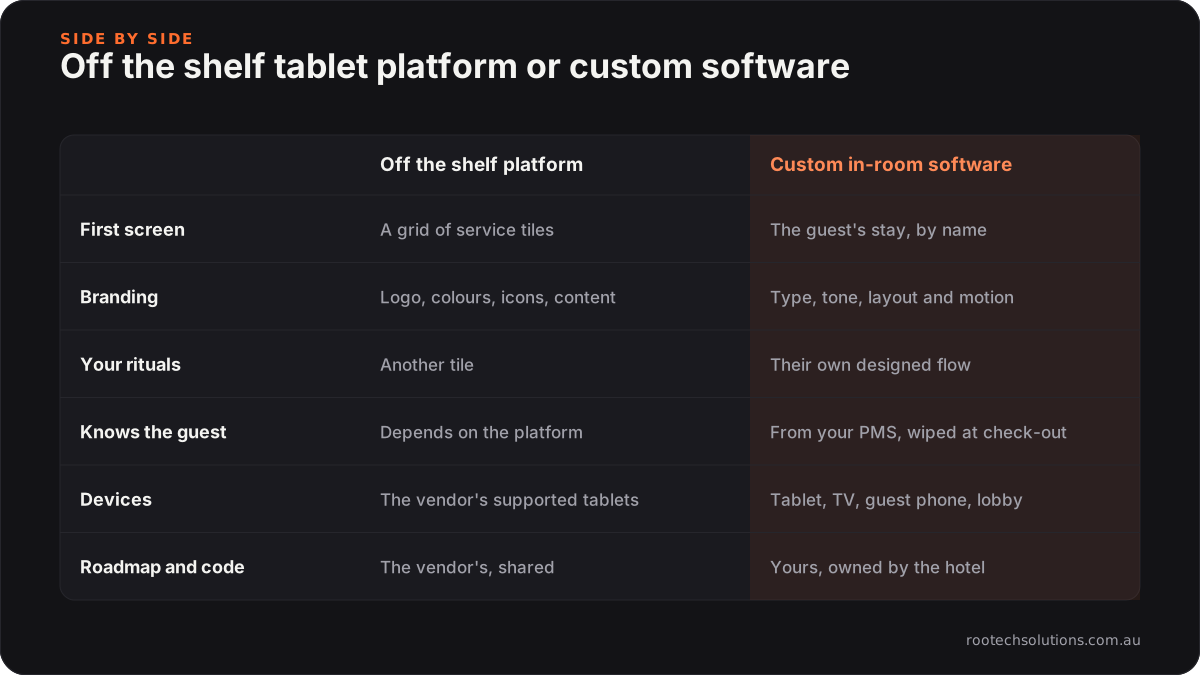
Caption: A platform lets you brand its screens. Custom software lets you design the stay.
What does a better guest experience on an in-room tablet look like?
It asks less of the guest. The best in-room screen does one useful thing at the right moment and gets out of the way. A few examples of what that looks like at a luxury property:
- On arrival: a welcome in the guest's language, the room's controls explained once, and nothing else.
- In the evening: tonight's reservation, the car, the turndown, and one invitation that suits the guest (the rooftop is open until midnight, the spa has a late booking).
- On a long stay: what is on in the city tomorrow, written by your concierge, not pulled from a generic local guide.
- At check-out: the folio to review, a car to the airport, and a goodbye in the same voice as the welcome.
None of these need new technology. They need the screen to be designed around your stay and connected to your systems, which is the part a shared platform cannot do for one hotel.
Is custom in-room software worth it for every hotel?
No, and we will say so on a call. If you run a large portfolio of similar properties, need the same features in every room quickly and your guests choose you for location and price, an off the shelf platform is probably the right call. It is proven, it is supported and it is ready now.
Custom software earns its keep when:
- Your brand is the product. A signature property, a boutique group or a hotel known for its design, where a generic screen undercuts the rate.
- You have rituals worth designing. Butler service, a curated minibar, an art collection, a restaurant with a name.
- You want one experience across devices. Bedside tablet, TV, the guest's phone and the lobby, all speaking with one voice.
- You want to own the roadmap and the data. Rather than renting a platform and waiting for features, you add what your guests ask for.
Be honest about the costs too. Custom software is built once at a fixed price and then needs looking after, the tablets still need to be managed and kept in a locked single app mode, and the integrations with your property management and point of sale systems need testing before guests see them. Weigh that against what you pay for a platform each year; our post on custom software vs SaaS subscriptions sets out how to compare the two.
Has Rootech built touchscreen software for a brand before?
Yes. For Minto Apartments' sales office, delivered through MammothXR, we built a touchscreen application where buyers explore a 3D model of the building, open the floor plan of any available unit and see the neighbourhood around it, in Minto's own look, with a web back end that keeps availability live without anyone touching the screen.
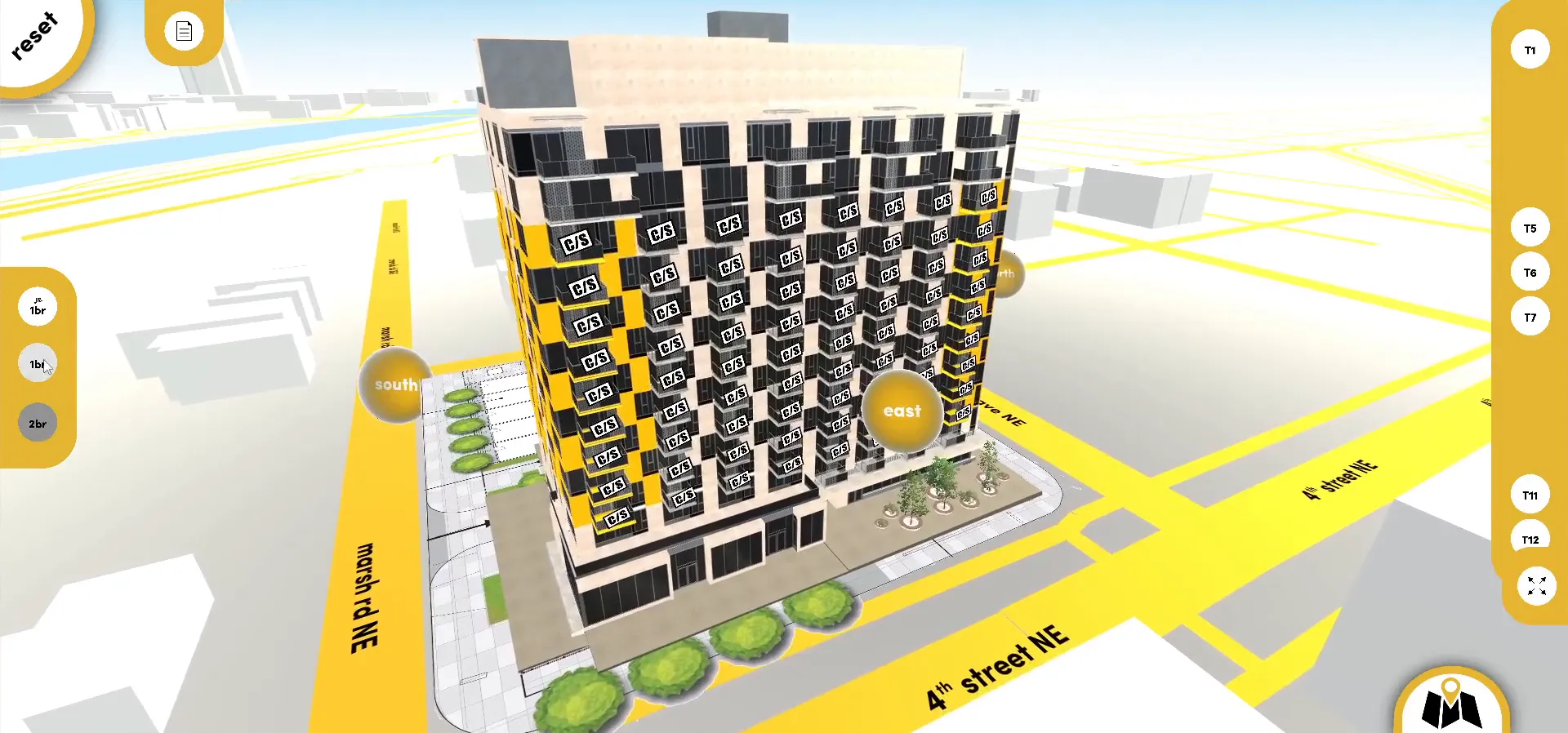
Caption: A touchscreen built in the client's brand, with a live back end, for a room where first impressions sell.
A sales office and a hotel room ask the same thing of a screen: look like the brand, explain itself without a person driving it, stay current without anyone updating it by hand, and reset cleanly for the next person. We have also built touchscreen installations for trade show stands. We are a small team of engineers in Melbourne and work with hotels anywhere in Australia, remotely for discovery and design reviews, with the software built in the cloud and devices set up with your team over a call.
Frequently asked questions
Can SuitePad, INTELITY or Crave tablets be branded?
Yes. These platforms let a hotel add its logo, colours, imagery, icons and content, and SuitePad describes tailored layouts and an animated splash screen. What stays the vendor's is the platform underneath: the overall structure, the flows behind each service, the supported devices and the roadmap.
What is the difference between a branded platform and custom in-room software?
A branded platform is the vendor's product with your logo, colours and content. Custom in-room software is designed and built for your hotel, so the first screen, every flow, the typeface and motion, the devices and the integrations are chosen for your brand and your guests, and the hotel owns the code.
Does custom in-room software work with our property management system?
It should be designed to. Most modern property management systems publish APIs, and the integration with yours (and with point of sale, room controls and housekeeping tools where you want them) is scoped before a price is agreed and tested before any guest sees it.
Who owns custom in-room tablet software?
On a Rootech build, the hotel does. The code, the content and the guest data are yours, the accounts it runs on are in your name, bug fixes on anything we built are included after launch, and ongoing support is optional and month to month.
Can we start with one floor or one room type?
Yes, and it is a sensible way to start. A pilot on one floor or one suite type shows how guests use it and what housekeeping and the front desk need from it, before the rest of the hotel is rolled out.
Design the stay, not just the screen
Tell us about your hotel: the brand, the rooms, the rituals your guests remember and the systems you run. We will tell you honestly whether a platform would do, and if custom is the better fit, give you a fixed price before any work starts. Start with a free call.