Chinese AI Models vs Frontier Models: Where the Savings Are Real
DeepSeek, Qwen, GLM and MiniMax cost far less than frontier flagships. Where the savings hold, where they do not, and how to use them with data kept in Australia.
If your business runs an AI integration, most of the running cost is tokens: the words a model reads and writes, billed per million. And over the last two years the cheapest capable tokens have increasingly come from Chinese labs. DeepSeek, Alibaba's Qwen, Zhipu's GLM, Moonshot's Kimi and MiniMax all sell models that do serious work for a fraction of what the frontier flagships from Anthropic, OpenAI and Google charge, and most of them also publish the weights so anyone can run them.
That makes them genuinely useful for a small business. It does not make them the right answer for every job. Here is where the savings are real, where they are not, and how we use these models without sending customer data somewhere it should not go.
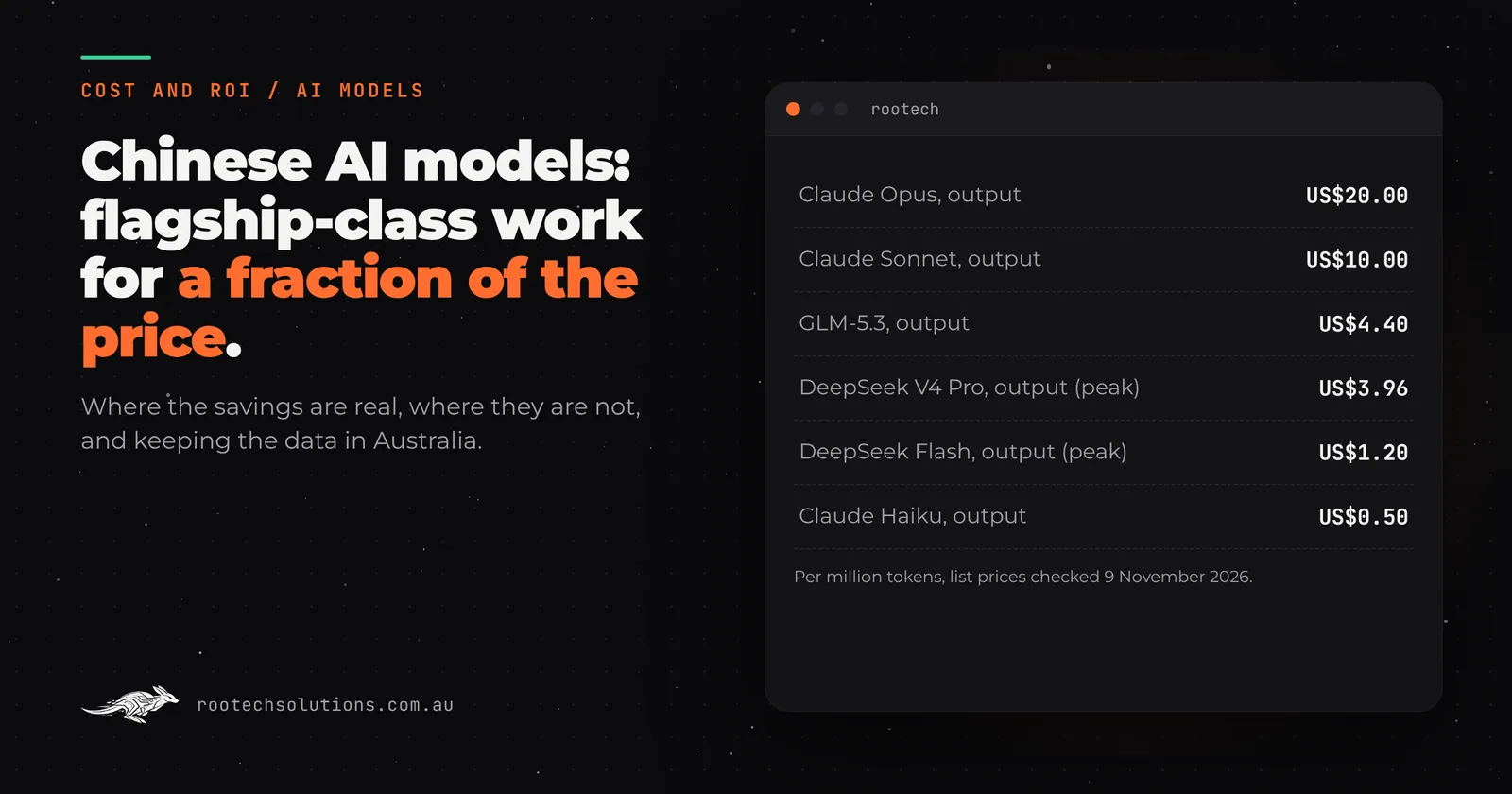
Short answer: For flagship-class work, Chinese models are much cheaper. In November 2026 DeepSeek's V4 Pro lists at $1.32 per million input tokens and $3.96 per million output at peak, half that off-peak, against $4 and $20 for Anthropic's Claude Opus. But the gap closes at the small end: Claude Haiku and OpenAI's smallest model cost about the same as, or less than, DeepSeek's Flash model. The best savings come from routing each task to the cheapest model that does it well, and running open-weight Chinese models in an Australian cloud region rather than through their makers' own APIs, so your data stays onshore.
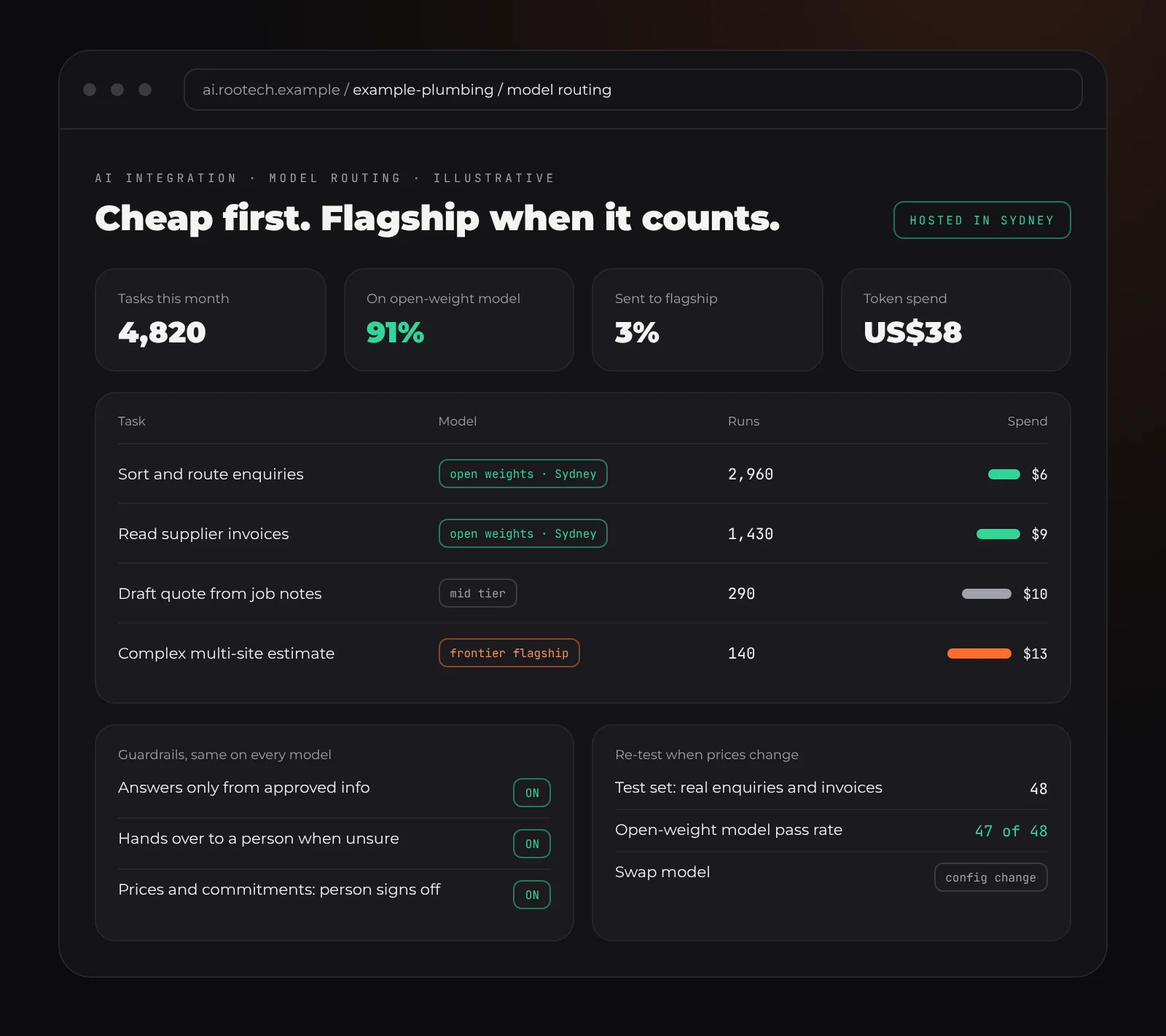
Illustrative. Most of the work goes to the cheap model; the expensive one is kept for the few tasks that need it.
What the models cost, side by side
These are the list prices on each provider's own pricing page, checked on 9 November 2026, in US dollars per million tokens. Prices in this market move every few months, so check the current page before you plan around them.
| Model | Input | Output | Cached input |
|---|---|---|---|
| Claude Opus (Anthropic) | $4.00 | $20.00 | $0.20 |
| Claude Sonnet | $2.00 | $10.00 | $0.10 |
| Claude Haiku (prompts up to 100K tokens) | $0.10 | $0.50 | $0.01 |
| Gemini 4 Argon (Google, rises to $4 / $20 on 1 December 2026) | $2.00 | $10.00 | $0.10 |
| Qwen 3.8 Max (Alibaba Cloud, international) | $2.00 | $6.00 | 10% of input |
| GLM-5.3 (Z.ai) | $1.40 | $4.40 | $0.26 |
| DeepSeek V4 Pro, peak (DeepSeek) | $1.32 | $3.96 | $0.044 |
| DeepSeek V4 Pro, off-peak | $0.66 | $1.98 | $0.022 |
| MiniMax-M3 (MiniMax) | $0.30 | $1.20 | $0.06 |
| DeepSeek Flash, peak | $0.30 | $1.20 | $0.006 |
| Qwen 3.8 Flash | $0.15 | $0.47 | 10% of input |
OpenAI's current lineup runs from $0.10 in and $0.50 out for its smallest model to $10 in and $50 out for its largest.
Two things stand out. Against the flagships, the Chinese models are several times cheaper, especially on output, which is where agent workloads spend most of their money. And at the small end, there is no gap to speak of: the cheapest frontier tiers are priced right alongside the cheapest Chinese ones.
A worked example: what the difference looks like in a month
Say you run an AI workflow that reads 50 million tokens and writes 5 million a month. That is roughly what a busy document automation or a multi-step agent might use. At the list prices above, before any caching or batch discounts:
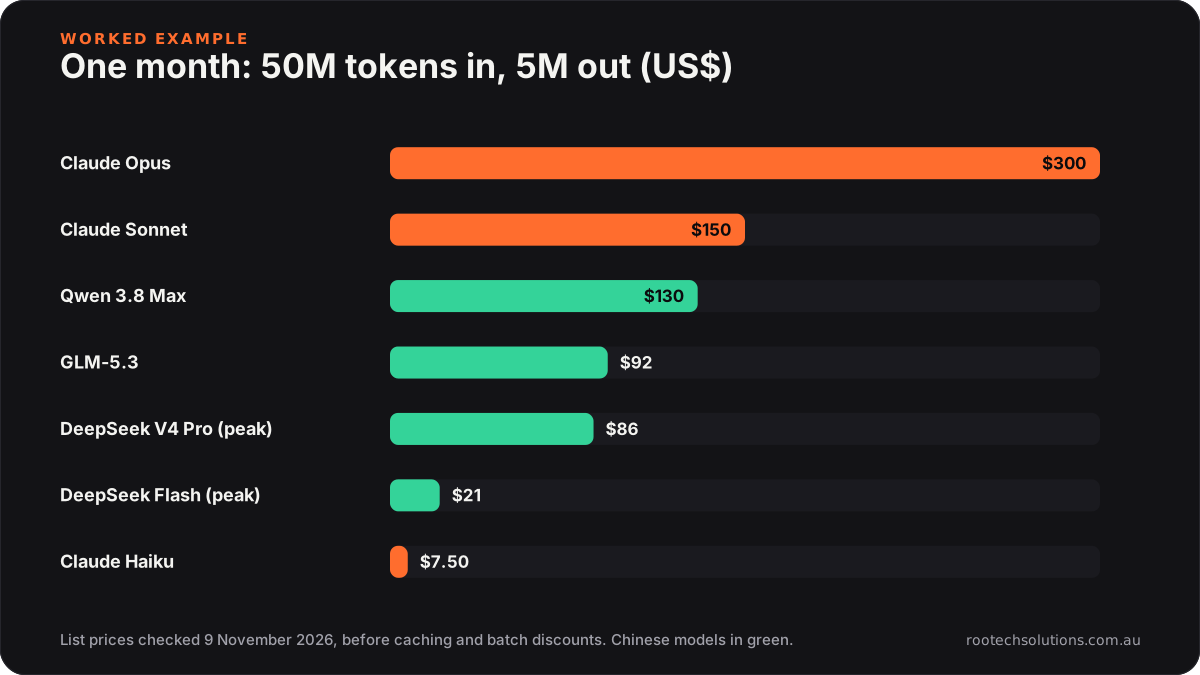
The flagship-to-Chinese gap is real: $300 on Claude Opus against $86 on DeepSeek V4 Pro, or $43 if the work can run off-peak. But notice the bottom bar. If the task is simple enough for a small model, a small frontier model can be the cheapest option of all.
And for most small businesses, the absolute numbers are modest. The AI usage on a typical Rootech integration runs $20 to $200 a month depending on volume. The model choice starts to matter in dollars when volumes grow, when an agent takes many steps per task, or when long documents go through it every day.
Is cheaper also good enough?
Not always, and the benchmarks say so. On Artificial Analysis's intelligence index, which scores models across a set of reasoning, coding and knowledge tests and reports what each costs to run, the best Chinese models still sit clearly below the top frontier models in November 2026. What they offer is a very good score per dollar, not the best score.
In practice that splits work into two kinds:
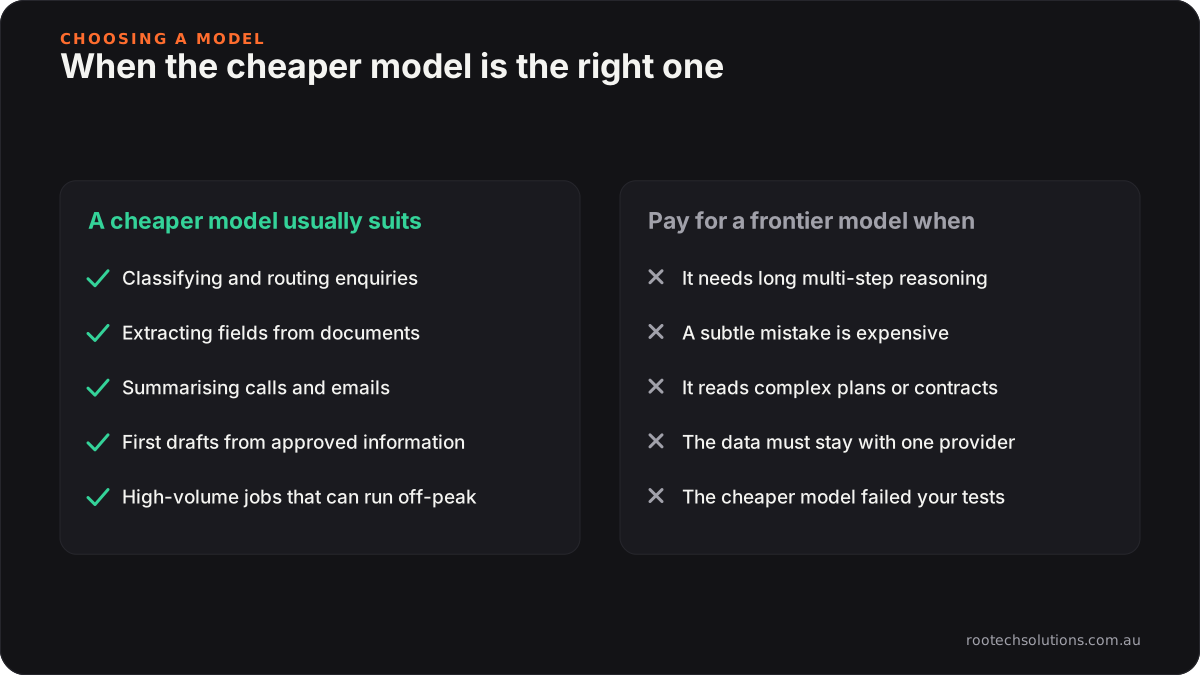
- Routine, well-defined tasks (sorting enquiries, pulling fields out of an invoice, summarising a call, drafting a reply from approved information) usually run fine on a cheaper model, Chinese or frontier small tier. You test it on your own real examples and keep the one that passes at the lowest price.
- Hard, open-ended tasks (reading a full set of construction plans, multi-step reasoning across many documents, anything where a subtle mistake is expensive) are where a frontier flagship often earns its price. Paying five times more per token is cheap if it saves a person an hour of checking.
The cheapest way to use them: open weights in Australia
The Chinese labs' biggest advantage is not the API price. It is that most of them publish their model weights. DeepSeek V4 Pro is released under the MIT licence, and Qwen's smaller models under Apache 2.0. Other flagships, including Qwen's largest model, Kimi, GLM and MiniMax, use their own licences with conditions such as attribution above a large revenue or user threshold, or a label on commercial products, so read the licence for the specific model before you build on it.
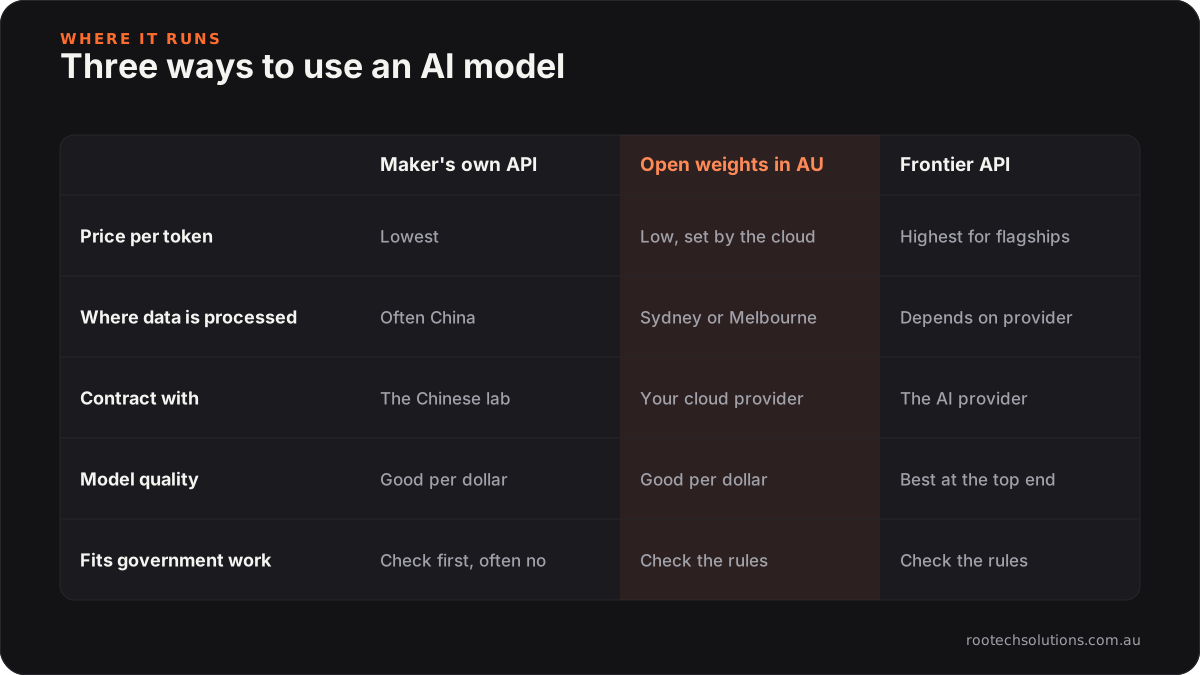
Open weights mean you do not have to send anything to China to use the model. Amazon Bedrock offers DeepSeek V3.2 in-region in both Sydney and Melbourne, and Qwen3 235B in Sydney. Some others, such as Kimi K3 and GLM 5.3, are only offered there through global cross-region routing, which means requests can be processed outside Australia, so check the model card for each one.
The risks, stated plainly
Where the data goes. DeepSeek's own privacy policy says it collects, processes and stores personal data in the People's Republic of China. That covers DeepSeek's own app and API, not the same model run on AWS in Sydney. If your business is covered by the Privacy Act, sending personal information offshore brings obligations under the Australian Privacy Principles. We do not send customer data to a Chinese provider's own API; when we use these models, they run in an Australian region.
Government and client rules. In February 2025 the Australian Government directed its agencies to remove DeepSeek products from government systems and devices (PSPF Direction 001-2025). If you supply government, or your clients have their own AI policies, check what they allow before anything else, whatever the price.
Built-in censorship. Researchers have documented Chinese models refusing or steering answers on topics that are politically sensitive in China, for example Northeastern University's study of DeepSeek R1. For quoting jobs or reading invoices this rarely matters. For anything that answers open questions from the public, test for it.
Prices and models change fast. Kimi, for example, has said its K2 series is closing to new users and being retired by the end of 2026. Build so the model can be swapped without rewriting the integration.
How we choose a model for a client
- Write down the task and collect real examples. Twenty to fifty real enquiries, invoices or documents from your business, with the right answer for each.
- Test the cheapest candidates first. A small frontier model, an open-weight model hosted in Australia, then mid-tier, then flagship, stopping at the first one that passes.
- Route by task, not by business. One integration can send routine sorting to a cheap model and the occasional hard case to a flagship.
- Keep the guardrails the same on every model. Customer-facing AI answers only from approved information, hands over to a person when unsure, and never makes up prices or commitments. Anything involving money or legal commitments keeps a person in the loop.
- Keep it swappable. When prices drop or a better model appears, changing it is a configuration change and a re-run of the tests, not a rebuild.
Frequently asked questions
Are Chinese AI models cheaper than ChatGPT, Claude and Gemini?
Than their flagships, yes, often by several times, especially on output tokens. Against the small frontier tiers, not really: Claude Haiku and OpenAI's smallest model are priced at or below DeepSeek's Flash model in November 2026. Compare the specific models, not the countries.
Is it safe to use DeepSeek for my business?
Using DeepSeek's own app or API sends data to servers in China, according to its privacy policy, and the Australian Government has banned it on its own systems. Running an open-weight DeepSeek model in an Australian cloud region, such as on Amazon Bedrock in Sydney or Melbourne, keeps the data onshore under your cloud provider's terms. Check your own obligations and your clients' policies first.
Are Chinese models as good as frontier models?
For many routine tasks they are good enough, and that is what matters. On broad benchmarks the best of them still sit below the top frontier models. Test on your own examples before deciding.
How much will AI cost to run for my business?
On a typical Rootech integration, AI usage runs about $20 to $200 a month depending on volume, and hosting usually comes in under $50 a month. Choosing the right model per task is one of the ways we keep it at the low end.
Can you switch models later?
Yes. We build integrations so the model can be changed with a configuration change and a re-run of the tests, which matters in a market where prices and models change every few months.
Get the cheapest model that does the job
If you are paying for AI, or about to, we can look at what it does and test cheaper models against your own examples, with the data kept in Australia. Every project is a fixed price, and it starts with a free AI workflow audit. Start with the contact form at Rootech Solutions.