What AI Automation Costs a Canberra Landscaper
AI automation cost for Canberra landscapers: what a build and the running costs really are in AUD, a payback sum you can redo with your own numbers.
A Canberra landscaping business loses money in quiet ways. The enquiry that came in at 7pm on a Friday and never got a call back. The quote that went out three days after the measure-up, by which point the client had booked the other crew. The hour every night spent retyping job details from the ute into the diary and the invoice. You suspect AI could help, but you want to know what it actually costs and whether it pays back before you spend anything.
Short answer: A first AI automation for a landscaping business typically costs $2,000 to $5,000 to build and $50 to $300 a month to run, depending on how much it does. Crews that lose enquiries to slow follow-up usually recover the build in one to three months from jobs they would otherwise have missed. It pays back slowest where one person already handles every enquiry within the hour.
How does a landscaping business actually make money?
Before the costs, the economics, because they decide the payback. A landscaper earns per job, the job value swings wildly (a lawn round is $80 a visit, a retaining wall and paving job is $15,000 or more), and most of the profit sits in the bigger jobs. Winning those comes down to being first with a credible quote and looking organised.
That makes landscaping a follow-up business. Homeowners usually contact two or three crews, and the first one to send a proper quote and ask for the job tends to get it. The second difference is seasonality: spring and autumn are frantic, winter is thin. Whatever you automate has to earn its keep across the whole year, or at least pay for itself in the busy months.
What does AI automation cost a landscaping business?
There are three builds most landscapers consider first. The build range below is an estimate for a build similar in scope to the AI lead agents we publish for other service businesses, typically $2,000 to $5,000 in AUD excluding GST for a single crew; a bigger operation with more systems to connect sits higher, and the final figure is quoted after scoping.
| Workflow | What it does | Build (estimate) | Running (estimate) |
|---|---|---|---|
| Enquiry capture and instant reply | Grabs website, Facebook and missed-call enquiries, texts back within a minute, asks suburb, job type and rough size, books the measure-up | $2,000 to $5,000 | $50 to $200 a month |
| Quote follow-up assistant | Nudges clients who went quiet after receiving a quote, answers simple questions, flags the ones ready to proceed | $2,000 to $4,000 as an add-on | Mostly SMS costs |
| Job admin automation | Turns your voice notes and photos into job records, invoices and Xero entries without retyping | $3,000 to $5,000 | $50 to $300 a month |
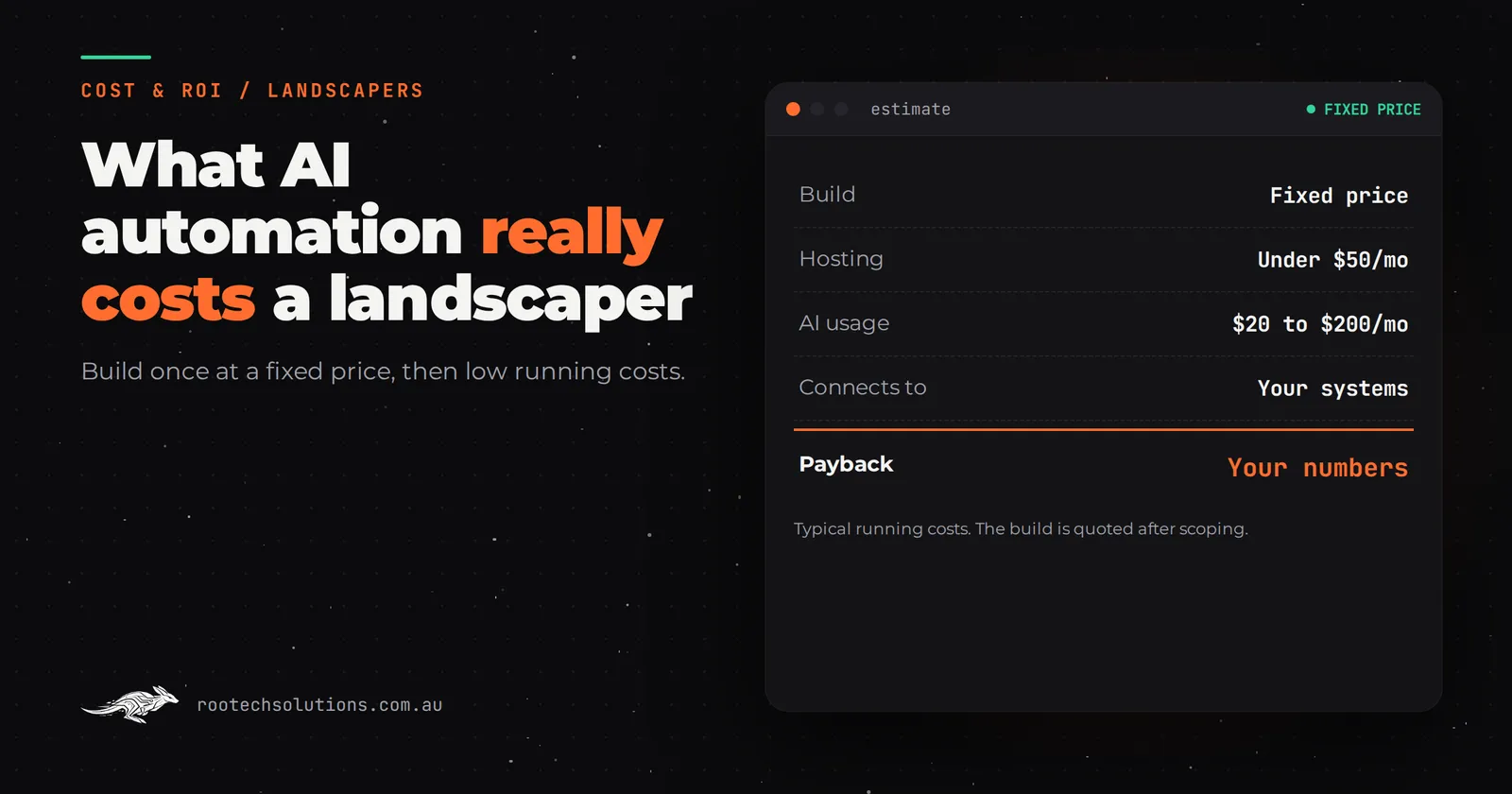
Hosting is usually under $50 a month on top of any of these, and AI usage typically runs $20 to $200 a month depending on volume. SMS is charged per message by your provider, so check their current pricing. Most Canberra landscapers we would advise start with the first one, because an enquiry that never gets a reply is a job you have already lost, no matter how good the quoting is.
What does the payback look like for a crew like mine?
One formula: divide the build cost by the extra money each month brings in after running costs. The work is choosing honest inputs. Here is a worked example for a two-crew operation, with every assumption labelled as an assumption and a blank column so you can swap in your own numbers.
| Assumption | Example value | Your number |
|---|---|---|
| Build cost (enquiry capture plus quote follow-up) | $4,000 | |
| Running cost a month | $150 | |
| Enquiries a month that go unanswered or unanswered in time | 8 | |
| Share of those that would have become jobs | 40% | |
| Average job value | $1,800 | |
| Quotes sent that go quiet without an answer | 6 a month | |
| Jobs saved by one polite follow-up round | 1 |
Working it through:
- Recovered enquiries: 8 x 40% = about 3 extra jobs a month, at $1,800 = $5,400.
- Recovered quotes: 1 extra job a month at $1,800 = $1,800.
- Extra income: $7,200 a month. Minus $150 running costs: about $7,050.
- Payback: $4,000 / $7,050 = under one month. Even if the real numbers are half the example, payback is roughly a month and a half.
Those assumptions are deliberately mid-range and they are estimates, not data. If your jobs average $400 lawn rounds rather than $1,800 builds, halve everything twice and check it still pays: at $400 jobs the same recovery rate gives about $1,600 a month, which is still payback inside three months. The number that matters most is the first one. Check your phone and email for a normal fortnight and count how many enquiries never got a same-day reply. Most owners undercount that figure badly. We did the same worked sum for a Perth pool builder and for a Gold Coast pest controller, and the pattern holds across the trades: the payback lives or dies on how many enquiries are currently going cold.
Which tasks are worth paying for, and which are not?
Worth it, in order:
- Instant enquiry reply. After-hours and on-site-you-cannot-answer enquiries get a text back in a minute, with the qualifying questions done and a measure-up booked. This is where the leak is biggest.
- Quote follow-up. Most quotes die in silence, not in rejection. One polite, well-timed nudge recovers a share of them at almost no marginal cost.
- Job admin. Voice note to invoice to Xero without the nightly retyping session. Less dramatic than winning jobs, but it claws back five to eight hours a week of owner time, and owner time on a landscaping crew is worth real money in busy season.
Honestly not worth it yet: AI-designed garden layouts and planting plans. Clients hire the crew and the eye, and a generated concept image that does not match what gets built creates more arguments than it wins. Automate the paperwork around the work before you automate anything about the work itself.
Is off-the-shelf field service software enough?
Partly. Apps such as ServiceM8, Jobber and Fergus already handle scheduling, quoting templates and invoicing well, and if you are not using one, sorting that out comes before any AI. Many also send automatic quote reminders, which may cover the second workflow above on its own.
A custom AI layer earns its place when the software cannot do the conversation. Field service apps send a reminder; they do not answer "do you also do the decking, and can you start before Christmas?" at 9pm and book the measure-up with the details attached. Custom also means the enquiry lands in the system you actually run, whether that is ServiceM8, a spreadsheet or nothing at all yet, with suburb, job type and photos already sorted. We wrote about the general trade-off in chatbot platforms compared: when to go custom instead, and the same logic applies to trade services.
What does the build look like, start to finish?
A build like this ships in two to four weeks at a fixed price agreed before work starts.
- Week one: your rules. Your suburbs, your services, your qualifying questions, your measure-up availability and the answers the assistant is allowed to give. Anything about price beyond your published minimums stays with a human.
- Weeks two and three: build and connect. The assistant is connected to your website form, your Facebook page messages, your missed-call number and your booking or scheduling tool.
- Final week: testing. It runs against your last few months of real enquiries before a customer sees it.
The guardrails matter in a trade like this. The AI only answers from information you have approved, escalates anything unusual to you, never invents a price or a start date, and every booking it makes is one you can see and change. Rootech builds this way on every job, and clients own the code when it ships.
When is AI automation not worth it for a landscaper?
Be honest about these three situations:
- You answer every enquiry within the hour already. If a partner or office manager handles the phone all day, the biggest workflow is automating a problem you have solved with people. Job admin automation may still pay, but start there, not with an enquiry agent.
- You are booked out months ahead. If the problem is too much work rather than too little, an enquiry agent adds nothing. Quote follow-up still can, but a waiting-list and scheduling fix is the better spend.
- You take fewer than about ten enquiries a month. At that volume the running cost eats most of the gain, and a better voicemail message plus a same-day callback habit is free.
Canberra seasonality sharpens this. A crew that earns most of its money from September to December should time the build for late winter, so it is humming before the spring rush of turf, planting and patio jobs arrives. Cost guides for other trades, such as what AI automation costs a Newcastle flooring business, reach the same conclusion from different numbers: timing the build matters as much as pricing it.
Frequently asked questions
Do I need to change my phone number or website?
No. A missed-call text-back runs over your existing number, and the enquiry agent connects to the website and Facebook page you already have. If your site cannot take a form submission reliably, that is a small fix we would do first.
What if the AI quotes a job badly?
It should not quote at all beyond your published minimums. Quoting a retaining wall needs a site visit, and the AI's job is to get that visit booked with the details gathered, not to put a number on it. Anything involving money stays with you.
Will clients mind dealing with an AI?
The assistant says what it is in its first message and offers a person whenever someone asks. Most homeowners care that they got a fast, useful reply at 8pm. The ones who want a human get one quickly, and you see every conversation.
Can I start with just one workflow and add more later?
Yes, and that is the usual path. Start with enquiry capture, run it through a full season, then add quote follow-up or job admin once you can see what it actually saved you. Each build is priced separately, so you are never committing to the whole lot up front.
Want the numbers for your crew?
Book a free AI workflow audit. We look at how your last month of enquiries was handled, where quotes went quiet and what your admin evenings cost you, then give you a fixed-price estimate and an honest payback figure, including "not yet" if that is what the numbers say. The audit fee comes off your first project if you go ahead.