AI Order Automation: Why Trade Wholesalers Lose Reorders
Trade wholesalers lose reorders to big suppliers' apps. AI order automation for wholesalers lets tradies text an order and get a priced reply in seconds.
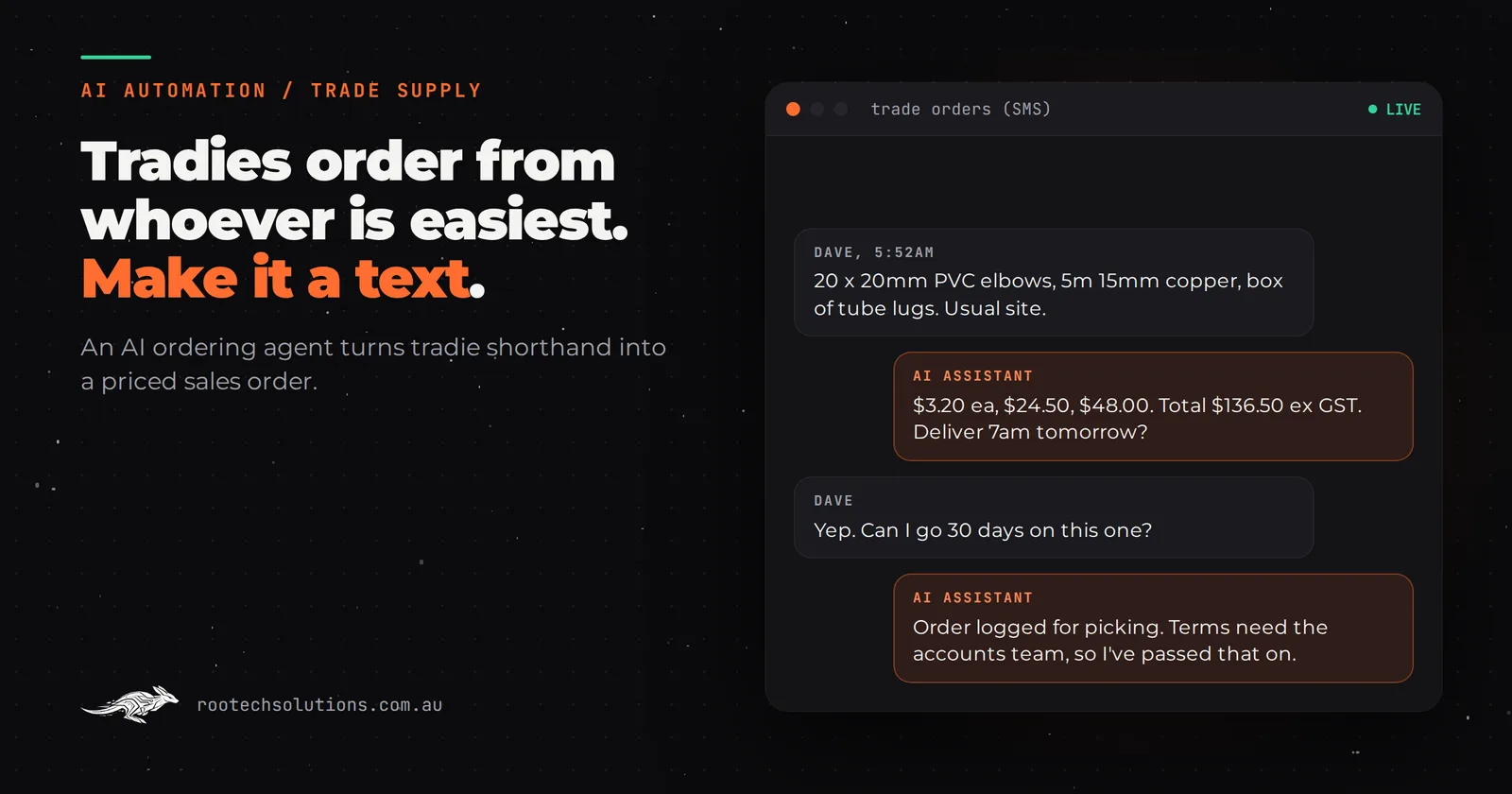
Most trade wholesalers don't lose customers because their prices are wrong. They lose reorders because a plumber on a site in Werribee at 4:45pm can't be bothered ringing your counter, so they open the big national supplier's app instead. AI order automation for wholesalers lets that same tradie text you the order from the ute and get a priced confirmation back before they've started the engine.
Short answer: Trade wholesalers lose reorders because ordering from them takes a phone call during counter hours, while the big suppliers take an order in a few taps at any hour. An AI ordering agent connected to your stock system and account pricing closes that gap: tradies text an order in plain words, the agent matches it to your catalogue and confirms, and your team handles only the exceptions.
Why do tradies drift from their local wholesaler?
Convenience, not price. Ten years ago a tradie rang the counter, talked to someone who knew the range, and the order was done. Now they plan tomorrow's job at 9pm on the couch or at 6am before they leave home, and the supplier who takes an order at those hours gets it.
The painful part is that you rarely see it happen. A big one-off quote you lose, you notice. The weekly run of fittings, fixings and consumables that quietly moves to an app does not come with a phone call or a complaint. The account just gets a bit lighter each month, and by the time the rep notices, the habit has formed somewhere else.
A worked example, with round numbers you can swap for your own: 30 regular trade accounts each spending about $500 a week is $15,000 a week. If a quarter of those accounts move their routine reorders elsewhere, that is $3,750 a week, or around $195,000 a year in sales, gone without anyone deciding to leave you.
What does AI order automation for wholesalers actually do?
It takes an order written the way a tradie talks, turns it into lines on a sales order, and confirms it with the customer's own pricing. Nothing about it requires the tradie to download an app or remember a password.
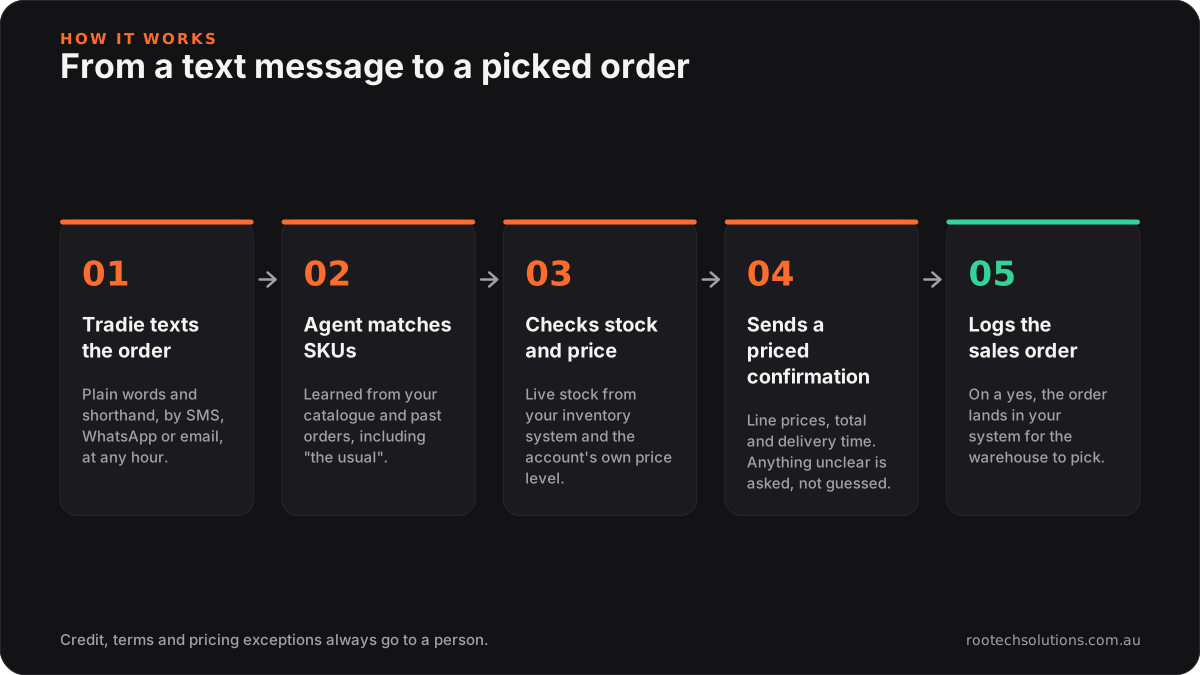
Caption: The agent does the matching and the typing; the warehouse sees a normal sales order.
- The tradie texts the order. "Need 20 x 20mm PVC elbows, 5m of 15mm copper and a box of tube lugs, usual site."
- The agent matches each item to your catalogue. It knows that "20mm elbows" means a specific SKU, that this customer always buys a particular brand of lug, and that "usual site" means the delivery address on their last three orders.
- It checks stock and the account's price. Live stock from your inventory system, and the customer's own price level rather than list price.
- It replies with a priced confirmation. "20 x 20mm PVC elbows at $3.20, 5m 15mm copper at $24.50, 1 box tube lugs at $48.00. Total $136.50 ex GST. Deliver to Hoppers Crossing tomorrow 7am?"
- On "yes", it logs the order. The sales order appears in your system for the warehouse to pick, exactly as if the counter had keyed it.
The same agent answers the calls that clog your counter: "got any 32mm waste fittings?", "what's your equivalent of that brand's fitting?", "what's my balance, can I still order this week?". Each of those is a lookup, and a lookup is what software is good at.
Is a B2B ordering portal better than ordering by text?
For some wholesalers, yes. A self-serve B2B portal suits customers who order large, structured baskets from a desk: builders' purchasing officers, maintenance contractors, other businesses with an office. Tradies on the tools are different. They order from memory, in shorthand, often with a photo of the empty box, and a portal makes them do the catalogue search themselves.
| Phone or counter | B2B portal or app | AI ordering by text | |
|---|---|---|---|
| Hours | Counter hours only | Any time | Any time |
| How the tradie orders | Talks to a person | Searches and taps | Writes it like a text to a mate |
| Shorthand and "the usual" | Understood by experienced staff | Not understood | Understood once trained on order history |
| Account pricing | Staff look it up | Shown after login | Quoted in the confirmation |
| Your staff time per order | Full call | Low | Exceptions only |
| Build effort | None | Large, often a long project | Two to four weeks on top of existing systems |
Plenty of wholesalers end up with both: a portal for the office buyers and text ordering for the tradies. The point is not to pick a channel you like. It's to match the channel to how each customer group actually buys.
Should we buy off-the-shelf software or build a custom ordering agent?
Keep your inventory system and add the agent on top. Wholesalers already run real software: inventory and ERP platforms such as Unleashed, Cin7, MYOB Advanced or Pronto Xi, with Xero or MYOB for the accounts. Those systems are good at what they do, and replacing them to fix an ordering problem would be a mistake.
Off-the-shelf is the right call when your ERP or e-commerce platform already offers a B2B ordering portal and your customers are happy to log in and use it. Turn it on, load your price levels and check the vendor's current pricing for the module.
A custom AI integration earns its keep when your customers won't use a portal, when orders arrive as free text by SMS, WhatsApp or email, or when your counter staff spend hours turning "the usual plus a few extra elbows" into sales orders. That translation from tradie shorthand to SKUs is exactly the bit no off-the-shelf module does well, because it depends on your catalogue, your customers' habits and your naming. We weigh this decision across industries in off-the-shelf software versus a custom AI agent.
What does it cost to build an AI ordering agent?
Most AI ordering agents for a small wholesaler are a fixed-price build in the range of $5,000 to $12,000, depending on how many systems it touches and how messy the catalogue is. These are estimates, not quotes. Running costs are usually hosting under $50 a month plus AI usage of $20 to $200 a month, depending on order volume, plus whatever your SMS or WhatsApp provider charges per message.
The build usually takes two to four weeks:
- Week one: the catalogue. We pull your product list and a few months of past orders, then build the matching layer that maps tradie language ("20 elbows", "the grey ones", "same as last Tuesday") to SKUs. This is where most of the accuracy comes from.
- Week two: the connections. Read stock and price levels from your inventory system, write sales orders back into it, and read account balances from your accounting software.
- Weeks three and four: the pilot. A handful of friendly tradies order through it for real while your counter staff check every order before it is picked. Only when the matching is reliable does it go live to everyone.
If your stock lives in a well-kept spreadsheet rather than an ERP, it can still work. It just means the agent reads the spreadsheet, and the case for eventually moving to proper inventory software gets stronger.
Where does a person stay in the loop?
Anywhere money, credit or judgement is involved. The agent handles routine reorders, stock questions and balance checks. It does not:
- approve credit overrides, payment plans or orders on an account that's on stop (those go to your accounts person);
- quote a big project for a builder you've never dealt with (that goes to your rep);
- grant pricing exceptions or bulk discounts;
- guess. If it can't match an item with confidence, it asks the tradie or flags the line for the counter, rather than picking something close.
When something needs a person, the agent tells the tradie someone will confirm shortly and drops the conversation into a queue your team sees. A good rule of thumb is that the agent should never make a decision you wouldn't let a new junior on the counter make in their first week.
The payoff for your staff is time on the work that grows accounts: calling builders about upcoming jobs, following up quotes and visiting sites. That's the same logic that applies to tradies automating their own data entry, just from the supplier's side of the counter.
Frequently asked questions
Do tradies need to download an app to order by text?
No. The agent works over SMS, WhatsApp or email, which every tradie already uses. That's most of the point: the lowest-effort way to order wins the order, and a text message is lower effort than any app.
What happens if the AI matches the wrong product?
During the pilot, every order is checked by a person before it is picked, and mismatches are used to improve the matching. After launch, the agent only confirms lines it can match with confidence, asks the tradie about anything ambiguous, and flags unusual orders for a person. A wrong product is far more likely to come from a guess than from the AI, which is why it is built not to guess.
Will it work with our existing inventory and accounting software?
Usually, yes. Most inventory, ERP and accounting systems used by Australian wholesalers can be read from and written to through an API or a scheduled export. If yours can't, we'll tell you during the audit, before you spend anything on the build.
Is this only worth it for large wholesalers?
No. Smaller wholesalers often get more out of it, because the same two or three people run the counter, answer the phone and pick orders. If routine reorders and stock questions take hours of counter time every day, the agent gives most of those hours back.
Want to see where an agent would fit?
We're a Melbourne studio that builds custom software and AI integrations for businesses like yours. Book a free AI workflow audit and we'll look at how your orders arrive now, which of them an agent could handle, and what it would cost to build and run. The audit fee comes off your first project if you go ahead.