AI Phone Answering vs. Website Chatbot: Which Wins?
AI phone answering vs a website chatbot: which catches more enquiries for your business, what each costs to build and run, and when you need both.
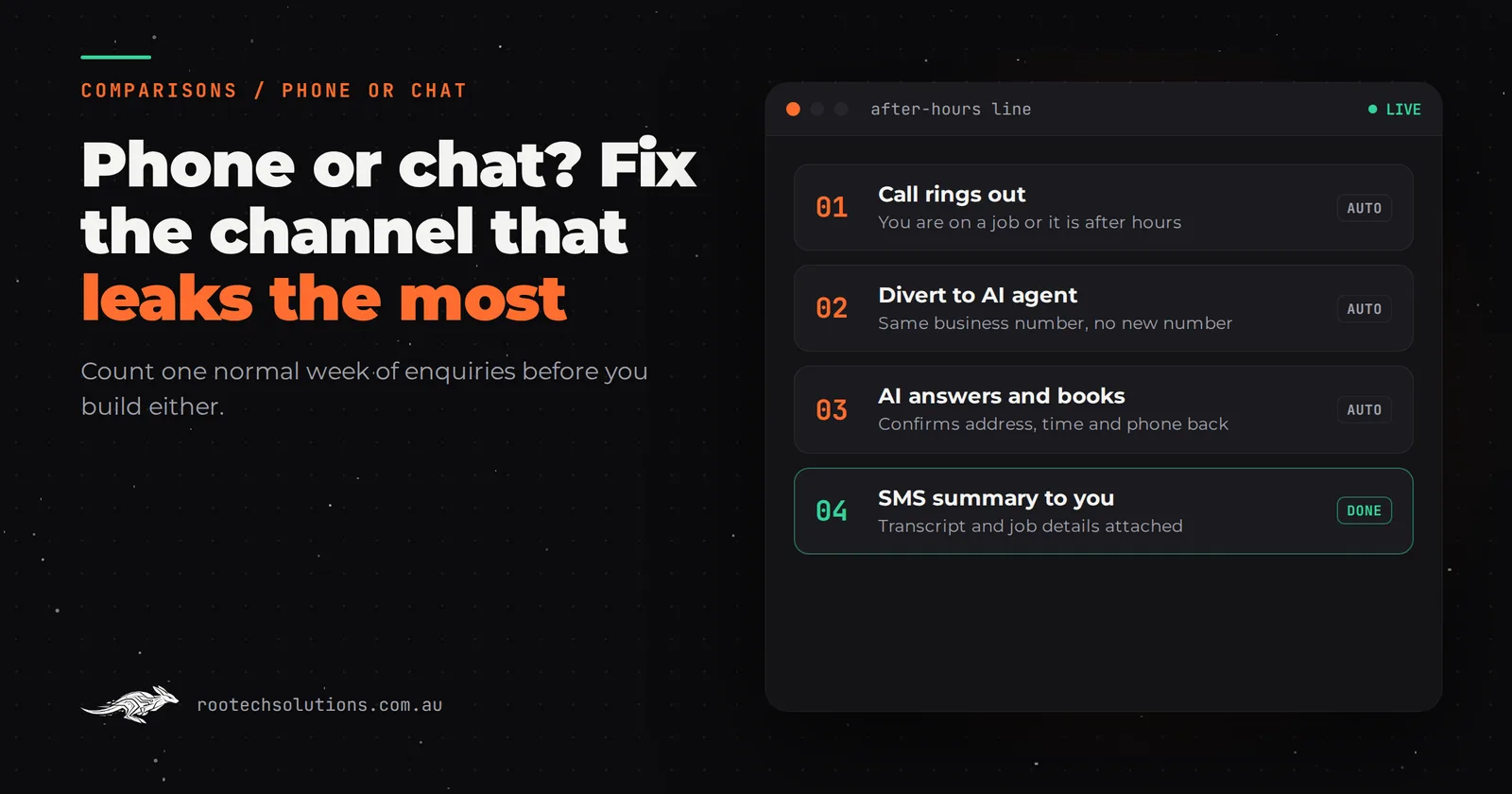
Calls go to voicemail while you are on a job, and website enquiries sit in the inbox overnight. You know AI can answer both. What you do not know is which one to build first, because AI phone answering and a website chatbot catch different customers, fail in different ways and cost different amounts to run.
Short answer: Choose AI phone answering if most of your new customers call, especially from mobiles, after hours or while you are on the tools. Choose a website chatbot if most enquiries start on your site and people want to browse prices or services first. Count where one normal week of enquiries came from before deciding; the bigger leak gets fixed first.
Which channel are you actually losing customers on?
Most owners guess, and most guess wrong in one direction or the other. Before comparing technology, spend one ordinary week counting. It costs nothing and it decides the answer for you.
- Pull your phone's call log (or your phone system's report) and count missed calls, including ones that rang out with no voicemail.
- Count website enquiries from forms and email, and note what time each arrived.
- Count social messages on Facebook and Instagram.
- Mark everything that arrived outside business hours or while you were on a job.
- Note how many of the missed callers you got back to, and how many had already booked someone else.
If missed calls dominate, start with the phone. If forms and after-hours web visits dominate, start with chat. If it is close, start with whichever channel brings higher-value work.
What does AI phone answering actually do?
An AI phone agent answers calls in a natural voice, works out what the caller needs, answers common questions, and books the job or takes a detailed message, then texts or emails you a summary. It is usually set up as a divert: your normal number rings first, and only unanswered or after-hours calls go to the AI.
It shines for businesses where the customer reaches for the phone: trades with an urgent job, clinics, mechanics, removalists, anyone whose customers are on a mobile and in a hurry. A caller with a burst pipe is not going to open your website and type.
Where it is honestly weaker:
- Noise and accents. Voice AI is now good, but a caller on speaker in a car or on a building site is harder to understand than typed text. A well-built agent confirms key details (address, phone number, time) back to the caller.
- Long, multi-part calls. Someone describing a complicated renovation should be handed to you, not interviewed by a bot.
- Spam and wrong numbers. Each call costs a little in voice AI usage, so the build should screen out robocalls quickly.
- Integration with your phone setup. It needs to work with your mobile carrier's call divert or your business phone system (Aircall, RingCentral, 3CX and similar), which takes more setup than pasting a chat widget on a site.
What does a website chatbot do better?
A website chatbot catches people who are already on your site and about to leave. It answers questions in text, shows prices or links, collects details and books, all without the visitor having to call.
It shines where customers research first: salons, gyms, builders and renovators, ecommerce, professional services. People browsing at 10pm want to ask "do you do bathroom renos in Frankston, and roughly what does one cost?" without talking to anyone.
Its honest limits: it only reaches people who visit your site, many mobile visitors close chat windows, and it does nothing for the customer who rings. A chatbot on a site with little traffic will sit quietly.
How do AI phone answering and a website chatbot compare?
| AI phone answering | Website chatbot | Missed-call text-back | |
|---|---|---|---|
| Catches | Callers you miss | Visitors about to leave your site | Callers you miss, by SMS |
| Strongest for | Urgent jobs, mobile customers, clinics | Researchers, after-hours browsers | Tight budgets, mostly-phone businesses |
| Can book into your system | Yes, if integrated | Yes, if integrated | Only via a booking link |
| Running cost driver | Minutes of voice AI | Number of conversations | SMS volume |
| Typical build time | Two to four weeks | One to three weeks | About a week |
| Main failure mode | Mishearing details | Ignored on mobile | Caller never replies |
Missed-call text-back is the often-forgotten third option: when a call is missed, the caller gets an SMS within seconds saying you are on a job and asking what they need, and an AI handles the text conversation. It costs less than voice AI and suits many trades. We compared it with a full AI receptionist in missed-call text-back vs AI receptionist for electricians.
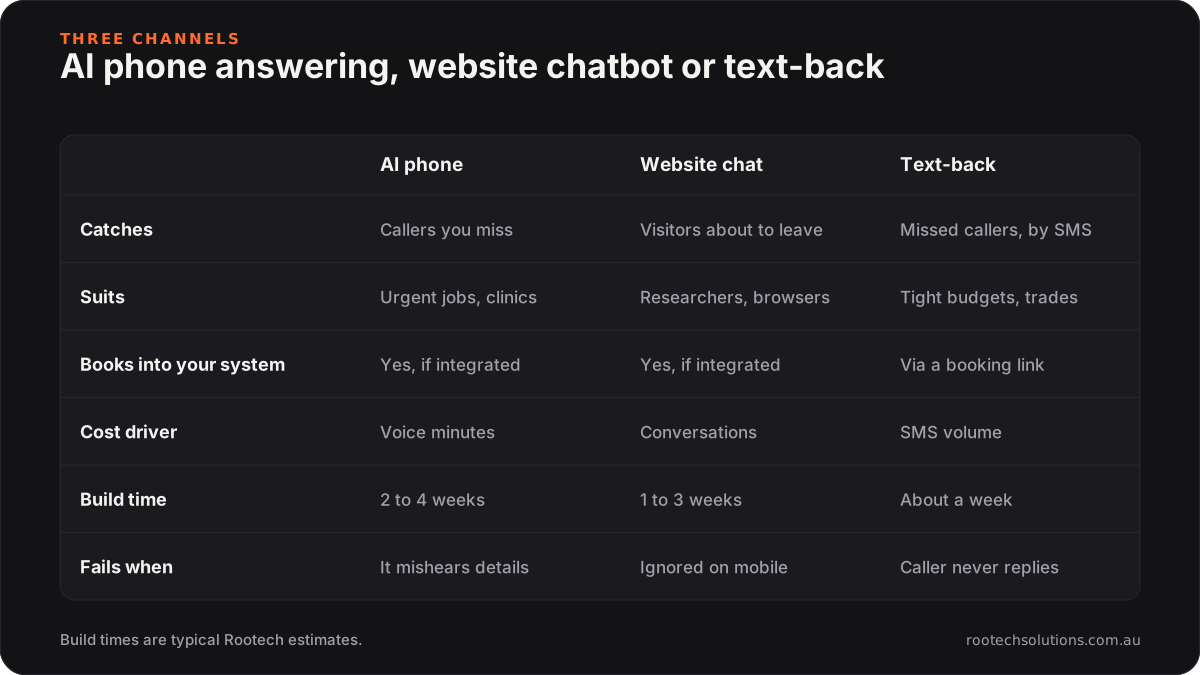
Caption: Three channels, three different customers; the cheapest one is the one that matches where yours already are.
Should I buy an off-the-shelf AI receptionist or have one built?
Buy off the shelf when you need a message-taker; build custom when the AI has to work inside your systems. There are plenty of subscription AI answering services and chatbot platforms, and for answering basic questions and taking a message they are a reasonable start (check their current pricing and where call data is stored).
A custom build earns its keep when the AI needs to:
- Book into the software you already run, such as ServiceM8, Tradify, simPRO or Fergus for trades, Cliniko or Nookal for clinics, Fresha or Timely for salons.
- Quote or triage using your rules ("we do not take jobs past Pakenham", "anything with gas goes to the licensed tech").
- Give the same answers on the phone and in chat, from one set of approved information.
- Hand the job to a person with the transcript and details already filled in, rather than a voicemail to transcribe.
We cover the platform question in more depth in chatbot platform vs custom AI agent.
What does it cost to build and run each one?
As a fixed-price build, a website chatbot that books into one system typically starts at the lower end of our $3,000 to $15,000 range; an AI phone agent with call divert and booking usually costs more, because voice needs extra testing. Running costs are hosting (usually under $50 a month) plus AI usage, roughly $20 to $200 a month for most small businesses, with voice minutes the bigger driver. These are estimates; your call volume and integrations set the real number.
A sensible build order for many businesses:
- Fix the bigger leak first, phone or web, based on your one-week count.
- Run it for a month and read the transcripts.
- Add the second channel on the same knowledge and rules, which costs less because the hard part (your information and booking logic) is already done.
Where does a person stay in the loop?
Always on judgement calls. Complaints, emergencies with safety risk, refunds, unusual jobs and anything the AI is unsure about go to a named person straight away, by SMS or call transfer during hours and as a priority message after hours. Customers should also be told up front that they are talking to an AI; a good agent says so in its first line. If you are still weighing AI against a person on the front desk, see should I hire a receptionist or use AI.
Frequently asked questions
Will customers hang up on an AI phone agent?
Some will, particularly if it sounds robotic or will not let them reach a person. Callers are far more patient with an agent that says it is an AI, answers quickly and offers to pass a message or transfer. The ones who hang up were usually going to voicemail anyway.
Can I keep my existing business number?
Yes. The usual setup is a divert from your existing number on no answer, busy or after hours, so customers dial the same number they always have. Nothing changes for the calls you do pick up.
Does a website chatbot help my Google ranking?
Not directly. A chatbot helps you convert the visitors you already get; it does not bring more. If your site gets few visitors, fix being found first, then add chat.
Can one AI handle both phone and chat?
Yes, if it is built that way. The same knowledge, rules and booking integration can sit behind a phone line, website chat and social messages, so a customer gets the same answer wherever they ask. That is one of the main reasons to build custom rather than buy two separate products.
Not sure which leak to fix first?
Bring us a week of call logs and enquiries and we will show you where customers are slipping away and which channel to cover first. Book a free AI workflow audit. If you go ahead with a build, the audit fee comes off your first project.