How Melbourne Plumbers Rank Locally and Get Cited by AI
AI search for plumbers splits into emergencies and planned jobs like hot water. How Melbourne plumbers get found for both, then answer every call.
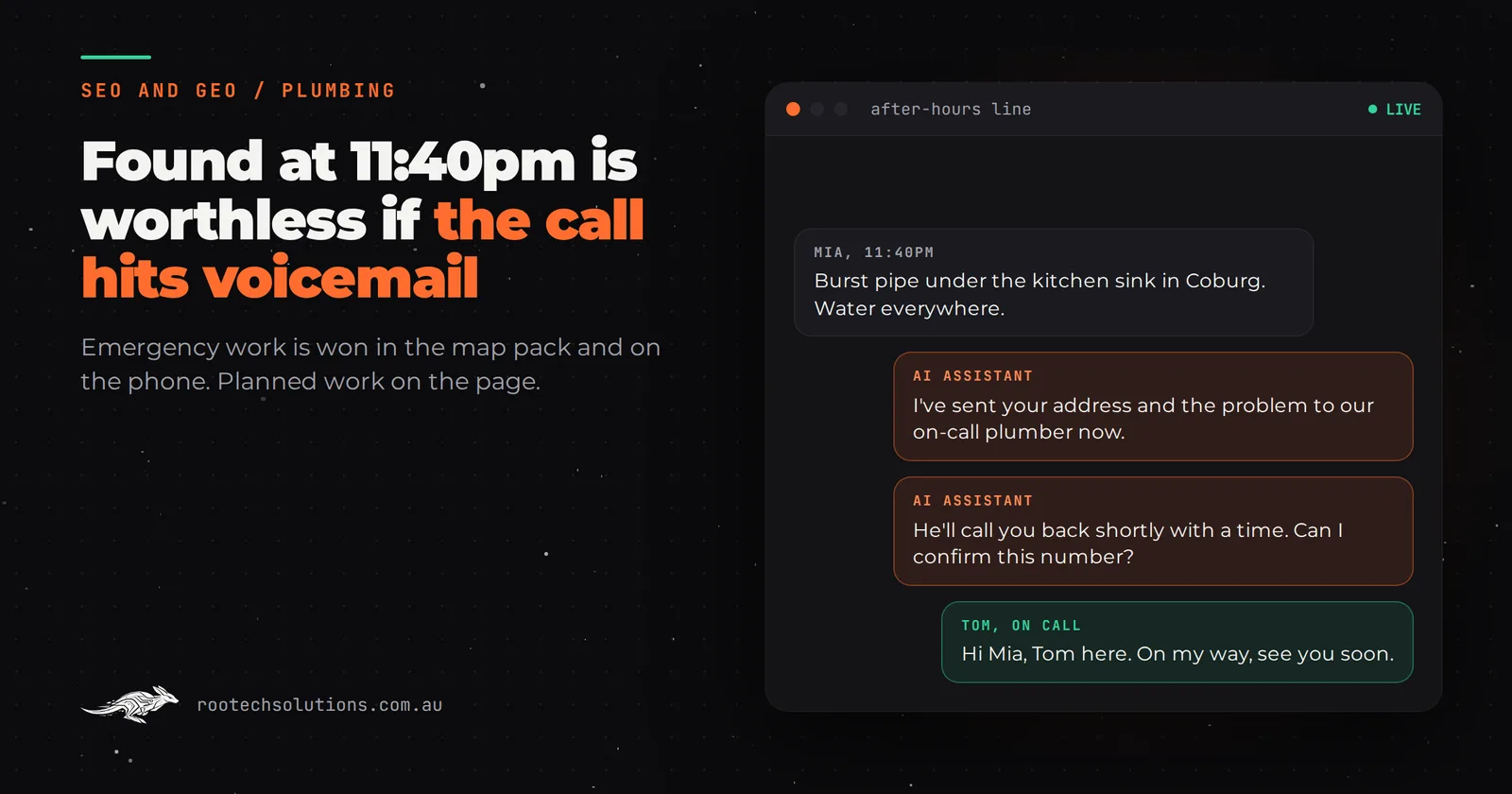
Plumbing has two kinds of customer, and they search in completely different ways. One is standing in a wet kitchen at 11pm tapping "emergency plumber Coburg" and calling the first number that looks open. The other is comparing heat pumps against gas for a hot water replacement and asking an AI assistant what it costs and whether there is a rebate. Most plumbing websites are written for neither.
Short answer: AI search for plumbers works differently for emergencies and planned jobs. Emergency work is won in the Google map pack by a complete profile, accurate hours and a phone that is answered. Planned work, like hot water replacement, is won by pages that answer cost, system choice and rebate questions plainly. A Melbourne plumber needs both, plus a way to answer calls after hours.
How do emergency plumbing searches differ from planned work?
Emergency searches are short, local and phone-first; planned-work searches are long, researched and comparison-heavy. That split decides what you build.
| Emergency (burst pipe, blocked sewer, no hot water) | Planned (hot water replacement, renovation, gas appliance) | |
|---|---|---|
| How they search | "emergency plumber near me", from a phone | "heat pump vs gas hot water", "hot water rebate Victoria" |
| Where they decide | The Google map pack, in minutes | AI answers, your pages, two or three quotes, over days |
| What wins | Open now, nearby, answers the phone | Clear costs, system advice, rebate process, licence details |
| What loses the job | Voicemail | "Call us for a quote" and nothing else |
| What to build | Accurate profile plus after-hours call capture | Detailed pages plus an instant quote tool |
Google's own help says local results are based mainly on relevance, distance and how well known the business is, and that there is no way to pay for a better local ranking. For emergency work, distance is fixed, so relevance (your categories, services and hours) and a strong review base carry the weight. For planned work, the content on your pages carries it.
Why is being found at night worthless without someone to answer?
Because an emergency customer does not leave a message. If your profile says "open 24 hours" and the call goes to voicemail, the customer rings the next plumber in the pack within a minute, and you have paid for the visibility without getting the job. It also teaches customers, and reviewers, that your hours are not real.
This is the plumbing-specific failure: search success that leaks out through the phone. Before spending money on more visibility, check three things.
- Are your listed hours true? If you only take emergencies until 10pm, say so. Accurate hours beat optimistic ones.
- What happens to a call at 11:40pm? Ring your own number tonight and find out.
- How fast does the on-call plumber get the details? A voicemail checked at 6am is not after-hours service.
An AI receptionist or a missed-call text-back fixes the gap: the call is answered, the address, problem and urgency are captured, the on-call plumber gets a text with everything, and the customer is told when to expect a call back. We compare the two approaches in missed-call text-back vs an AI receptionist.
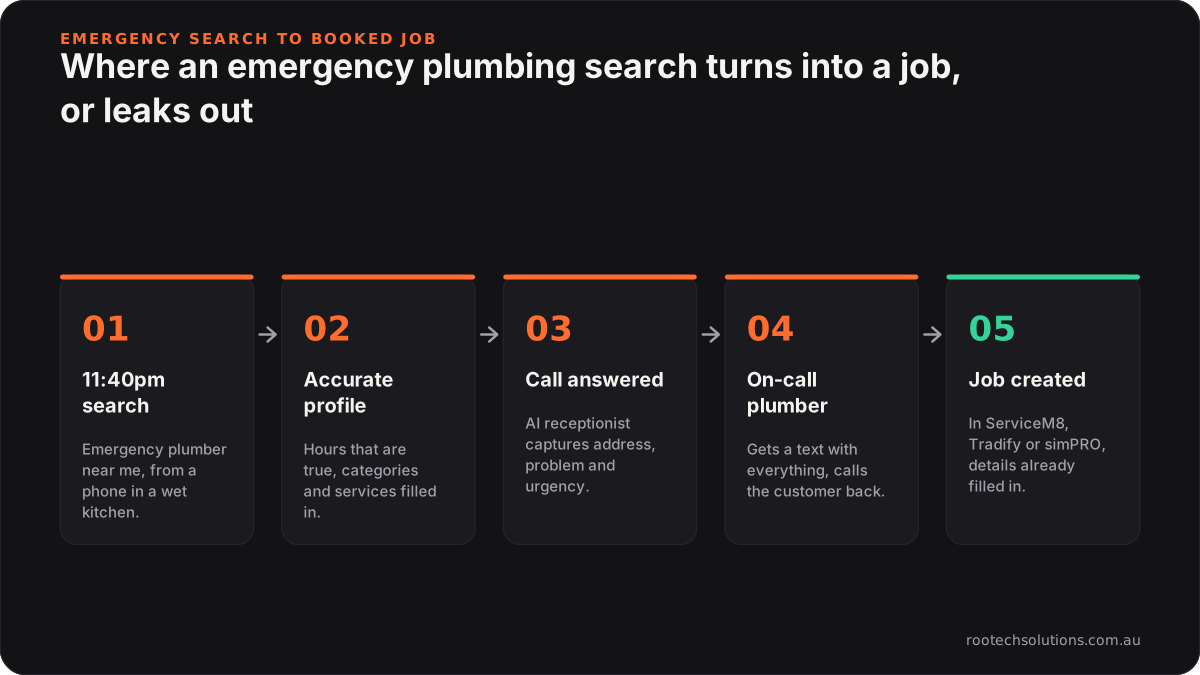
Caption: Visibility only pays when the call at 11:40pm is answered and the details reach the on-call plumber.
What hot water pages win AI search for plumbers?
Hot water is the clearest example of a planned-work search an answer engine handles well, because the questions have factual answers: what types of system exist, what affects the price, how long installation takes, and whether a rebate applies.
Victoria adds a specific question most plumbing sites never answer. Solar Victoria's hot water rebate runs through authorised retailers, and the process involves the retailer uploading a written quote to the Solar Victoria portal before the customer gets confirmation. Customers search for this. A page that explains, honestly, whether you are an authorised retailer, which eligible products you install and how the quote step works is precisely what an answer engine can cite. Do not claim to be authorised if you are not, and do not quote a rebate amount without checking the current figure, because it changes.
A strong hot water page covers:
- the systems you install (gas, electric, heat pump, solar) and what each suits;
- the price factors (tank size, access, moving the system, gas or electrical work) with your own ranges;
- typical installation time and whether you remove the old unit;
- the rebate process, if it applies to you;
- your licence or registration number and the brands you are accredited for.
Write each point as a sentence that stands on its own. "We replace most gas storage hot water systems in a single visit" survives being quoted. "Fast, reliable service" does not.
Does structured data help plumbers in Google and AI answers?
It helps Google read your basics consistently, and that is all it should be sold as. Google's LocalBusiness documentation uses Plumber as an example subtype and asks for the most specific type that fits. Mark up name, address (or service area), phone and hours, and keep them identical to your Google Business Profile.
Google's guidance on AI features says there is no special markup needed to appear in AI Overviews. FAQ rich results are no longer shown in Google Search, so "add FAQ schema to get into AI" is out of date advice. Keep good question-and-answer content on the page for people; just do not expect markup to do the work.
Are ServiceM8, Tradify or simPRO enough, or do plumbers need custom software?
For running jobs, the established job management tools are usually enough. ServiceM8, Tradify, Fergus, simPRO and AroFlo handle scheduling, quoting, job cards and invoicing for plumbing businesses of different sizes. Lead platforms such as hipages and ServiceSeeking can add work. If your problem is job management, pick one of those and use it fully.
Custom software or an AI integration earns its keep on top, where those tools stop:
- After-hours call capture that answers, triages and creates the job in your job system with the details filled in.
- An instant hot water quote tool on your site, built from your own price rules, that gives a range and books a site visit for anything unusual.
- Job pages from completed jobs. With the customer's permission, a short write-up of a real job ("replaced a 135-litre gas storage unit in Pascoe Vale, relocated to meet clearance requirements") generated from your job notes and photos. These are original, specific and local, which is what thin suburb pages never are.
We go further on where to start in where Melbourne plumbers should start with AI automation.
What does it cost to build for a plumbing business?
Most builds take two to four weeks at a fixed price. The figures below are estimates in AUD, excluding GST, and depend on how many systems are connected.
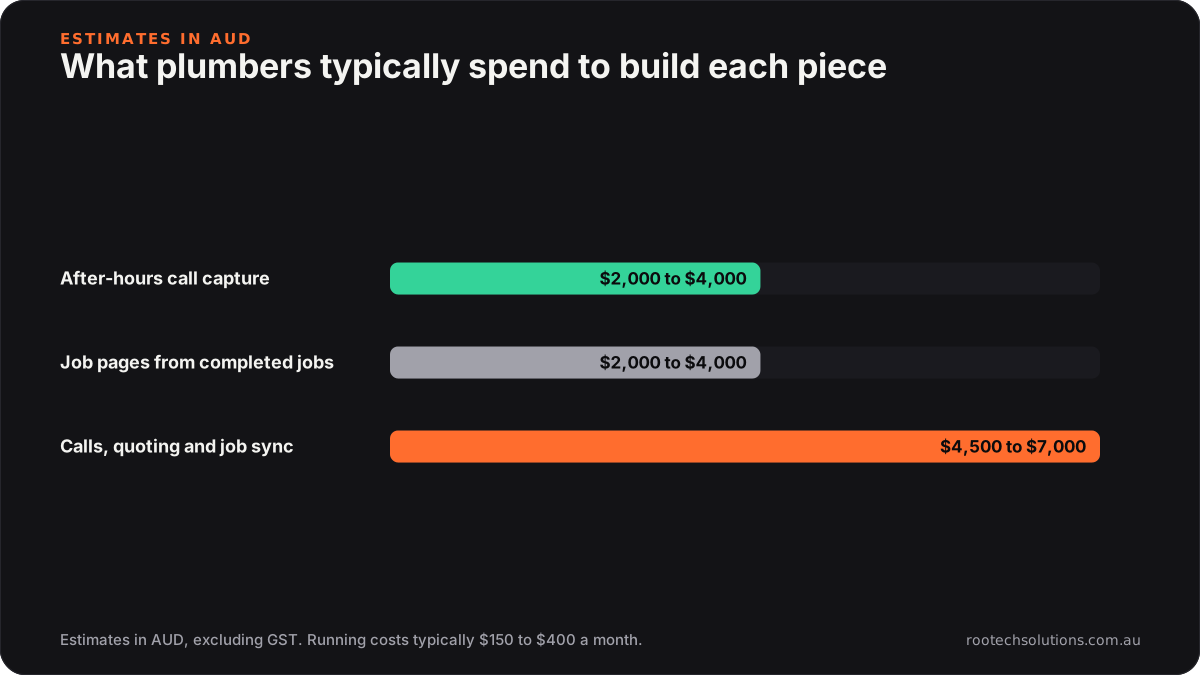
Caption: Most plumbers start with call capture, because that is where search visibility leaks first.
- After-hours call capture: typically $2,000 to $4,000 to build.
- Job pages generated from completed jobs: typically $2,000 to $4,000.
- Call answering, quoting and job sync together: typically $4,500 to $7,000.
- Running costs: usually $150 to $400 a month all up, covering hosting (under $50), AI usage and call minutes.
- Human in the loop: the AI captures and triages; a plumber decides on price, attendance and anything involving gas.
The full breakdown sits in what AI automation costs a Melbourne plumber.
Frequently asked questions
Should a plumber list "open 24 hours" on Google?
Only if a call is genuinely answered and acted on at any hour. Listing 24 hours and sending calls to voicemail loses the job and invites poor reviews. If you take emergencies until a set time, list that time.
Do suburb pages help plumbers rank?
Thin suburb pages with only the name swapped rarely help and can drag a site down. Real job write-ups, service-area lists in plain text and an accurate service area on your profile do more. Build suburb content only where you have something specific to say.
Can an AI receptionist handle gas emergencies?
It should not try to diagnose or advise on gas. It should give the standard safety instruction you have approved, capture the address and contact details, and alert the on-call plumber immediately. Any gas call is a human call.
Is hipages or a similar lead platform better than SEO?
They do different jobs. Lead platforms can fill a quiet week quickly, while your own profile and pages build enquiries you do not pay per lead for. Many plumbers use both, and check each platform's current pricing against the jobs it actually produces.
Want every call answered, not just found?
We build after-hours call capture, hot water quote tools and job systems for plumbers, connected to ServiceM8, Tradify, simPRO or whatever you already run, at a fixed price. Book a free AI workflow audit and we will trace what happens to your calls after 6pm. The audit fee comes off your first project.