Missed-Call Text-Back vs. AI Receptionist for Electricians
Missed-call text-back or an AI receptionist for electricians? What each handles, what each costs, and which stops new customers ringing the next sparky.
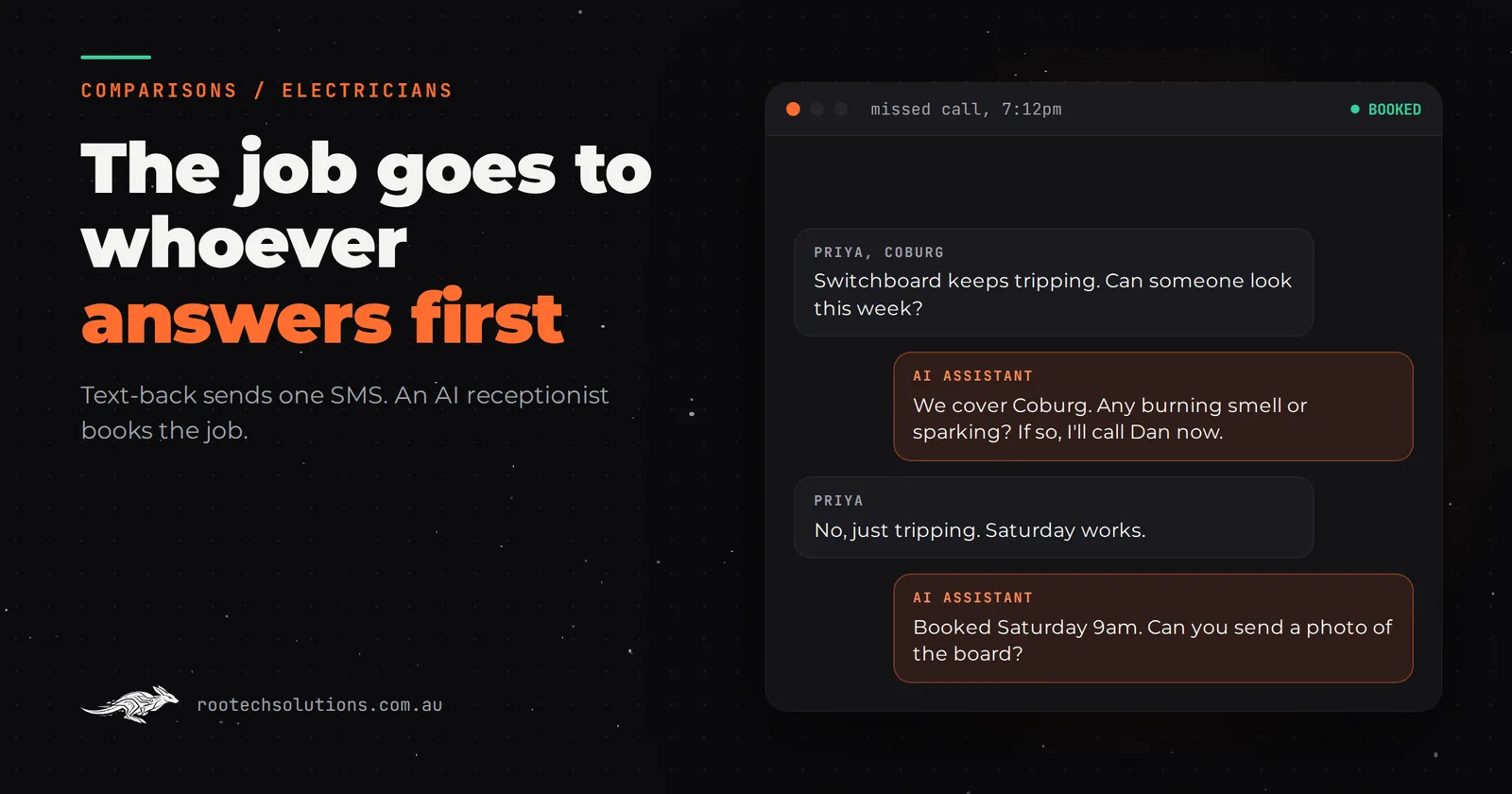
You're up a ladder rewiring a switchboard and your mobile rings three times. By the time you've climbed down and wiped your hands, it has stopped, and the caller has already dialled the next electrician on the list. Most sparkies don't lose work to a better competitor. They lose it to whoever answered first.
Short answer: A missed-call text-back is the cheap fix: it sends one SMS when you miss a call, then hands the conversation back to you. An AI receptionist for electricians carries the conversation through: it asks what the job is, checks your area, flags emergencies to a person, and books a slot. Text-back suits repeat clients; an AI receptionist suits electricians paying for new leads.
What does a missed-call text-back actually do?
It sends the caller a text within seconds of a missed call, so they know you exist and are likely to reply. Something like: "Sorry we missed you, it's Dan from Northside Electrical. What do you need a hand with? Reply here and I'll get back to you."
Its strength is simplicity. It runs off your existing number, most Australian business phone apps and VoIP providers offer it, and you can usually switch it on yourself in an afternoon for a modest monthly fee (check what your provider charges; it's often bundled). It catches the caller while they're still looking, which beats a callback four hours later.
Its weakness is that it hands the work straight back to you. The caller replies, and now you still have to stop, text back, ask what the job is, work out whether it's urgent, agree a time and put it in the calendar. It also can't answer a question. "Do you do switchboard upgrades in Coburg on a Saturday?" gets "Sure, what do you need?" rather than a real answer.
What does an AI receptionist do differently?
It keeps going after the first text, and it can answer the phone itself. An AI receptionist is a conversational agent trained on your business: your service suburbs, your call-out fee, the jobs you take and the ones you refer on, and your rules for after hours. On a missed call (or on every call, if you choose) it:
- Asks what the job is, in plain questions: power point, lights, switchboard, fault, new install.
- Confirms the address is in your area.
- Checks urgency, and hands anything dangerous straight to a person (more on that below).
- Asks for a photo of the switchboard or the fault where it helps you quote.
- Offers real times from your calendar, or queues the job in ServiceM8, Tradify, simPRO or Fergus with all the details filled in.
You start the next morning with booked jobs and qualified enquiries instead of a list of missed calls.
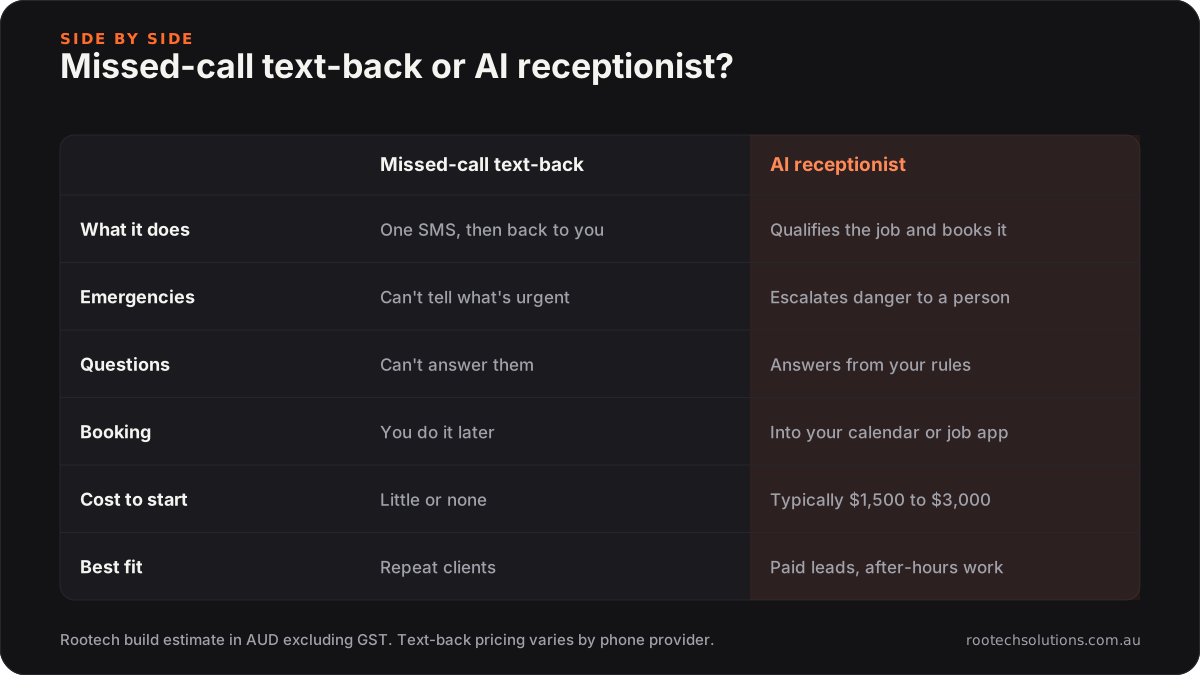
Caption: Text-back stops you looking uncontactable. An AI receptionist stops the lead going to the next name on the list.
How do the two compare on cost and effort?
Text-back costs almost nothing to start. An AI receptionist is a fixed-price build, then a monthly running cost.
| What matters | Missed-call text-back | AI receptionist |
|---|---|---|
| Upfront cost | Little or none, often bundled with your phone plan | Typically $1,500 to $3,000 for call and enquiry capture (Rootech estimate) |
| Ongoing cost | Your provider's monthly fee | Typically $150 to $300 a month, covering hosting, AI usage, call minutes and SMS |
| Time to set up | An afternoon | Two to four weeks |
| What it does | Sends one SMS, then hands it back to you | Qualifies, books and hands you a ready job |
| After hours | Sends the text; you still reply | Answers and books while you sleep |
| Emergencies | No idea what's urgent | Spots danger words and escalates to a person |
| Best fit | Sole trader, mostly repeat clients | Anyone paying for new leads or taking after-hours work |
Those AI receptionist figures match our breakdown in what AI automation costs a Melbourne electrician, which also covers quote drafting and certificate admin.
How should an AI receptionist handle electrical emergencies?
It should never try to solve them. Anything that sounds dangerous (sparking, burning smells, a shock, water near a switchboard, a fallen powerline) gets a fixed safety response and goes straight to a person by call or SMS, with the conversation attached. For fallen powerlines and hazards on the network, the caller should be told to stay clear and contact their electricity distributor or emergency services, which is the advice on Energy Safe Victoria's electrical emergencies page.
That rule is written into the build before anything else, and it is tested against real examples before the AI talks to a customer. An AI that gives electrical advice is a liability; an AI that recognises danger and gets you on the phone fast is a safety improvement over a missed call. We go further into the safety question in can you trust AI for electricians with safety calls.
Which should an electrician pick?
Pick by where your work comes from.
- Mostly builders, strata managers and past customers? They'll leave a voicemail and wait. Text-back is genuinely enough. Don't over-engineer it.
- Paying for leads through Google Ads, hipages or Oneflare, or chasing after-hours call-outs? Every paid lead that rings out and only gets a "sorry we missed you" text is spend partly wasted. The AI receptionist turns that call into a booked job before the caller tries the next name.
- Somewhere in between? Switch on text-back this week, then count your missed calls for a month. Most phone systems report them, and the number is usually a surprise. If it's more than a few new customers a week, that's the case for the AI receptionist.
The two also stack. Many electricians keep text-back as the instant first touch and let the AI receptionist take over the conversation from the reply.
Off-the-shelf AI answering or a custom build?
There are off-the-shelf AI answering services and virtual receptionist products aimed at tradies, and for a straightforward "answer, take a message, book a slot" setup they can be fine. Try one before you pay for anything custom.
A custom AI integration earns its keep when the receptionist has to follow your rules rather than generic ones: your exact service suburbs, your call-out and after-hours fees, the job types you refer on, your emergency escalation, and writing the job straight into your job management software with the photos attached. That's the difference between an AI that takes messages and one that hands you a job you can quote from the van.
What does the build look like?
A fixed-price build, live in two to four weeks:
- Week one: we capture your rules: suburbs, fees, job types, after-hours policy, emergency words and who gets called.
- Build: the AI receptionist is connected to your phone number, SMS and your calendar or job management system.
- Test: it's run against your real past enquiries, including the awkward ones, before it talks to a customer.
- Go live: you see every conversation, and anything involving price disputes, complaints or danger goes to a person.
If you also want quotes drafted from the enquiry and photos, that is a second workflow on the same foundation. The same pattern applies to any trade; AI phone answering vs a website chatbot covers which channel to start with, and our Melbourne custom software page lists the trades work we've shipped.
Frequently asked questions
Will customers know they're texting an AI?
They should, and a good build says so in the first message. Callers care most that they get a fast, correct answer and a booked time. Being upfront also avoids misleading anyone about who they're dealing with.
Can the AI give a price over the phone?
It can quote your fixed prices, such as a call-out fee or a standard power point install, if you give it those rules. Anything that needs eyes on the job gets a price range only if you approve one, or a booked inspection. It never makes up a price.
What if I'm already using ServiceM8 or Tradify?
Keep it. The AI receptionist writes the enquiry into the job management software you already run, so the job, the customer details and the photos are waiting there when you open the app.
Is an AI receptionist worth it for a sole trader?
If most of your work is repeat customers, probably not yet; use text-back. If you're paying for new leads or want after-hours work, a sole trader often benefits most, because nobody else is answering the phone while you're on the tools.
Not sure which one you need?
We build the AI receptionist side, so we're not neutral, but plenty of electricians don't need us yet, and we'll say so. Book a free AI workflow audit and we'll look at how many calls you're missing and what each one is worth. The audit fee comes off your first project if you go ahead.