Tapendium vs Custom Software: Buy It or Build It?
Off the shelf software like Tapendium vs custom software for hotels, hospitals and retirement villages: what each does well and how to choose.
You run a hotel, a private hospital or a retirement village, and the printed folder in every room is out of date again. Someone has shown you Tapendium, a Melbourne-made digital compendium on Samsung tablets, and someone else has said "we could just build our own". Both can be right. The question is which problem you are actually solving.
Short answer: Off the shelf software such as Tapendium is the better choice when what you need is a digital compendium: room information, ordering, requests and guest messaging, branded for your property and live quickly. Custom software is the better choice when the screen in the room is only one end of a process that is specific to you, when you want to own the code and the data outright, or when no product covers the work in between. Many operators should buy the product and build only the piece it does not do.
What does Tapendium actually do?
Tapendium is a guest engagement platform from Port Melbourne that replaces printed compendiums in hotel rooms, hospitals and retirement villages. It is a mature product, and its own pages describe a lot more than a digital folder:
- Tapendium Stay puts it on in-room tablets, with integration levels that go from a hotel information module up to links with the property management system (PMS), point of sale and housekeeping systems, room controls for air conditioning, lighting and curtains, and calls through the hotel phone system.
- Tapendium Go is the same service on the guest's own phone, opened from a QR code or web link as a progressive web app, so nobody downloads an app.
- Tapendium Home is a version for retirement villages, with resident messaging, maintenance and feedback requests, bookings for tours, restaurants and activities, and entertainment.
- The technology runs on 8 or 10 inch Samsung tablets managed with Samsung Knox, hosted on AWS, with a web-based content management system designed for staff who are not in IT.
Tapendium also says it builds customised features for its hotels, from branded landing pages to specific PMS and point of sale integrations. So the choice is not "a rigid template versus total freedom". It is a product with room to tailor it, versus software that exists only for you.
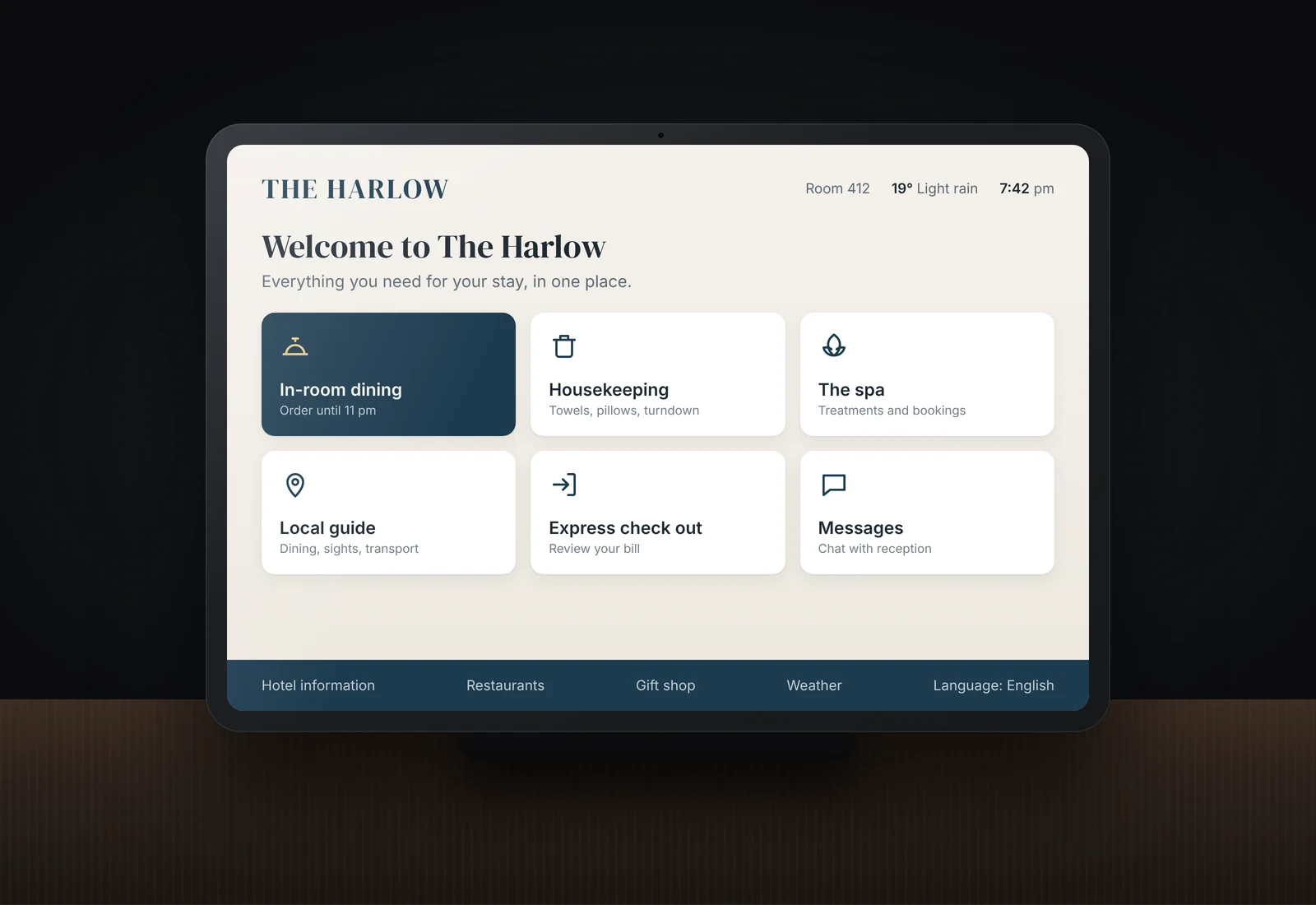
Caption: Illustrative, for a fictional hotel. A digital compendium does the standard jobs well: information, ordering, requests and messages, in the hotel's colours.
When is off the shelf the right call?
Buy when your need matches what the product was designed for. For a lot of properties it does, and building your own would cost more and take longer to reach the same place.
Off the shelf is the right answer when:
- The job is the compendium. You want the folder replaced, in-room dining ordered from a screen, requests sent to the right department and a way to message guests. That is the product's whole purpose.
- You need it across many rooms soon. Hardware, device management, the content system and support already exist. A custom build has to design and build all of that first.
- Your systems are on its integration list. If your PMS, point of sale and room controls are ones the vendor already connects to, most of the hard work is done.
- Nobody on your team wants to own software. With a product, the vendor carries updates, security fixes and device management. That is worth paying for.
Ask any vendor the same questions before you sign: which of your systems it integrates with today (not "can integrate with"), what you can change yourself, how custom features are priced and who owns them, what the contract term is, and how you get your content and data out if you leave. Check their current pricing and terms directly, because both change.
When does custom software fit better?
Custom fits when the screen in the room is the easy part, and the hard part is everything behind it. The tell is usually one of these:
- The request is the start of a process, not the end of it. A resident reports a leaking tap. In a retirement village that may need a maintenance job, a contractor booking, a cost split under the residence contract, a message to the family and a sign-off. A compendium can take the request. Custom software can run the whole job.
- Your process is genuinely yours. A hospital that wants meal ordering tied to its own diet codes and ward rounds, a serviced apartment group with its own owner and cleaner arrangements, a village with its own care levels. If you find yourself describing a workflow no vendor has heard before, that is the signal.
- The guest, patient or resident screen is one of several. Staff tablets, a manager dashboard, a family portal, a reception screen and the room device all need to work off the same records. One system built for that is simpler than three products and a spreadsheet in the middle.
- You want to own it. With custom software the code, the hosting accounts and the data are in your name. Nobody else can change the price, change the roadmap or end the product. Our post on who owns the code your developer writes covers what to check in the contract.
- The brand is the product. For signature properties where every surface has to feel like nowhere else, a platform that lets you change the skin may not be enough. We went through that case in off the shelf versus custom in-room tablets for luxury hotels.
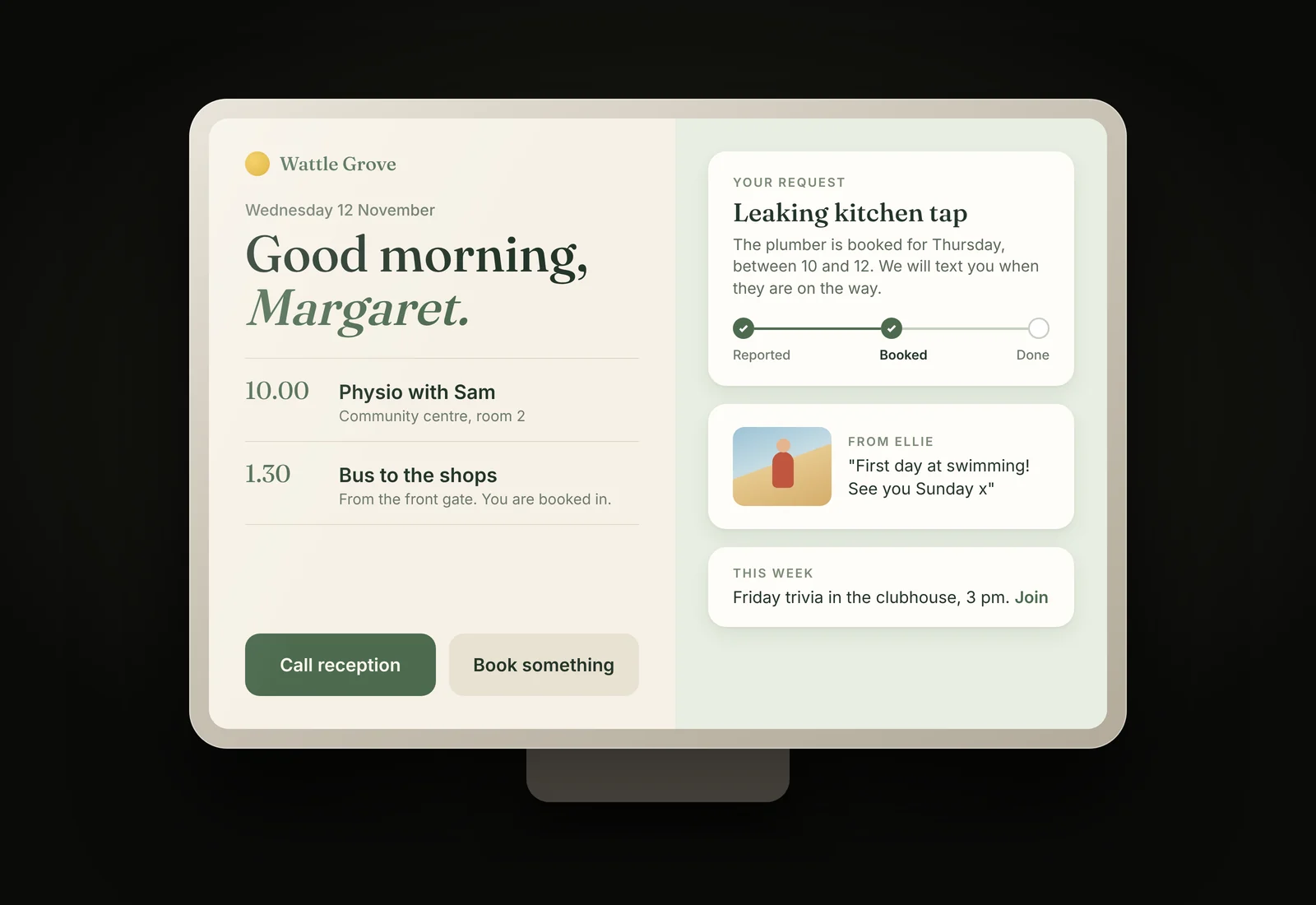
Caption: Illustrative, for a fictional village. The screen opens on the resident's day, and the maintenance request shows where the job is up to, because the same system runs the job.
What makes the second picture different is not the design. It is that the screen can say "plumber booked for Thursday, 10 to 12" because the same software that took the request also booked the job. That only works when one system owns the whole process.
What does the "one system" look like from the staff side?
The guest or resident sees a calm screen. Staff see the work: every request in one queue, routed to the person who handles it, with its status visible to whoever asked. That is the part off the shelf products and custom builds most differ on, because every operator runs it differently.
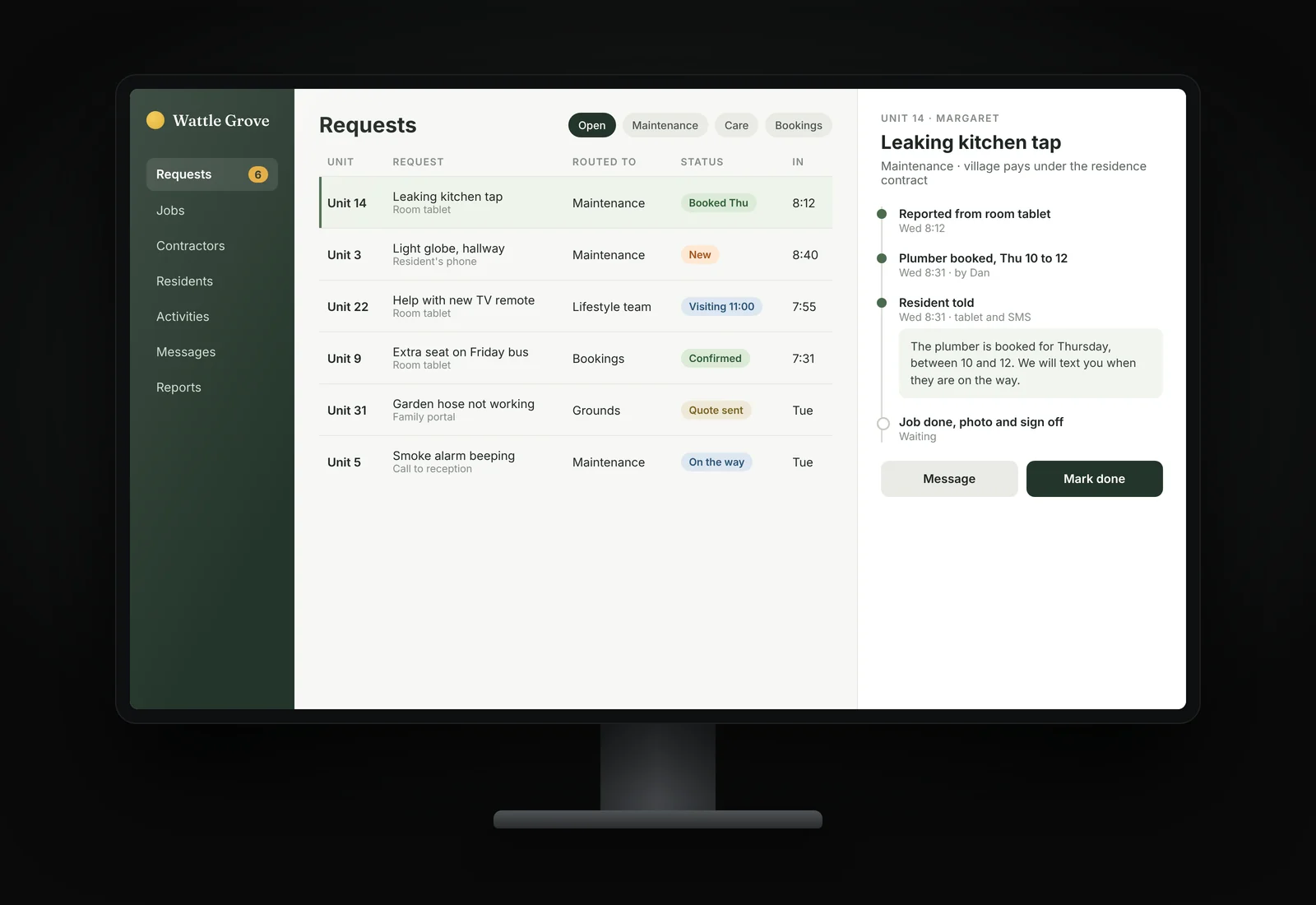
Caption: Illustrative. Requests from room screens and residents' phones land in one queue, routed by your rules, and every status change goes back to the person who asked.
This is the same pattern as the booking platform we built for Kaladi Kitchens, where members book any kitchen at any location from their phone and every session opens and closes with a photo-backed checklist. The front end is simple because the system behind it was built around how the business actually runs.
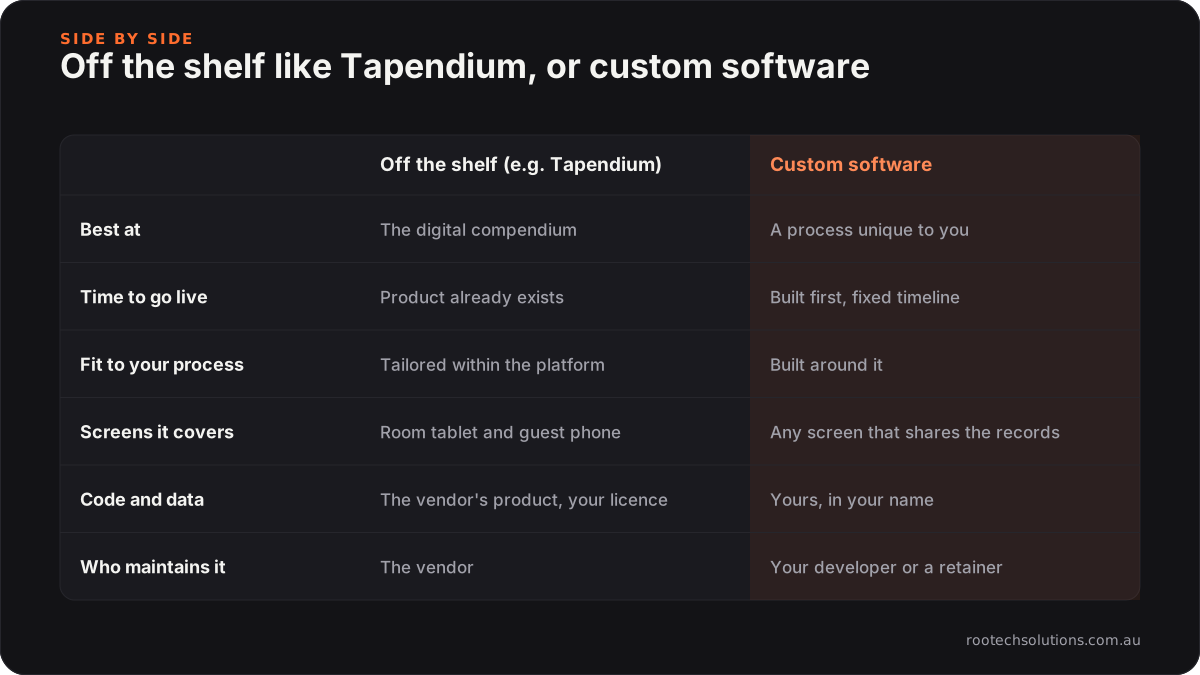
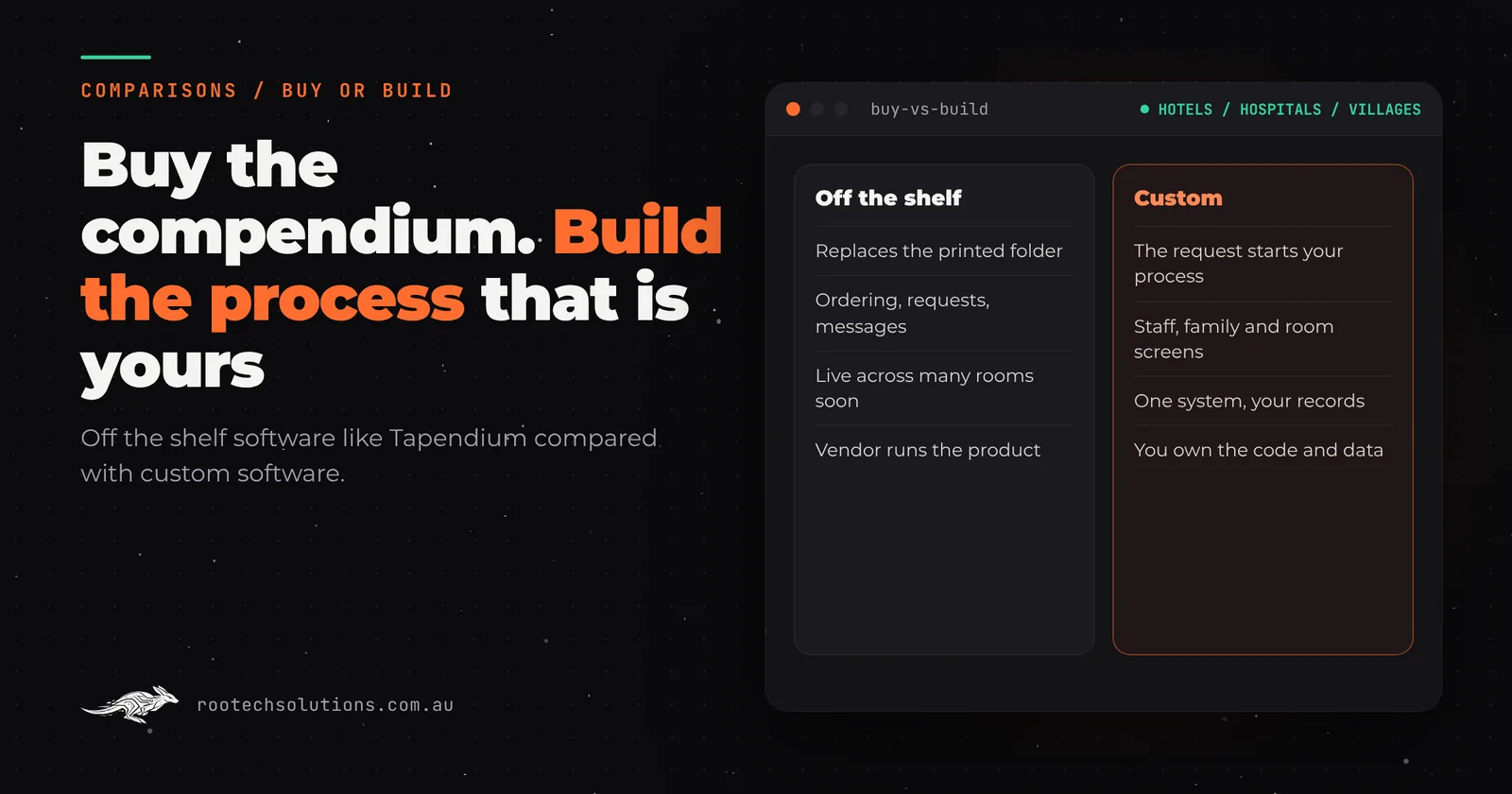
Caption: Off the shelf wins on the standard jobs and speed. Custom wins when the process is yours and you want to own it.
Can you use both?
Yes, and for many operators that is the best answer. Keep the product for the standard jobs and build a small custom piece for the part it does not cover.
Ways that usually works:
- Keep the compendium, build the back office. Requests from the product feed a custom job system that books contractors, tracks costs and reports back, if the vendor exposes the data through an integration or API. Ask before you assume.
- Keep the product in the rooms, build the portal around it. A family portal for a retirement village, or an owner portal for an apartment group, that the room product was never meant to be.
- Build the piece no product does, and connect it to the rest. The same approach we describe for replacing overlapping subscriptions with custom software: rent what is standard, own what is yours.
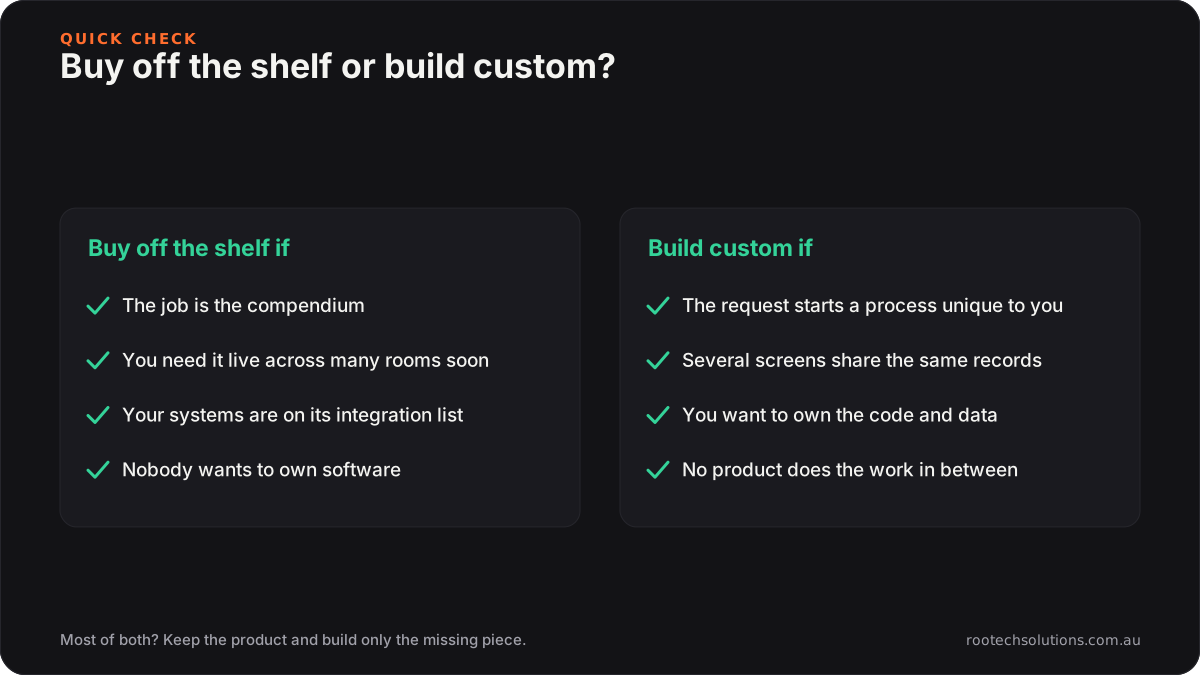
Caption: If most of your answers are on the left, buy. If most are on the right, talk to a developer, and keep anything on the left that already works.
How do you decide without a long consulting project?
Write down the three requests your guests, patients or residents make most often, then follow each one from the screen to the moment it is done. Note every person, system and spreadsheet it passes through.
- If the trail ends at the department that receives it, a product like Tapendium covers it. Get a demo and check the integrations against your systems.
- If the trail keeps going through phone calls, a shared inbox, a contractor's email and someone's spreadsheet, that trail is what custom software replaces. The room screen is the last thing to design, not the first.
Then get a fixed price for the custom option before you compare. Rootech quotes every project at a fixed price before work starts, most builds ship in two to four weeks, and bigger platforms get a fixed timeline up front. Running costs are small: hosting is usually under $50 a month, and AI usage, if the system uses AI, typically $20 to $200 a month depending on volume.
Frequently asked questions
Is Tapendium off the shelf or custom?
It is an off the shelf product that can be tailored. Each property gets its own branding and content, and Tapendium says it also develops custom features and integrations for its hotels. The platform, devices and core flows are the vendor's, shared with its other clients, and the vendor owns the product.
Is custom software more expensive than a product like Tapendium?
Up front, almost always. A custom build has a real development cost where a product spreads that cost across many clients. Over several years the comparison depends on what you pay the vendor, how many products and workarounds sit around it, and whether the custom system replaces more than the room screen. Compare five years of both, using your own numbers and the vendor's current pricing.
Can custom software run on guests' own phones instead of tablets?
Yes. A custom system can be a web app opened from a QR code or a booking link, with no download, the same way Tapendium Go works. Many operators start with guests' own phones and add room tablets later, or never.
Who owns the software and the data?
With a product, the vendor owns the software and you hold a licence; check the contract for how your content and data come back to you if you leave. With custom software built by Rootech, you own the code, the hosting accounts stay in your name, and launch comes with a handover of the code, documentation and credentials.
What happens after a custom system launches?
Bug fixes on anything Rootech built are included after launch. Updates and improvements are covered by an optional monthly retainer you can cancel any time, or by any developer you choose, because you own the code.
Not sure whether you need a product, a custom build or both? Book a free call. Bring the three requests you would follow from screen to done. We will tell you plainly if a product like Tapendium already covers them, and give you a fixed price for anything worth building. Rootech is a Melbourne studio working Australia-wide; see custom software development in Melbourne.