Motion Games for Sydney Caravan and Camping Shows
A motion game on your Sydney caravan show stand stops crowds, runs all day and captures leads while your team sells. What it costs and how to brief it.
You have booked floor space at one of the big caravan and camping shows in Sydney. Your product is a caravan, a camper trailer or a swag. It is either right there on the stand taking up half your footprint, or it is back at the factory because you could not bring the full range. And a few aisles over, a stand is pulling a crowd of twenty people who are watching someone wave their arms at a big screen and laughing.
That is the problem this post is about. Not whether interactive tech is fun. Whether it earns its floor space at a show where visitors have already walked past two hundred vans and their feet hurt.
Short answer: A motion or computer vision game puts a camera-driven experience on your stand: visitors step in front of a screen and their body becomes the controller. It pulls a crowd, holds them for a minute and hands you their details, all day with no staff. As an estimate, budget $30,000 to $80,000 for the software, hardware hired separately.
Why does a motion game suit a caravan and camping show?
A caravan and camping show has a visitor problem most expos do not: the product is enormous and already everywhere. Rows of caravans line the aisles. Families walk through them all day. So an exhibitor with something to say faces a question the mining or medtech exhibitor never has: how do you get noticed when the guy next door is literally standing inside his product?
A motion game answers it with movement. A camera watches the space in front of your screen, tracks whoever steps into it, and turns their body into the controller. No headset, no touchscreen to wipe down, no controller to sanitise between visitors. A kid wanders up, jumps, and the game reacts. Two seconds later the parents are watching too, and you have a crowd around a stand that would otherwise be another row of vans.
It also solves the range problem. If you sell accessories, awnings, solar setups or off-grid power, none of it photographs well from the aisle. A game built around your product story, say a packing challenge where players load a camper in the right order, or a setup race that walks through your awning deployment, makes invisible features something people physically do.
What does the visitor actually do in 60 seconds?
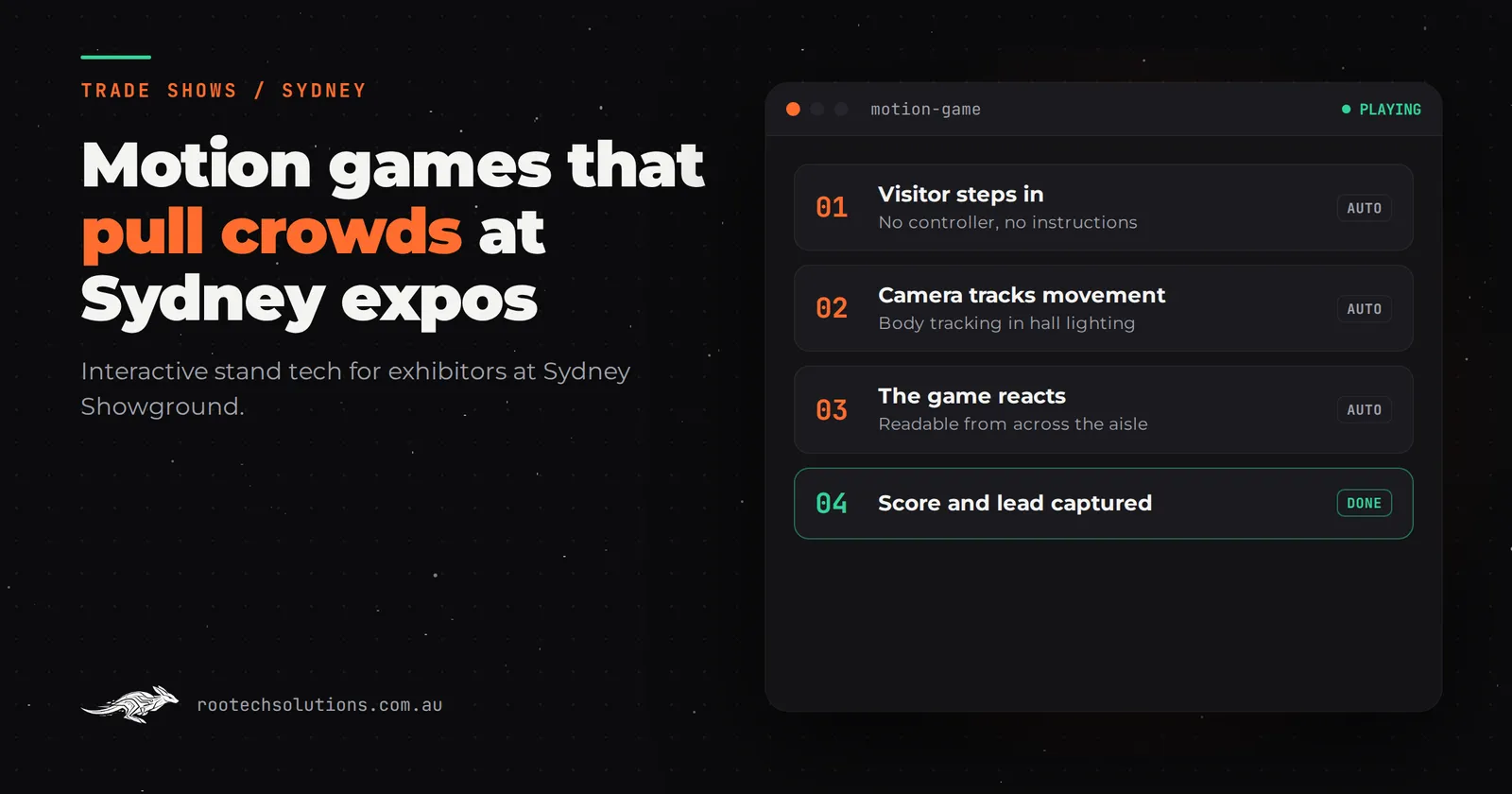
Assume every visitor gives you between 30 and 60 seconds, because that is what a show floor gives you. The sequence needs to work without instructions:
- First five seconds. They see the attract loop: a short repeating animation showing other visitors playing, plus big text saying what to do. Nobody reads a sign on a show floor; they copy what they see.
- Next ten seconds. They step onto a floor mark, the camera picks them up, and the game starts with their movement. No button press, no "press start". This is the whole point of computer vision: the visitor is already playing before they decide to play.
- The next 30 seconds. A short, satisfying round. A packing challenge, a steering game, a setup race. It ends with a clear result on screen, and a prompt to enter their details for a prize draw.
- The last five seconds. The lead capture. They tap their email on a screen or scan a code, and the details land in your CRM with a note that they played the packing game and scored 82.
That last step is the part exhibitors forget to budget for, and it is the part that pays for the whole build. A game nobody plays is decoration. A game with lead capture attached is a lead machine that runs unattended while your team talks to the serious buyers.
What makes a motion game survive three days on a show floor?
This is the unglamorous half, and it is where most builds succeed or fail. The things that decide whether your game is still running at 3pm on Sunday:
- Boots straight into the attract loop. If the screen sits on a desktop or a loading bar, visitors walk past. Power it on and it should be playing within seconds, every time.
- Offline first. Venue Wi-Fi is shared with thousands of visitors and their phones, and caravan shows often run in big shed spaces where reception is patchy. The game must run entirely on the machine in front of you. Cloud is for the lead sync, not the game.
- Crash recovery. Something will go wrong at some point on day two. The software should detect it and restart itself into the attract loop without a staff member knowing how to fix it.
- Idle reset. A player walks away mid-round. The game needs to reset itself back to the start, ready for the next visitor, without anyone touching it.
- Content your team can edit. You will want to change the prize, the copy, maybe a question, the night before the show. If that needs a developer, it will not happen. Build the edits into a simple screen.
- No controllers, no consumables. That is the point of camera tracking. There is nothing to charge overnight, sanitise, or have stolen.
We built a computer vision installation where a camera tracked visitors' bodies and turned their movement into the game for the whole run of the show: visitors walked up, moved, and played, with a camera doing the work a controller used to do. You can read that build at Nutrients 4 Revolution, and it ran unattended for the full event. The unattended part is the design goal, not a bonus.
What does a motion game cost, honestly?
Rootech's indicative range for a computer vision or motion game is $30,000 to $80,000, software only, excluding GST, with hardware hired separately. That is a real gap, so here is what drives it:
| Cost driver | Lower end of range | Upper end of range |
|---|---|---|
| Game mechanics | One simple round, one mode | Multiple modes, scoring, difficulty levels |
| Visuals | Clean 2D graphics | Custom 3D models of your actual product |
| Camera tracking | Single player, one zone | Multi-player, large floor zone |
| Lead capture | Simple form plus CRM sync | Prize logic, qualifying questions, same-day follow-up |
| Reuse across shows | Built for one show | Built to be re-skinned for every show on your calendar |
A few honest notes on that range. First, this is the most expensive format in the interactive toolkit: a templated touchscreen or a stand quiz starts far lower, and if your budget is under $30,000, one of those is the better buy. Second, the money goes mostly into making it feel good, not into a list of features. A cheap motion game feels laggy, and a laggy motion game has visitors walking away mid-round, which is worse than no game. Third, hardware is separate: hire the screen and the machine locally, and check current rates with the hire company rather than trusting anyone's old quote.
If you want a sense of how this format compares with putting a touchscreen product explorer on a stand, we compared the cost of interactive touchscreens built direct with engineers, and the same trade-offs apply in Sydney.
How do you brief it, and how long does it take?
Bring three things to the first conversation, because they decide the price more than anything else:
- The one thing a visitor should remember. Not five things. "Our awning sets up in four minutes", or "our camper packs smaller than anything else on the market". The game is that claim, made playable.
- Your lead plan. What happens to the details after the show? Which CRM? Who calls them, and when? A game with no answer here is a toy. If same-day follow-up is part of the plan, read how same-day AI follow-up works for expo leads.
- Your show calendar for the next 12 months. If you exhibit four times a year, build it once and re-skin it. The second show costs a fraction of the first because the engine already exists.
On timing, most Rootech builds ship in two to four weeks, and bigger builds get a fixed timeline up front. A motion game is toward the bigger end, so give it the full runway: brief it as soon as your stand is booked, not in the fortnight before doors open. You want time to test the camera tracking with real people at real distances, because show-floor crowds behave nothing like an office.
Should you reuse it across shows?
Yes, and design for it from day one. The expensive parts of a motion game, the tracking, the game engine, the lead plumbing, do not care what city you are in. The skin does. So build the engine once, then swap the graphics, the copy and the prize for each show. The same build that pulls a crowd at a Sydney caravan show can be re-themed for a capital city 4WD and fishing show or a home show with a weekend's work.
That reuse logic is the same argument we made for product configurators for Brisbane home show stands: interactive builds only make financial sense for most exhibitors when show number three is cheaper than show number one.
Does it work from Melbourne when your show is in Sydney?
Yes. Rootech is a Melbourne studio, and outside Melbourne delivery is remote: the software is built and tested on the same screen model you will hire, the hardware is hired locally, and the installation is set up with your team over a video call before doors open. We write more about how that works on the custom software in Sydney page. The one thing that changes is scheduling: build in one dry run with your stand team on the actual screen before the show, not on the morning of.
Frequently asked questions
How big a screen does a motion game need?
Big enough to be seen from the aisle, usually 75 inches or larger, because the game is also an advertisement. The camera needs a clear zone in front of it, so plan floor space for players and for the small crowd that will gather.
Do I hire or buy the hardware?
Hire. Screens and the machine that runs the game are cheap to hire locally for a show and expensive to own, store and transport between cities. Check current rates with the hire company.
What happens if the venue Wi-Fi drops out?
Nothing visible. The game runs entirely on the local machine; only the lead sync needs the network, and it catches up when the connection returns. This is built in from the start.
How do leads get captured and where do they go?
The game ends with a prompt, the visitor enters their details on screen or by scanning a code, and the details flow straight into your CRM with a note of what they played. Capture can also be added as an add-on to an existing build, typically in the $4,000 to $12,000 range.
What is the lead time?
Brief it as soon as the stand is booked. A motion game is a bigger build than a touchscreen app, so four or more weeks of runway is the safe planning assumption, with a fixed timeline agreed up front.
The takeaway
A motion game is the loudest tool in the trade show kit, and the loudest tool is only right for the noisiest problem. At a Sydney caravan and camping show, where every stand has a giant product and the aisles are full, being noticed is genuinely the problem. If that is you, a camera-driven game that runs itself all day, captures leads and gets re-skinned for your next four shows is worth the budget. If your problem is explaining a technical product quietly to fewer, better visitors, a touchscreen explorer is the better spend, and we will tell you so.
If that sounds like your stand, book a free call with Rootech. We will look at your product, your show and your floor space, and tell you which format earns its place. The audit fee comes off the first project.