How Darwin Removalists Get Found on Google and AI
Removalists in Darwin: what customers actually search, what Google and AI answers check about your business, and the fixes you can make this week.
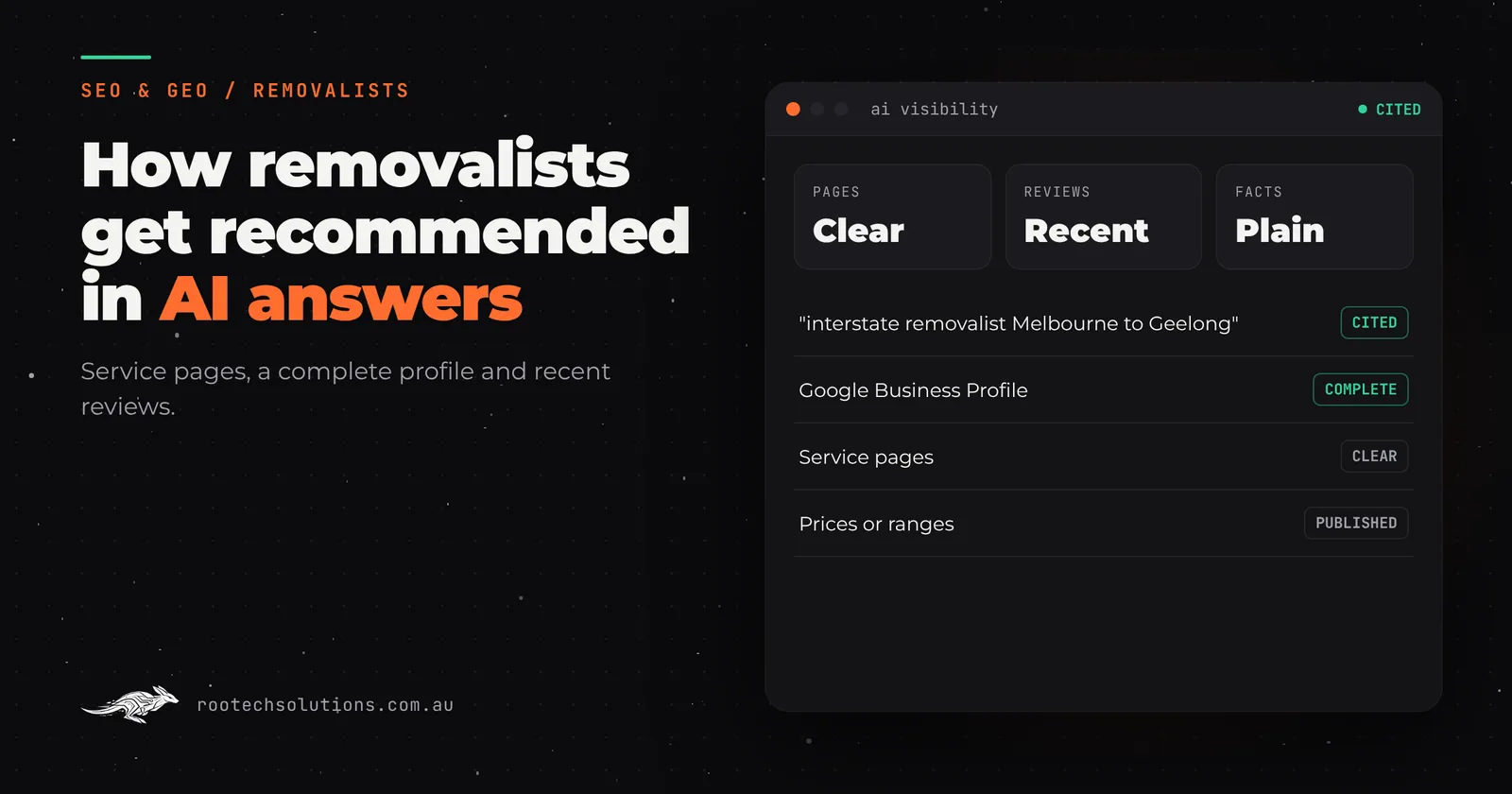
A family moving from Palmerston to Humpty Doo just asked an AI who they should hire, and your name never came up. Meanwhile two trucks you never hear about are booked solid for the whole dry season. The gap between those two outcomes is not advertising spend. It is whether your business states plain, checkable facts where Google and the AI tools read from them.
Most removalists lose enquiries to being invisible online, not to a better truck. And in a market the size of Darwin, where the same few names get repeated in every Facebook group, being the business that machines can describe accurately matters more than it does in a big city.
Short answer: Removalists get found in Darwin by making their services, service areas, prices and reviews explicit on their own website and Google Business Profile. Google says optimising for its AI features is ordinary SEO, with no special files or markup. The businesses AI tools quote are the ones that state the job, the suburbs and the credentials in plain language.
What do customers actually type before they book a mover?
Moving searches are unusually specific, and that is good news for a small operator. People rarely search "removalist". They search the job they have:
- "removalists Darwin to Adelaide" or "Darwin to Brisbane movers", because interstate is the big one up here. Moves long-distance to every southern capital, and the customer wants to know who actually does the run.
- "furniture removalists Darwin with piano" or similar, naming the awkward item that is worrying them.
- "removalists Palmerston" or "movers Nightcliff", because people search their suburb even when the business serves the whole Top End.
- "last minute movers Darwin", because defence postings and end-of-lease dates produce genuine urgency, and the searcher is often booking within days.
Write down the last ten enquiries you got and the words the customer used. That list is your keyword research. It will beat any tool, because moving language here is distinctive: hauls to Katherine or Alice Springs tacked onto an interstate run, pre-move storage because the new house is not ready, the wet season pushing people to move in the dry.
Every one of those phrases should exist somewhere on your site as a page or a clear paragraph. If your website says only "we move anything, anywhere", you match none of these searches.
What do Google and AI answers check about a removalist?
Google's own guidance (May 2026) is that appearing in its generative AI features is still standard SEO: no special files, no AI text files, no special markup required. The machines are reading the same pages people do, and they quote businesses they can verify. For a removalist that means five things on your own site and profile:
| What gets checked | What it looks like when done | What it looks like when missing |
|---|---|---|
| Services | A page per job type: local, interstate, packing, storage, single items | One "Our Services" line listing everything |
| Service areas | Suburbs and towns named: Darwin, Palmerston, Casuarina, Humpty Doo, Katherine | "We service the NT" and nothing else |
| Prices or ranges | Published hourly rates or a "what a move to Adelaide costs" page | "Call for a quote" as the only pricing signal |
| Credentials | NT registration, insurance for goods in transit, accreditations, named | Not stated anywhere |
| Reviews | Recent reviews, with replies, matching the services on the site | Reviews that mention nothing specific, or none at all |
The AI answer that says "X is a removalist that runs regular interstate services to Adelaide and Brisbane and publishes hourly rates for local moves" is quoting sentences you wrote. The one that hedges, or names only the biggest interstate franchise, is hedging because you gave it nothing to quote.
Does my Google Business Profile still matter?
Yes, and for a removalist it is arguably the single highest-value listing you have. Moving is a local, urgent, phone-first purchase. Your profile controls whether you appear in the map results for "removalists near me", and it is one of the first things both Google and AI tools cross-check against your website.
The checklist is short:
- Your category is accurate and your service list names real jobs: local moves, interstate, packing, storage, office relocations.
- Your service area names Darwin and the towns you genuinely run to, not the entire Territory.
- Your hours and phone number match your website exactly.
- Your photos are your trucks, your crew and real jobs, not stock images.
- Recent reviews exist and you reply to them, including the unlucky ones.
Review asking can be systematised without breaking Google's rules. Google's review policy allows encouraging reviews of a genuine experience and prohibits incentives or selectively soliciting only happy customers. The practical version: every completed job gets the same one-tap review link, sent once, with one reminder if it goes unopened. Ask the same way every time and the volume looks after itself.
Why does a bigger city playbook fail up here?
Because this market is thin and seasonal. There are fewer searches than in Melbourne, so each one matters more, and there are fewer businesses competing, so a modest, well-executed website can realistically own its niche. Two local realities:
- The interstate corridor is your headline service. Almost every other capital is a long haul from the Top End, and the customer researching a Darwin to Perth move has usually never heard of you. That search deserves its own page with the route, the transit time in general terms, how storage before delivery works, and what the quote includes.
- The defence and posting cycle creates deadline movers. Families on a posting date cannot choose a flexible moving week. Pages that answer "how fast can you move me and what if my date shifts" capture enquiries that generic sites lose.
Small market, small website. You do not need fifty pages. You need about six good ones: local moves, interstate, packing and materials, storage, an about page with credentials, and a suburb or corridor page or two.
What should a removalist website actually contain?
Strip it back to what a moving customer needs in order to ring you instead of the next result:
- A home page that states the job. "Local and interstate removals from Darwin, seven days" beats a carousel of truck photos with no sentence underneath.
- One page per service, each naming the jobs, the areas, and what changes the price.
- A published price anchor. You do not need a fixed quote online. An hourly rate for local moves, or an honest explanation of what drives interstate pricing, stops price-shoppers bouncing and starts better conversations.
- Proof. Named credentials, insurance for goods in transit, and two or three job stories with photos. A moving customer is handing you everything they own; trust signals do real work here.
- A quote form that asks the right questions. Move date, from, to, home size, stairs, storage needed. The more the form captures, the faster you can turn around an accurate quote, and speed of quote is where most moving jobs are won.
If your current site cannot do any of this because it is a template you cannot edit, that is usually the moment a rebuild beats another subscription. We wrote separately about when a mobile app or a plain fast web app is the right tool for a small business, and the answer for most removalists is a fast web app: read it at /blog/2026-11-15-mobile-app-vs-web-app-small-business-australia.
Can software help after the website is right?
Yes, in two unglamorous ways. First, content: every completed job is a story. A simple workflow where the crew logs the move (from, to, what was shifted, a photo or two) and AI drafts a job page and social post from their notes keeps your site growing without you writing anything at night. Photos of real jobs are also what your social posts should run on; we covered that workflow for trades at /blog/2026-11-15-social-media-posts-from-job-photos-tradies.
Second, response speed: enquiries that arrive at 8pm from a posting family comparing three movers go to whoever replies first with a real number. An AI quoting and follow-up workflow wired into your existing tools can hold that first response while you stay on the road.
Both are built, not bought off a shelf, which is where a studio like Rootech comes in: custom software and AI integrations for Australian businesses, fixed price, usually live in two to four weeks, working remotely across Australia with clients in the Top End by video and call.
A checklist you can start this week
Nothing here needs a developer to begin:
- Search your own services the way a customer would ("removalists Darwin to Adelaide", "furniture movers Palmerston"). Note where you appear and where you do not.
- Ask an AI tool "who are good removalists here and why" and read what it says. If it cannot describe you, it has nothing to quote. Fix that first.
- Write one page you are missing, starting with your biggest interstate corridor.
- Publish a price anchor on your local moves page, even as a range.
- Audit your Google Business Profile against the five-point checklist above.
- Send your next five customers the same one-tap review link and reply to every review that comes back.
Do those six and you have done more for your visibility than any "AI SEO hack" anyone sells you. Google's May 2026 guidance is explicit that no special tactics are needed for AI features; the work is the same clear, verifiable content it has always rewarded (https://developers.google.com/search/docs/fundamentals/ai-optimization-guide).
If you would rather have a professional set of eyes on where your enquiries leak, book a free AI workflow audit with Rootech. The audit fee comes off your first project if you go ahead.
Frequently asked questions
How do I get my removalist business to show up on Google in Darwin?
Cover the basics completely rather than cleverly: a website that names your services, suburbs and prices in plain language, a complete and matching Google Business Profile, and a steady stream of genuine reviews with replies. In a market this size, consistent basics beat volume.
Do AI tools like ChatGPT recommend removalists?
They recommend the businesses they can describe with confidence. If your services, service areas, pricing signals and reviews are stated clearly on your own site, AI answers can quote and name you. If your site is vague, the answer will name whoever stated things clearly, which is often a bigger interstate brand.
Do I need special schema or files to appear in AI search results?
No. Google's guidance from May 2026 says optimising for its AI features is ordinary SEO, with no special files or markup required. Structured data can still help Google understand your pages, but it is not a ticket into AI answers, and FAQ rich results no longer appear in Google Search.
How many reviews does a removalist need?
There is no magic number and quoting one would be inventing a statistic. What matters is recency, honesty and replies: a steady trickle of genuine reviews asked for the same way every time, including the occasional critical one answered professionally, reads as more trustworthy than a wall of old five-star ratings.
Is it worth building custom software for a small moving business?
Once the website basics are right, the usual wins are job-to-page content workflows, faster quoting and after-hours enquiry capture. A fixed-price build that pays for itself in saved admin and won quotes is realistic, but only after the free foundations above are done.