What AI Automation Costs a Perth Mechanic
What AI automation costs a Perth mechanic: build and running costs in AUD, a worked payback on missed bookings, and when a workshop should wait.
The phone rings while a wheel is off and the car in the next bay is due at four. By the time you wipe your hands and call back, the driver has already booked with the workshop down the road. Multiply that by a few calls a week and the lost work starts to look like a staff wage.
Mechanics ask a fair question before spending anything on software: what does AI automation actually cost, and how long until it pays for itself? This post works through the numbers for a Perth workshop, in AUD, with every assumption labelled so you can swap in your own.
Short answer: A call capture and booking build for a Perth workshop typically runs $2,000 to $4,000, and the full set with quote follow-up and service reminders lands around $4,500 to $7,000. Running costs are usually $150 to $400 a month. With two or three recovered jobs a week, most workshops get their money back inside six months. If you miss only a couple of calls a month, hold off.
Why is the payback different for a workshop?
Because a workshop's money comes from filling bays, and a bay sitting empty on Tuesday is gone forever. You cannot bank a spare hour and sell it later. Three things shape the maths:
- The booking is the unit of value. A lost phone call is not just one service; a customer who books elsewhere for their first logbook service often stays elsewhere for years of repeat work.
- You cannot answer mid-job. Like other trades, the miss is structural, not sloppy. Someone under a car cannot take a call.
- The admin sits after the job. Typing the job card, checking parts availability, texting the quote, chasing the approval: that is where the hours leak, usually in the evening.
So the useful sum is not "hours of admin saved". It is "how many bookings a month go unanswered, and what is each one worth in margin and repeat work?"
What does AI automation for mechanics cost to build?
A workshop build is usually a handful of linked components, quoted as one fixed-price job. The numbers below are estimates, and they match the scope of the call capture and quoting builds in our plumber cost guide, the closest published range on this site. Your phone setup and workshop software will move them.
| Component | Job it does | Build (one-off) | Running (monthly) |
|---|---|---|---|
| Call capture and triage | Answers when the workshop can't, takes the car details, sorts urgent from routine, texts you the job | Around $500 to $1,000 beyond the base build | AI usage, often $80 to $200 |
| Quote drafting and follow-up | Turns the inspection notes into a quote on your rates and chases approval after two days | $2,000 to $4,000, inside the base build | Covered by AI usage |
| Booking and job sync | Writes the booking, vehicle and contact into your workshop software or calendar | Included in the base build | Normally free; a paid connector is possible |
| Service reminders | Logbook and next-service texts timed off each job | Modest add-on | SMS, about $30 to $90 |
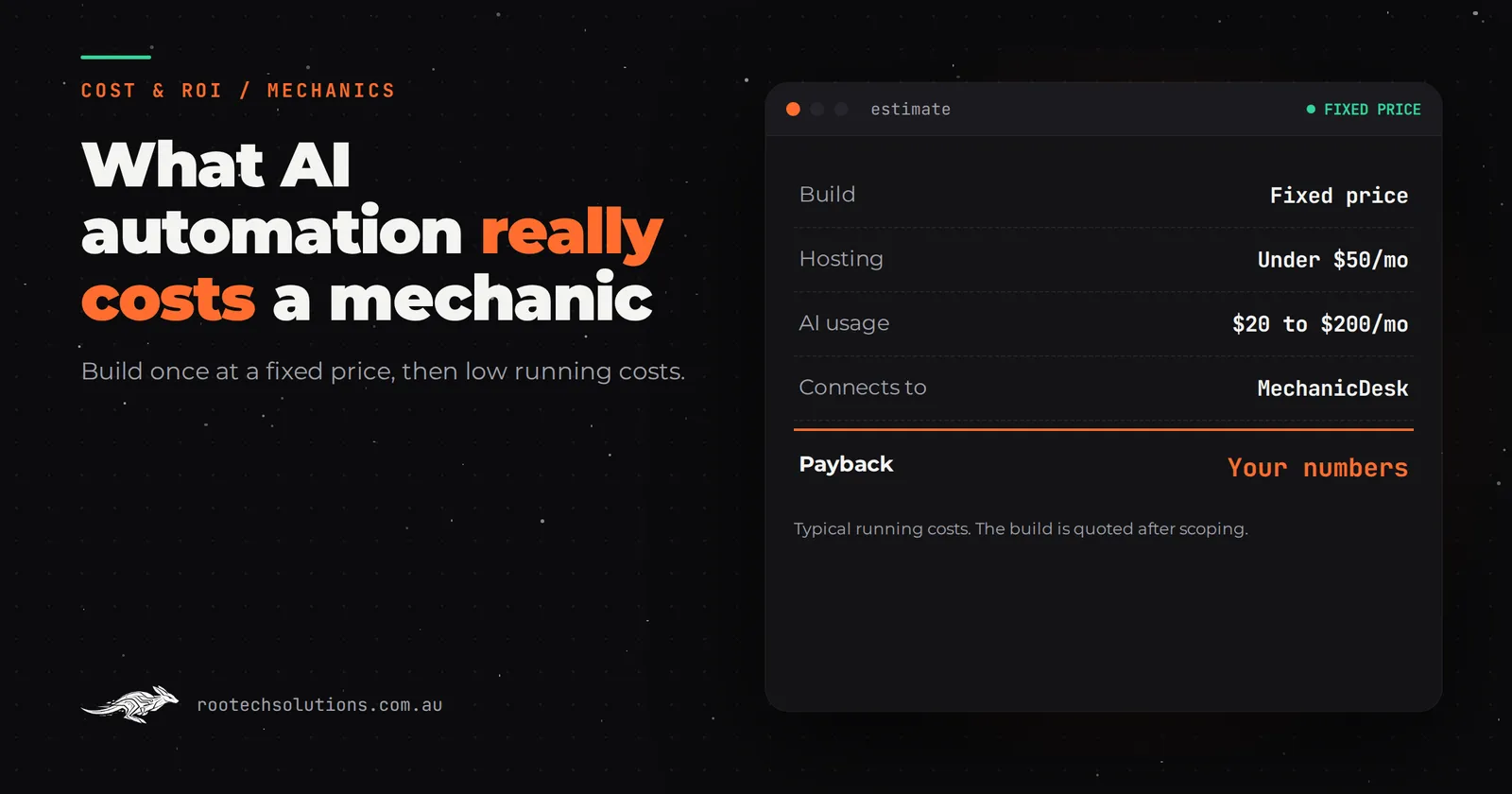
A single-bay workshop on a simple calendar sits at the low end of those figures. A multi-bay operation with workshop management software and a big fleet book sits at the high end. Altogether, expect roughly $4,500 to $7,000 to build the full set and $150 to $400 a month to keep it running, of which hosting is usually less than $50.
Working out the payback for your workshop
Count recovered bookings and use your gross margin, because invoice totals flatter every pitch. Here is a worked example. Treat each figure as an assumption and substitute your own:
- One-off build: $4,500, covering call capture, quote drafting and booking sync.
- Monthly running cost: $250.
- Recovered bookings: 8 a month, roughly two a week that used to hit voicemail.
- Average job value on those bookings: $450.
- Gross margin once parts and tech time are paid: 50%, or $225 per job.
- Monthly gain: 8 x $225 = $1,800, minus $250 running = $1,550 a month.
- Payback: $4,500 / $1,550 = about 3 months.
Now stress-test it. Recover only three bookings a month and the net gain drops to about $425, stretching payback past ten months, which is fair but not compelling. Add the repeat value: if half the recovered customers come back twice more over the next two years, each recovered booking is worth roughly double the first invoice's margin. That is the argument for tallying your unanswered calls for a fortnight before spending anything. Your telco's call log lists the numbers that never got through.
Which workflows are worth paying for first?
Rank them by money leaked per week, not by how clever they sound:
- Missed-call capture and booking. The highest-value gap, because the call arrives while nobody can answer and the customer is already comparing workshops. An AI receptionist takes the car, the issue and the preferred time, and texts you the job.
- Quote drafting and approval chasing. Inspection-based quotes sit unsent for a day and unapproved for a week. A draft quote plus a polite chase converts work you have already won once.
- Service reminders. Logbook reminders timed off each job bring back repeat work at almost no marginal cost. This is the cheapest piece and often the steadiest return.
One thing to skip for now: fully automated diagnosis over the phone. The AI can take symptoms and book an inspection, but it should never price an unseen repair. Keep that with the mechanic.
What does the workshop software already do?
A fair amount, and it is worth exhausting before you spend anything. Workshop management tools handle job cards, booking calendars, invoicing, parts and customer records, and many include online booking forms and SMS reminders. Features change, so check their current plans and prices.
The gap appears at the phone and the judgement attached to it. The software will not answer while your hands are in an engine bay, tell the caller that a grinding noise gets them in tomorrow but an oil change can wait until Friday, and turn a scrawled inspection note into a quote the customer approves by text. That layer follows your own rules, your service menu and your prices, which is exactly what makes it worth building. For the two cheapest ways to cover the phone line, see text-back or an AI receptionist for missed calls; the reasoning applies to workshops too.
What the build involves, and when it goes live
Plan on two to four weeks from kickoff to switch-on, at a fixed price agreed up front.
- First week: we document how calls, texts and web enquiries reach the workshop today, then set the triage rules together: what counts as urgent, which services book straight in, which need a quote, and what the AI must never do, like naming a price for work nobody has inspected.
- Second week: call capture, quote drafting and booking sync are built and wired into your existing software.
- Final two weeks: real past enquiries are replayed through the system, the responses are tuned, and it goes live. Most workshops keep their existing number and forward it on no-answer, so callers dial the same digits printed on the signage.
A person stays in the loop where it counts. The AI books routine services and takes details, but anything diagnostic becomes an inspection booking, and no quote leaves without your tick. If you are unsure where to begin, what mechanic workshops should automate first walks through the order, and quoting first to win the job covers the quote side.
When should a workshop hold off?
Hold off if the sums above do not work for your workshop. The usual reasons look like this:
- Fewer than two or three calls a week go unanswered, because someone at the counter already picks up all day.
- There is no workshop software or even a shared calendar, so nothing exists to connect to. Sort the basics first.
- You are booked out weeks ahead and turning work away. A recovered call is worthless if the car cannot get a slot.
- Most of your work is fleet contracts arriving by email with plenty of lead time. Speed of answer counts for less there.
Frequently asked questions
Does the AI use my current phone number?
It can. Callers normally keep dialling the digits on your signage, and the AI only steps in when the workshop cannot pick up or outside opening hours. One check first: your phone provider has to allow conditional call forwarding.
Can it give repair prices over the phone?
Only the ones you approve in advance. Workshops usually let it name set items, like a basic service menu or a booking fee, and nothing beyond that. Repairs that need the car on the hoist turn into an inspection booking or a draft quote you look over first.
What about fleet vehicles and warranty work?
You write those rules into the build. A booking that needs a courtesy car, a specific lane or a fleet sign-off gets marked for a person to confirm. The AI says that plainly to the caller instead of guessing.
Is an off-the-shelf workshop app enough?
If the booking forms and reminder texts in your current workshop software already cover how customers reach you, use those and spend nothing. Custom AI earns its keep when you want phone answering, triage and quote chasing that run to your rules and drop straight into the system your team already uses.
Get the numbers for your workshop
We build call capture, quoting and booking automation for workshops in Perth and right across Australia, delivered remotely: video calls for discovery and reviews, cloud builds, and a setup call with your team to switch it on (see custom software in Perth). Every project is priced as a fixed sum, agreed before work starts. Book a free AI workflow audit and we will look through your call log and quoting process and give you an honest verdict on whether the numbers work. The audit fee comes off your first project.