Can You Trust AI for Electricians With Safety Calls?
AI for electricians: why customers fear bots giving bad safety advice, what a guardrailed AI receptionist must never say, and what it should do.
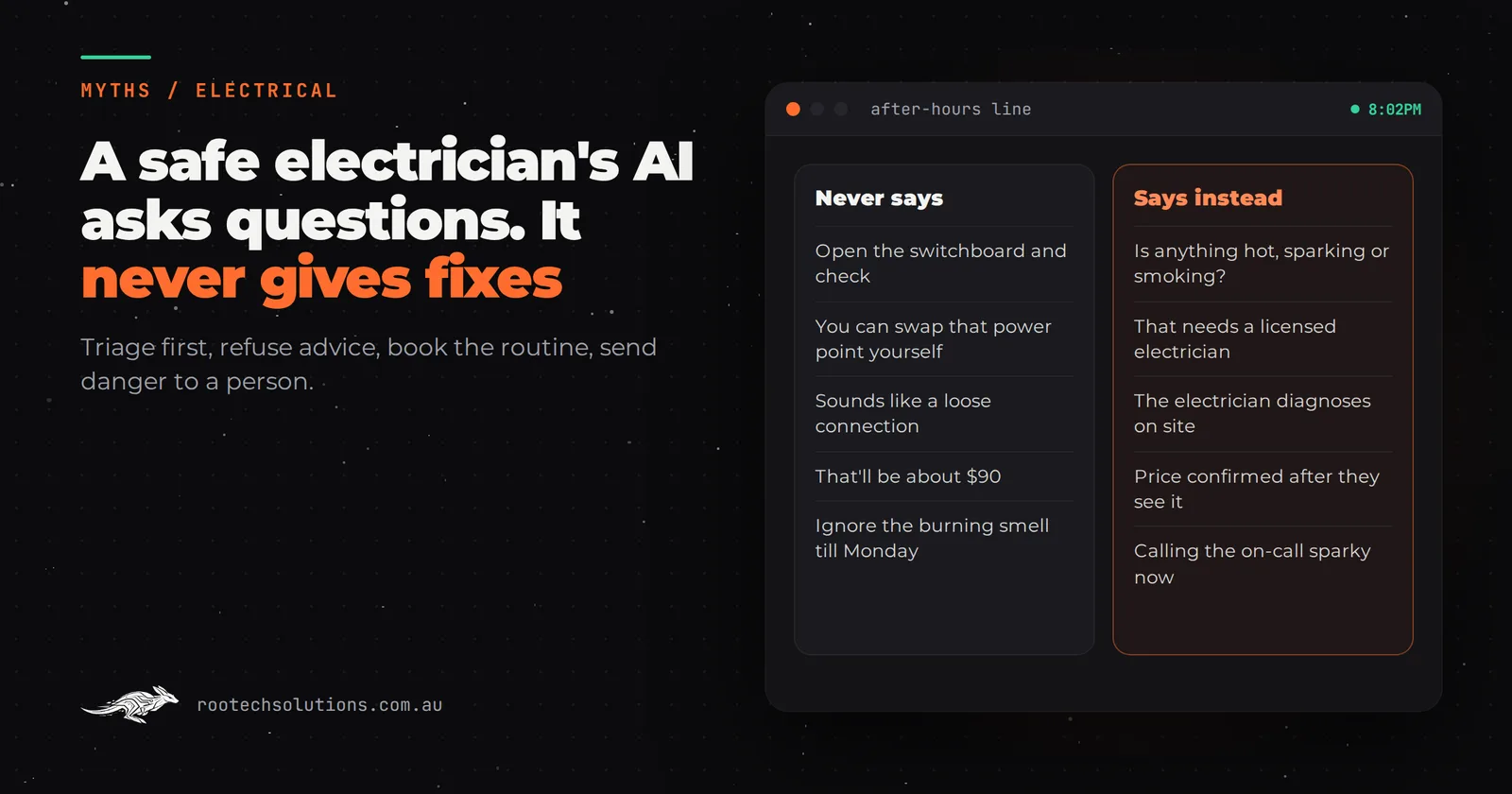
A customer smells burning near their switchboard at 8pm, calls you, and you're under a house in Reservoir. You've thought about AI for your electrical business, but the idea of a bot taking that call, and maybe telling them something stupid, is exactly why you haven't.
Short answer: Customers will trust AI for electricians when it does intake, not diagnosis. A guardrailed AI receptionist answers the call, asks whether anything is hot, sparking or smoking, routes danger to your phone or 000, and books routine work. It must never troubleshoot, suggest DIY fixes or price a job unseen. Built that way it's safer than voicemail.
What do customers actually fear about an electrician's AI?
The fear in electrical work is sharper than in most trades, because the cost of a wrong answer isn't a bad haircut. It's a fire or a shock. Customers and electricians tend to name the same four worries:
- "The bot will tell me to fiddle with the switchboard." Generic chatbots happily produce step-by-step troubleshooting. In Victoria that's the wrong instinct entirely: Energy Safe Victoria's advice to householders is don't do your own electrical work, because it's illegal and can be deadly.
- "It won't know an emergency when it hears one." A tingle from the shower tap and a request for a new power point are not the same priority.
- "It'll quote a switchboard upgrade off three questions." Then the real price lands and the customer feels baited.
- "I'll lose my regulars." The builder who sends you work every month wants you on the phone, not an assistant.
Every one of those fears is correct about a generic chatbot dropped onto a website. None of them is a reason to leave the phone ringing out.
Is voicemail actually safer than an AI receptionist?
Usually not. Voicemail can't tell a burning smell from a quote request, and neither can a missed call. Both sit in the same queue until you're off the tools. The risk with no answer is that the urgent call waits two hours, or the customer rings someone else for the routine job.
A guardrailed AI receptionist is built around one question that voicemail can't ask: is anything hot, sparking, smoking, wet or giving shocks? The answer decides everything that happens next.
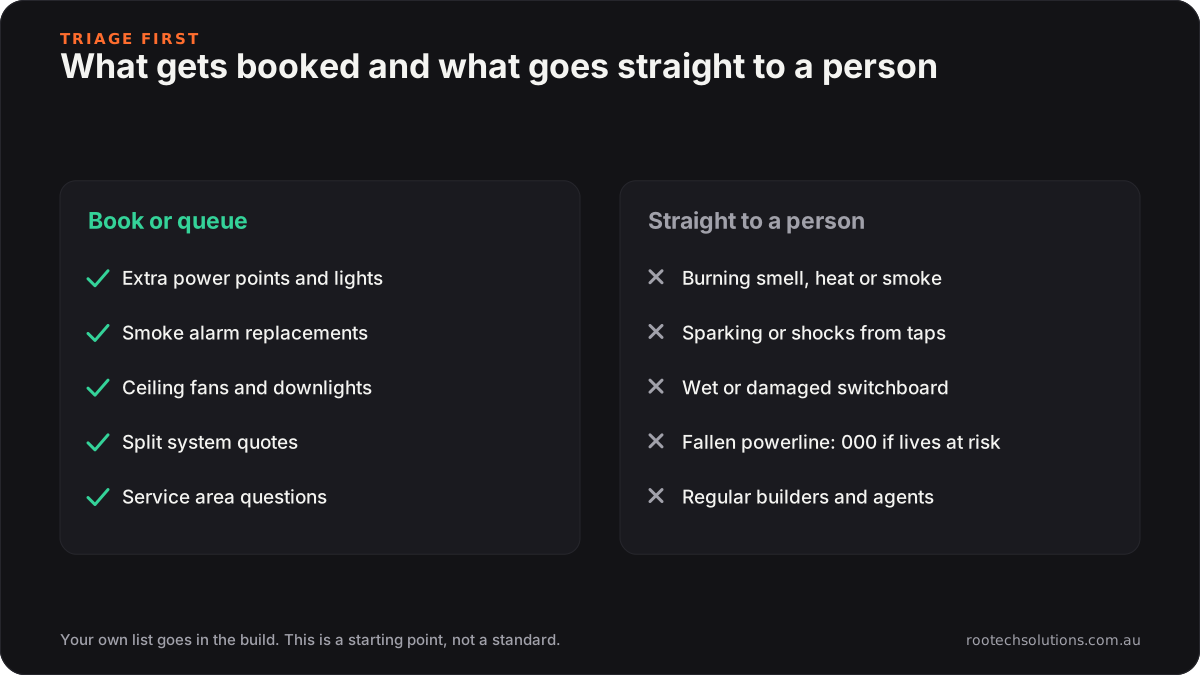
Caption: The triage question comes first, and the AI never tries to fix anything itself.
What must an AI for electricians never say?
It must never give technical advice. That's the line, and it has to be enforced by the build, not trusted to the AI's manners. In practice the refusal list looks like this:
| A customer asks | A generic chatbot might say | A guardrailed AI says |
|---|---|---|
| "My safety switch keeps tripping, what do I do?" | Steps for isolating circuits at the switchboard | "I can't troubleshoot electrics. Is anything hot, sparking or smelling of burning? I'll get the electrician to call you." |
| "Can I replace this power point myself?" | A how-to with photos | "In Victoria electrical work needs a licensed electrician. Want me to book one?" |
| "How much for a switchboard upgrade?" | A firm number | Your typical range, if you've approved one, and that the electrician confirms after seeing it |
| "Is it the oven or the wiring?" | A guess | "That's for the electrician to diagnose on site." |
| "There's a powerline down on our fence" | Anything at all about the line | "Stay well clear. If anyone is in danger call 000. Report it to your electricity supplier and the police." |
That last row follows Energy Safe Victoria's electrical emergencies advice: stay more than 8 to 10 metres from fallen lines, treat them as live, report them to the supply company and police, and call 000 if lives are in danger. It's also not your job, which is why the AI hands it straight back to the right people.
Where do electricians still win?
Electricians win everywhere judgement meets the switchboard. Diagnosing a fault, deciding whether an old installation needs more work than the customer asked for, testing and signing off. Under Victorian rules a licensed electrician must provide a Certificate of Electrical Safety for electrical installation work, and only licensed and registered people can lodge one. No AI is anywhere near that.
People also win on relationships. Builders, property managers and long-standing customers should be recognised by phone number and put straight through to you, or get a text saying you'll call back within the hour.
Where is the fear wrong?
The fear is wrong about the routine work, which is most of the phone. Smoke alarm replacements, extra power points, downlights, ceiling fans, a quote for a split system, "do you cover Preston?". These calls need someone to take the address, the job, photos and a time, and to say honestly when you'll get back to them. An AI does that at 8pm on a Sunday without forgetting a detail.
It's also wrong about the paperwork. AI that works from your job notes can draft the invoice, tidy the job description and pre-fill the admin that eats your evenings. You check it and send it. We covered that side in automating data entry for tradies.
Should you buy off the shelf or build a custom AI integration?
Start with what you have. Job management software such as ServiceM8, Tradify, simPRO, Fergus and AroFlo already handles quoting, scheduling, job cards, invoicing and the link to Xero or MYOB. Some offer online booking and missed-call features. Check their current features and pricing, and for many sole traders a simple missed-call text-back is enough. We compared the two in missed-call text-back vs AI receptionist for electricians.
A custom AI integration is worth it when:
- You get enough after-hours and on-the-tools calls that triage matters, not just a callback list.
- Your quoting needs details a form doesn't collect (photos of the switchboard, meter box location, house age).
- You want leads written straight into your job software as a job card, not retyped from a text message.
Then the AI sits in front of your job software. It has the conversation, applies your triage and refusal rules, and creates a clean job in ServiceM8 or whichever tool you use.
What does the build look like and what does it cost?
Most builds go live in two to four weeks at a fixed price. As estimates: AI lead capture or missed-call handling typically costs $1,500 to $3,000 to set up; adding quoting intake brings it to $3,000 to $6,000; a full setup with intake, quoting and data entry usually sits between $5,000 and $8,000. Running costs land around $150 to $300 a month for a small team and $300 to $500 for a larger setup. The full breakdown is in what AI automation costs a Melbourne electrician.
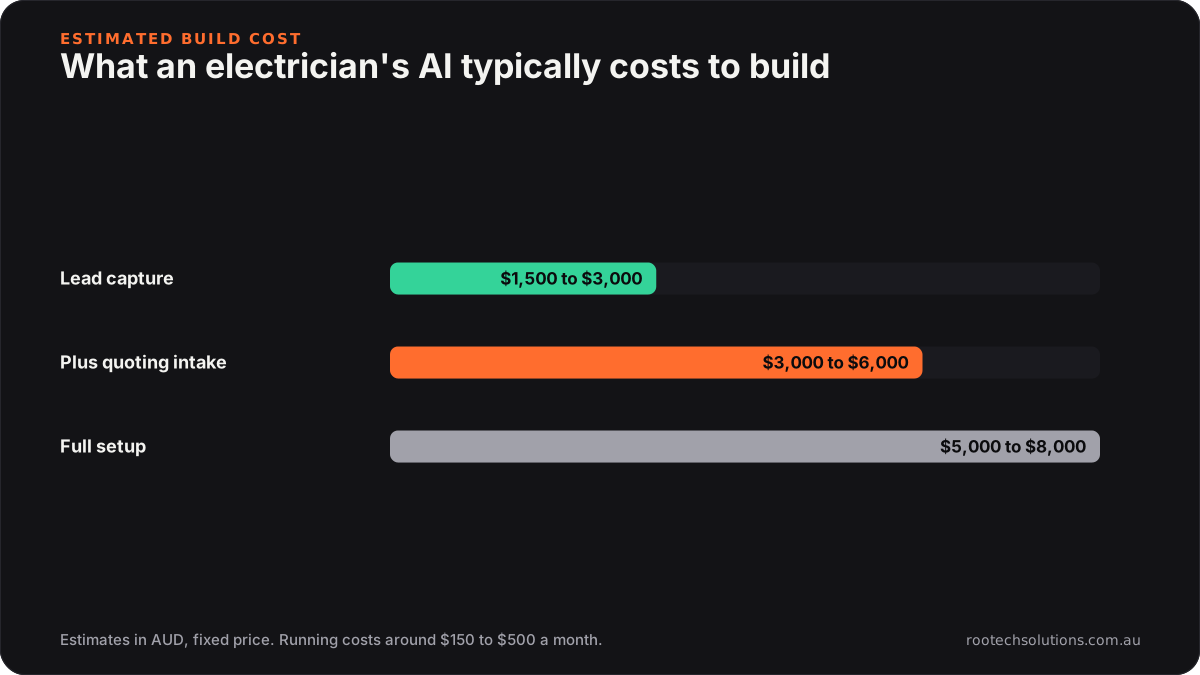
Caption: Start with intake and triage; add quoting once you trust it.
What gets built:
- Your triage rules, written with you: the urgent words, who gets called, and what the AI says while it waits.
- The refusal list in the table above, tested by trying to make it give advice. It has to refuse every time.
- Your service area, call-out policy and approved price ranges, so routine answers come from you.
- Connections to your phone line, SMS, website and job software.
- A fortnight of supervision where you read every conversation before it runs on its own.
You're in the loop for every urgent call, every quote and every regular. We're Melbourne-based and build for electricians across Melbourne and remotely Australia-wide.
Frequently asked questions
Can an AI receptionist handle an electrical emergency?
It can recognise one and escalate it fast, which is the part that matters. It should never try to manage the hazard itself. Danger to life means telling the caller to ring 000; everything urgent goes to your on-call phone with the details attached.
Will the AI tell customers how to reset a safety switch?
Not if it's built properly. Troubleshooting advice, however harmless it sounds, is outside its job. It asks the safety questions, takes the details and gets an electrician to call back.
Does the AI quote electrical jobs?
Only within ranges you've approved, for jobs you've decided are routine, and always with the note that the electrician confirms the price. Switchboards, rewires and fault-finding get a site visit or a call from you.
Will my regular builders and property managers have to deal with it?
No. Recognised numbers can be put straight through or sent a personal "I'll call you back within the hour" text from you. The AI is for new and after-hours enquiries.
Want to see how your calls would be triaged?
We'll go through a fortnight of your calls and messages with you, sort them into urgent, routine and advice-seeking, and show you what a guardrailed AI would answer and what it would send to you. Book a free AI workflow audit; the audit fee comes off your first project if you go ahead.