Video Walls for Melbourne Medtech Expo Stands
Do video walls work at Melbourne medtech expos? What a multi-screen stand should show, what it costs, and how to brief it. Fixed price, live in weeks.
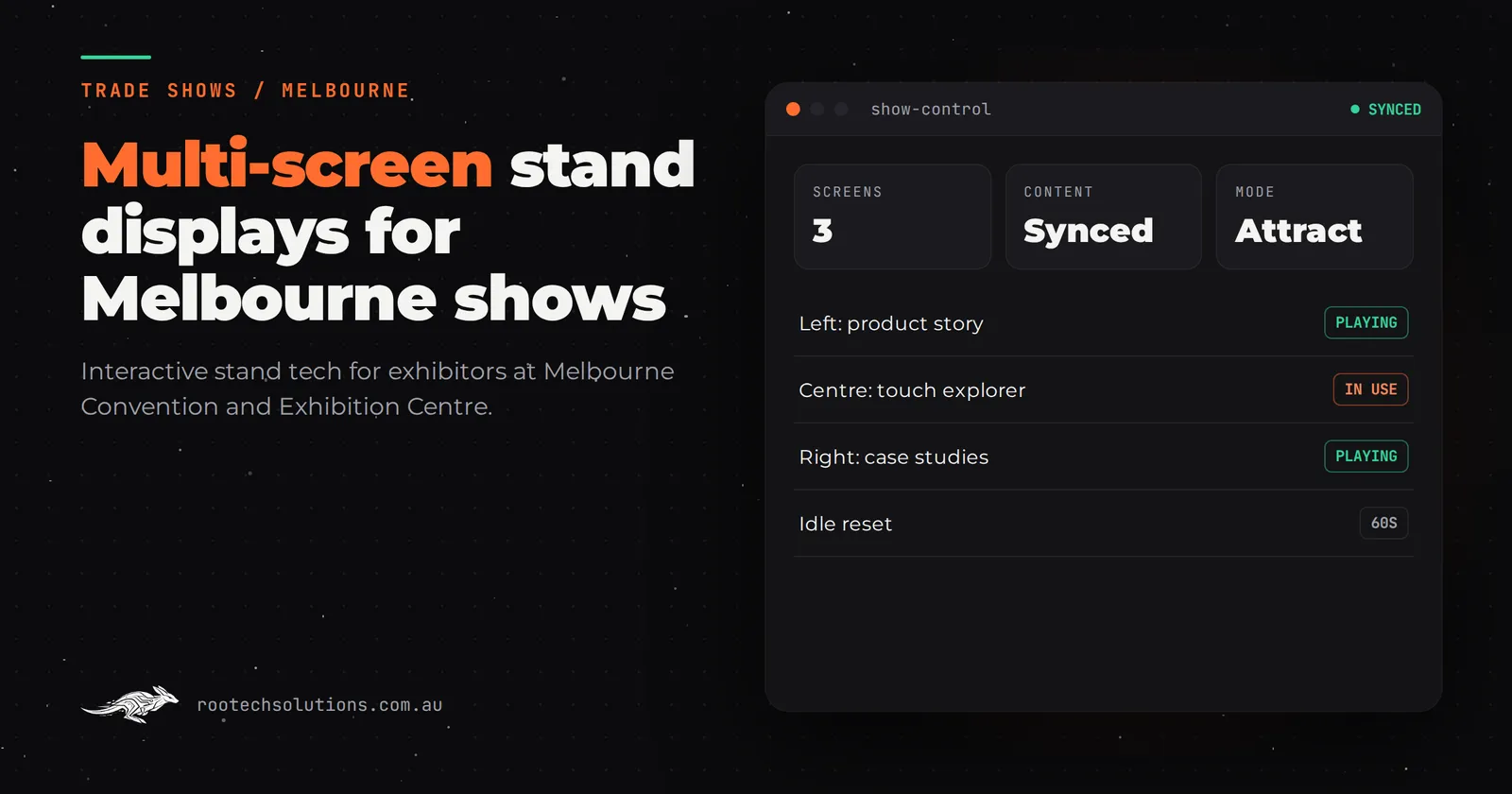
You have booked floor space at a Melbourne health and medtech expo, and your product is the hardest kind to show: a device, a platform or a diagnostic that clinicians need to see working, but that you cannot set up live on a stand. A banner and a table of brochures will not carry it. A video wall, run by the right software, can.
Short answer: For Melbourne medtech exhibitors, a video wall works when it is driven by purpose-built software that shows your product in use, step by step, and hands visitors off to your team to talk. Off-the-shelf slideshows on hired screens get ignored. Expect a fixed-price custom build from around $15,000 for software, with screens hired locally, and weeks, not months, to be ready.
Why a video wall suits a medtech stand
Medtech has a display problem most industries do not. Your buyers are clinicians and practice managers, and they are trained to distrust marketing claims. They want to see the device in use, the software workflow, or the evidence. But you often cannot show any of it live: the device is in clinical use elsewhere, the demo environment needs patient-shaped data, or the regulatory framing means casual demos are not appropriate.
A video wall solves that by doing what a clinical demo does: it shows the real sequence, at full scale, without needing the room, the device or a patient. Three screens can run three things at once: the workflow on one, the outcome or evidence on another, and a looping attract sequence that stops foot traffic on the third.
The comparison that matters is a single screen running a promotional video. Visitors walk past promotional videos all day. What stops them is something that behaves like the product: a walk-through they can step into, a case they can explore, something that responds when they touch it.
What visitors actually see in the first minute
Assume each visitor gives you 30 to 60 seconds. The wall has to earn its attention in the first five.
A pattern that works for medtech stands:
- Attract (first five seconds). The outer screens loop a short, striking sequence: the product in a real clinical setting, or a bold claim about the outcome. No menus, no logos-first intro. Movement and a clear benefit.
- Touch (the next 20 seconds). The centre screen invites a tap. The visitor picks a scenario that matches them: a GP clinic, a hospital department, a specialist practice. The wall then plays that scenario's workflow, step by step, with the screens working together.
- Handoff (the last 30 seconds). The sequence ends with a question the wall can answer, and a natural moment for your team to step in: "That's the pathway you'd get in your clinic. Which best matches yours?" A quiet lead capture on the side screen records who is interested, so the conversation follows up after the show.
That handoff is the whole point. The wall does not replace your team; it starts conversations your team can finish, and it keeps the stand busy even when the team is already talking to someone.
What makes it work on a show floor
The difference between a video wall that earns its cost and one that plays to nobody is almost never the visual design. It is the boring parts:
- Boots straight into the attract loop. Nobody at a Melbourne Convention and Exhibition Centre stand should ever see a desktop, a loading spinner or a login screen.
- Runs offline. Venue Wi-Fi is shared with thousands of visitors and it will drop. All content, all video, all interactions must run from the local machine. Anything cloud-based is a backup, not a dependency.
- Recovers from crashes on its own. If a player freezes, a watchdog restarts it into the attract loop within seconds, without a staff member noticing.
- Resets itself. A home button and an idle timer put every visitor back at the start, so the fiftieth visitor of the day gets the same experience as the first.
- Editable between shows. Your content will change: new evidence, a new module, a different show audience. Your team should be able to swap content without a developer.
- Lead capture built in. Details captured on the stand flow into your CRM, so follow-up starts the same week.
What a video wall costs for a Melbourne stand
Hardware is not the expensive part. Screens and mounting are hired locally in Melbourne; check current rates with the hire company, because AV pricing moves around and depends on screen sizes and run length.
The software is where the money goes, and it is usually quoted fixed price. As estimates, excluding GST:
| Software component | Indicative range (AUD) |
|---|---|
| Templated content touchscreen app (adapted to your brand) | $5,000 to $15,000 |
| Custom touchscreen or wall experience with video and animation | $15,000 to $30,000 |
| Bespoke 3D or highly interactive build | $25,000 to $60,000 |
| Lead capture with CRM integration (as an add-on) | $4,000 to $12,000 |
A multi-screen installation sits above a single-screen build because it has to choreograph several players and stay stable all day, so it gets a fixed timeline agreed up front rather than a one-size number. Ask for a fixed price before work starts either way; hourly billing on show projects is how budgets blow out.
The honest cost question is not the build price, it is the payback: one large hospital or clinic group account that starts with a stand conversation usually repays the whole thing. If your deal value is small and one-off, a templated build and a hired screen is the right level.
How to brief it and how long it takes
A good brief fits on a page. Bring these five things:
- The scenarios your buyers actually fall into (which clinical settings, which roles).
- The one workflow or outcome you most need them to see.
- Any footage or imagery you already have, and what is missing.
- The evidence you are allowed to show, and how it is framed.
- Where captured leads should go (your CRM, and who follows up).
Most builds like this ship in two to four weeks. If you are reading this more than a month before the show, you are comfortably in time; if it is closer, a templated build on hired screens is still achievable, and a custom build may not be.
Should you reuse it across shows?
Yes, if you brief it that way. A medtech video wall built around scenarios, not a single event, travels well: the same three-screen experience works at a Melbourne health expo, a Sydney clinical technology show and a regional health conference, with content swapped between them. Build the scenario structure once and treat the content as the thing you refresh.
That is also how the economics work. The second show costs you content updates and hardware hire, not another build. Exhibitors who treat stand software as a one-event expense end up paying full price every time.
We have built in this space before. For the International CCS Knowledge Centre, an interactive e-learning experience walks visitors through carbon capture stages with animated video and hands-on interactives, running on the web or on the show floor without a presenter in the room. And a large-scale immersive wildlife exhibition built with Zebrar combined projection with environments visitors move through, which is the same craft at a bigger scale: choreographed screens holding an audience.
Is a video wall better than a hands-on demo for medtech?
Not better. Different jobs. If you can safely run the real product at the stand, do that; nothing beats it. The video wall earns its place when the product cannot come to the stand, when multiple visitors need something to watch while the team is busy, or when the evidence needs more room than a conversation allows. Many Melbourne medtech stands do both: a demo corner for qualified visitors, a wall that qualifies them first.
How Rootech builds these from Melbourne
Rootech Solutions is a Melbourne software studio, and in-person meetings are offered here. For exhibitors anywhere else in Australia, delivery is remote: the software is built and tested on the same screen setup you will hire, the hardware is hired locally, and the installation is set up with your team over a call. See our custom software page for how we work, and our take on touchscreen capability explorers for a related format, or VR site tours when the product is a place rather than a device.
Frequently asked questions
How many screens does a video wall stand need?
Two to three does most of the work: one attract screen, one interactive or main screen, and one for evidence or lead capture. More than three only pays off if the content genuinely splits, such as a large projection feature plus touchscreens.
Do the screens need the venue Wi-Fi?
No, and they should not depend on it. Everything runs locally from the machine behind the screens; the network is only for syncing leads, and it should fail gracefully if it drops.
Can we update the content ourselves between shows?
Yes, if that is in the brief. Structure the build so scenarios and videos are swappable by your team, and you will reuse the same system for years of shows.
How far ahead should we start?
Two to four weeks is a typical build. Starting earlier than a month out gives room for content review, which in medtech is often the slow step.
What happens to the leads captured on the stand?
They flow into your CRM, and same-day follow-up while the show is still fresh beats a spreadsheet typed up the week after.
If you have a Melbourne medtech expo coming up and a product that is hard to show, book a free call and we will look at your stand, your product and your audience together. The audit fee comes off the first project.