Caravan Park Booking Software: Buy or Build?
Caravan park booking software covers sites and cabins, but most Hobart parks hit its limits. When an off-the-shelf system is enough, and when custom wins.
Your Hobart caravan park takes bookings by phone, email and a booking platform, and the three do not agree. A family rings about a powered site for the long weekend, you say yes, and then discover the platform has them in a different site for different nights. The question most park owners land on is simple: is the caravan park booking software you can subscribe to good enough, or is it time to build something that fits how your park actually runs?
Short answer: For a small park taking straightforward powered-site and cabin bookings, off-the-shelf campground booking software is the right call and you should not build anything. Custom booking software earns its keep when your park has rules a standard system cannot express: seasonal site types, long-term residents beside tourists, group bookings, or channels and prices that never quite line up.
What off-the-shelf caravan park software does well?
The subscription products in this category are genuinely good at the core job. They handle site maps, nightly pricing, cabin and site inventory, online bookings through your website, deposits, confirmation emails and channel connections to the big listing sites. For a park where the answer to "can we fit this van in?" is mostly yes, that is the whole job, and a subscription covers it for less than a day's wages a month.
Build nothing. This is the honest part of the comparison. A park with 60 powered sites, 10 cabins, school-holiday peak pricing and nothing stranger should subscribe to a product, spend a weekend setting it up properly, and spend the saved money on anything else.
Where off-the-shelf systems fall short?
The trouble starts when your park does not match the template. Most products assume a park is a grid of uniform sites and cabins that all behave the same way. Real parks in Tasmania are rarely that tidy.
- Mixed tenancy. Long-term residents who live at the park beside tourist sites that turn over nightly. Many products bolt this on awkwardly or not at all, so managers keep a separate spreadsheet for residents and reconcile it by hand.
- Site-specific rules. "Site 12 only takes vans under 20 feet because of the tree", "these four sites share a water hook-up", "the cabins cannot be sold separately from the annex site next door in January". Generic rules engines choke on this, so staff fall back on memory.
- Group and club bookings. A caravan club wants 15 sites together, arrivals spread over two days, one invoice for the club and individual confirmations for each van. That is a phone call and a spreadsheet in most systems.
- Channel drift. Listings on the big booking sites show availability that your park already promised to someone else, or prices that ignore your local rules, and someone spends hours each week reconciling.
None of these are exotic problems. They are just not the problems the template was built around, and a subscription product will not change its data model for one park.
How do you choose between buying and building?
Run this test on your park before you spend anything:
- Write down every booking rule you explain on the phone. If a new front-desk person would need a page of notes to take a booking correctly, a template system will need the same page of notes.
- Check the reconciliation. Count the hours a week spent fixing double bookings, retyping between the platform and the spreadsheet, or chasing channel errors. Under about two hours a week, buy. Over it, the leak has a price.
- Look at what you turn away. Group bookings, rally weekends, multi-site arrangements you decline because the system cannot hold them. Turned-away revenue is the strongest case for custom.
- Price the subscription honestly against the hours, using each vendor's current pricing, for your park's size and channels.
- Decide who does the front-desk work. Software does not answer the 9pm phone call either way; that is a separate problem, which we covered for Hobart tour operators losing after-hours bookings.
If you get through that list and every rule fits the template, buy the subscription and stop reading. That is the right answer for most parks, and a builder who talks you into custom anyway is not doing you a favour.
What does the custom option actually look like?
Custom does not mean a developer rebuilds a booking engine from scratch for the fun of it. It means a system shaped around your park: the site map as it really is, residents and tourists in one place, your pricing rules in code instead of a manager's memory, and your channels connected so availability is true everywhere.
The comparison, honestly weighted:
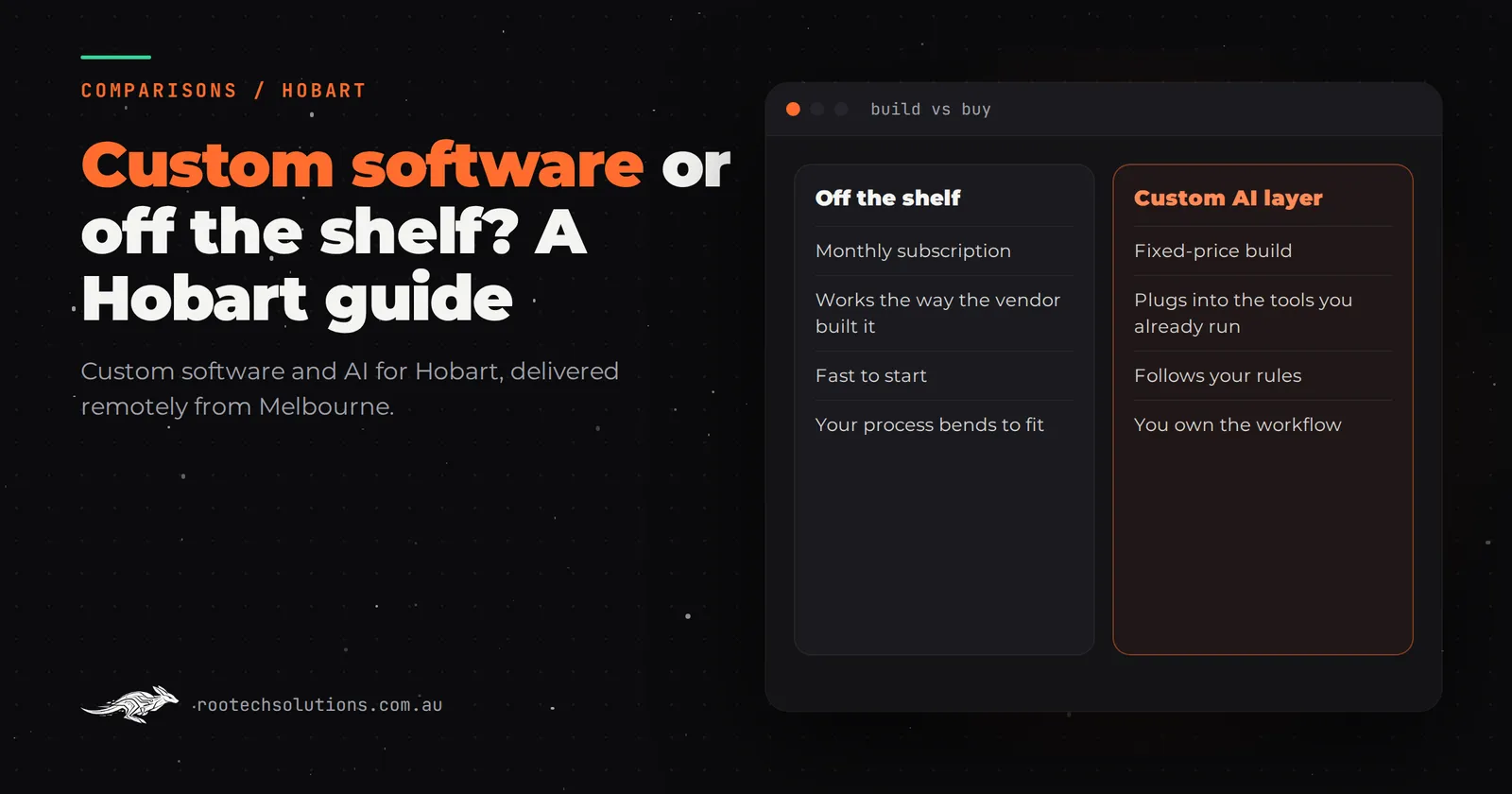
| Off-the-shelf subscription | Custom booking system | |
|---|---|---|
| Cost to start | Small monthly fee per vendor's current pricing | Fixed-price build, typically a few thousand to tens of thousands depending on scope |
| Running cost | Subscription continues forever, rises with your size | Hosting usually under $50 a month, plus optional maintenance |
| Time to live | Days | Weeks |
| Booking rules | Whatever the template allows | Exactly your rules, including mixed tenancy and group bookings |
| Channels | Built-in connectors to major listing sites | Connected to the channels that matter to your park |
| Ownership | Vendor owns the product and your data sits in their system | You own the code and the accounts stay in your name |
| Best fit | Uniform sites, standard rules, no admin drain | Park-specific rules, reconciliation drain, revenue you currently turn away |
The same trade-off shows up in every industry we compare, and the general version is in custom software vs SaaS subscriptions: subscriptions win on speed and predictability, custom wins the moment the product fights your business instead of supporting it.
A real example of the middle path: for Kaladi Kitchens we built a multi-location booking platform where members book any kitchen from their phone and every session opens and closes with a photo-backed checklist. No off-the-shelf product held both the booking rules and the compliance workflow, so the workflow went into the build. That is what custom is for: the part the template refuses to do.
Can you do both?
Often, yes, and it is the cheapest answer that actually works. Keep the subscription for the channels and the standard tourist bookings, and build the thin layer around it that holds what it cannot: resident management, group bookings handled by your office, or an automation that reads enquiries, answers the standard questions and drops confirmed details into whichever system holds the truth. This is the same pattern as DIY tools with an agency-built layer: let the commodity product do the commodity job.
The risk to watch is data living in two places with no agreement about which is right. Any hybrid needs one system declared the source of truth, and the layer disciplined about it.
The takeaway
Off-the-shelf caravan park booking software is the right answer for a park that fits the template, and most parks should test whether they do before considering a build. If you keep a resident spreadsheet beside the booking system, turn away group bookings you cannot configure, or lose hours a week reconciling channels, the fit has failed and a custom system or a hybrid layer is where the money goes. Either way, the decision should come from your own list of rules and your own reconciliation hours, not from a sales call.
Frequently asked questions
How much does a custom caravan park booking system cost?
It depends entirely on scope, so treat any figure you read as an estimate. A thin layer over an existing platform costs less than a full replacement system. Rootech prices every build as a fixed price agreed before work starts, so you know the number before you commit, and most builds ship in two to four weeks.
Will a custom system connect to the big booking sites?
It can, through the channels and integrations those platforms expose. Part of scoping a build is checking exactly which connections your park needs and what each channel supports, because channel requirements vary and change over time.
We already have subscription software. Is switching worth it?
Only if the fit has failed: rules the system cannot hold, hours of reconciliation each week, or bookings you turn away. Switching to a different subscription fixes none of those. Switching to a system built around your park does, at a higher upfront cost you should weigh against the hours and the turned-away revenue.
Who owns a custom booking system?
With a Rootech build, you do. The client owns the code, the accounts it runs on stay in the client's name, and launch comes with a handover of the code, documentation and credentials, with bug fixes included after launch.
Can AI help a caravan park?
Where there is repetitive conversation and data entry: answering common enquiries, taking booking details after hours, chasing deposits and pre-arrival information, and keeping the park's channels and records in step. Rootech's guardrails apply to anything customer-facing: the AI answers only from approved information, escalates to a person when unsure, and never makes up prices or commitments.
Not sure which side of the line your park is on?
Book a free AI workflow audit. We will map how bookings actually flow through your park today, tell you honestly whether an off-the-shelf product covers it, and only scope a build for the gaps that are left. The audit fee comes off your first project if you go ahead. Rootech works with Hobart businesses remotely, with video calls for discovery and reviews.